
 Political > Campaigns
April 16, 2025
TV Advertising for Political Campaigns: A Modern Candidate's Guide
How local and state candidates can reach voters through streaming TV without a massive war chest
Table of Contents
TV advertising for political campaigns has traditionally been reserved for candidates with deep pockets. If you're running for city council, school board, or state legislature, you've probably assumed TV isn't in your budget. National campaigns spend millions. Congressional races spend hundreds of thousands. What's left for candidates trying to win local races with modest war chests?
More than you might think.
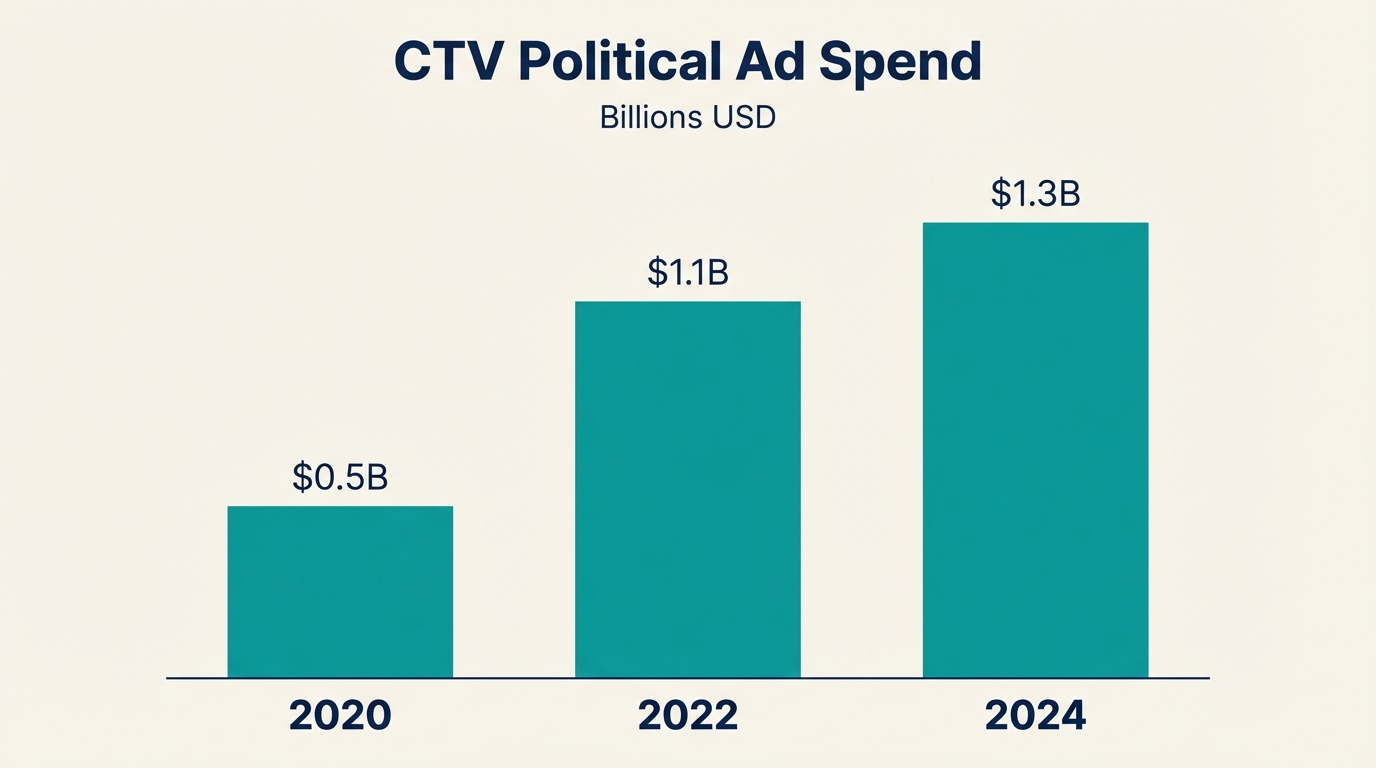
The streaming revolution has fundamentally changed political advertising CTV spending. CTV political advertising reached $1.3 billion in 2024, and that number is growing fast. More importantly, the barriers that kept local candidates off TV have largely disappeared. Streaming TV political ads now let you reach voters in your district on the same platforms they watch every night, starting with budgets that would have been laughable just a few years ago.
Here's what modern candidates need to know about local candidate TV advertising in the streaming era.
The CTV Revolution in Political Advertising
Political advertising on streaming TV isn't new anymore. It's mainstream.
According to Basis Technologies, CTV ad impressions bought through programmatic channels surged more than 100% from 2022 to 2024. Video now accounts for 76% of all political digital ad spending, with CTV claiming 50% of programmatic device ad spend, leapfrogging mobile for the first time.
Why does this matter for your campaign? Because streaming has become how Americans watch TV.
CTV now commands 40.3% of all television viewing, compared to just 20.5% for broadcast and 27.2% for cable. And this isn't just young voters. Sixty-three percent more baby boomers cut the cord in 2023 compared to the previous year. Your voters, across all age groups, are streaming.
The old model, where TV advertising meant buying expensive broadcast slots and hoping your message reached the right people, is being replaced by something far more accessible. Programmatic advertising lets you target specific voters in specific districts with precision that broadcast simply can't match.
Why TV Advertising Works for Political Campaigns
TV advertising has always been powerful for candidates. What's changed is who can afford to use it.
The trust factor is real. Voters perceive candidates they see on TV as more established and credible. There's a psychological weight to appearing on the "big screen" that social media posts simply don't carry. When constituents see your face during their favorite streaming show, you gain legitimacy that's hard to earn elsewhere.
The reach is massive. More than 85% of U.S. households now have at least one streaming device. In battleground states, nearly three-quarters of voters use streaming services. Your potential voters are already there, watching content every evening.
Engagement rates beat other channels. CTV advertising delivers video completion rates around 92%, far higher than skippable digital formats. When your ad runs on streaming, people actually watch it.
Premium context builds association. Your campaign ad runs alongside content from NBC, Hulu, ESPN, and other trusted networks. That context matters. Voters associate your message with the premium content they're already engaged with.
For down-ballot races especially, TV advertising can be the differentiator. While your opponents focus on yard signs and social media, you can be reaching undecided voters in their living rooms.
Budget Reality Check: Political Campaign Advertising Costs
Here's where things get interesting for local candidates exploring political campaign advertising costs.
Traditional broadcast TV advertising remains expensive. During the 2022 midterms, campaigns spent $6.4 billion on linear TV compared to $1.1 billion on CTV. Those broadcast buys typically require commitments of $5,000 to $50,000 per week in even modest markets.
Streaming changes the math entirely.
CTV advertising costs typically run $25-$40 CPM (cost per thousand impressions) for political campaigns. That means reaching 1,000 voters costs roughly what you'd spend on a few yard signs. And unlike yard signs, you know exactly who saw your message.
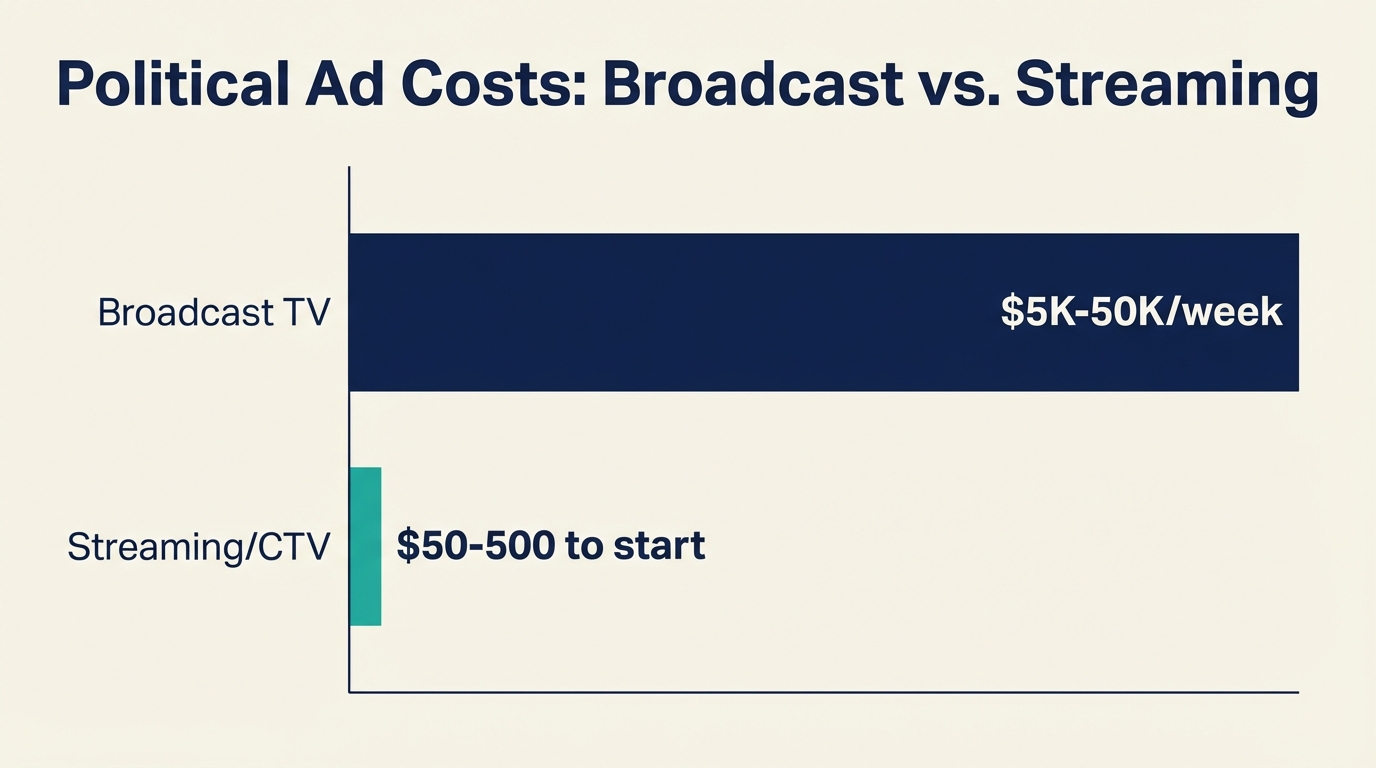
With platforms like Adwave, you can launch a campaign for as little as $50. That's not a typo. The minimum to get your message on streaming TV is roughly the cost of printing campaign flyers.
For a local race, a realistic starting budget might look like:
Testing phase: $100-$500 to validate your message and targeting
Active campaign: $500-$2,000 per week in the final month
Final push: Additional investment in the last 10 days (when 22% of political ad spend happens)
These numbers would have been impossible in the broadcast era. Now they're standard for smart local campaigns.
Targeting Voters Effectively
One of the biggest advantages CTV offers political campaigns is precision targeting. Instead of hoping your ad reaches likely voters, you can ensure it does.
Geographic targeting by district. This is crucial for local races. You can target specific zip codes, districts, or even draw custom boundaries around your constituency. No more paying to reach voters in the next district over who can't vote for you anyway. (During the 2022 midterms, more than 50% of viewers in battleground states saw linear TV ads for candidates they couldn't even vote on. CTV eliminates that waste.)
Demographic targeting. Reach voters by age, household composition, income level, and more. Running for school board? Target households with children. Focused on senior issues? Reach voters 55 and older.
Behavioral and interest targeting. CTV platforms can identify voters who watch news programming, follow political content, or have demonstrated civic engagement. These are the voters most likely to actually show up on election day.
Timing around key moments. Increase your presence during early voting periods, immediately after debates, or in the critical final days before the election. Programmatic buying lets you adjust spending in real-time based on campaign needs.
The targeting available on streaming platforms rivals what you'd find on social media, but delivered through a medium voters trust more.
Creating Effective Political Ads
You don't need a Hollywood production to create an effective political ad. In fact, authenticity often beats polish.
The essentials: Every political ad needs three things: the candidate (you), a clear message, and a call to action. Voters should know who you are, what you stand for, and what you want them to do (vote for you, visit your website, attend an event).
30 seconds is the standard. This format has been proven effective for political messaging. It's long enough to make a point but short enough to hold attention. You have time to introduce yourself, state your key message, and ask for the vote.
Authenticity wins. Voters respond to candidates who seem real. A genuine message delivered without perfect lighting often outperforms a slick production that feels manufactured. Talk directly to the camera. Be yourself. Address the issues your constituents actually care about.
Keep compliance in mind. Political ads have disclosure requirements. Make sure your ad includes proper "Paid for by" disclaimers and follows FCC and FEC guidelines. Most platforms have political ad policies that require verification and accurate labeling.
AI-powered tools have made ad creation dramatically more accessible. You can create a professional political ad from your campaign website and existing photos in minutes, without hiring a production company or spending thousands on video shoots.
Measuring Campaign Impact
One advantage CTV has over traditional TV advertising is measurability. You can actually see what's working.
Impressions and reach. Know exactly how many voters saw your ad and how many unique households you reached. Unlike broadcast, where ratings are estimates, CTV provides actual viewing data.
Completion rates. See what percentage of viewers watched your entire ad. High completion rates suggest your message is resonating. Low rates might indicate you need to adjust your creative.
Website traffic correlation. Track whether ad exposure drives visits to your campaign website. Platforms can show you the relationship between ad impressions and online engagement.
Geographic performance. See which areas are responding to your ads. Maybe voters in certain precincts are more engaged. That information can inform both your advertising and your ground game.
Frequency management. Ensure you're reaching voters enough times to be memorable without annoying them with the same ad repeatedly. Most experts suggest voters need to see a message 7-10 times for it to stick.
The measurement capabilities available today would have seemed like science fiction to campaigns even a decade ago. Use them to continuously optimize your approach.
Getting Your Campaign on TV
TV advertising used to require media buyers, agency relationships, and significant upfront commitments. That's no longer the case.
Adwave makes political TV advertising accessible to campaigns of any size. You can create a professional ad from your campaign website, target voters in your specific district, and launch with a budget that fits your race. The minimum spend is $50, and you can have your ad running on 100+ premium channels within days.
The process is straightforward:
Provide your campaign information. Your website URL or social media presence gives the platform what it needs to gather your images, messaging, and branding.
Review and customize your ad. AI generates a broadcast-ready commercial in minutes. Adjust the messaging, swap images, or change the voiceover as needed.
Set your targeting. Define your district or constituency. Choose demographic targets that match your likely voters.
Set your budget and launch. Start small to test, then scale based on results.
Your opponent may have more money, but they probably don't have better access to voters' screens. Streaming has leveled the playing field in ways that benefit candidates who are willing to try new approaches.
The Bottom Line for Political Campaigns
TV advertising is no longer reserved for campaigns with six-figure media budgets. The streaming revolution has democratized access to the most powerful advertising medium in politics.
For local and state candidates, this is an opportunity. While your opponents rely on the same tactics everyone's been using for decades, you can reach voters where they're actually spending their evenings: streaming their favorite shows on platforms like Hulu, Roku, and Peacock.
The math works at almost any budget level. The targeting ensures your message reaches actual constituents. The measurement tells you what's working. And the credibility of TV advertising still carries weight with voters who are tired of being bombarded on social media.
Ready to put your campaign on TV? Adwave can have your first political ad ready in minutes, running on premium streaming channels, starting at just $50. Your next voter might be streaming right now.