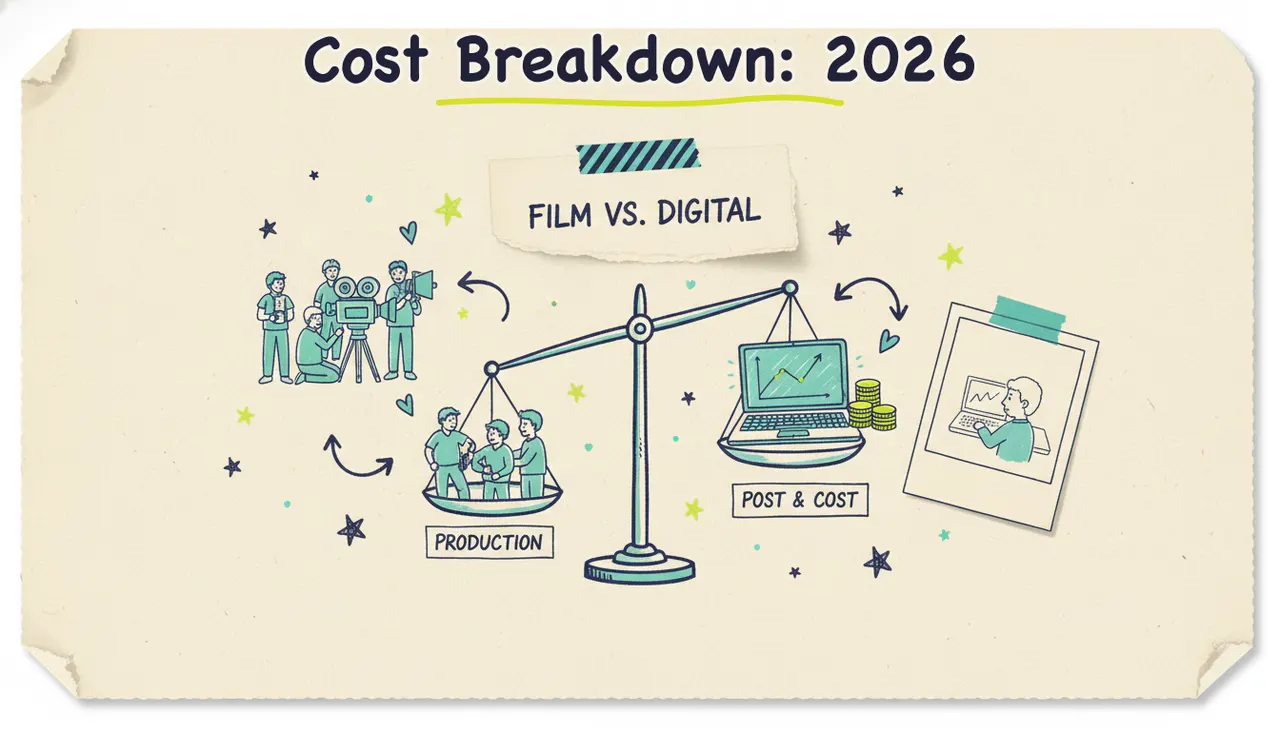
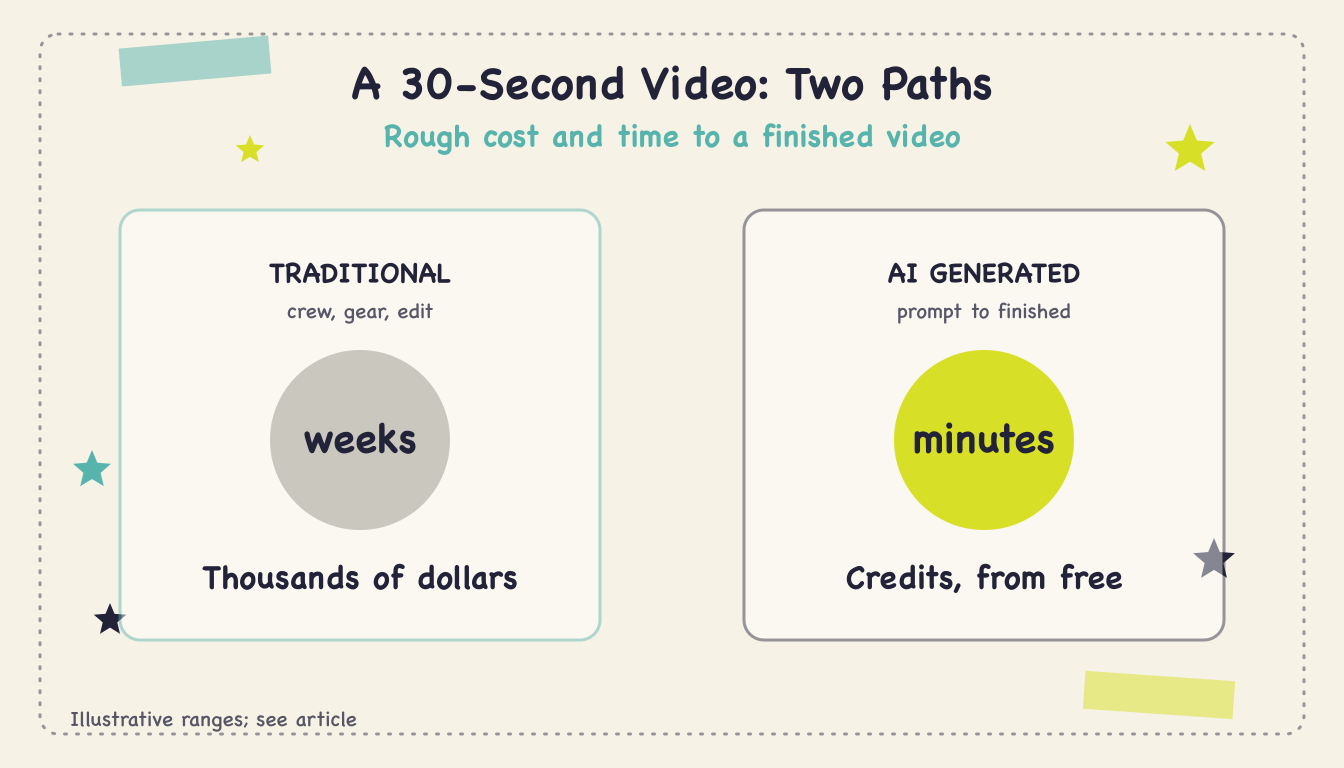
Here's the short answer: a traditional 30-second video typically runs anywhere from a few thousand dollars for a scrappy local shoot to well past six figures for a polished brand film, and it takes days to weeks to deliver. An AI-generated 30-second video with Wavemaker costs 75 credits (your free plan includes exactly that, so your first video is $0) and finishes in two to five minutes. That's the headline. But the honest version has more nuance, because the two approaches aren't really competing for the same job. This breakdown walks through what each one costs, where the time goes, and when you'd want one over the other.
Why the two approaches are hard to compare
Traditional video production and AI video generation solve overlapping problems in completely different ways. Traditional production is a service: people, gear, and time assembled into a bespoke result. AI generation is software: a pipeline that turns your input (a prompt, a URL, a document) into a finished video on demand.
So comparing them purely on a single price tag is a little unfair to both. A traditional agency isn't selling you one video; it's selling craft, direction, and a repeatable process. An AI tool isn't selling craft; it's selling speed and volume at a flat, predictable cost. once you see the full cost stack side by side, it's obvious which jobs belong to which.
We'll use realistic, clearly labeled ranges throughout. Traditional production costs vary wildly by market, talent, and ambition, so treat every number below as an illustrative range, not a quote.
What traditional video production costs
A traditional video isn't one invoice. It's a stack of line items, and most of them are labor. Here's the anatomy of a typical branded 30 to 60 second spot, with illustrative ranges you'd see quoted by production companies and freelancers in 2026.
Pre-production
This is the planning phase: concept, script, storyboard, shot list, casting, location scouting, and scheduling. It's invisible in the final cut but often 20 to 30 percent of the budget.
Concept and scriptwriting: roughly $500 to $5,000 depending on whether you hire a freelancer or an agency creative team (illustrative range).
Storyboarding: $300 to $2,000 (illustrative range).
Casting and pre-pro coordination: $500 to $3,000 (illustrative range).
Crew
The people on set. Even a modest shoot needs several roles: director, camera operator, sound, lighting, and a producer keeping it all on schedule.
Director: $500 to $5,000 per day (illustrative range).
Videographer / DP: $500 to $2,500 per day (illustrative range).
Sound, lighting, and grip: $300 to $1,500 per person per day (illustrative range).
A single shoot day with a small crew can easily reach $3,000 to $10,000 in labor alone.
Gear
Camera, lenses, lighting kits, audio, stabilizers. You either rent or pay for a crew that owns it.
Equipment rental: $500 to $3,000 per day (illustrative range).
Talent
On-camera actors or voice talent, plus usage rights. Usage rights are the part people forget: paying an actor to appear is one cost; the license to run that footage in your ads for a year is another.
On-camera talent: $500 to $5,000 per person, plus usage fees (illustrative range).
Professional voiceover: $200 to $1,500 (illustrative range).
Location
Studio time or a permitted real-world location. Permits, insurance, and location fees add up fast in a city.
Location or studio: $500 to $5,000 (illustrative range).
Editing and post-production
Where the raw footage becomes a video: editing, color grading, motion graphics, sound mixing, and licensed music.
Editing and color: $1,000 to $5,000 (illustrative range).
Motion graphics / animation: $1,000 to $10,000+ (illustrative range).
Licensed music: $50 to $2,000 depending on the track and license (illustrative range).
Revisions
Every round of changes means more editor hours, and sometimes a reshoot. Reshoots are the budget-killer: if a line reading is wrong or a product changed, you might be paying for a whole crew day again.
Add it up. A lean local business video might land around $2,000 to $8,000. A mid-tier branded spot commonly runs $10,000 to $50,000. A high-end national commercial with recognizable talent and a full agency can run $100,000 to $500,000 or more. These are illustrative industry ranges; your actual quote depends entirely on ambition and market.
What AI video generation costs
Now the other side. With an agentic video creator like Wavemaker, the cost model isn't a stack of line items. It's a subscription plus credits, and the credits map cleanly to what you generate.
Here's Wavemaker's pricing as of 2026:
Free: $0. 75 credits to start (enough for your first video), 480p export, watermark, one seat.
Starter: $29/mo. 500 credits per month, exports up to 1080p, no watermark, 3 seats, 5 API keys.
Pro: $99/mo (most popular). 2,000 credits per month, API and MCP access, priority generation, custom voice design, 20% credit rollover.
Business: $299/mo. 8,000 credits per month, exports up to 4K, 25 seats, webhooks, 50% rollover.
Credit packs: from $9.99 per 100 credits, and packs never expire.
The part that matters for cost-per-video is the credit math. A roughly 30-second video costs 75 credits. A 60-second video costs 150. An edit or refine pass is just 15 credits. Generating a single image is 3. Exports scale by quality: 480p is free, 720p is 5 credits, 1080p is 10, and 4K is 25.
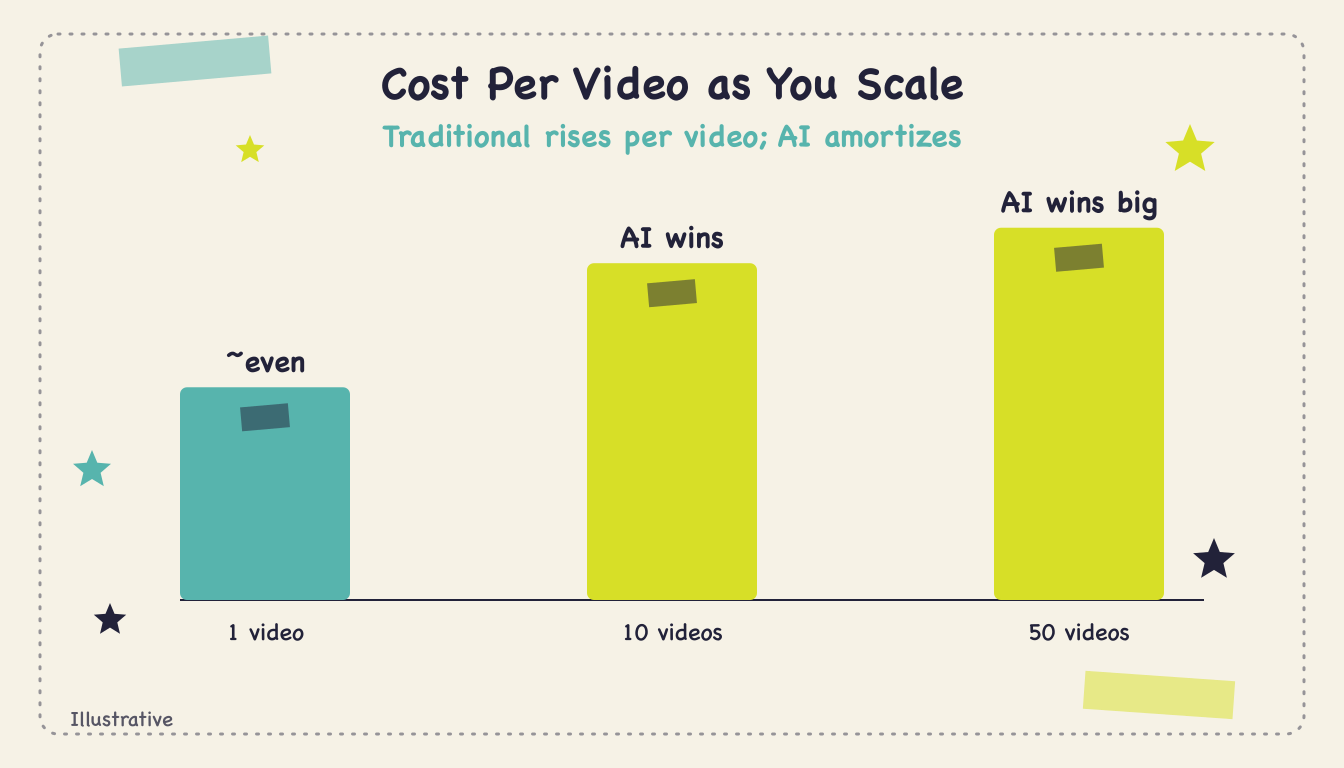
So what does one finished video cost? On the free plan, your first 30-second video is $0. On Starter at $29 a month, 500 credits covers roughly six 30-second videos, which works out to under $5 per video including a 1080p export. On Pro at $99 a month, 2,000 credits covers around 25 to 26 thirty-second videos, dropping the effective cost to roughly $4 each, and that's before rollover. The more you make, the cheaper each one gets, which is the exact opposite of how traditional production scales.
And critically: Wavemaker isn't stitching stock clips into a slideshow. It runs a full pipeline. Script, AI storyboard, generated images and video clips with subject consistency, AI voiceover with custom voice design, BPM-aware music with audio ducking, and an AI vision QC pass. You get a finished video, not raw clips you still have to assemble.
Time: weeks versus minutes
Cost is only half the story. The other half is time, and here the gap is even wider than the dollars.
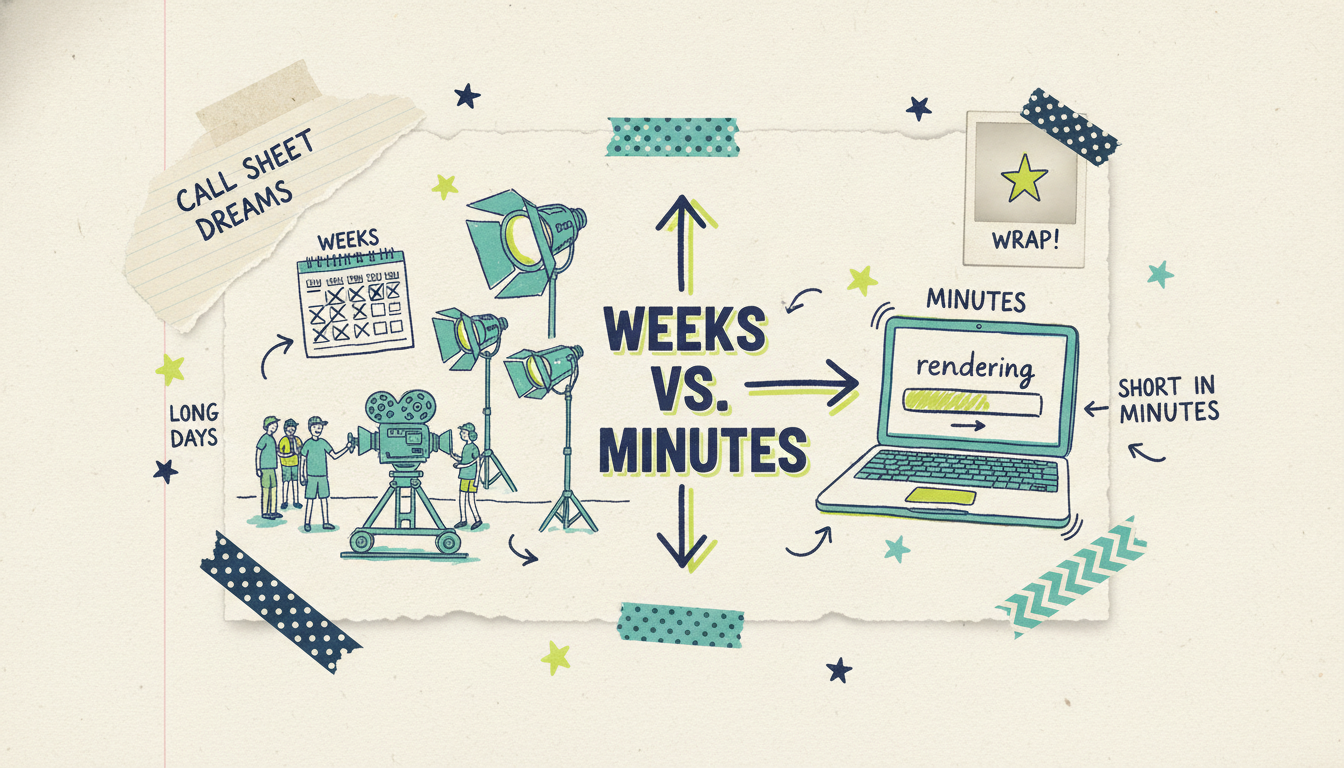
A traditional video's timeline usually looks like this: a week or more for concept and scripting, several days to a couple of weeks to schedule and shoot (coordinating crew, talent, and location calendars is the slow part), then one to three weeks for editing, revisions, and final delivery. Two to six weeks end to end is normal, and rush jobs cost extra.
Wavemaker generates most videos in two to five minutes. Want the intro longer or the music swapped? You tell it in plain language, no timeline editor, and it re-renders. A change that would've meant an editor's afternoon (or a reshoot) is now a sentence and a couple of minutes.
That speed changes what's possible. When a video takes minutes instead of weeks, you can test five versions of an ad instead of betting everything on one. You can make a video for a product launch the same morning you decide to launch. Iteration stops being a budget line and becomes a habit.
The side-by-side comparison
Here's the full picture in one place. Traditional figures are illustrative industry ranges; Wavemaker figures are its published 2026 pricing.
Where traditional production still wins
This isn't a hit piece on traditional video. There are real jobs where hiring a crew is still the right call, and pretending otherwise would be dishonest.
High-end brand films. When a video is the centerpiece of a national campaign and every frame carries the brand, a human director's taste, a location you can't fake, and cinema-grade craft are worth the spend. The budget buys intentionality that matters at that scale.
Live action with real, specific talent. If you need a recognizable spokesperson, a founder on camera telling a genuine story, real customers, or a physical product demonstrated by human hands in a specific way, that's live action. AI can generate a lot, but it can't be your actual CEO looking into a lens.
Highly specific physical reality. Certain shots (a real storefront, a specific product's exact packaging, a real event as it happened) call for a camera pointed at the real thing. Documentary and testimonial work often falls here.
Where AI generation wins
The flip side is a set of jobs that traditional production has always been bad at, because its economics don't allow for it.
Volume. Need 20 product videos, one per SKU? Or a localized version for ten cities? Traditional cost multiplies with each one. AI cost barely moves.
Speed. A trend to jump on, a same-day announcement, a video you need before lunch. Minutes beats weeks every time.
Iteration and testing. Running paid ads well means testing variations: different hooks, different lengths, different calls to action. At a few dollars and a few minutes each, you can afford to test. At thousands of dollars and weeks each, you can't.
AI video tools give businesses with limited production budgets another way to create ads.
Repurposing. Turn a blog post, a URL, a PDF, or an existing video into a fresh video in minutes. The source material you already have becomes new content.
The smart move: use both
For most businesses in 2026, the answer isn't "AI or traditional." It's using each where it's strongest. Book the crew for the once-a-year hero brand film. Use Wavemaker for everything else: the product promos, the social ads, the seasonal spots, the ten variations you want to test, the quick announcement video. You get cinematic craft where it counts and speed plus volume everywhere else, without blowing the budget.
And here's the part that's unique to Wavemaker. When your video's ready, it doesn't have to stop at an MP4. A finished Wavemaker video can run as a real streaming TV commercial on 100+ networks through Adwave, starting from $50, alongside Google, YouTube, Meta, Reddit, and display. Most AI tools' story ends at the download button. This one can put your video on television.
Common questions answered
Is AI video cheaper than hiring a production company? For most everyday videos, yes, dramatically. A traditional 30-second video runs from a couple thousand dollars into six figures depending on ambition, while a Wavemaker video costs $0 on the free plan and roughly $4 to $5 each on a paid plan. The bigger savings, though, come from volume and iteration, where traditional costs multiply and AI costs barely move.
Does AI video look as good as professionally produced video? It depends on the job. For social ads, explainers, product promos, and most business video, AI output on paid tiers (up to 4K) looks polished and finished, not like a stock slideshow, because Wavemaker generates custom visuals, voiceover, and music through a full pipeline. For a high-end cinematic brand film with a specific human story, a traditional crew still delivers a level of craft AI can't match yet.
How long does each approach take? Traditional production commonly takes two to six weeks from concept to final cut, since scheduling crew, talent, and locations is slow. Wavemaker generates most videos in two to five minutes, and revisions happen in minutes through chat rather than billable editor hours.
When should I still hire a traditional production crew? Hire a crew when authenticity of a specific person or place is the point: national brand films, real spokesperson or founder footage, genuine customer testimonials, or documentary-style shoots of real events and products. When you need volume, speed, iteration, or you're working with a tight budget, AI generation is the better fit.
What can I make on Wavemaker's free plan? The free plan gives you 75 credits, which is exactly enough for your first 30-second video at $0. Free exports are 480p with a watermark and one seat. It's a genuine free tier, so you can test the full pipeline before paying anything, and upgrade to Starter or Pro when you need higher resolution, no watermark, or more monthly credits.
Can I put an AI-generated video on real TV? Yes, and that's what sets Wavemaker apart. A finished Wavemaker video can run as an actual streaming TV commercial on 100+ networks through Adwave, starting from $50, plus other paid channels like Google, YouTube, Meta, and Reddit. Wavemaker makes the video; Adwave handles the media buy and distribution.