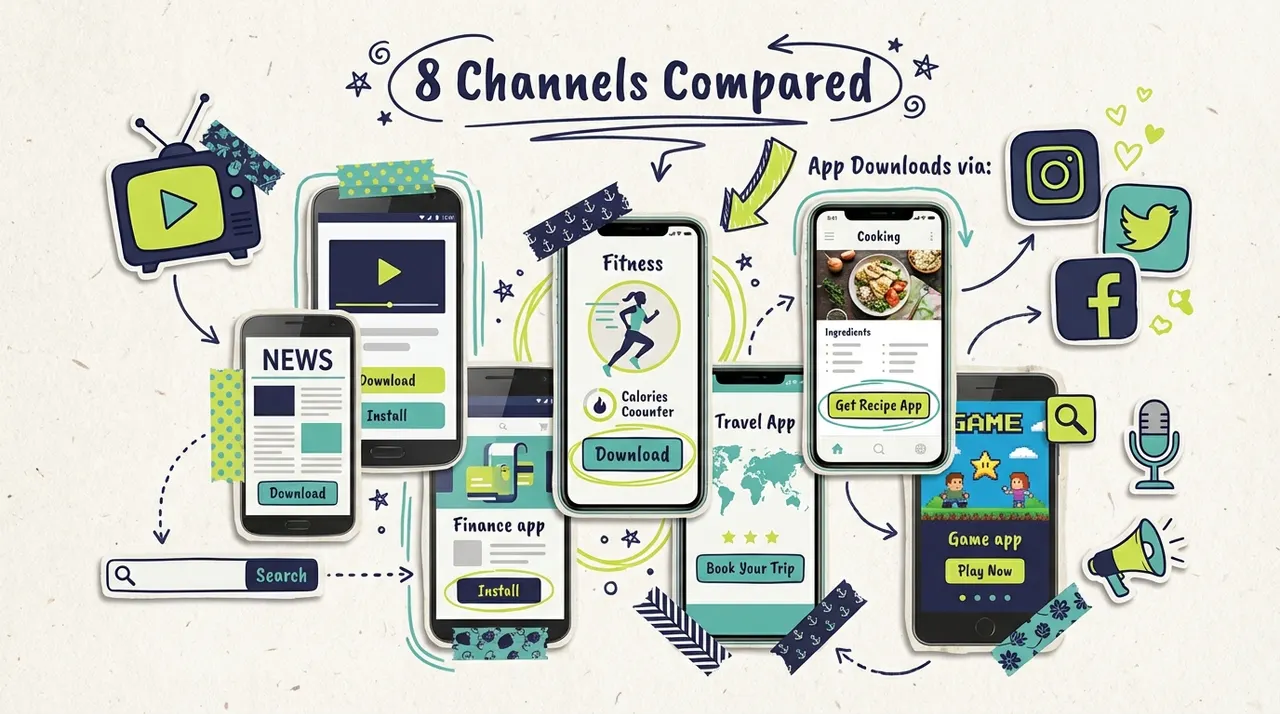
Mobile app growth still depends on paid distribution. Organic installs help, but most apps that break out of a niche mix several paid channels, measure cost per install (CPI) and cost per paying user, and keep creative fresh enough that the same audience does not tune out. This guide compares eight advertising options for mobile apps in 2026, with practical cost ranges, stage-based budget notes, and where Adwave’s suite fits when you want TV, social, and search from one prepaid budget.
For industry-specific playbooks, start with the apps industry hub and our guides on CTV advertising for mobile apps and how to get users for a mobile app.
How to read this comparison
Every channel below can work. The right mix depends on your category (gaming, utility, fintech, local services), your price point, and whether you need installs, trials, or brand recall that makes later search cheaper. Treat CPI benchmarks as directional. Network averages move with seasonality, privacy changes, and creative quality. Your creative and product onboarding usually move CPI more than the media plan alone.
Adwave positioning for app marketers: Wavemaker builds video and static ads from a URL or brief, and Adwave runs them across streaming TV, Meta, Google, TikTok, Reddit, web, and mobile from one daily budget starting at $30/day. New accounts get $60 starter credit. That is not a replacement for App Store Optimization or deep UA tooling on Google App Campaigns, but it is a practical way to add brand and performance channels without standing up a separate agency stack.
1. App Store Optimization (ASO)
ASO is the foundation. You improve title, subtitle, keywords, screenshots, preview video, and ratings so store search and browse convert. Cost is mostly time or a specialist retainer. There is no media CPI, but weak ASO wastes every paid install you buy.
Best for: every stage. Watch for: treating ASO as a one-time launch task. Competitor keywords and creative fatigue force ongoing updates. Pair paid UA with store tests so you are not optimizing screenshots in a vacuum.
2. Apple Search Ads
Apple Search Ads puts you at the top of App Store search results. You bid on keywords with high intent. CPI often lands in the mid tens to low hundreds of dollars depending on category competitiveness. Finance, dating, and gaming keywords run hot.
Best for: apps with clear search demand and strong conversion on the product page. Watch for: brand terms that look cheap but only capture users who already knew you. Keep a separate brand campaign and measure incremental lift.
3. Google App Campaigns
Google App Campaigns automate bidding and placement across Search, YouTube, Play, Discover, and the Google Display Network. You supply assets and a target CPI or ROAS. Reported CPI varies widely by vertical. Many teams see productive ranges from roughly $1 to $3 for some casual games up through $20 to $80+ for subscription and finance apps.
Best for: scale once you have conversion events and a stable onboarding funnel. Watch for: black-box placement mix. Feed high-quality video and end cards, and validate against your MMP, not only Google’s dashboard.
4. Meta (Facebook and Instagram)
Meta remains a core performance channel for apps that can tell a visual story. Advantage+ app campaigns and manual setups both work. CPI is often competitive for consumer apps, with wide variance by country and creative. Video that shows the product in the first three seconds usually beats logo intros.
Best for: consumer apps with strong creative volume and clear value props. Watch for: iOS measurement noise and creative burnout. Plan a weekly creative refresh cadence. Wavemaker helps when you need variants without a full production team.
5. TikTok and short-form video
TikTok and similar short-video placements reward native-feeling demos, UGC-style hooks, and sound-on storytelling. CPI can look excellent for entertainment and lifestyle apps and painful for dry B2B utilities. Creative production cost is the real gate.
Best for: apps that look good in motion and can ship many hooks. Watch for: over-indexing on vanity installs that never open day two. Optimize to retained users or trial starts, not installs alone.
6. Influencer and creator partnerships
Paid creators and affiliate-style installs can beat network CPI when the creator’s audience matches your category. Pricing runs from a few hundred dollars for micro creators to five figures for larger names, often plus a CPA kicker.
Best for: lifestyle, fitness, education, and gaming apps with a personality. Watch for: weak tracking and one-off spikes. Use unique codes, deferred deep links, and a simple brief that still leaves room for the creator’s voice.
7. Programmatic and DSP app inventory
Programmatic open exchange and private marketplace buys can extend reach into in-app inventory and CTV-adjacent inventory. Useful for retargeting and brand scale once you have a data partner and fraud controls. Minimums and ops overhead are higher than self-serve social.
Best for: growth teams with an MMP, brand safety rules, and budget to test. Watch for: bot installs and opaque supply. Start with curated deals, not the cheapest open inventory.
8. Streaming TV and connected TV
CTV and premium streaming put your app on the living-room screen. Viewers cannot tap to install from the couch the same way they tap a social ad, so the job is different: brand recall, search lift, and “I should download that” moments that convert later on mobile. Category CPMs for CTV commonly land in the mid teens to forties, depending on targeting and season.
For app marketers, TV works best as a halo around performance UA. Households that see your spot are more likely to search your name, click your App Store listing, or respond to a retargeting ad. That is why many teams keep a modest daily CTV or multichannel budget even when CPI-focused channels get most of the spend.
Best for: apps with brand upside, subscription LTV that can absorb a longer path to install, and categories where trust matters (finance, health, education, local services). Watch for: buying CTV in isolation without a mobile conversion path. Pair spots with strong ASO, brand search coverage, and a simple URL or QR destination.
Adwave’s suite is built for this mix. Paste your site or store URL, generate ads in Wavemaker, then run Adwave across TV plus Meta, Google, TikTok, and more from $30/day. You are not forced into a five-figure CTV-only contract to test living-room reach. See also TV advertising for mobile app developers.
Side-by-side snapshot
Budget guidance by stage
Pre-launch / soft launch. Put most effort into ASO, onboarding, and a small paid test on one or two channels. A few hundred dollars a day split between Meta or Apple Search Ads and creative production is enough to learn. Skip heavy CTV until the product page converts.
Early growth. Fund the channel that already produces retained users, then add a second for diversification. Keep 10 to 20% of media for brand or CTV experiments so you are not 100% dependent on one auction. On Adwave, that can mean a $30 to $50/day multichannel campaign while your core UA stack runs elsewhere.
Scale. Protect ROAS or LTV:CPI targets on Google and Meta, expand geo, and use CTV to lower branded search costs and raise awareness in priority markets. Refresh creative weekly. Measure incrementality with geo splits or holdouts when you can.
Local and SMB apps. If your app serves a metro or service area (booking, delivery, home services), geographic CTV and local social often beat national UA. Target ZIPs, not the whole country. Browse related playbooks under apps and neighboring verticals on the industries index.
Creative and measurement checklist
Show the product fast. First three seconds should show the UI or outcome, not a logo sting.
Match store screenshots. Paid creative that looks nothing like the listing hurts conversion.
Optimize past install. Track day-1 retention, trial start, or purchase. Cheap installs that churn are expensive.
Use one MMP of truth. Reconcile network claims against your own attribution.
Plan creative volume. Expect winners to decay. Wavemaker helps ship variants; you still need a testing calendar.
Connect TV to mobile. Cover brand search terms, keep ASO sharp, and retarget site or app visitors after CTV flights.
Where Adwave fits in an app media mix
Dedicated UA tools still matter for App Store Search Ads, Google App Campaigns, and deep SKAN or MMP workflows. Adwave is the suite layer for teams that want professional video creative and a prepaid multichannel budget without hiring a full media team for every test. Daily budgets start at $30/day. New accounts get $60 starter credit. You approve ads before spend, pause anytime, and see one report across the channels in the campaign.
That combination is especially useful when you want streaming TV in the mix alongside social and search, or when marketing and growth share one wallet for brand experiments. It is less ideal as the only system of record for large gaming UA desks that need exchange-level controls. Use the right tool for each job.
Common questions
What is a good CPI for a mobile app in 2026? There is no single good number. Casual games in broad geos can see low single-digit CPIs. Subscription and finance apps often sit much higher. Judge CPI against LTV and retention, not a blog average.
Should I buy CTV before I have product-market fit? Usually no. Fix onboarding and ASO first. Add CTV when you can afford brand lift and have a mobile path to convert interest.
Can I run TV and social from one budget? Yes on Adwave. One prepaid wallet and one daily budget can cover streaming TV, Meta, Google, TikTok, and more. That is the Adwave suite model: Wavemaker makes the ads, Adwave runs them.
How small can I start? Sitewide Adwave starts at $30/day with a $60 starter credit for new accounts. Scale after you see which messages and geos move installs or branded search.
The bottom line
The best advertising for mobile apps is rarely one channel. ASO and high-intent search capture demand. Social and short video create it. Creators add trust. Programmatic extends reach. Streaming TV builds the recall that makes every other channel work harder. Start where you can measure retained users, keep creative shipping, and add multichannel brand when your unit economics allow it.