
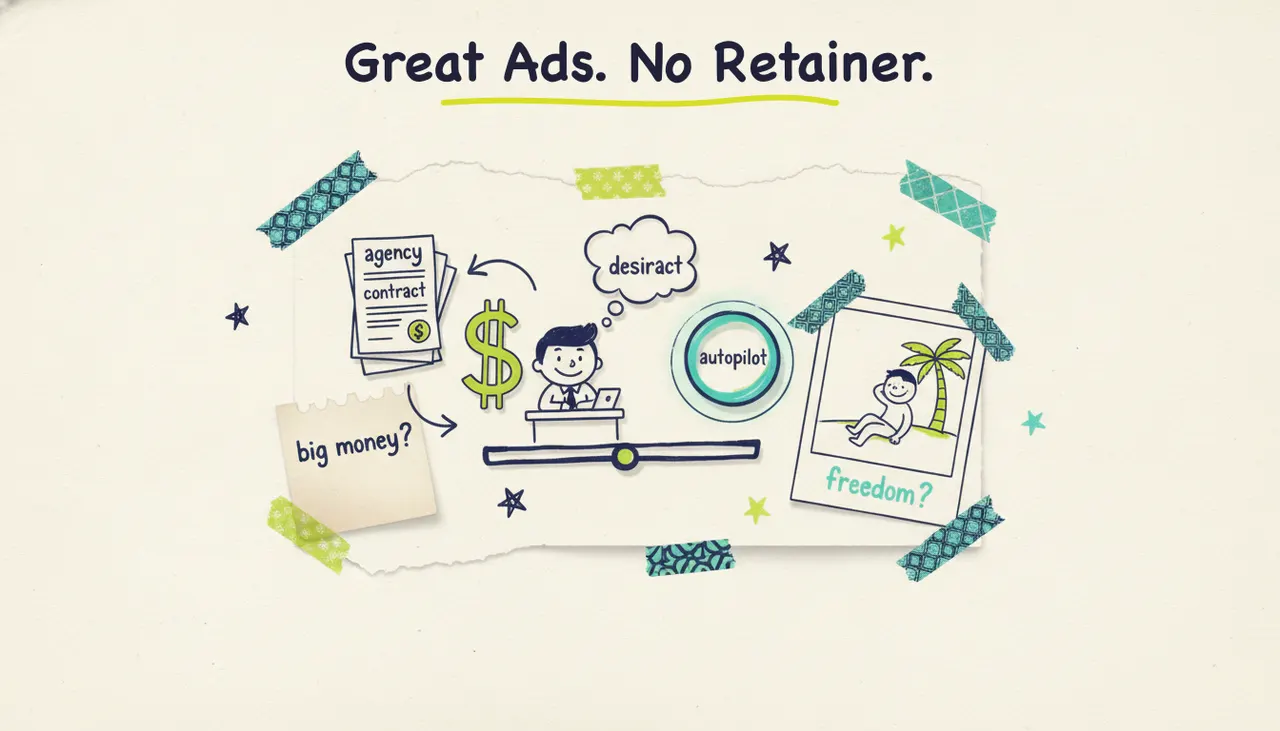
Here's the honest answer up front: sometimes, but a lot less often than you'd think. For years, "hire an agency" was the default move once a business was ready to advertise seriously. The tools were complicated, the platforms were fragmented, and running ads well was a full-time skill. So you paid someone to do it.
That math has changed. A lot of what agencies used to charge a retainer for, building the ads, buying the media, moving the budget around, watching the numbers, can now run on autopilot. Which means the real question isn't "agency or nothing." It's "what do I need done, and what's the cheapest way to get it done well?" Let's work through it honestly, including when an agency is the right call.
What a marketing agency does
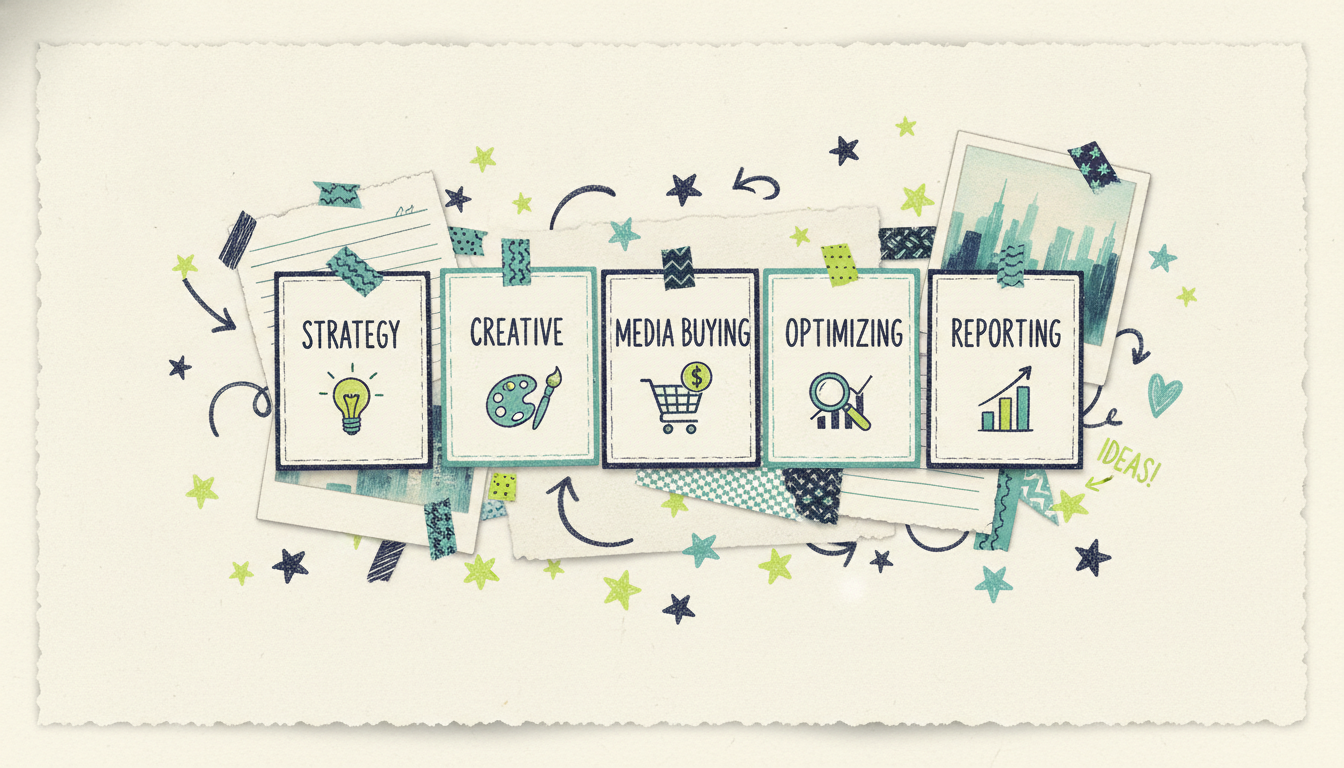
Strip away the jargon and most agency work for a small business falls into a few buckets:
Strategy: deciding what to advertise, to whom, and where.
Creative: making the ads, the videos, the images, the copy.
Media buying: setting up and running campaigns across platforms.
Optimization: adjusting budgets, audiences, and creative based on results.
Reporting: telling you what happened and what it meant.
That's a real amount of work, and a good agency does it well. The question is how much of it still requires a human on a retainer, versus how much a modern platform now handles for you.
What agencies cost a small business
This is the part that stops most small businesses, and it's worth being clear-eyed about. Agency pricing usually comes in one of a few shapes, and often a combination:
A monthly retainer, a fixed fee just to have them working for you.
A percentage of your ad spend, commonly somewhere in the 10 to 20% range, so the more you spend, the more they make.
Project or setup fees for building campaigns or creative.
Minimums, both on their fee and often on how much you have to spend to be worth their time.
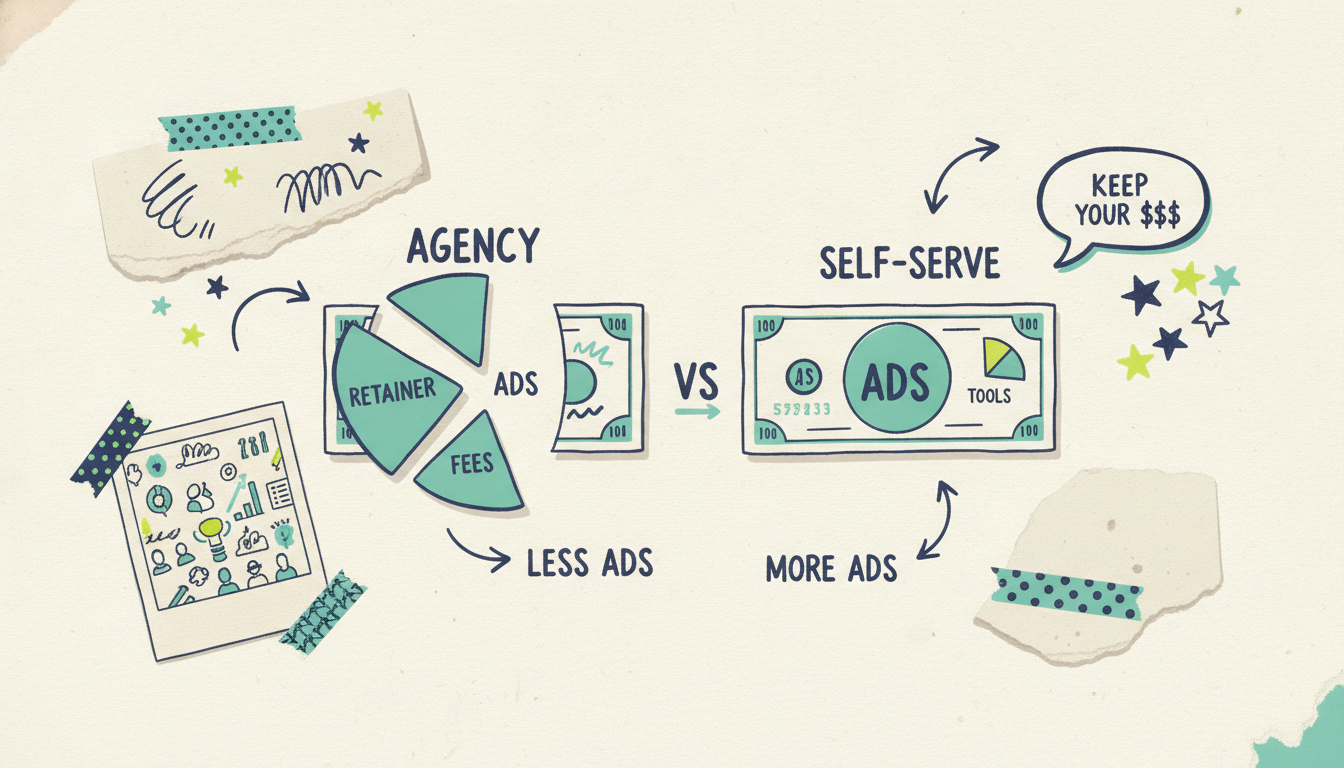
Add it up and the true cost isn't just the retainer. It's the retainer plus a cut of your media plus the fact that a chunk of every dollar you spend is going to management rather than reach. For a business spending modestly, the overhead can eat a painful share of the budget. And you're usually signing a contract to get started.
None of that makes agencies bad. It makes them a serious commitment, one that should clear a real bar before you make it.
When you need an agency
Let's be fair to agencies, because sometimes they're exactly right. Consider one when:
Your strategy is complex. Multiple brands, complicated funnels, big-budget national campaigns with a lot of moving parts. Real strategic complexity is where good agencies earn their fee.
You need hands-on creative direction. Custom brand campaigns, original video production, a distinct creative vision that goes beyond "make me effective ads."
You have the budget for it to make sense. If you're spending enough that a 15% management fee is small next to the results a great team can unlock, the math can work.
You want it fully off your plate and you can afford that luxury. Sometimes paying to never think about it is worth it, if the numbers support it.
If that's you, an agency can be a great partner. The problem is that most small businesses get sold the agency model when their actual needs are much simpler.
When you don't (which is most of the time)
For a huge number of small and growing businesses, the real need is straightforward: good ads, running across the right channels, that work, without a second job or a big retainer. That need no longer requires an agency, because the hard parts are now automated.
Here's what used to justify the retainer, and what handles it now:
When a platform builds the ads, buys the media across channels, and optimizes on autopilot, the thing you were paying an agency to do is largely done for you. You keep the control and the savings, and you skip the contract.
The self-serve alternative, in plain terms
"Do it yourself" used to mean learning five ad platforms and babysitting them. That's not the choice anymore. The modern self-serve alternative is closer to "set it up once and let it run," with you approving the important stuff and the software handling the grind.
This is what Adwave is built for. It's performance advertising on autopilot: it builds the ads from your website, buys the media across Meta, Google, Reddit, TikTok, web, mobile, and television, and optimizes continuously, all from one budget. You get the things you'd hire an agency for, without the retainer or the contract:
The ads get made (from your site, brand-matched, and you approve them before they run).
The media gets bought across every channel from one campaign, so you're not managing five accounts, which is the other thing agencies charge to handle. Our guide to cross-channel ad campaigns covers how that works.
The budget optimizes itself on autopilot, and every change is logged so you can see what it did.
You measure real results from your own site data, not a polished monthly slide deck.
It's prepaid, so you fund a wallet, set a daily ceiling, and never sign a contract or go into debt. Prepaid advertising platforms explains the pay-as-you-go model.
The difference in cost is the whole point: you're paying for the media and the tools, not for a middleman's retainer and a percentage of every dollar.
A quick cost reality check
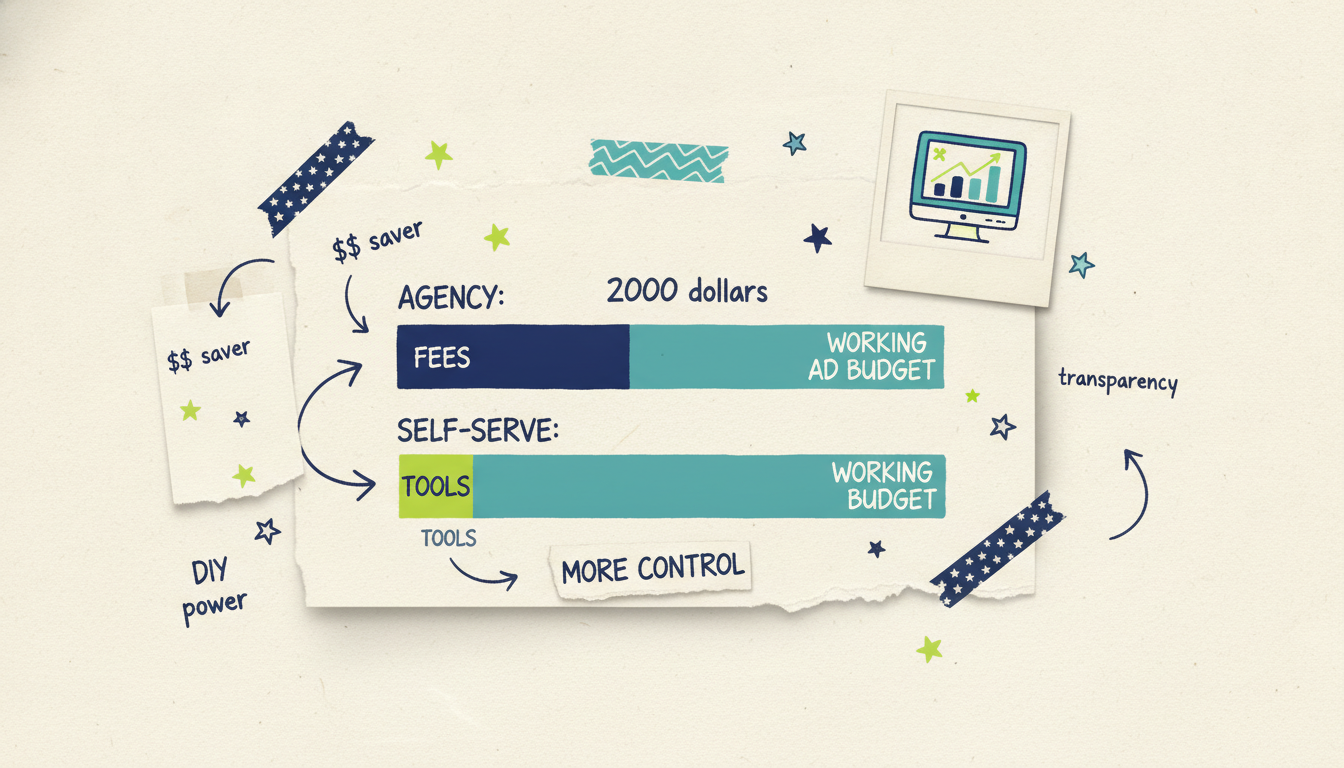
Compare the costs below when deciding which work to handle yourself and which to hire out.
Say you're ready to put $2,000 a month into advertising. Go the agency route and a common structure might be a retainer plus a percentage of that spend. Between the fee and the management cut, a real chunk of your $2,000 goes to the agency rather than to reaching customers, so your actual working media budget is meaningfully smaller than the number you're writing checks for. And you're likely locked into a contract to boot.
Run the same $2,000 on a self-serve, prepaid platform and the split flips. You pay for the media and the tools that make and run the ads, and the rest is working budget in front of real people. No retainer skimming off the top, no percentage of spend, no contract holding the door shut.
The exact figures vary, but the direction never does: the smaller your budget, the more an agency's fixed overhead costs you as a share of it. That's precisely why the agency model fits big spenders and pinches small ones.
Signs you've outgrown (or never needed) your agency
If you already work with an agency, a few signals suggest it's worth rethinking:
Your reports look great but your results don't. Polished slides, flat sales. A monthly deck can dress up a thin quarter.
A big share of your spend is management fees. If you did the math and winced, that's the math telling you something.
You could describe what they do in one sentence: "they run my ads." That sentence is now a product, not a service.
You're locked in and can't easily test an alternative. The contract itself is a cost, it takes away the flexibility to change your mind.
None of these means fire your agency tomorrow. They mean it's fair to test a low-commitment alternative alongside them and let the results decide.
How to decide
Skip the sales pitches and ask yourself four questions:
Is my advertising complex, or do I mostly need effective ads running well? If it's the latter, you probably don't need an agency.
Can I afford to give up 10 to 20% of my ad spend, plus a retainer, to management? If that overhead would meaningfully shrink your actual reach, that's a strong signal to go self-serve.
Do I want a contract? Self-serve platforms don't require one. Agencies usually do.
Do I want to see what's happening, or be told once a month? Autopilot with a logbook gives you the former; a retainer often gives you the latter.
If your honest answers point to "I need good ads running well, without a big commitment," you have your answer, and it's not an agency. If you have complex, high-budget, custom needs, an agency might be worth it. Most businesses are in the first camp and get sold the second.
A good middle path, if you're not sure: try the self-serve route first. It's low-commitment by design, so you can find out whether you need more before you sign anything. If you want to see how the multi-channel side looks without an agency, multi-channel advertising for small business is a good starting point.
Common questions answered
Is it cheaper to run ads myself than to hire an agency? Usually, yes, especially at smaller budgets. With an agency you pay a retainer plus, commonly, a percentage of your ad spend, so a meaningful share of every dollar goes to management instead of reaching customers. Self-serve platforms remove that middleman layer, so more of your budget goes to actual media. The gap is widest for businesses spending modestly, where agency overhead bites hardest.
Can I really run cross-channel ads without an agency or a media buyer? Yes. That used to be the strongest argument for hiring help, because managing search, social, and TV separately was hard. Platforms like Adwave now run one campaign across every channel from a single budget and optimize it automatically, so the multi-channel work that justified a media buyer is handled for you.
When is an agency worth it? When your needs are complex, multiple brands, complex funnels, big-budget national campaigns, or when you want custom creative direction and have the budget to make the management fee small next to the results. If you mostly need effective ads running well across channels, that's now automatable, and the agency overhead is hard to justify.
Won't I lose quality by not having experts run my ads? Not necessarily. Modern platforms build brand-matched ads from your website and optimize continuously using your real site data, which is more than many small businesses got from a stretched-thin agency account. You approve the ads before they run and can see every change, so you keep oversight without paying for hours.
What about strategy? Isn't that what agencies are really for? For complex businesses, strategic guidance is a real agency strength. But for most small businesses, the "strategy" that matters is straightforward: advertise across the right channels, to the right people, and let the results guide the budget. A good self-serve platform bakes that into how it runs, so you get sound execution without paying separately for a strategy deck.
Do self-serve platforms lock me into a contract like agencies do? No, and that's a core difference. Agencies typically require a contract and a monthly commitment. A prepaid, self-serve platform lets you fund a wallet, set a daily budget, and pause or stop anytime with no contract and no notice period. You keep the flexibility that a retainer takes away.
Bottom line
Agencies still make sense for complex, well-funded, creative-heavy needs. But for most small businesses, the honest answer to "do I really need a marketing agency?" is no, not anymore. The work you'd pay a retainer for, making the ads, buying the media, optimizing the spend, now runs on autopilot, and you keep both the control and the savings.
If you'd rather get agency-grade execution without the agency, see how Adwave works. Fund a wallet, set a budget, approve the ads, and let it run across every channel.


