
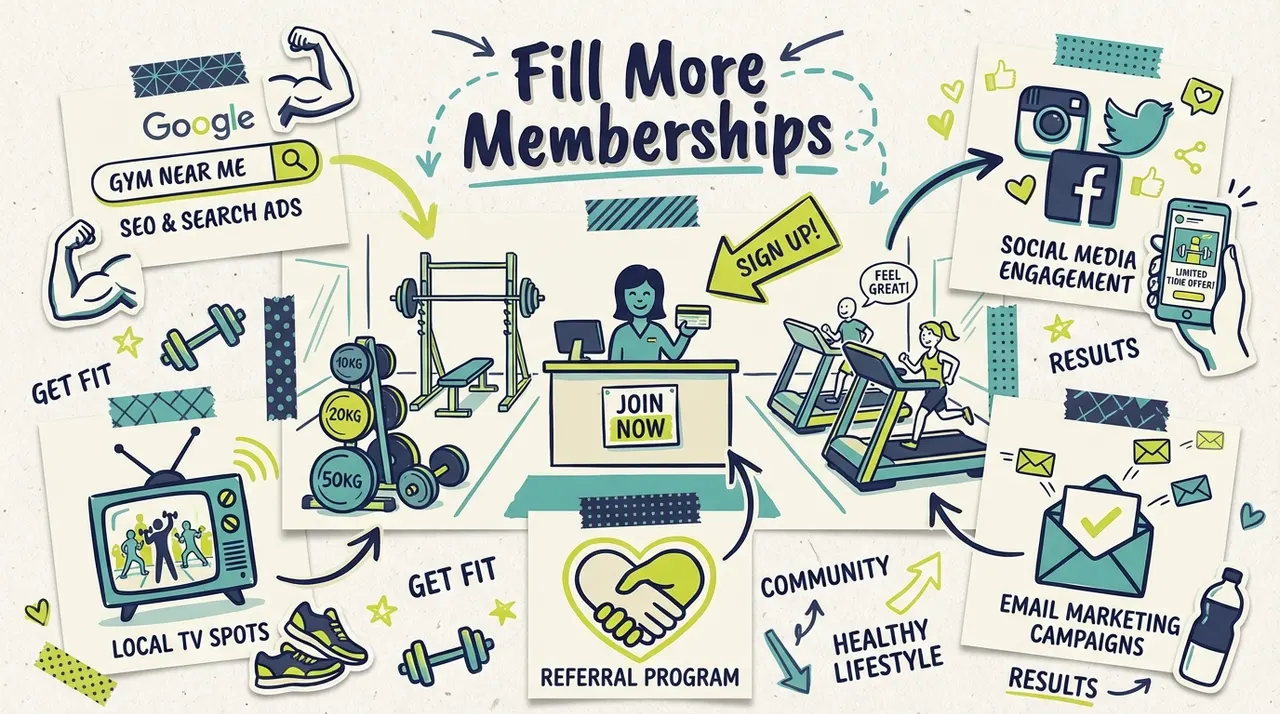
Gym membership is a trust decision. People join the facility they already recognize when motivation finally tips into action. Advertising that only chases last-click coupons leaves money on the table. The strongest gym marketing mixes channels that build familiarity with channels that capture intent when someone is ready to tour or join. This guide compares seven advertising options for gyms and fitness centers, with cost notes and a membership-focused budget approach.
For more vertical detail, see the gym advertising landing page, the fitness and recreation hub, and TV advertising for gyms and fitness studios.
What gym advertising is really for
A new member is worth months of dues, retail, and personal training. Your ads should do three jobs: make the gym familiar in the neighborhood, fill classes and day-pass traffic in slow weeks, and convert high-intent searchers who already typed “gym near me.” No single channel does all three well. Plan the mix on purpose.
Adwave’s suite helps local gyms run that mix without an agency retainer. Wavemaker builds professional video from your website. Adwave runs campaigns across streaming TV, Meta, Google, TikTok, Reddit, web, and mobile from one prepaid daily budget starting at $30/day. New accounts get $60 starter credit. Pause anytime.
1. Google Ads (Search and Maps)
Google Search and Local campaigns capture people actively looking for a gym, CrossFit box, or pilates studio. Cost per click in competitive metros often lands in the $2 to $8 range for fitness keywords, higher for specialized training. Local Service-style visibility and strong Google Business Profile listings matter as much as the ad copy.
Best for: converting ready-to-tour demand. Watch for: bidding on ultra-broad terms that attract tire-kickers from outside your drive radius. Use location targeting tightly, and send clicks to a page with hours, parking, and a clear CTA to book a tour.
2. Instagram and Meta ads
Meta is where fitness brands show classes, transformations, and community. Advantage+ and interest-based prospecting can fill top-of-funnel cheaply if creative is strong. Cost per lead varies widely. Many gyms see workable cost-per-tour or cost-per-trial in the tens of dollars when the offer is clear.
Best for: visual storytelling, new class launches, and retargeting website visitors. Watch for: before/after claims and health claims that violate ad policies. Lead with community, coaching, and specific class times instead of miracle results.
3. Local SEO and Google Business Profile
Local SEO requires staff time or a service fee rather than an ad budget. Accurate categories, photos, reviews, and business details can improve your visibility in local results.
Best for: every gym with a physical location. Watch for: ignoring review velocity. Ask happy members for Google reviews after good sessions. Paid ads cannot fully fix a thin or poorly rated profile.
4. Streaming TV and connected TV
TV still signals that a business is real. For gyms, that matters when someone is choosing between three options within ten minutes of home. Streaming and CTV let you target ZIP codes around your facility and appear on premium networks without a broadcast buy. Category CPMs commonly sit in the mid teens to forties.
On Adwave, you can include TV in a multichannel campaign from $30/day instead of committing to a traditional spot schedule. Members often mention “I saw you on TV” even when the spot also ran on social. That familiarity lifts your Google and Meta response.
Best for: brand building, January and New Year pushes, new location openings, and competitive markets. Watch for: running TV with a weak landing experience. Pair spots with a simple offer page and covered brand search terms.
5. Email and SMS to your list
Owned channels convert frozen members, past day-pass users, and leads who never joined. Cost is a light ESP or SMS tool fee. Performance depends on list quality and cadence.
Best for: win-backs, class reminders, and referral prompts. Watch for: over-texting. Permission and frequency caps protect your brand. Use paid ads to grow the list, then nurture with owned channels.
6. Direct mail and neighborhood tactics
Door hangers, shared mailers, and geo-fenced print still work for hyperlocal gyms, especially near new developments. Cost per piece is low; response rates are modest. Combine with a QR code to a tracked offer page.
Best for: opening weeks and apartment-dense radii. Watch for: generic “join now” mail with no deadline or tour CTA. Tie mail to a short class pack or free assessment.
7. Referral and member advocate programs
Referrals remain among the highest-LTV memberships. Budget for member rewards, not just hope. A structured “bring a friend” month with tracked codes often beats another cold prospecting campaign.
Best for: gyms with strong retention and community culture. Watch for: rewards that attract deal-seekers who cancel after the promo. Reward the referrer after the friend hits a tenure milestone.
Channel comparison
Membership-focused budget allocation
A practical starting split for a single-location gym spending $1,000 to $3,000 per month on paid media:
40% Google and local search. Protect high-intent queries and brand terms.
30% Meta / Instagram. Prospecting plus retargeting of site and video viewers.
20% streaming TV / multichannel brand. ZIP-targeted familiarity. On Adwave that can be one Adwave campaign covering TV and digital together from $30/day upward.
10% experiments. TikTok, Reddit, or a creator partnership tied to a challenge.
Shift heavier to brand and TV four to six weeks before January, summer shape-ups, and location launches. Shift heavier to search when you are capacity-constrained and only want ready buyers.
Track cost per tour and cost per paid membership, not likes. Ask every tour how they heard about you. Many will say a friend or “I’ve seen you around,” which is exactly what TV and consistent local presence buy.
Creative that fills the floor
Gym ads that work usually show real members, real coaches, and a specific next step. Open with the workout or the community, not a logo. Name the neighborhood. Offer a tour, a week pass, or a challenge with a date. Avoid stock abs and empty promises.
If you do not have a production budget, paste your website into Wavemaker and generate a first cut you can edit. Then run the spot on Adwave across the channels above. Keep a second cut for class-specific promotions so you are not running the same creative for six months.
Seasonality and offers
January demand is real, and so is the hangover in February. Plan creative and budget before New Year’s, not on January 2. Summer and back-to-school are the next peaks for many markets. Offers should match capacity: unlimited classes only if you can staff them; otherwise sell intro packs with a clear path to membership.
Corporate and apartment partnerships can amplify paid media. Use ads to fill partnership events, then convert attendees with a short trial.
Common mistakes
Only buying discount clicks. Race-to-the-bottom pricing attracts churn. Lead with coaching and community; use discounts as a deadline, not the brand.
Ignoring the tour experience. Ads cannot fix a messy front desk. Align marketing with operations.
No geographic discipline. Paying for clicks 40 minutes away wastes membership budget.
One channel forever. When Meta CPMs spike, gyms with only Meta freeze. Keep search and a brand layer warm.
No creative refresh. Fitness audiences scroll past the same reel quickly. Ship new cuts monthly.
How Adwave helps gyms
Adwave is built for local operators who want big-brand presence without big-brand process. Enter your gym website, generate ads with Wavemaker, set a daily budget from $30/day on Adwave, and target the ZIPs around your facility. Your campaign can include streaming TV plus Meta, Google, TikTok, and more from one wallet. Reporting shows views, clicks, and spend in one place. There are no subscriptions or long media contracts.
That does not replace your Google Business Profile work or member referral program. It does replace the need to open four ad accounts and hire a video crew for every promo. For a deeper TV-focused walkthrough, read TV advertising for gyms and best advertising for gyms and fitness centers.
Common questions
How much should a gym spend on advertising? Many single-location gyms start between $500 and $3,000 per month in paid media, then scale when cost per membership stays inside LTV. Daily budgets from $30/day let you test without a huge commit.
Is TV worth it for a small gym? Yes when you need neighborhood familiarity and can pair TV with search and a strong tour offer. Streaming makes ZIP targeting practical at small budgets.
What offer converts best? Clear, time-bound intros (7-day or 14-day access, assessed consult, challenge signup) usually beat vague “join today” messaging.
Can I advertise multiple locations? Yes. Run separate campaigns or ad sets per geography so budgets and creative stay local.
The bottom line
Gym advertising that increases memberships combines intent capture (Google), visual demand (Meta), local trust (SEO and reviews), and familiarity (streaming TV). Referrals and owned channels protect LTV. Start with a simple ZIP-targeted mix, measure cost per tour and join, and refresh creative with the seasons.
Want one campaign across TV, social, and search from $30/day? Start with Adwave, or visit the gyms page and the fitness industry hub for more guides.


