You've got the raw offer, the URL, and maybe a rough idea for a TV spot. What usually breaks next is the script itself, because a line that looks sharp in a doc can still miss runtime, sound clunky aloud, or fail a compliance review once it's headed for broadcast. An AI script maker helps with the first draft, but the job is turning that draft into something that can air.
The market signal says this isn't a gimmick anymore. In screen and script writing software, one independent estimate puts the market at USD 185.78 million in 2025 and projects USD 412.84 million by 2030, a 17.32% CAGR over that span, while a separate estimate for AI script generators for video places the category at USD 1.15 billion globally in 2024 and projects USD 9.23 billion by 2033 at a 23.7% CAGR ( Mordor Intelligence industry report). That's the backdrop for the practical workflow producers use when the script needs to do more than sound clever.
Why Broadcast-Ready Scripts Need a Different Workflow
A broadcast script has to do several jobs at once. It needs to speak to the right viewer, fit a fixed runtime, sound natural out loud, and survive an approval process without last-minute rewrites. That is a different assignment from a blog intro, a social hook, or a podcast read, because every line has to earn airtime.
Read the script aloud, check its timing, and get approval before production.</p>
An AI script maker helps with the first draft, but the actual workflow starts with constraints, not polish. The draft has to be shaped for runtime math, broadcast compliance, and the channel it will eventually run on. That is why I treat the tool as the first step in a production pipeline, not a substitute for the rest of it.
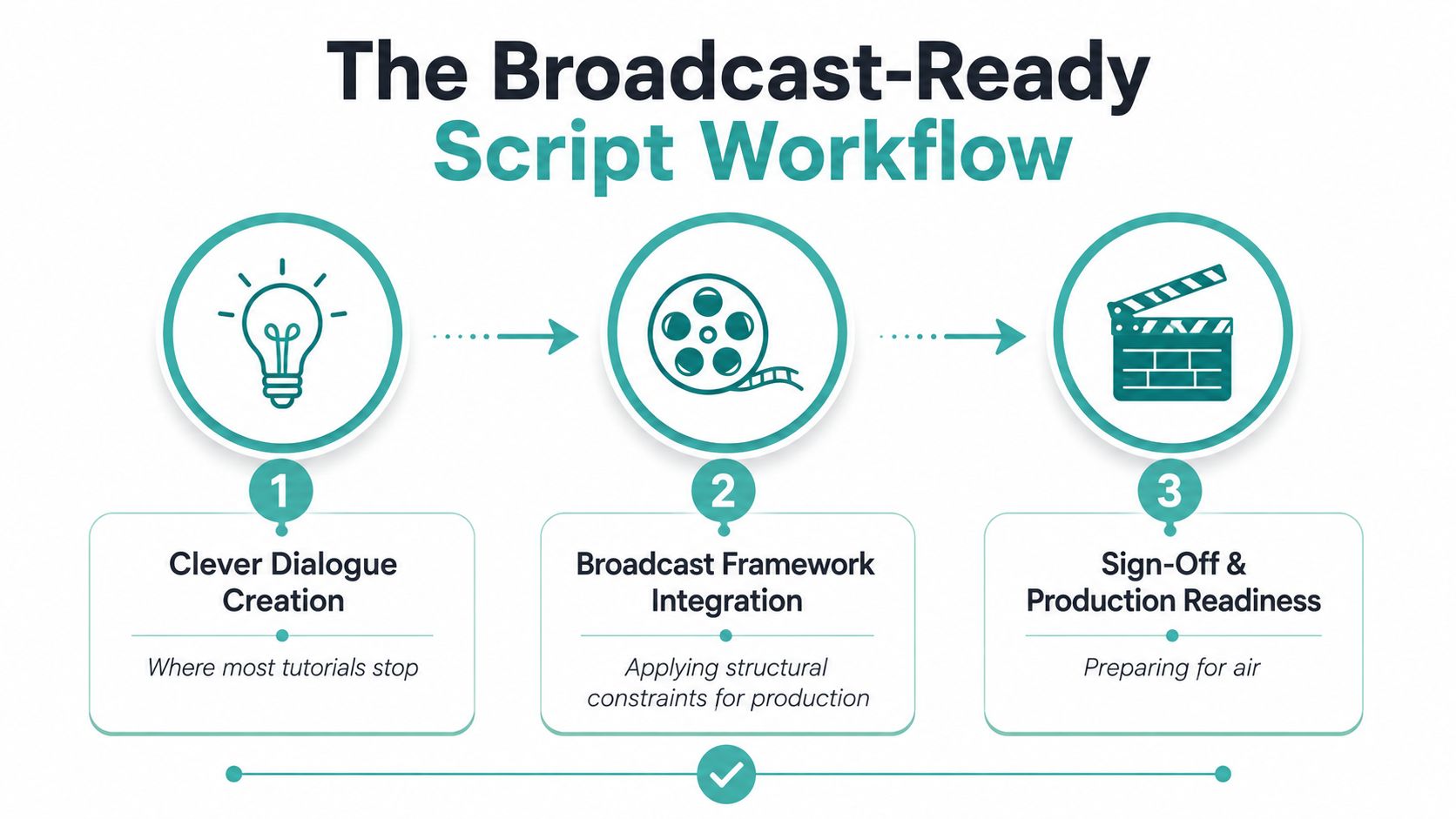
The Broadcast-Ready Script Workflow works because it puts structure ahead of polish. Most tutorials stop at the clever line of dialogue, but broadcast work starts after that first draft exists.
Read the script aloud and check that the visuals support the message. (create content that works with AI)
Building the Constraints Brief Before You Prompt
Every weak AI script starts with a weak brief. If the model has to guess the audience, offer, runtime, or call to action, it usually gives you something that sounds plausible and fails the business test. A good brief cuts off that drift before it starts.
Start with five fields and don't prompt until all five are locked: target viewer, single offer, runtime window, proof point, and call to action. The model can help with wording, but it should not invent what you're selling. That mistake is common, and it's why so many drafts feel generic.
A simple brief for local work
For an HVAC company, the brief might read like this, in plain language:
Target viewer: homeowners worried about a storm, or a weather-driven outage.
Single offer: emergency inspection or repair booking.
Runtime window: 30 seconds for local TV.
Proof point: same-day service, licensed technicians, or another verifiable claim the business can stand behind.
Call to action: call now, book online, or request service.
That's enough for a model to draft something useful without wandering into unrelated services or overstuffed language. For a dental practice, the structure is the same, but the content changes. The viewer is a prospective new patient, the offer is a new-patient promotion or consultation, the proof point is experience, location, or accessibility, and the call to action is usually a booking step rather than a broad brand statement.
A fill-in-the-blank brief only takes a few minutes, but it saves a lot of cleanup later. That's also how you keep the script aligned with the sales funnel, which is where a guide like how to write a commercial script becomes practical instead of theoretical.
The model should never decide the offer for you. If it does, you've already lost control of the ad.
The same discipline shows up in other prompt-driven workflows, including inspiration for song starting points, where the best results come from constraints, not from vague creative wishes. Script generation works the same way. The more specific the brief, the less the model has to improvise.
Prompt Formulas That Get a Usable First Draft
A structured prompt does four things at once. It assigns a role, supplies context, defines structure, and pins down constraints. That's the difference between asking for “an ad script” and asking for a draft that knows what it is supposed to be.
The prompt shape that works
Use this sequence:
Role. Tell the model what it is writing as, such as a direct-response TV copywriter.
Context. Paste the constraints brief.
Structure. Ask for hook, problem, solution, proof, and call to action.
Constraints. Specify the runtime, audience, tone, and any must-use details.
The technical side matters too. One implementation guide recommends defining the model persona, forcing screenplay-format constraints, and tuning temperature in the 0.75 to 0.90 range while using repetition penalties to reduce formulaic output ( The Art of Start implementation guide). The point isn't to chase maximal creativity. It's to get enough variety to avoid flat openings without letting the draft drift off brand.
The cleanest way to use that formula is to ask for 5 to 10 hook options before committing to one direction. A single bad opening can waste more time than a small batch of alternatives, because the right hook usually makes the rest of the draft easier to solve. That's especially true for local service ads, where the first line has to sound immediate, not literary.
Before and after on the same HVAC brief
A vague prompt looks like this, and it usually produces fluff:
Write a TV ad for an HVAC company.
A structured prompt gives the model actual boundaries:
Write a 30 second spot for a local TV audience.
Speak to homeowners before a storm.
Sell emergency HVAC inspection and repair only.
Use a homeowner-friendly tone.
Include one verifiable proof point.
End with a direct call to action.
That kind of prompt produces cleaner first drafts because the model isn't guessing the job. It also makes review faster, which matters more than people think when the goal is a finished spot, not a writing sample.
For teams comparing workflow tools, the AI video ad creator page is a useful reference because it shows how prompt structure connects to actual ad output. The best results usually come from pairing the prompt with industry cues like local TV, 30 second spot, homeowner-friendly, and a clearly named audience.
Structuring the Script and Timing It for Real Speech
Most AI scripts are too short when they're measured as spoken copy, not as text. A draft that looks full on the page can still come in 30 to 50 percent short of the runtime you need if you rely on word count alone. That's why timing belongs in the outline, not after the fact.
Build the script by seconds, not by paragraphs
Start with the blocks that matter in nearly every spot: hook, problem, solution, proof, and call to action. Assign rough seconds to each block before you write dialogue. That gives the model a shape to fill instead of a blank page to wander across.
A practical rule of thumb is simple, 150 words is about one minute of natural speech. That doesn't mean every 30 second ad should be exactly 75 words, because pacing changes with pauses, music, and visual transitions. It does mean you should stop trusting raw word count as a timing tool.
Practical rule: time the script the way a producer will hear it, not the way a writer will read it.
A read-aloud pass is the quickest filter. If a line sounds polished but can't be spoken naturally, cut it or rewrite it. The words that feel “written” on paper are usually the ones that stumble in performance, especially in calls to action and benefit statements.
Use scene-by-scene direction in the same draft
Write the script with rough visual and voice direction in-line. That can be as simple as warm, confident, mid-tempo for VO, or a note that a line should land over a product shot instead of a talking head. Producers can work with that immediately, and editors can adjust the storyboard with the same language.
Separate passes waste time. If you draft the words in one document and the storyboard in another, you'll often discover that the pacing is off only after both are already half-finished. It's cheaper to revise the script and scene timing together.
A small habit helps here. Put a stopwatch on the read-aloud, then compare the actual delivery to the target runtime. If the ending gets crowded, the call to action is too late or the setup is too long. If the opening drags, the hook is doing too much explaining.
Editing for Brand Voice, Compliance, and Disclosure
A clean draft still needs a human pass before it reaches a broadcaster. The edit is where the script gets aligned with the brand, checked for claims, reviewed for disclosures, and stripped of phrasing that sounds fine in text but awkward in speech.
Five checkpoints that catch most problems
The disclosure question matters more than it used to. Adobe's 2024 survey found that 91% of consumers said brands should clearly disclose when content is AI-generated ( Adobe survey cited in Sumera documentary resource). In practice, that doesn't mean every local ad needs a banner announcing AI involvement. It does mean the team should decide on disclosure deliberately instead of ignoring the issue.
For higher-stakes categories like healthcare, legal, and financial services, the review has to be stricter. The script needs exact naming, approved terminology, and any required disclaimer language. If the copy sounds too broad, too absolute, or too polished to be true, send it back through the model with tighter constraints rather than trying to rescue it line by line.
What a fast review pass catches
An editing pass should also catch passive wording, bloated transitions, and lines that sound like corporate filler. A useful companion guide from AI Video Detector on passive voice misuse is helpful because awkward construction often shows up first in ad scripts, not in long-form writing.
The fastest scripts to approve are the ones that answer three questions clearly: who it's for, what it offers, and what happens next. If any one of those is fuzzy, the spot will usually feel soft on air.
Taking the Script All the Way to Air With Adwave
A finished script only matters if it reaches real viewers. After sign-off, the production question becomes whether the copy will be matched to footage, turned into a new spot, or handed into a platform that can carry it from text to launch without a traditional crew.
From script to channel-ready ad
The handoff usually follows a simple path. First, confirm the final script and any visual notes. Then match it to existing footage or generate the spot from the same brief. After that, choose channels and dayparts, set pacing, and watch the early signals that show whether the creative is landing in the right way.
A platform that manages the next steps can remove a lot of friction. Adwave fits this workflow as a practical example because it turns a website URL into a broadcast-ready ad, places AI-generated spots across 100+ premium channels including NBC, Hulu, and ESPN, and starts campaigns at $50 with an estimated $15 to $35 CPM ( Adwave). For a small business, that means the script can move into real inventory without needing a production crew or a large media commitment.
The important part is not just launch, it is pacing and visibility. If the spot runs through a system that handles audience targeting and performance tracking, the team can compare the script's intent with what viewers see. That closes the loop between writing and distribution, which is where many standalone script tools stop short.
For a closer look at the launch side, how to create and air a TV ad for your business using Adwave is the most direct next step.
Why this matters for small teams
A lot of businesses can write a decent script. Fewer can turn that script into an aired spot with controlled spend and real channel placement. Adwave's model matters here because it combines creative generation, launch, and tracking in one workflow, which is what a first-time TV advertiser needs to keep the process moving.
The script is the foundation. The platform is what builds on it.
Your Repeatable Script-Making Checklist
Use the same chain every time. Brief first, prompt second, time third, edit fourth, launch fifth. The scripts that hold up are the ones where the team runs a read-aloud performance pass before anything else and refuses to accept a draft that only looks good on the page.
A strong next script should hit a few measurable signals. It should land within five percent of target runtime, contain zero unsubstantiated claims, and end with a clear call to action in the final stretch. If it misses those marks, it's not ready, even if the wording sounds polished.
The next wave of AI-assisted scripting for local businesses will reward teams that treat the model like a production partner instead of a shortcut. The businesses that win will be the ones that keep the brief tight, the timing honest, and the review human.
If you want a faster path from URL to broadcast-ready ad, Adwave is built for that workflow. It turns a website into a polished spot, places it across premium channels, and keeps the creative and launch steps connected in one system. Visit Adwave to see how your next script can move from draft to air without the usual production overhead.