
Before you type a word, you need a plan. A great commercial script isn't just a flash of creative lightning; it's a carefully constructed blueprint designed to get a specific job done. For small business owners, this roadmap is the key to creating an effective ad without the big agency budget.
The four pillars of any great script are your core message, your audience, your story, and your call to action. Get these right, and you've got a foundation for an ad that works.
Your Blueprint for a Winning Commercial Script
Let's break down how these pieces fit together. Think of it as a strategic process, not just a creative one.
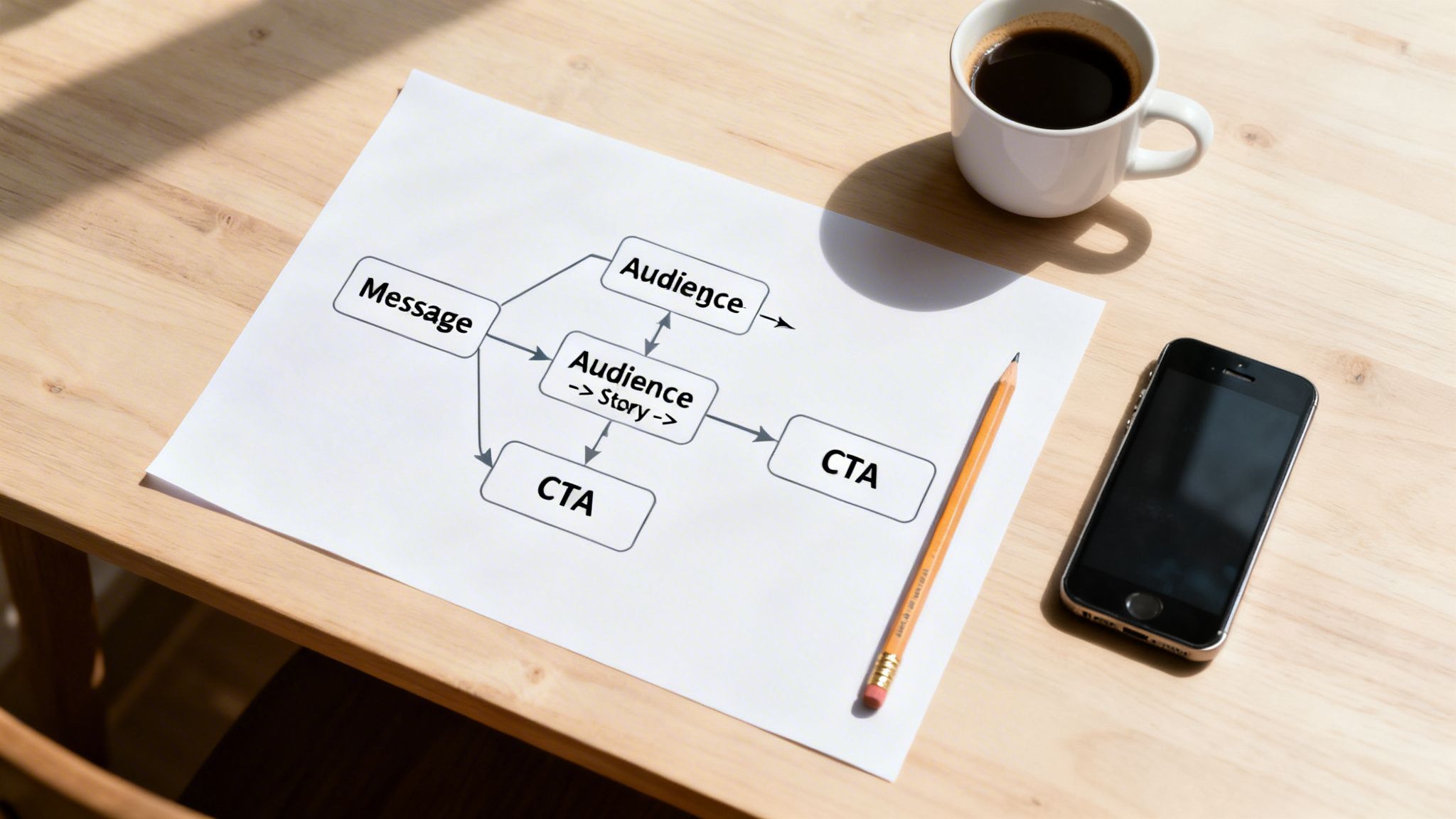
It all starts with a simple, yet powerful question: What's the one thing you absolutely need your viewer to remember? If you try to say everything, they'll remember nothing. You have to focus on a single, compelling idea.
Define Your Core Message and Audience
Your core message is the commercial’s true north. It's the one-sentence idea that lodges in a viewer’s brain. For a local coffee shop, the message isn't a laundry list of every pastry they sell; it's "Your perfect morning starts here."
Just as important is knowing who you're talking to. Writing for "everyone" means you're really writing for no one. Are you trying to reach busy parents who desperately need a quick, healthy dinner option? Or are you aiming for first-time homebuyers completely overwhelmed by the market? Your script's language, tone, and scenarios have to connect with their specific world.
Key Takeaway: A winning script isn't about selling a product; it's about solving a specific problem for a specific person. When you know who you're talking to and what you want to say, the creative part becomes much easier.
Build a Compelling Narrative
Once you have your message and audience locked in, it's time to build a simple story. This doesn't need to be a Hollywood blockbuster. All you need is a clear beginning, middle, and end that introduces a relatable problem and neatly positions your business as the solution.
This narrative structure is what makes an ad feel helpful instead of just another interruption. And, of course, every great commercial has to stick the landing with a crystal-clear Call to Action (CTA). Tell viewers exactly what to do next. "Visit our website," "Call for a free estimate," or "Stop by our new location." A script without a strong CTA is a story without an ending.
To give you a bird's-eye view, here's a quick breakdown of how these foundational elements come together in a script.
Core Components of an Effective Commercial Script
Thinking through each of these components ensures your script is built on a solid strategic foundation, making the entire creative process more focused and effective.
Time the script, check the claims, and plan the visuals before production.
Crafting Your Story with the Three-Act Structure
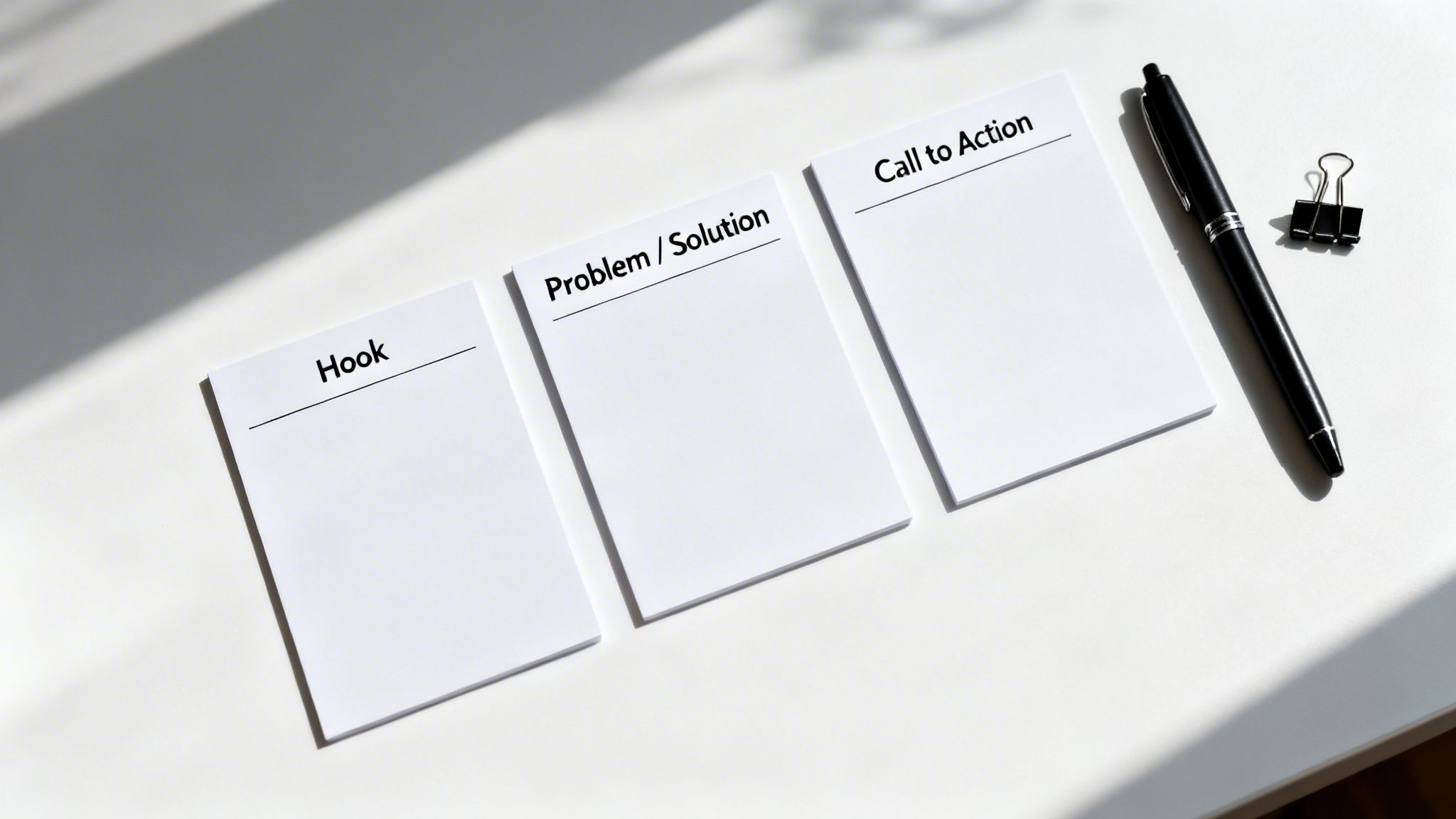
Think of your commercial as a mini-movie. It needs a beginning, a middle, and an end to have any real impact. This is where the classic three-act structure comes in. It’s a simple but powerful blueprint for grabbing attention, presenting a relatable problem your product solves, and then telling the viewer exactly what to do next.
Act 1: Hook Your Audience
You’ve got just a few seconds to stop someone from skipping your ad or looking back at their phone. Your hook is everything. It needs to land within the first 3 to 5 seconds and can be a powerful visual, a provocative question, or a statement that makes people lean in.
A compelling question that taps into a common pain point ("Still wrestling with last year's tax software?").
A striking visual or sound effect that’s impossible to ignore.
A relatable scenario that viewers instantly recognize from their own lives.
A good hook isn't just a gimmick; it’s about creating an immediate emotional connection between your brand and the viewer.
As one seasoned producer always says, "If you don’t have their full attention in the first three seconds, you’ve already lost."
Test Your Hooks
Don’t just guess what will work. Test different hooks to see what stops viewers in their tracks. A surprising statistic might work wonders for one brand, while a quick, funny visual gag could be the winner for another.
Try running A/B tests on different opening lines or visuals and keep a close eye on your viewer drop-off rates in those first important seconds. If you’re using a platform like Adwave, the built-in analytics will show you which hook holds attention the longest, taking the guesswork out of it.
Act 2: Present the Problem and Solution
Once you have their attention, it’s time to pivot smoothly into the problem your customer is facing. This is what makes your ad feel relatable. before you introduce your brand, you need to show you understand their struggle.
Imagine an ad for a local bakery. It might open with a shot of someone biting into a sad, stale pastry from their own kitchen, only to be followed by a shot of fresh, steamy rolls arriving at their door. The contrast is what sells the solution.
Key Stat: According to studies from WPP, ads that follow a clear problem-solution-benefit script convert up to 28% better.
Focus on a scenario that mirrors your customers' real-life frustrations. Show the negative impact of that problem in a quick shot or two, and then (bam!) introduce your product or service as the hero that delivers the perfect outcome.
Act 3: Craft a Compelling Call to Action (CTA)
You've hooked them and shown them the solution. Now what? You have to tell them exactly what to do next. A clear, direct Call to Action (CTA) removes all ambiguity.
Use strong, action-oriented language. Don't be shy about it.
"Visit our website to book your consultation."
"Call now to get 20% off your first order."
"Download our app and claim your free trial."
Tell customers what they receive when they respond, such as an estimate, appointment, or discount.
Add a Little Urgency
To make your CTA even more effective, create a sense of urgency or exclusivity. This is what nudges someone from "I'll do that later" to "I need to do this now."
Add a deadline or mention a limited-time offer.
Highlight the value they're getting ("Get a free gift with your purchase, this week only!").
Be crystal clear on the next step ("Click the link below to get started").
Here’s how the entire structure might look for a simple sandwich shop ad:
With the market for screen and script writing software booming, projected to grow from USD 185.78 million in 2025 to USD 412.84 million by 2030, it’s clear that well-structured stories are more valuable than ever.
For more tips on perfecting each of these acts, check out our guide on What Makes a Good TV Commercial.
Getting Your Script into Shape: Formatting for Production
Think of your script as the blueprint for your commercial. If it's messy or confusing, you can't expect the final product to be clear and effective. A properly formatted script isn't just about looking professional, it's about creating a universal language that your entire production team can understand instantly. From the director to the sound engineer, everyone needs to be on the same page, and good formatting is what gets them there.
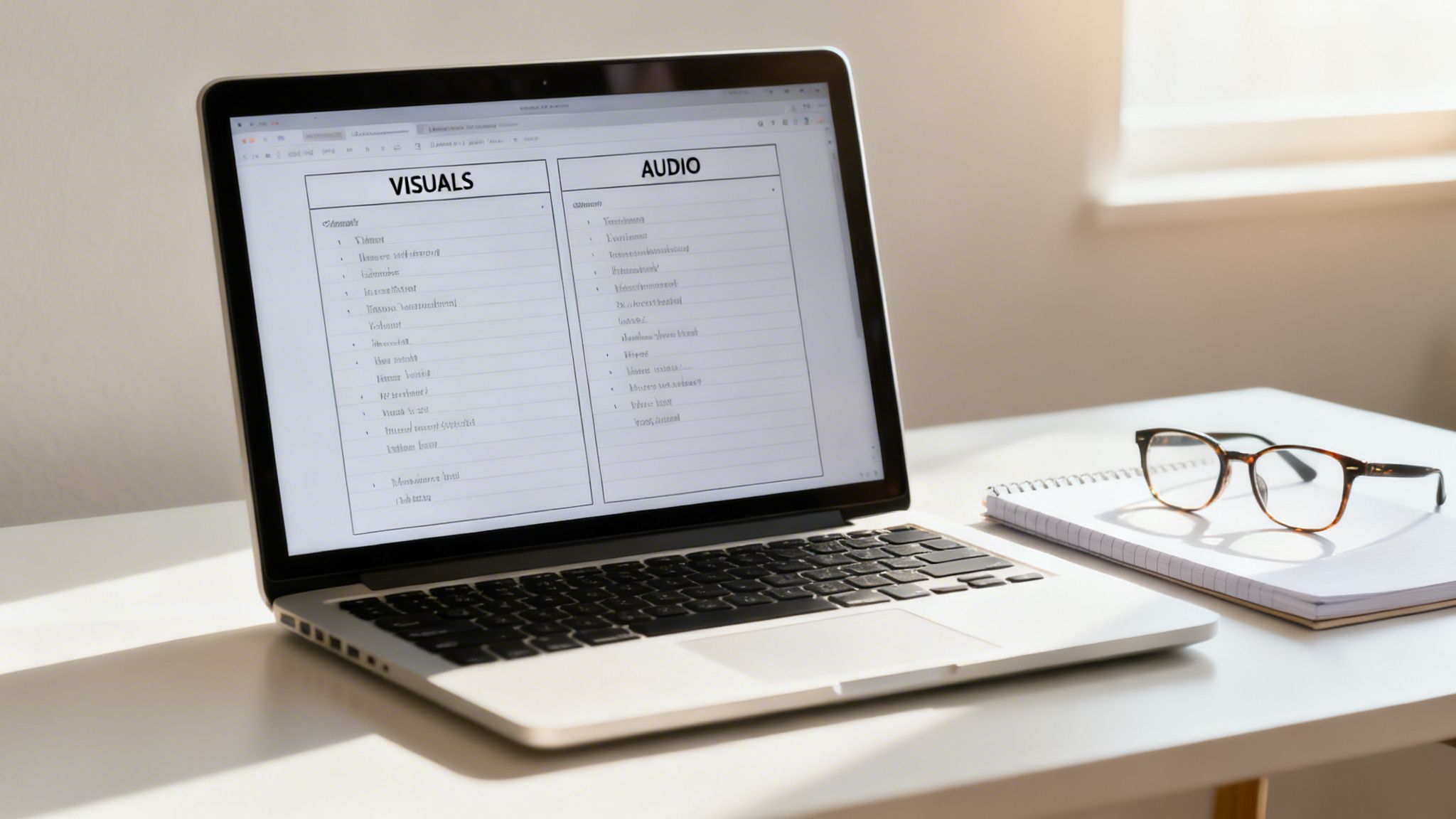
The gold standard for this is the two-column Audio/Visual (A/V) script. It’s a beautifully simple layout that synchronizes everything the audience sees with everything they hear, moment by moment.
The Two-Column A/V Format Explained
Imagine your page split right down the middle. Everything on the left describes the visuals, and everything on the right covers the audio. This structure is brilliant because it forces you to think about how sight and sound work together to tell your story.
VISUALS (Left Column): This is where you paint a picture with words. Describe what’s happening on screen: camera shots, character actions, graphics, or any text you want to pop up. Be specific.
AUDIO (Right Column): This side is for everything your audience hears. This includes dialogue, a voiceover, music cues, and any important sound effects.
Lining these up side-by-side ensures that for every visual beat, there's a corresponding sound. It’s the clearest way to get the ad out of your head and onto a page your team can use.
Speaking the Language: Key Scripting Terms
To keep your script clean and easy to read, you'll want to use a few industry-standard abbreviations. They're simple, but they signal to your team that you know what you're doing.
VO (Voiceover): This is for any narration spoken by someone who isn't on screen. It’s a staple in advertising.
SFX (Sound Effects): Any sound that isn't music or dialogue. Think a phone buzzing, a car door slamming, or a coffee maker gurgling.
ON-SCREEN TEXT: Any words that appear on the screen. This could be your website, a special offer, or your business name.
A Script in Action: Example for a Local Bakery
Let's see how this all comes together. The Daily Rise bakery script below shows a 30-second spot in the A/V format.
Pro Tip: Your visual descriptions should be concise but evocative. Don't just write "We see a croissant." Instead, try "a perfect, golden-brown croissant." That one small change helps your director and crew capture the exact feeling you're going for.
See how clear that is? There's no guesswork. The director knows exactly what to shoot, and the voiceover artist knows the precise timing and tone for each line.
If you’re a business owner who would rather skip the manual work, platforms like Adwave offer a powerful shortcut. Its AI can take your website URL and generate a complete, professionally formatted script (and the video to match) in just a few minutes. It handles all the formatting, timing, and production details, giving you a broadcast-ready ad without you ever having to open a word processor.
Making Your Script Fit: 15, 30, and 60-Second Spots
One size definitely does not fit all when it comes to TV ads. A script that feels perfect for a 60-second commercial will turn into a jumbled, rushed mess in a 15-second slot. You have to learn how to tailor your message for each format; it's a non-negotiable skill for getting the most out of your ad budget.
Think of it this way: your core message is the melody of a song. In a short ad, you're just playing the hook. For a longer one, you can add a verse and a chorus. The trick is to make sure that melody is still catchy and recognizable, no matter how long you play it.
The 15-Second Sprint: A Single, Punchy Message
Fifteen seconds is lightning-fast. You've only got about 30-40 words to work with, so there's absolutely no time for a winding story. The goal here is to land one single, powerful idea and make it stick.
This super-short format is perfect for:
Brand Awareness: Just getting your name out there and keeping it familiar.
Event Reminders: Think, "Our big sale ends this Saturday!"
Promoting a Single Offer: "Get free delivery this week only."
For a 15-second spot, your script has to be surgically precise. Hit them with a hook, state your one key benefit, and close with your brand name or a super-quick call to action. There is zero room for fluff.
A 15-second ad isn't just a shrunken 30-second ad; it’s more like a billboard that talks. The message has to be immediate and impossible to miss.
This is an area where a smart platform like Adwave really shines. When it generates your ad, it can automatically create versions for different lengths. This ensures your 15-second spot isn't just a hack job, but a concentrated, perfectly-paced dose of your brand's message.
The 30-Second Sweet Spot: Telling a Quick Story
There's a reason the 30-second commercial is the industry standard, it just works. With a comfortable word count of around 65-75 words, you have enough runway to tell a complete mini-story: Hook, Problem/Solution, and a Call to Action.
You can show a relatable scenario, present your brand as the hero, and clearly guide the viewer on what to do next. For instance, a local plumber could use a 30-second spot to show a homeowner panicking over a burst pipe (the problem), cut to a friendly plumber arriving in the nick of time (the solution), and end with "Call us anytime for 24/7 service." It's a full narrative arc that builds confidence and gets people to pick up the phone.
Knowing your audience and platform is important for making these scripts land, especially when you're looking at things like social media marketing for small businesses.
The 60-Second Deep Dive: Building an Emotional Connection
When you have a full minute, you have the luxury of time. A 60-second script, which runs about 150-170 words, lets you go deeper with storytelling and forge a real emotional connection. You can build atmosphere, develop a character people care about, and let your brand’s true personality come through.
This longer format is your best bet when you need to:
Explain a more complex product or service.
Share a powerful customer testimonial or story.
Create a strong, emotional bond with your audience.
In a 60-second spot, you can let key moments breathe. You have time for a meaningful pause, impactful music, and more detailed visuals that really pull the viewer into the world you're creating. It’s less about the hard sell and more about making your brand unforgettable.
Want to learn more about the strategy behind each format? Check out our guide on the optimal TV commercial length.
How to Condense or Expand Your Core Idea
Adapting your script isn't about randomly slashing words or adding filler. It’s a strategic process of deciding what's most important for the time you have.
Choose an ad length that fits the message and budget. Time the script aloud before producing the video.
Using AI to Generate Your Script in Minutes
Now that you've got the fundamentals down, what if you could skip most of the heavy lifting? For a long time, writing a commercial script meant hiring an agency or spending weeks agonizing over every word. That’s no longer the case. New technology offers a fantastic shortcut, giving small businesses a way to create professional-grade scripts without the agency price tag.
You’ve probably heard about the boom in AI writing tools. Many are great for brainstorming or getting a first draft on paper. But for creating a TV commercial, some platforms are built to do much, much more than write text.
How Adwave Turns Your Website into a Broadcast-Ready Ad
This is where specialized AI really shines, and it’s the thinking behind the Adwave platform. It was designed specifically for small and medium businesses who don't have a marketing department but still need to get their message out there. Forget wrestling with script formats and production, all you need is your website URL.
Adwave's AI gets to work, scanning your site to learn who you are, what you sell, and who you're trying to reach. In just a few minutes, it does something pretty amazing. It doesn't just hand you a script; it produces a complete video ad, ready for broadcast, with visuals, a professional voiceover, and perfectly timed on-screen text.
The entire process is designed to be as simple as possible.

The goal was to create an interface where any business owner could get a professional campaign up and running in just a few clicks. This level of automation completely sidesteps the traditional hurdles of high costs and confusing production workflows.
The Power of Automated Scriptwriting and Placement
The real useful option here is how scriptwriting is tied directly to ad delivery. Once your ad is created, Adwave takes over the placement, getting your commercial seen on major channels like NBC, ESPN, and Hulu. It intelligently targets the right local viewers, making sure your ad budget is spent reaching people who are likely to buy from you.
A Note from Experience: Creating a great commercial is no longer just about writing a clever script. It’s about directly connecting that script to video production and media buying. When those pieces work together automatically, that’s when you see real results. Adwave excels at integrating these steps into one fluid process.
This integrated approach is all about maximizing your return. By combining an effective ad with precise targeting, your marketing dollars go a lot further. We dive deeper into how this works in our guide on https://adwave.com/resources/ai-tv-commercial-production.
Ultimately, using a platform like Adwave isn't just about learning to write a script. It’s about adopting a system that handles everything for you, from the first word to the final broadcast.
Answering Your Top Commercial Script Questions
Even with a great guide, it's normal to have a few lingering questions. Let's tackle some of the most common ones we hear from business owners diving into scriptwriting for the first time.
How Many Words Can I Fit in a 30-Second Commercial?
You're aiming for the sweet spot: 65 to 75 words for a 30-second spot. That might sound surprisingly short, but it's the perfect amount for a natural, unhurried pace.
Remember, what's happening on screen is doing a ton of the heavy lifting. Your visuals, graphics, and on-screen text are all part of the story. If you cram the script with too many words, you’ll just overwhelm the visuals and your main point will get lost in the noise.
My favorite reality check: Read your script out loud and time yourself. It’s the simplest, most effective way to feel the pacing. If you feel rushed saying it, your audience will feel it even more.
This is something we obsessed over when building Adwave. The platform's AI is built to nail this from the start, generating scripts that are perfectly timed for a professional, polished delivery every time.
What are the Biggest Scriptwriting Mistakes I Should Avoid?
A great script can take many forms, but a few common missteps can quickly sink a great idea. If you can steer clear of these, you're already way ahead of the game.
Here are the classic traps to watch out for:
The "Everything but the Kitchen Sink" Approach: Don't try to list every single feature your business offers. It just creates confusion. Instead, focus on one powerful idea and drive it home.
A Snooze-Worthy Opening: You have about 3-5 seconds to hook someone. Seriously, that's it. If your opening is flat, they've already mentally checked out.
The Vague "So... Yeah" Ending: What do you want people to do right now? If you don't tell them clearly and directly, you're just throwing your money away. Be specific with your call to action.
Forgetting to Write for the Eyes: Some people write a script like it's for radio, focusing only on the voiceover. Television is a visual medium. Your script needs to balance what people hear with what they see.
An integrated platform like Adwave helps you avoid these pitfalls, as its AI is designed to focus on a core message, craft a strong hook, and sync visuals with audio effectively.
Can I Really Make a TV Ad Without a Huge Production Team?
This is the whole reason Adwave exists. It was built for business owners who don't have a full-scale marketing department or a blank check for ad production.
Instead of juggling a scriptwriter, director, voice talent, and a media buyer, you have one simple system. The AI in Adwave can analyze your website and generate a complete, broadcast-quality commercial (script, visuals, and professional voiceover included) in just a few minutes. It manages everything from creation to placing your ad on major networks, making professional TV advertising a genuine option for pretty much anyone.
How Do I Make My Commercial Memorable?
Making an ad that sticks with someone isn't about some secret formula. It really comes down to three things: clarity, authenticity, and emotion.
First, find your single, powerful idea. What's the one thing that sets you apart? That’s your Unique Selling Proposition (USP). Make it the absolute core of your message.
Second, be real. Your ad’s tone (whether it's funny, serious, or inspiring) needs to feel like it comes from your brand's actual personality. People can spot a fake a mile away, so don't try to be something you're not.
And finally, connect on an emotional level. Don't just list features; tell a small story that shows how you solve a real problem for a real person. When a clear message is delivered with professional quality and a bit of human connection, you get a commercial that not only stands out but also gets results. Using a platform like Adwave ensures the production quality is high, which allows your authentic message and story to shine through effectively.


