-
15-30s
Optimal TV commercial length
-
95.9%
Completion rate for 30-second ads
-
93.9%
Completion rate for 15-second ads
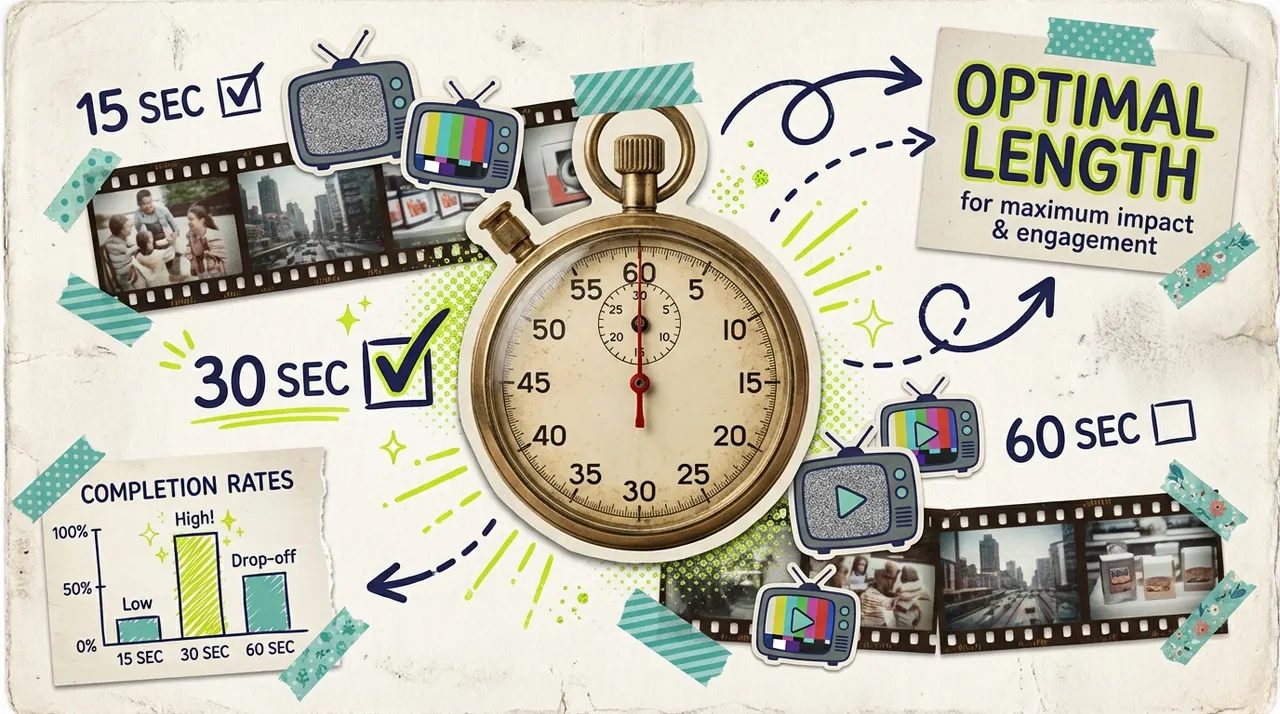
The ideal TV commercial length depends on your goals, but data consistently points to 30 seconds as the sweet spot for most advertisers. According to Adwave's CTV benchmarks, 30-second streaming ads achieve a 95.92% completion rate, slightly outperforming 15-second ads at 93.88%. But completion rate is just one piece of the puzzle. Research from the Journal of Advertising Research shows that 15-second commercials deliver approximately 75% of the memory-based effectiveness of 30-second spots, while Mountain Research found that 30-second ads drive 24% higher conversion rates than their shorter counterparts.
For small businesses entering TV advertising, the length question carries real budget implications. A 30-second ad costs twice as much airtime as a 15-second spot, so understanding which length delivers the best return on investment matters. This guide breaks down the data on TV commercial length, explores when different durations make sense, and helps you choose the right format for your advertising goals.
What the data shows
The effectiveness of different TV commercial lengths has been studied extensively, with clear patterns emerging across completion rates, brand recall, and conversion metrics.
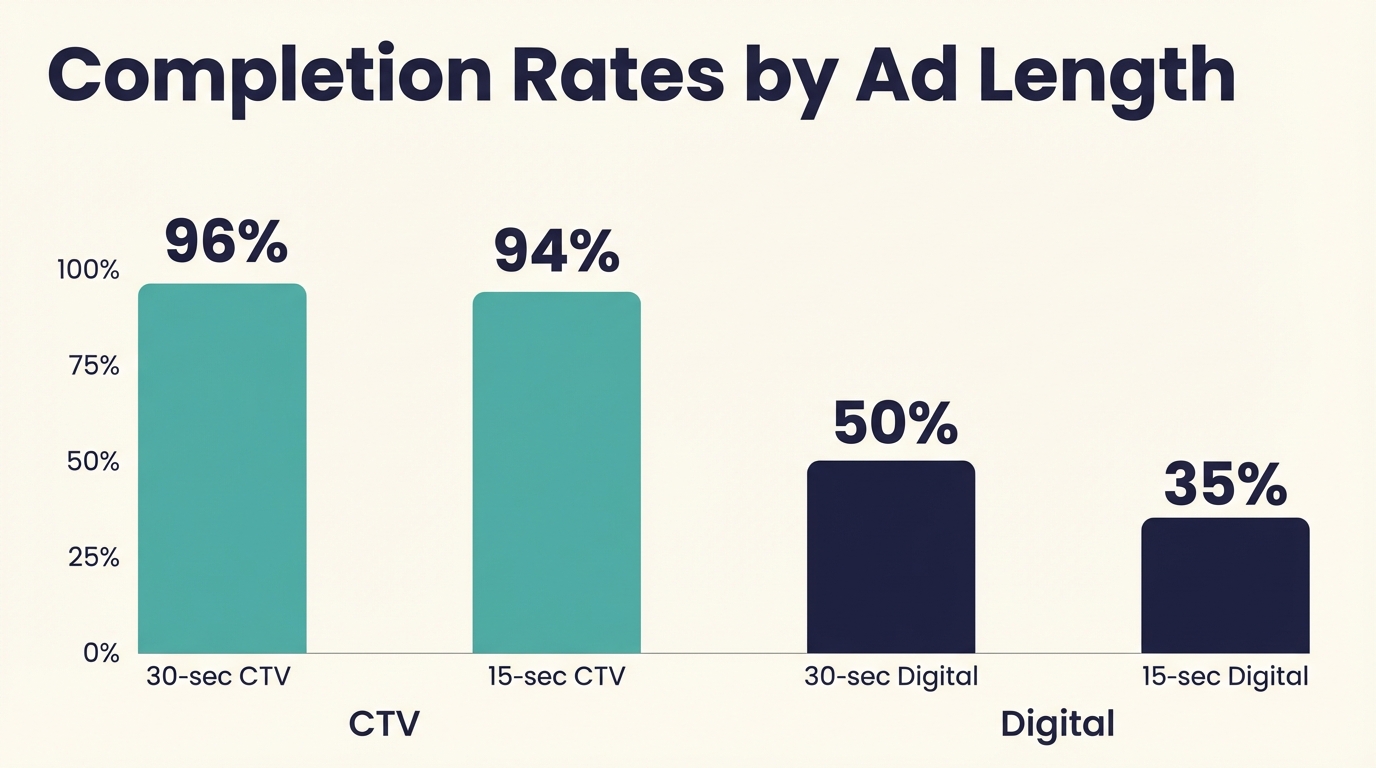
Completion rates on connected TV platforms favor 30-second ads, though the margins are surprisingly close. According to Adwave's benchmarks, 30-second CTV ads achieve an average video completion rate (VCR) of 95.92%, compared to 93.88% for 15-second ads. Both figures dramatically exceed completion rates on other digital platforms, where skippable ads often see 30-50% completion. The non-skippable nature of CTV advertising and the "lean-back" viewing environment drive these high completion rates regardless of length.
Brand recall metrics tell a nuanced story. Research published in the Journal of Advertising Research found that 15-second commercials achieve approximately 75% of the memory-based measures of 30-second ads. Similarly, Ameritest research indicated that 15-second ads are roughly 80% as effective as 30-second ads in generating attention. These findings suggest that shorter ads aren't dramatically less effective per impression, but they do sacrifice some impact.
The conversion story favors longer formats. Mountain Research analysis revealed that while 15-second ads drive 46% more site visits than 30-second ads (likely due to frequency advantages at equal budgets), 30-second ads generate 24% higher conversion rates. This suggests that shorter ads excel at driving initial interest, while longer ads better persuade viewers to take action.
Attention metrics provide additional insight. A TVision study found that approximately one-third of viewers paid attention across all ad lengths (15, 30, and 60 seconds), indicating that length has minimal impact on capturing initial attention. However, 15-second ads captured attention for 48% of total ad duration, compared to 36% for 30-second ads and just 19% for 60-second ads. This means shorter ads hold attention more efficiently on a percentage basis, even though longer ads accumulate more total attention time.
The data suggests no universally "best" length exists. Instead, the optimal commercial duration depends on campaign objectives: awareness campaigns may benefit from shorter, higher-frequency ads, while conversion-focused campaigns often see better results with 30-second spots that allow more persuasive messaging.
Breaking down the numbers
By ad length category
Understanding each standard commercial length helps advertisers match format to objectives.
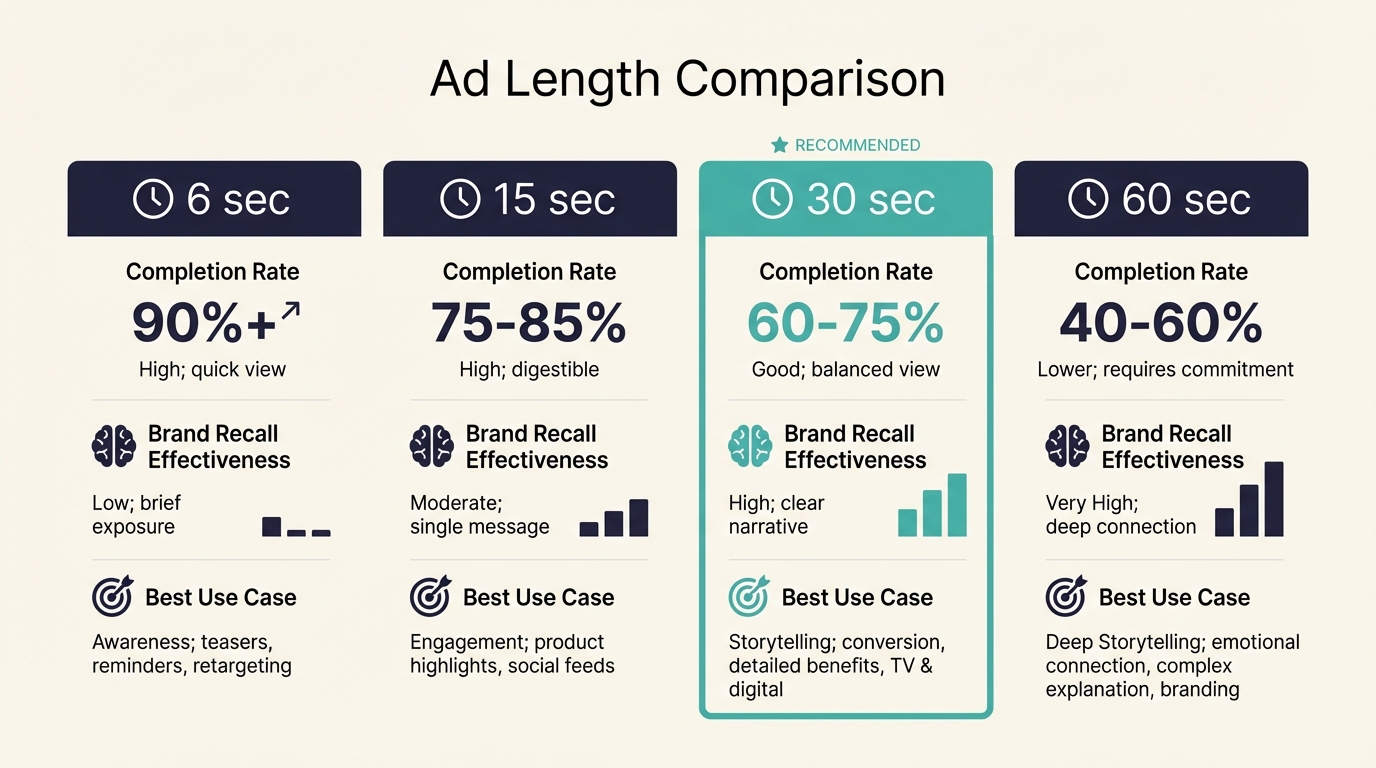
6-second bumper ads represent the shortest standard format, primarily used on digital platforms like YouTube. According to Google's research, six-second bumper ads capture 8-11% more attention per second compared to longer formats and deliver approximately 60% of the impact of a 30-second commercial. On YouTube, these ultra-short ads achieved an 82% completion rate in 2024, compared to 60% for 15-second spots. Bumper ads work best for simple, single-message campaigns, brand reminders, and retargeting efforts. However, they don't allow time for storytelling or complex value propositions.
15-second ads have become increasingly popular as advertisers seek cost efficiency. These spots work well for established brands with high awareness, simple promotional messages, or frequency-focused campaigns. The 15-second format forces creative discipline, requiring advertisers to distill their message to its essence. On CTV platforms, 15-second ads achieve 93-94% completion rates, making them highly effective for reach-focused campaigns. The format is especially popular in retail advertising, where quick promotional messages dominate.
30-second ads remain the standard length for television advertising and represent the best balance of storytelling capability and viewer attention. This duration allows time to establish a problem, present a solution, and include a call to action, the classic advertising narrative arc. Research consistently shows 30-second ads outperform shorter formats on conversion metrics. For businesses new to TV advertising, 30 seconds provides enough time to introduce your brand and value proposition without demanding excessive viewer patience.
60-second ads offer extended storytelling opportunity at premium cost. Pharmaceutical advertisers often use this format to accommodate required disclosures, though recent Innovid analysis found that even pharma ads perform better at 30 seconds on CTV platforms. The 60-second format can be effective for complex products, emotional brand stories, or tutorial-style content. However, attention research shows viewers only maintain attention for 19% of 60-second ad duration on average, suggesting diminishing returns beyond 30 seconds.
90+ second ads are rare outside specific contexts like pharmaceutical advertising or high-profile events. While these extended formats allow detailed storytelling, their premium cost and attention challenges limit practical application for most advertisers.
By platform
Commercial length considerations vary significantly across advertising platforms.
Connected TV (CTV) and streaming platforms support all standard lengths but show strongest results for 30-second ads. The non-skippable format and high-attention viewing environment mean completion rates remain strong regardless of length. However, streaming platforms often limit total ad load per break, making 30-second ads the dominant format. Platforms like Adwave focus on 30-second creative as the standard for streaming TV advertising.
Linear broadcast and cable TV traditionally accommodated varied lengths within commercial breaks, though 30-second spots dominate. Super Bowl advertising and other premium placements sometimes feature 60-second or longer spots, but standard broadcast advertising relies heavily on 30-second and 15-second combinations. Media buyers often purchase 30-second spots and receive bonus 15-second placements to extend reach.
YouTube and digital video support the widest range of lengths, from 6-second bumpers to skippable ads of any duration. The skippable nature of YouTube ads (after 5 seconds for TrueView format) means creative must capture attention immediately. Shorter formats often perform better on YouTube because viewers who stay through a complete short ad represent higher engagement than viewers who skip longer content.
Social media platforms favor shorter formats due to scrolling behavior and brief attention windows. While technically supporting longer video ads, platforms like Facebook, Instagram, and TikTok see best performance from 15-second or shorter content. The autoplay, sound-off default environment requires instant visual impact.
By industry
Different industries have developed distinct norms for commercial length based on their messaging needs and regulatory requirements.
Retail and e-commerce advertisers typically favor 15-30 second spots that quickly communicate promotions, sales, or product availability. According to MediaRadar research, nearly 60% of retail TV ad spending goes to ads between 16-30 seconds, with another third allocated to 15-second spots. The urgency-driven nature of retail messaging fits well in shorter formats.
Pharmaceutical advertising traditionally used 60-90 second formats to accommodate FDA-required risk disclosures. However, CTV-specific analysis found that 30-second pharma ads achieved 83.7% completion rates, outperforming both shorter and longer formats. This suggests viewers may engage better with more concise pharma messaging, even when disclosures are included.
Automotive advertising employs a mix of formats, with 30-second spots common for model launches and 60-second ads used for brand storytelling. The visual nature of automotive products, showing vehicle design, features, and driving experience, benefits from adequate screen time. Local dealership advertising often uses 30-second spots for promotional messaging.
Local business advertising across categories like restaurants, dental practices, and home services typically works best at 30 seconds. This length provides enough time to establish local presence, communicate key differentiators, and include contact information or calls to action.
6-second bumper ads: 60% impact of 30-second spots, 82% completion rate on YouTube
15-second ads: 75% effectiveness of 30-second ads, 93.88% CTV completion rate
30-second ads: Industry standard format, 95.92% CTV completion, 24% higher conversions
60-second ads: Extended storytelling opportunity, only 19% attention retention on average
Why it matters for your business
Choosing the right commercial length directly impacts both advertising effectiveness and budget efficiency. Understanding the tradeoffs helps businesses make informed decisions.
Cost is the most obvious consideration. On CTV platforms, you typically pay per impression regardless of ad length, but different lengths carry different CPM rates. Longer ads often command premium pricing, meaning a 30-second spot might cost 10-30% more per thousand impressions than a 15-second ad on the same inventory. For businesses with limited budgets, this difference significantly affects reach.
However, cost per impression doesn't equal cost per result. If 30-second ads generate 24% higher conversion rates as research suggests, paying a modest premium for the longer format may deliver better return on investment. A business spending $1,000 on 30-second ads generating 100 conversions achieves $10 cost per conversion. The same budget split across more 15-second impressions might generate only 80 conversions at $12.50 each, despite lower per-impression costs.
Message complexity should guide length decisions. Simple messages, such as "Sale ends Sunday" or "Now Open in Riverside," communicate effectively in 15 seconds. Complex value propositions, differentiated offerings, or emotional brand stories typically need 30 seconds to land properly. Trying to compress a complex message into too short a format creates confusion rather than clarity.
Brand awareness versus direct response objectives also matter. Awareness campaigns benefit from frequency, suggesting shorter ads that allow more impressions per budget. Direct response campaigns prioritizing immediate action often perform better with longer formats that include more persuasive content and clear calls to action.
For most small businesses exploring TV advertising, 30 seconds represents the recommended starting point. This length provides enough time to introduce your business, communicate value, and prompt action, all critical elements for businesses building awareness in local markets. Once baseline performance is established, testing 15-second variations can reveal whether shorter formats maintain effectiveness at lower cost.
How to take advantage of this trend
Making smart commercial length decisions requires matching format to objectives and testing to optimize results.
Start with 30 seconds for your primary creative. This length provides the flexibility to tell a complete story while maintaining viewer attention. Platforms like Adwave generate 30-second commercials using AI, creating broadcast-quality spots that work across all streaming platforms. The 30-second format gives you a complete creative asset that can also inform shorter versions if needed.
Consider your campaign objectives when selecting length. If you're building awareness for a new business or launching a new product, prioritize 30-second ads that allow proper introduction. If you're running promotional campaigns for an established brand, 15-second ads can efficiently communicate time-sensitive offers. Match length to message complexity.
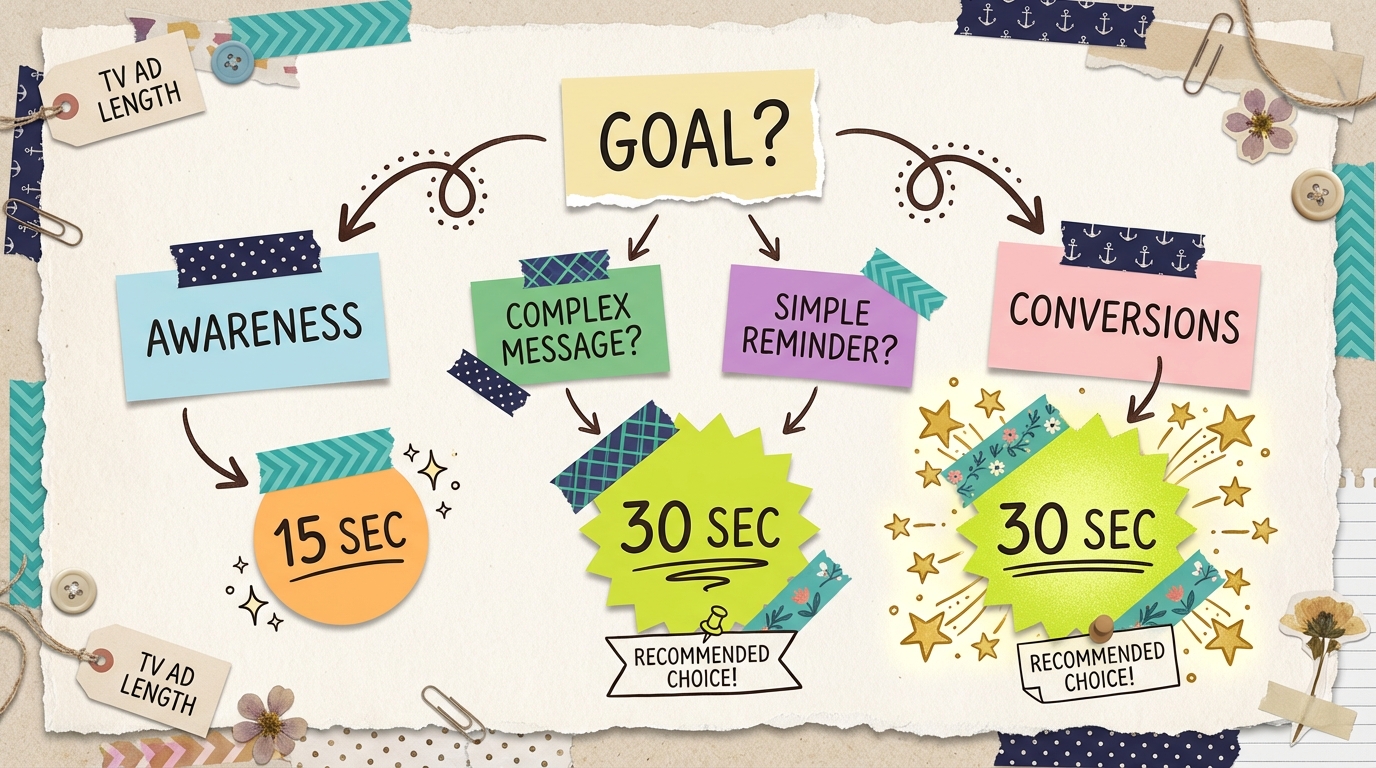
Test multiple lengths when budget allows. Many advertisers find success running both 30-second primary creative and 15-second "cutdowns" that distill the core message. The 30-second version can introduce your brand to new viewers, while 15-second spots reinforce messaging to audiences who've already been exposed. This complementary approach maximizes both depth and frequency.
Front-load your message regardless of length. Research shows attention is highest in the opening seconds of any ad. Place your brand name, key benefit, and visual identity early in the spot. Even if attention wanes, viewers should have absorbed your core message. This front-loading strategy is critical for 30-second and longer formats where attention percentage naturally declines.
Optimize creative for the format. A good 15-second ad isn't simply a trimmed version of a 30-second spot. Effective short-form creative is designed from the ground up for brevity, with single-minded focus and immediate impact. Similarly, 30-second ads should use the additional time purposefully, not simply stretch thin content. Each length requires intentional creative development.
Consider frequency alongside length. A $1,000 budget might buy either 50,000 impressions of 30-second ads or 60,000 impressions of 15-second ads (assuming typical CPM differentials). The shorter format delivers more frequency, meaning individual viewers see your ad more times. For awareness campaigns where repetition matters, this frequency advantage can outweigh per-impression effectiveness differences.
For brand awareness: 30-second spots maximize recall and memorability with complete messaging
For frequency campaigns: 15-second ads stretch budgets for more impressions and reach
For complex messaging: 30+ seconds allows fuller value proposition and storytelling
For retargeting: 15-second reminders reinforce previous awareness efficiently
The bigger picture
Evolution of TV commercial length
Television commercial lengths have evolved significantly since the medium's early days. In the 1950s and 1960s, 60-second spots dominated, giving advertisers ample time for elaborate productions. The shift toward 30-second ads began in the 1970s as broadcasters sought more inventory within fixed commercial break time. By the 1980s, 30 seconds had become the standard.
The 15-second format emerged in the late 1980s as advertisers sought cost efficiency and frequency. Cable television's proliferation created more inventory and competitive pressure on pricing. The 15-second spot offered a way to maintain presence at lower per-spot cost, especially for reminder advertising and promotional messages.
Digital video introduced even shorter formats. YouTube's 6-second bumper ads, launched in 2016, pushed the boundaries of how quickly brands could communicate. While some questioned whether meaningful advertising could occur in six seconds, research validated the format's ability to drive recall and complement longer campaigns.
The streaming era has somewhat standardized around 30 seconds. CTV platforms typically build commercial pods around 30-second ad units, and the non-skippable, lean-back viewing environment makes viewers more tolerant of this length than on digital platforms. While 15-second and shorter formats exist on streaming, the 30-second spot has re-emerged as the default.
Attention economy implications
The broader attention economy context shapes commercial length effectiveness. Viewers today encounter thousands of advertising messages daily across platforms, creating competition for limited attention. This environment favors clear, concise messaging that respects viewer time.
However, research suggests the "shortening attention spans" narrative may be overstated for television viewing. TVision data shows that initial attention capture is consistent across ad lengths, with approximately one-third of viewers paying attention regardless of whether an ad is 15 or 60 seconds. The viewing environment, not the ad length, primarily determines attention availability.
The shift toward streaming may favor longer formats compared to digital video. Streaming viewers are in a "lean-back" mode, expecting commercial interruptions similar to traditional TV. This mindset differs from the "lean-forward" digital environment where viewers are actively scrolling and seeking content. The streaming context creates space for 30-second storytelling that might struggle on social platforms.
Future format trends
Industry observers anticipate continued evolution in commercial formats. Interactive CTV ads, which allow viewers to engage via remote control or QR codes, may justify longer formats as engagement rather than passive viewing becomes the goal. These interactive experiences require time for viewers to understand and act on participation opportunities.
Shoppable TV ads represent another evolution. As streaming platforms enable direct purchase from ads, commercial length may need to accommodate product demonstration, pricing information, and purchase prompts. The transactional nature of shoppable ads could favor formats that provide adequate consideration time.
Personalization technology may eventually enable variable-length delivery based on viewer data. An interested viewer might see an extended version while a less-engaged viewer receives a compressed message. While technically feasible, widespread implementation of dynamic ad length remains years away.
What experts are saying
Advertising professionals and researchers have weighed in on optimal commercial length based on evidence and experience.
Media strategists increasingly advocate for portfolio approaches rather than single-length commitments. The consensus view holds that different objectives warrant different lengths, and advertisers benefit from having multiple creative lengths available for different campaign phases and platforms.
Creative directors emphasize that good advertising at any length requires intentional design for that format. A 15-second spot should be conceived as a 15-second spot, not derived from longer content. Similarly, 30-second ads should use their additional time purposefully. Length choice comes first, then creative development follows.
Research analysts point to the diminishing returns beyond 30 seconds as a key finding. While 60-second and longer ads can serve specific purposes, they don't proportionally increase effectiveness. Much of an ad's impact is delivered in the initial seconds, meaning extended formats face declining efficiency.
Small business advertising advocates highlight 30 seconds as the entry point for television advertising. This length provides adequate time for businesses to introduce themselves while remaining cost-effective. Shorter formats work better for established brands with existing awareness, not new advertisers building recognition.
Common questions answered
What is the best length for a TV commercial?
For most advertisers, 30 seconds is the optimal TV commercial length. This duration achieves the highest completion rates on CTV platforms (approximately 96%), delivers strong conversion performance (24% higher than 15-second ads according to research), and provides adequate time for storytelling and calls to action. While 15-second ads can be effective for simple messages or high-frequency campaigns, 30 seconds represents the best balance of impact and efficiency for general advertising purposes.
Are 15-second commercials effective?
Yes, 15-second commercials are effective, delivering approximately 75-80% of the brand recall and attention generation of 30-second ads according to research. They achieve high completion rates on CTV platforms (93-94%) and can drive significant site visits. However, they generate lower conversion rates than 30-second spots and offer less time for storytelling. 15-second ads work best for established brands, simple promotional messages, or frequency-focused campaigns rather than brand introduction.
How long are Super Bowl commercials?
Super Bowl commercials are typically 30 or 60 seconds, with some advertisers purchasing extended 90-second or even longer slots for premium creative. The 30-second Super Bowl spot remains most common, costing approximately $7 million in 2024. Some brands invest in longer formats to create memorable, shareable content that generates conversation beyond the game broadcast. The high-attention Super Bowl environment can justify longer formats that might underperform in normal advertising contexts.
Do shorter ads have higher completion rates?
On CTV platforms, longer ads have slightly higher completion rates because they're non-skippable. 30-second CTV ads complete at approximately 96% versus 94% for 15-second ads. On skippable digital platforms, shorter ads do show higher completion rates since viewers have less time to skip. YouTube bumper ads (6 seconds) achieve 82% completion versus 60% for 15-second skippable ads. The platform's skip behavior determines whether length impacts completion.
What length should small businesses use for TV ads?
Small businesses should start with 30-second TV commercials. This length provides adequate time to introduce your business, communicate your value proposition, and include a call to action. It's important for businesses building awareness to use enough time to make an impression. Platforms like Adwave generate 30-second commercials that achieve broadcast-quality results. Once baseline performance is established, testing 15-second variations can reveal whether shorter formats maintain effectiveness for your specific audience.
How much does commercial length affect CPM?
Commercial length typically affects CPM by 10-30%, with longer ads commanding higher rates. On streaming platforms, a 30-second ad might have a CPM of $25-35, while 15-second ads on the same inventory might cost $20-28 CPM. However, the relationship between CPM and cost-per-result depends on conversion performance. If longer ads convert better, the higher CPM may still deliver better ROI. Evaluate total campaign economics rather than CPM alone.
Supporting data
Additional context on TV commercial length effectiveness:
30-second CTV ad completion rate: 95.92% (Adwave)
15-second CTV ad completion rate: 93.88% (Adwave)
15-second ad effectiveness vs 30-second: 75-80% of recall (Journal of Advertising Research)
30-second ads conversion advantage: 24% higher than 15-second (Mountain Research)
15-second ads site visit advantage: 46% more than 30-second (Mountain Research)
Attention share for 15-second ads: 48% of duration (TVision)
Attention share for 30-second ads: 36% of duration (TVision)
Attention share for 60-second ads: 19% of duration (TVision)
6-second bumper ad completion rate: 82% (Google)
6-second bumper impact vs 30-second: ~60% (IAB)
Pharma 30-second CTV completion rate: 83.7% (Innovid)
All sources linked above. Data current as of September 2025.
Get started with 30-second TV commercials
Ready to create your TV commercial? The 30-second format offers the ideal balance of storytelling power and viewer engagement, and getting started has never been easier.
Adwave creates professional 30-second commercials using AI, generating broadcast-quality spots from your website or social media in just minutes. No production crew, no expensive shoots, and no weeks of waiting. Target viewers in your local market, set your budget starting at just $50, and launch your campaign across 100+ premium streaming platforms.