AI video generation went from a research demo to a production tool in about 18 months. Here's the short version: the AI video generator market sits somewhere between $716 million and $947 million heading into 2026, generation times have collapsed from minutes to seconds, a single Google product logged over 275 million generated videos in five months, and roughly 63% of video marketers now use AI to help make their videos. This post rounds up the numbers on the production side of AI video, the technology that creates the footage, and every figure here is sourced and dated below.
If you want the broader market and audience picture, see our AI video statistics 2026 roundup. If you care specifically about ad performance, see AI video ad statistics 2026. This one is about generation itself: how fast, how much, which models, and who's using them.
Market size: how big AI video generation is
The first thing to know about AI video generation market numbers is that they disagree, sometimes wildly, and the reason is scope. A "market size" for AI video depends entirely on what you count. Pure text-to-video generation is one number. Add editing, captioning, and avatar tools and it's a much bigger one.
Here's what the major research firms report for 2026:
The narrow AI video generator market (generation-focused tools) is valued at roughly $946.4 million in 2026, per Fortune Business Insights. A separate estimate put the 2025 figure at $716 million, projected to reach $3.35 billion by 2034 at an 18.8% CAGR.
Widen the definition to include AI video editing, captioning, and avatars, and Meticulous Research pegs the market at $3.67 billion in 2026, growing to $24.89 billion by 2036 at a 21.4% CAGR.
At the broadest scope, one forecast puts the market at $1.81 billion in 2026, reaching $21.61 billion by 2034 at a 46.0% CAGR.
Even the conservative numbers agree on direction: this is one of the fastest-growing software categories anywhere, with CAGRs ranging from roughly 19% to 46% depending on scope. For context, North America holds about 41% of global market share, followed by Europe at 23.1% and Asia-Pacific at 20.9%, per Grand View Research and related market reports.
Generation speed: from minutes to seconds
Speed is where the last two years show up most dramatically. This is the metric that turned AI video from a novelty into something people build workflows around.
Here's the trajectory reported by benchmark trackers and vendor data:
In 2024, text-to-video generation typically took 2 to 10 minutes per clip.
By Q1-Q2 2025, generation times dropped to roughly 30 seconds to 2 minutes per clip.
By Q3-Q4 2025, near-real-time generation emerged, with 5 to 15 seconds for many operations.
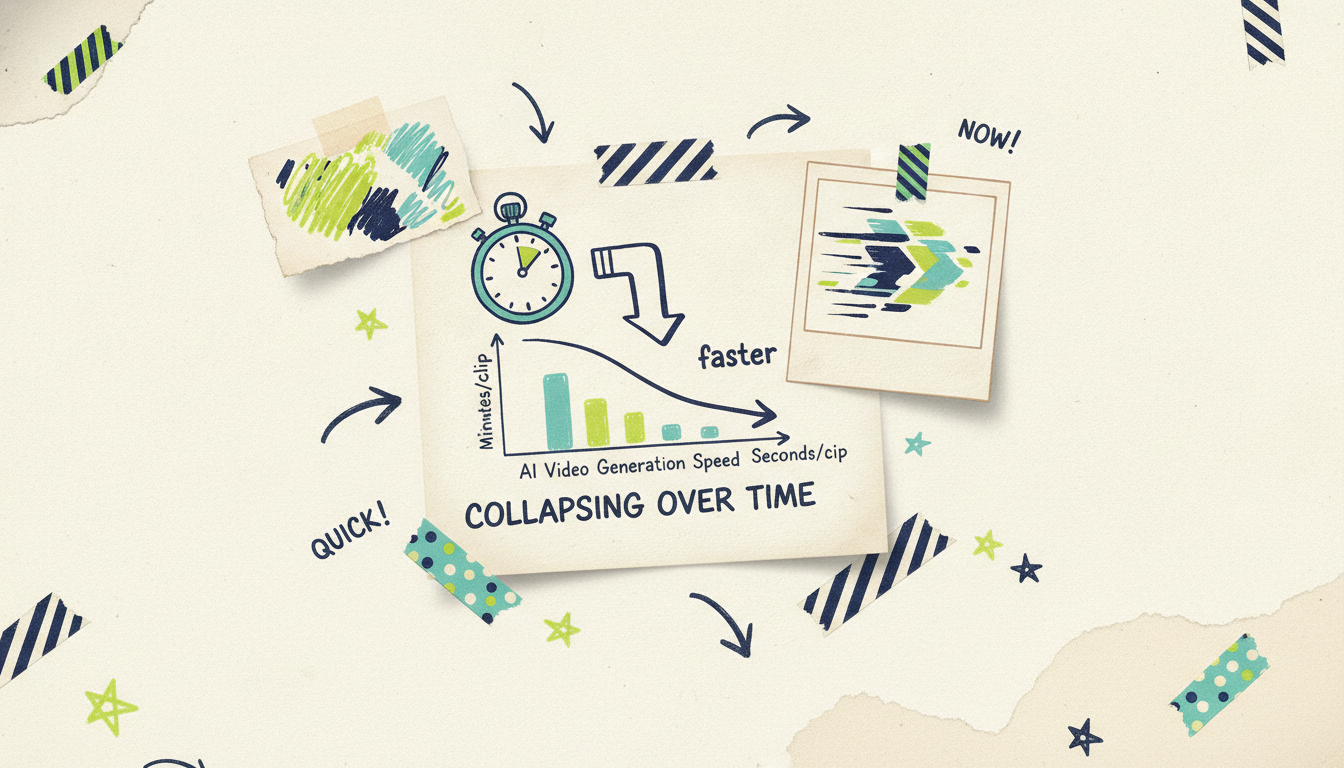
Put those numbers next to traditional production and the gap is enormous. One analysis found the average time to produce a 60-second marketing video dropped from 13 days to 27 minutes when teams switched to AI tools. That's not a 2x improvement; it's roughly a 700x compression of the timeline.
The catch worth naming: raw model speed and finished-video speed aren't the same thing. A foundation model can spit out a 5-second clip in 10 seconds, but a clip isn't a video. A real video needs a script, multiple scenes stitched together, a voiceover, music, and a quality check. That end-to-end pipeline is where finished-video tools spend their time. Wavemaker, for example, produces a complete video (script, generated visuals, voiceover, BPM-aware music, and an AI vision QC pass) in 2 to 5 minutes for most videos, which is a different job than generating one raw clip.
To remember: when you read a "generates video in seconds" headline, check whether they mean a clip or a finished piece. It's usually a clip.
Volume and scale: how much AI video is being made
Speed only matters if people use it, and the volume numbers from 2025 are the clearest sign that they did.
The standout figure comes from Google. Its AI filmmaking tool Flow, powered by the Veo model family, reported over 275 million videos generated in roughly five months, per Google's October 2025 announcement. To trace the ramp: Google said Veo 3 users had created over 40 million videos by July 2025, just weeks after the model launched at Google I/O in May 2025. Getting from 40 million to 275 million in about a quarter tells you how steep the adoption curve was.
On the consumer app side, the numbers are just as striking, if more volatile:
OpenAI's Sora app spent 20 days at the top of the U.S. App Store after its September 2025 launch and hit 1 million downloads faster than ChatGPT did, reaching roughly 3 million daily active users on mobile at peak, per a16z.
Counting all AI video platforms, monthly active users surpassed 124 million in January 2026.
The volatility matters too. Sora's downloads dropped 66% from their November 2025 peak by April 2026, and OpenAI discontinued the standalone Sora consumer app and sora.com on April 26, 2026. Novelty spikes fast and fades fast; sustained use tends to live in tools that fit into an actual workflow rather than a viral feed.
There's a useful pattern buried in these numbers. The apps that spiked hardest (a viral video feed you scroll and share) also fell fastest, while the tools that quietly climbed (a filmmaking utility people open to make something specific) kept growing. Google Labs rising from #36 to #25 in a16z's rankings on the back of Veo happened without a viral-app moment. Generation volume that comes from people getting work done is stickier than generation volume that comes from a novelty feed. That distinction is worth keeping in mind whenever you see a huge single-month download or usage figure: ask whether it's a spike or a base.
Which models people use
Not all generation models get used equally, and 2025-2026 saw fast consolidation at the top.
Per Artificial Analysis's State of Generative Media Survey (Q3 2025), Google's models were the most popular choices among respondents, Gemini for image and Veo for video. More recent model-usage data shows even sharper concentration: one 2026 tracker reported Google's Veo 3.1 at 96.4% market share of video generations measured, with OpenAI's Sora 2 at 2.0%. Treat that specific split as a snapshot of one measurement window rather than a permanent order, since model leadership in this space flips with every major release.
A few other findings from the generation-model side:
On raw output quality through much of 2025, Chinese-developed models (Kling AI, Hailuo, Pixverse) consistently led, per a16z's Top 100 Gen AI Consumer Apps. Veo 3 was described as the first US model to close that gap, and it drove enough traffic to lift Google Labs from #36 to #25 in a16z's web rankings.
Quality is the #1 model-selection factor for both personal and organizational users, per Artificial Analysis. Cost is the critical factor specifically for teams choosing video generation APIs.
The takeaway for anyone building on top of these models: the leaderboard is real but temporary. Tools that lock themselves to a single model inherit that model's ups and downs. Wavemaker uses multi-provider fallback throughout its generation pipeline for exactly this reason, so a single model's bad day doesn't become your bad day.
Compute and cost: the economics of generating video
AI video is cheap to buy and expensive to run, and the gap between those two facts drove some of the biggest stories of 2025.
Start with what generation costs at the model level. Runway's Gen-3 Alpha ran about 10 to 12 credits per second of generated video, or roughly $0.10 to $0.12 per second at published credit prices, with the faster Turbo mode around $0.05 per second. That sounds trivial until you multiply it by millions of users generating clips they'll mostly discard.
The clearest illustration of the underlying compute cost came from Sora. At peak usage, the app reportedly burned an estimated $15 million per day in inference costs, while each standard 10-second clip cost roughly $1.30 in compute to generate. Sora generated about $2.1 million in total lifetime revenue against that burn, which is a big part of why the standalone consumer app was shut down in April 2026. Generation is expensive to serve; the price you pay rarely reflects the full compute bill behind it.
Now compare that to traditional production, where AI's cost advantage is the whole point:
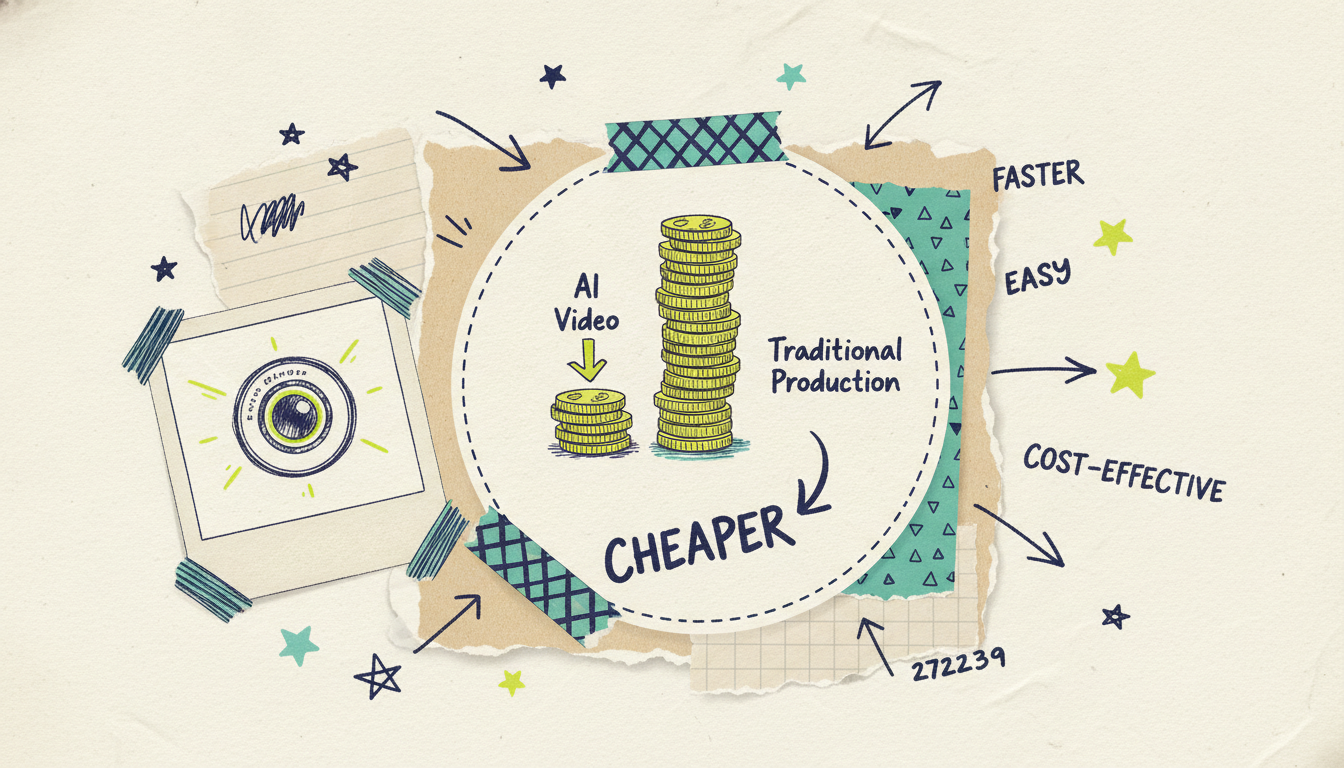
AI video reduces per-video cost by roughly 70% to 90% versus traditional production by cutting crew, equipment, and studio expense, per multiple 2025-2026 cost analyses.
One breakdown put AI video at $0.50 to $30 per minute against traditional production's $1,000 to $50,000 per minute.
Another found production costs dropped 91%, from about $4,500 per minute to roughly $400 per minute.
Here's the honest framing: those savings are real for the content types where AI excels, and overstated for the ones where it doesn't. A generated explainer or product promo can hit 90% savings. A nuanced brand film with real actors still belongs on a set. Match the tool to the job and the economics work.
Quality benchmarks: how good is generated video now
Speed and cost only matter if the output holds up. On quality, 2025-2026 data tells a split story: still frames got scary-good, motion is still the tell.
A few reference points from research and benchmark work:
On static, single-frame quality, some 2025 analyses reported 95%+ of viewers unable to reliably identify high-end AI stills as AI-generated. Photorealism at the frame level is largely a solved problem for the top models.
Motion is where it breaks down. A 2025 study reported viewers correctly identified AI-generated motion about 83% of the time based on movement alone, even when individual frames looked real. Temporal consistency (how objects move and hold together from frame to frame) remains the hardest part of generation.
Formal benchmarks like Video-Bench have emerged specifically to score generation on human-aligned quality dimensions rather than pixel similarity, a sign the field is maturing from "does it look like a video" to "does it look right."
Here's the practical read: the quality gap isn't about resolution anymore, it's about coherence. A generated product shot can look flawless. A generated 30-second scene with people walking and talking is where artifacts creep in. That's exactly why finished-video tools add a review step. Wavemaker runs an AI vision QC pass over its output to catch the coherence problems raw generation still produces, which is a different quality guarantee than "the model rendered something."
Clip length and resolution trends
Two specs shaped what generation could do in 2025-2026: how long a single clip can run, and at what resolution. Both moved fast, and both come with tradeoffs.
On length:
Most single-pass generation in 2026 produces clips of 5 to 120 seconds depending on platform and settings, with the 5-to-30-second range as the practical sweet spot for high quality.
Google's Veo 3 topped out around a 6-to-8-second native clip, on the shorter end. Kling caps a single generation near 10 seconds but can extend to roughly 3 minutes total via a stitching feature.
A mid-2025 breakthrough pushed some platforms past the 60-second single-clip mark, an eightfold jump over the old ~8-second ceiling.
On resolution:
Free and standard tiers commonly generate at 720p to 768p, with paid tiers reaching 1080p. Native 4K single-pass generation remained limited through 2026, with wider availability expected around 2027.
There's a direct duration-versus-resolution tradeoff: pushing to 4K typically shrinks the length you can generate in a single pass compared to 720p.
The takeaway for anyone planning real projects: don't assume one long, high-res clip. The reliable pattern is generating multiple shorter, coherent clips and assembling them into a finished piece, which again is the job a full pipeline does rather than a single model call. Wavemaker exports up to 4K on paid tiers and builds videos from multiple generated scenes rather than betting everything on one long generation.
Creator and enterprise adoption
The demand side rounds out the picture. Adoption of generation tools split into two lanes in 2025-2026: everyday creators making volume content, and enterprises folding AI into real workflows.
On the creator and marketing side:
63% of video marketers used AI tools to help create or edit videos, up from 51% the prior year, per Wyzowl's 2026 data. (Different reports cite figures from 41% to 84% depending on how they define "AI use," so read the methodology before quoting a single number.)
91% of businesses use video marketing in 2026, and 82% of video marketers report a good ROI from video, per Wyzowl.
On the enterprise side:
72% of organizations now use generative AI in at least one business function, and 88% use AI somewhere in the business, per McKinsey-cited industry roundups.
Among organizations using generative media specifically, 65% reported ROI inside 12 months, per Artificial Analysis's Q3 2025 survey.
Depth still lags breadth: an estimated 62% of companies remain in experimenting or piloting phases, with only about 7% having fully scaled AI throughout the enterprise.
That last stat is the honest counterweight to all the excitement. Lots of teams are trying AI video generation; far fewer have operationalized it. The gap between "we experimented" and "this is how we make video now" is where most of the real opportunity still sits, and it's mostly a workflow problem, not a technology one. The models are ready. Most production pipelines aren't built to use them yet.
What the numbers mean for how you make video
Pull the threads together and a clear picture emerges for 2026:
Speed is solved for most use cases. Finished videos in minutes is now normal, not remarkable.
Volume proves demand. Hundreds of millions of generated videos in months is real behavior, not hype.
Model leadership is fluid. Betting your workflow on one model is riskier than it looks.
The economics favor AI for the content types it handles well, with 70-90% cost cuts that hold up in practice.
Adoption is wide but shallow. The teams that move from piloting to production win the timing.
The strategic read: the generation layer is commoditizing fast. Raw clip generation gets cheaper and faster every quarter. The durable value is moving up the stack, to tools that turn generation into finished, useful videos and then help you do something with them. A clip is an input. A finished video you can publish is an outcome.
That's the thinking behind Wavemaker. Instead of handing you a raw clip, it runs the full production pipeline (research, script, generated visuals with subject consistency, AI voiceover, music, and a vision QC pass) and hands you a finished video in a few minutes. And when the video's ready, you can push it further than an MP4 export: through Adwave, a finished Wavemaker video can run as a real streaming TV commercial on 100+ networks from $50, alongside Google, YouTube, Meta, and Reddit. The generation stats above describe the raw material. What you build with it is the part that matters.
Common questions answered
How big is the AI video generation market in 2026? It depends on scope. The narrow AI video generator market is valued at roughly $946 million in 2026 per Fortune Business Insights, while broader definitions that include editing and avatars reach $3.67 billion (Meticulous Research). All major forecasts agree the category is growing fast, with CAGRs between roughly 19% and 46%.
How fast can AI generate video now? Raw clip generation dropped from 2-10 minutes in 2024 to 5-15 seconds for many operations by late 2025. Finished videos (with script, voiceover, music, and multiple scenes) take longer, typically a few minutes end to end. Wavemaker produces a complete video in 2 to 5 minutes for most projects.
How many AI videos are being generated? Google's Flow tool alone reported over 275 million videos generated in about five months (as of October 2025), up from 40 million in July 2025. Counting all AI video platforms, monthly active users surpassed 124 million by January 2026.
Which AI video model is most used? Google's Veo family led usage through 2025 and into 2026, with one 2026 tracker reporting Veo 3.1 at 96.4% of measured video generations and Sora 2 at 2.0%. Rankings shift with every major model release, so treat any single figure as a snapshot.
Is AI video cheaper than traditional production? For the content types AI handles well, yes, with reported savings of 70% to 90%. One analysis found production costs dropping 91%, from about $4,500 per minute to roughly $400 per minute. High-end brand films with live actors still favor traditional production.
How many businesses use AI to make video? About 63% of video marketers used AI to help create or edit videos in 2026, up from 51% the year before (Wyzowl). On the enterprise side, 72% of organizations use generative AI in at least one function, though only about 7% have fully scaled it.
Want to see finished AI video generation for yourself? Create your first video free with Wavemaker (75 credits, enough for your first video). Type an idea, paste a URL, or upload a document, and get a complete video back in minutes.