Here's the short version if you're in a hurry: AI video creation went mainstream in 2026. A majority of video marketers (63%) now use AI tools to help make or edit videos, up from 51% a year earlier (Wyzowl, 2026). The market behind those tools was worth roughly $788.5 million in 2025 and is projected to more than quadruple by 2033 (Grand View Research). And AI can cut per-video production cost by 70 to 90% versus traditional shoots. But adoption came with a catch, and the data shows it plainly: more teams making video pulled average ROI satisfaction down, and consumers still trust real people on screen more than machines.
Below is a roundup of the AI video creation statistics worth citing in 2026, organized by theme, each with a source you can check. If a number isn't sourced, we left it out. This is a general look at AI video creation across adoption, market size, cost, quality, and creator usage. For the ad-specific cut of the data, see our AI video ad statistics roundup, and for the underlying models and generation tech, see our AI video generation statistics breakdown.
Adoption: AI video creation crossed the majority line
The headline story of 2026 is that using AI to make video stopped being an experiment and became normal practice.
Stat callout: 63% of video marketers used AI tools to help create or edit marketing videos in 2026, up from 51% in 2025, a 12-point jump in a single year. Source: Wyzowl, Video Marketing Statistics 2026.
That 12-point year-over-year jump was the single fastest-growing trend Wyzowl tracked in its 12th annual survey. For context, 91% of businesses now use video as a marketing tool, matching an all-time high (Wyzowl, 2026). So AI adoption is spreading across a base that already treats video as essential, not optional.
The pattern holds beyond video specialists. Among social media marketers broadly, 94% report using AI somewhere in their workflow, most often for ideation, writing captions, and generating images (SocialPilot, 2026). Video is simply the newest and fastest-moving corner of a wider shift.
About that adoption curve: it's not slowing. Wyzowl expects the AI-in-video number to keep climbing "as video creation with AI continues to mature." When a tool goes from half the market to nearly two-thirds in twelve months, the direction is clear.
It helps to put the 63% figure in context against how quickly this happened. Two years earlier, AI-assisted video was a niche experiment most teams hadn't tried. The jump from 51% to 63% in a single reporting cycle means the fence-sitters moved in a group, which is usually what you see right before a technology becomes table stakes rather than an edge. Spending intentions back that up: 92% of marketers plan to spend the same or more on video in 2026 (Wyzowl, 2026), so the budget to feed AI video tools is there and holding.
One clarification worth making when you cite these numbers: "used AI to create or edit video" is a wide door. It counts everything from AI captioning and clipping to full text-to-video generation. The 63% figure measures how many teams have touched AI somewhere in the video workflow, not how many generate finished videos end to end. That distinction matters when you compare it against the narrower market-size figures below, which count dedicated AI video generator tools.
Market size: a small-but-fast-growing category
The money following AI video is real, and it's compounding quickly. Estimates vary by research firm and by exactly how each one draws the category line, so we've pulled several so you can see the spread.
Stat callout: The AI video generator market was valued at roughly $788.5 million in 2025 and is projected to reach about $3.44 billion by 2033, a CAGR of 20.3%. Source: Grand View Research.
Zoom out to the broader generative-AI models that power video, and the numbers get much larger. Grand View Research values the image and video generative-models segment at about $6.0 billion in 2025, growing at a 38.9% CAGR toward roughly $79 billion by 2033 (Grand View Research). The difference between that figure and the "AI video generator" figure is scope: the smaller number counts the finished-product tools, the larger one counts the underlying model layer that also feeds images and other media.
For the widest frame, the overall generative-AI market sat at roughly $37.89 billion in 2025 and is forecast to reach about $1.2 trillion by 2035 at a 36.97% CAGR (Precedence Research). Grand View Research, using a different methodology, pegs the total generative-AI market at $22.2 billion in 2025 rising to $324.7 billion by 2033 at a 40.8% CAGR (Grand View Research).
Why do the estimates diverge so much? Two reasons. First, category boundaries: a "dedicated AI video generator" is a much smaller universe than "all models capable of generating images and video," which in turn is smaller than "the entire generative-AI economy." Second, timing and methodology differ between firms, so base years and forecast horizons don't line up. When you're building a slide or a citation, pick the segment that matches your point, and say which one it is. Quoting the trillion-dollar total generative-AI figure to describe the AI video tool market, for example, would overstate the case by orders of magnitude.
The consistent signal across every one of these reports is direction and speed. Even the most conservative forecast here, the AI video generator market at a 20.3% CAGR, implies the category more than quadruples inside a decade. That's fast enough that the tools, pricing, and capabilities you're evaluating today will look very different in a couple of years, which is one more reason quality and workflow matter more than any single feature snapshot.
Cost and time: the economics that drove adoption
If you want to understand why adoption spiked, follow the cost curve. AI didn't just make video faster; it changed the unit economics enough to make video affordable for teams and individuals who could never afford a crew.
Stat callout: AI video platforms reduce per-video costs by 70 to 90% versus traditional production by cutting crew, equipment, and studio expenses. Source: Magic Hour.
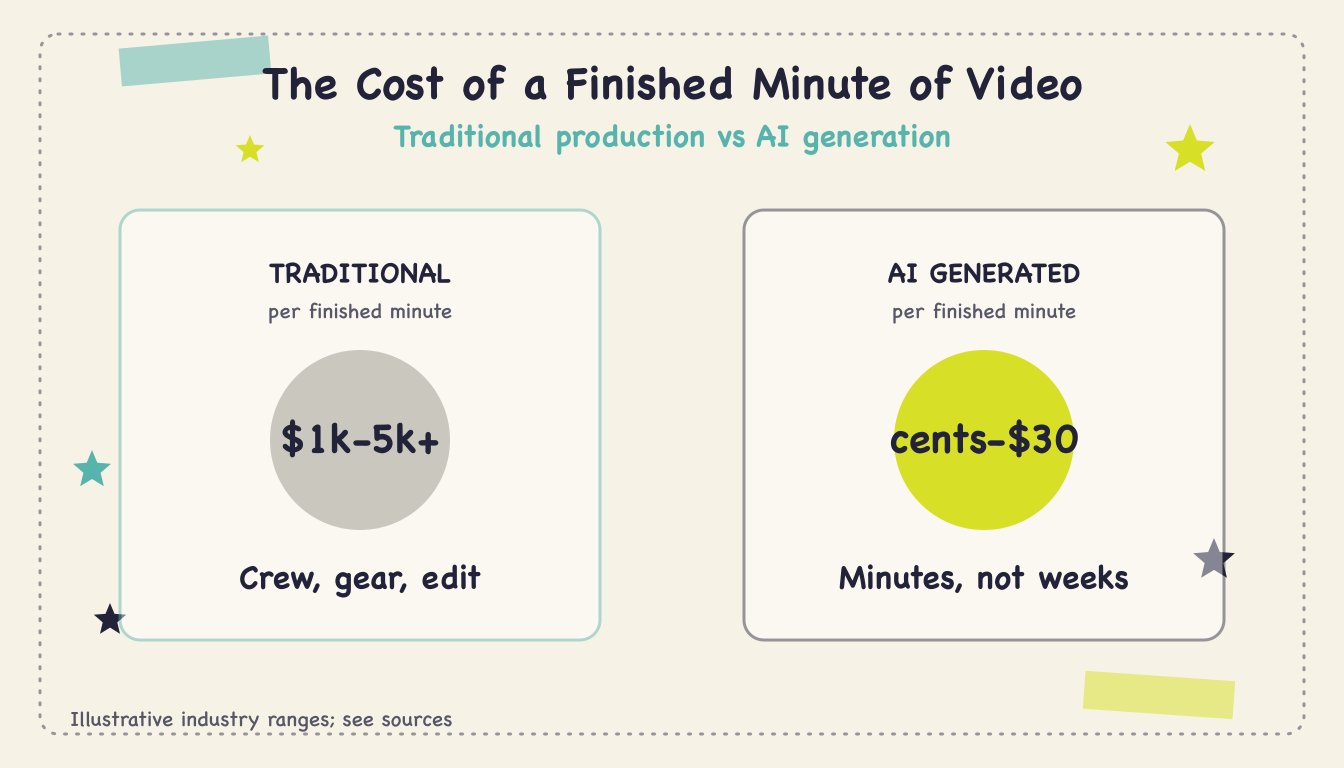
The per-minute gap is stark. Reported AI video generation costs run roughly $0.50 to $30 per minute depending on platform and quality, while freelance production runs $1,000 to $5,000 per minute and agency production starts around $15,000 per minute for complex work (Magic Hour, 2026). Even accounting for the fact that AI and human production aren't always doing the same job, the order-of-magnitude difference is the story.
Time compresses just as sharply. AI tools cut video production time by roughly 80%, turning timelines that ran weeks into hours (Magic Hour, 2026). And the savings show up on the books: companies adopting AI content tools reported an average 25.6% reduction in cost-per-piece, per the Content Marketing Institute's 2025 research (cited via OpusClip).
One caveat worth keeping honest: the cheapest AI comparisons and the most expensive agency comparisons aren't always producing the same output. A $15,000-per-minute agency shoot buys a director, on-camera talent, location, and a level of polish that a bargain AI clip won't match. The fair read of the data isn't "AI is 99% cheaper at identical quality," it's "AI collapses the cost floor for good-enough-to-great video, so the range of who can afford to make video expands dramatically." That's still a massive shift, and it's the honest version of the story.
Let's break down what that means in practice. When a task that used to demand a budget line and a two-week calendar hold becomes a same-day, low-cost job, the volume of video a team produces goes up. That's exactly what the adoption numbers show, and it sets up the tension in the next section.
Quality and trust: the tension nobody planned for
Cheaper and faster is only half the picture. The 2026 data surfaced a quality problem that came directly from the adoption boom, and it's the most important nuance in this entire roundup.
Stat callout: Marketer ROI satisfaction with video fell from 93% in 2025 to 82% in 2026, an 11-point drop, even as adoption climbed. Source: Wyzowl, 2026.
That drop is counterintuitive until you connect it to volume. More teams producing video means more teams producing mediocre video, which pulls the average down. The constraint in 2026 wasn't cost anymore. It was on-brand quality at scale. Producing a video got easy; producing a good, consistent one at volume stayed hard.
Consumers feel the shift too. Animoto's State of Video 2026 report (460 U.S. participants, surveyed September 2025) found that 78% of consumers trust videos featuring real people more than AI-generated content, and 82% say they've watched videos they believed were AI-generated (Animoto, via StudyFinds). Among people who spotted AI content, 36% said it lowered their trust in the brand behind it (Animoto).
There's a perception gap on top of that. A 2026 study found 65% of U.S. adults are somewhat or very uncomfortable with using generative AI to create ads, while only about 45% of Gen Z and millennial consumers feel positive about AI-generated ads (MarketingProfs, 2026). The gap between what ad executives assume consumers feel and what consumers feel widened to 37 points.
This cuts in favor of tools that do a full production job well, not tools that spit out obvious, generic clips. Quality is the differentiator now that cost has been solved.
Creators and marketers: who's using it
Adoption isn't just an enterprise-marketing story. Independent creators moved even faster, because for them the cost and speed gains are existential.
Stat callout: Over 70% of YouTube creators now use AI tools somewhere in their workflow, and more than half of new creators launching in 2025 used AI video tools to get started. Source: PodcastVideos, 2025.
Platforms are pouring fuel on this. In September 2025, YouTube rolled out an expanded AI creation suite, including Google DeepMind's Veo 3 Fast inside Shorts for generating video backgrounds and clips, plus an AI "creative partner" called Ask Studio (blog.youtube). When the largest video platform on earth ships free AI generation to its creators, adoption compounds fast.
On the marketing side, the ad world tells the same story with harder numbers. Per the IAB's 2025 Digital Video Ad Spend & Strategy Report (released July 15, 2025), 86% of buyers are using or plan to use generative AI to build video ad creative, and about half of advertisers were already actively using it (IAB). The IAB found genAI touched 22% of video ad creative in 2024 and projected that share to reach roughly 39 to 40% by 2026 (eMarketer, citing IAB).
One detail matters for smaller players: adoption skews toward smaller and mid-tier brands, which expect genAI to build about 45% of their video versus around 36% for the largest brands (IAB). The affordability and speed advantages land hardest where budgets are tightest. That's the same reason AI video creation matters for anyone without an agency on retainer.
Formats: short-form is where AI video lives
Where does all this AI-made video go? Overwhelmingly, into short, snackable formats built for social feeds. That matters for anyone deciding what to make, because the format that performs is also the format AI is best at producing quickly.
Stat callout: 85% of marketers believe short-form video is the most effective social media content format, and 57% of those already using it plan to increase investment. Source: Loopex Digital, 2026.
Length is part of the story. 71% of marketers rate the 30-second to two-minute window as the most effective range for marketing video, with platform sweet spots landing around 21 to 34 seconds on TikTok, 30 to 60 seconds on YouTube Shorts, and 30 to 90 seconds on LinkedIn (Loopex Digital, 2026). Those are short enough that a full AI production run, script through music, fits comfortably inside a coffee break.
Short-form also converts. Reporting compiled for 2026 found that 64% of consumers are more likely to buy after watching short-form content, and short-form ads deliver about 1.6 times the ROI of static ads (Loopex Digital, 2026). When the highest-performing format is also the fastest and cheapest to generate, the incentive to make more of it is obvious, which loops right back to the volume-and-quality tension above.
Here's the practical takeaway: the winning play in 2026 isn't making one long hero video, it's producing a steady stream of short, on-brand videos, each tuned to a platform. That's a volume game, and volume is exactly where AI creation earns its keep, as long as quality holds.
What the 2026 numbers add up to
Put the themes side by side and a clear picture forms. Adoption is past the majority line and still climbing. The market is small in absolute terms but growing 20 to 40% a year. Costs fell far enough to democratize video production. And the new frontier isn't access, it's quality and trust.
For creators, marketers, and business owners, the practical read is this: the question stopped being "should I use AI to make video?" and became "how do I make AI video that's good?" The tools that win from here are the ones that produce finished, on-brand, human-feeling video, not raw clips or generic slideshows.
That's the gap Wavemaker was built to close. Instead of handing you a clip to edit, Wavemaker runs the whole production, script, AI storyboard, generated visuals, voiceover, BPM-aware music, and an AI vision quality-control pass, from a single prompt, URL, document, or image. You refine it by chatting ("make the intro longer," "swap the music"), no timeline required. A finished video in minutes, exportable up to 4K on paid plans.
And when the video's ready, you're not stuck at the MP4 export like every other tool. A finished Wavemaker video can run as a real streaming TV commercial on 100+ networks through Adwave, from $50, alongside Google, YouTube, Meta, and Reddit. That's the part of the story the statistics above don't cover yet, because no other AI video creator can do it.
Common questions answered
How many marketers use AI to create video in 2026? According to Wyzowl's 2026 survey, 63% of video marketers used AI tools to help create or edit marketing videos, up from 51% the year before. That 12-point year-over-year jump was the fastest-growing trend in the survey, and Wyzowl expects the number to keep rising as the tools mature.
How big is the AI video market? Grand View Research valued the AI video generator market at about $788.5 million in 2025, projecting roughly $3.44 billion by 2033 at a 20.3% CAGR. Broader segments run larger: the image and video generative-models category was worth about $6.0 billion in 2025, and the total generative-AI market ranged from $22.2 billion to $37.89 billion in 2025 depending on the research firm.
How much cheaper is AI video than traditional production? AI video platforms cut per-video costs by roughly 70 to 90% by eliminating crew, equipment, and studio expenses. On a per-minute basis, AI generation reportedly runs $0.50 to $30 versus $1,000 to $5,000 for freelance production and $15,000-plus for complex agency work. Production time drops by around 80%, turning weeks into hours.
Do consumers trust AI-generated video? Not as much as video with real people. Animoto's State of Video 2026 report found 78% of consumers trust videos featuring real people more than AI-generated content, and 36% of those who spotted AI content said it lowered their trust in the brand. A separate 2026 study found 65% of U.S. adults are uncomfortable with using generative AI to create ads.
Why did video ROI satisfaction drop even as AI adoption grew? Wyzowl's ROI satisfaction figure fell from 93% in 2025 to 82% in 2026. The most likely explanation is volume: as more teams started producing video with cheap, fast AI tools, more of that video was mediocre, pulling the average down. The 2026 constraint shifted from production cost to on-brand quality at scale.
Are creators using AI video too, or just marketers? Both, and creators moved fast. Over 70% of YouTube creators now use AI tools in their workflow, and more than half of new creators launching in 2025 used AI video tools to get started. Platforms are accelerating this, with YouTube shipping free AI generation like Veo 3 Fast into Shorts in September 2025.
What length or format performs best for AI-made video? Short-form wins. 85% of marketers consider short-form the most effective social format, and 71% rate the 30-second to two-minute range as most effective overall. Platform sweet spots run roughly 21 to 34 seconds on TikTok, 30 to 60 seconds on YouTube Shorts, and 30 to 90 seconds on LinkedIn. Those short runtimes are also the fastest and cheapest for AI tools to produce.
Ready to make your own? You can create your first video free with Wavemaker (75 credits, enough for a full first video). Type an idea, paste a URL, and let the AI production team handle the rest.