
Running a food truck is a different advertising challenge than running a restaurant. You don't have a fixed address people can save in their phones, your location changes by the day, and a huge chunk of your success comes down to whether enough hungry people know where you'll be and want to come find you. Your advertising has to do two jobs at once: build a following that seeks you out, and tell that following where to catch you next.
Compare advertising channels for food trucks, including ways to promote your menu, current location, and upcoming events.
What makes food truck advertising different
Before we get into channels, it's worth naming the three things that make advertising a mobile food business unique, because they shape which channels matter most.
Publish your truck's current location and hours on channels you can update throughout the day.
Second, you live and die by local reach. A food truck serves a small radius at any given moment. National reach is worthless; hyper-local reach is gold. Every dollar should go toward people who can walk up to your window.
Third, you're visual and shareable. Great food photos, a distinctive truck, a signature dish, these are the kind of content people share for free. The best food truck advertising leans into that visual, social nature instead of fighting it.
Keep those three traits in mind, because the best channels for a food truck are the ones that are local, timely, and visual.
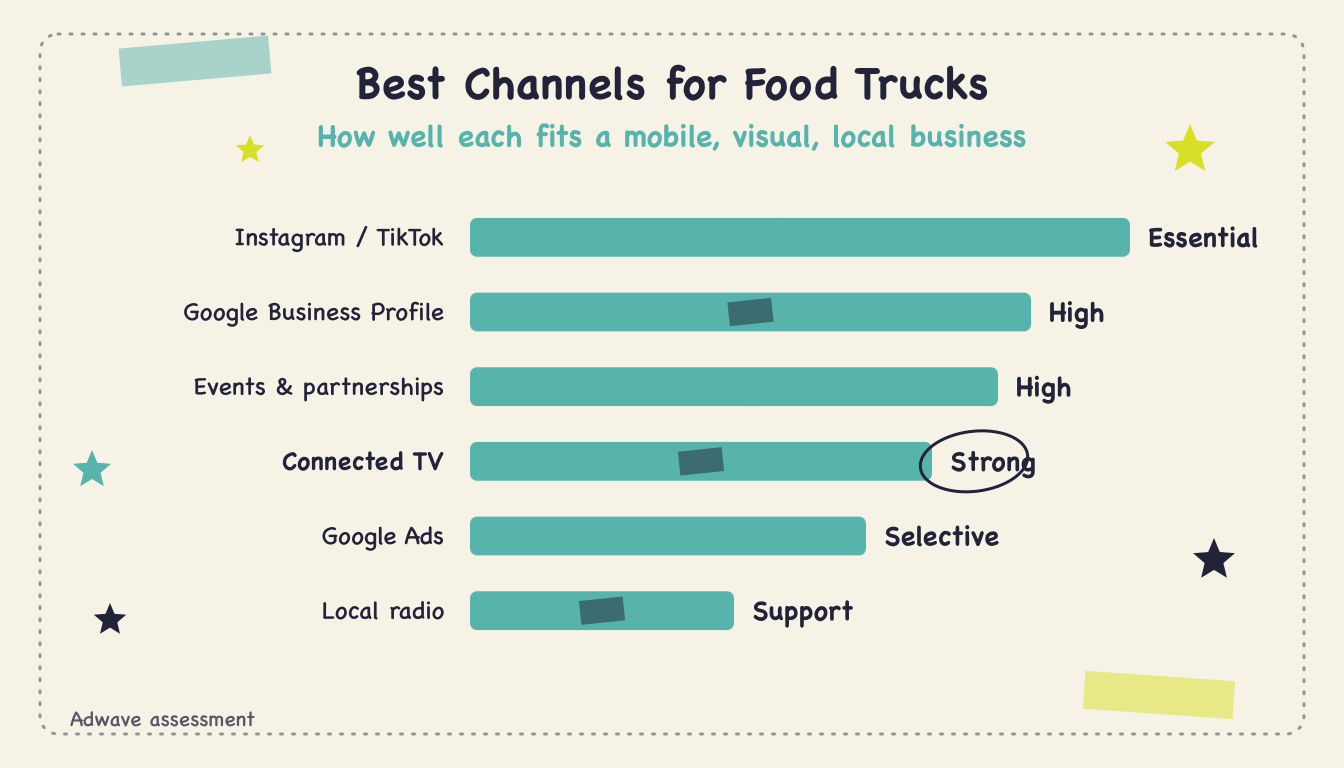
Channel 1: Instagram and TikTok (your home base)
For most food trucks, social media isn't just an advertising channel, it's the operating system of the business. Instagram and TikTok are where you post your daily location, show off your food, and build the following that seeks you out. If you do nothing else, do this well.
Why it works for food trucks: It's free to start, endlessly visual, and built for the daily location updates your business depends on. A well-run Instagram becomes a real-time schedule your regulars check before lunch. TikTok, meanwhile, can turn a single great video, your griddle sizzling, a messy sandwich pull-apart, into thousands of new local followers.
How to use it: Post your location every single day, consistently and early. Use Stories for the day's spot and menu specials, and your main feed for mouth-watering food photos and short videos. Turn on location tags so people nearby discover you. When you've built a following, a small paid boost on your best-performing posts, targeted to your city, extends your reach cheaply.
What it costs: Organic posting is free. Paid boosts and local ads can start at just a few dollars a day, and even $5 to $10 a day targeted to your metro can meaningfully grow your local following.
The catch is that organic reach takes consistency and time to build, and the algorithm doesn't guarantee your followers even see your location post. That's why the smartest food trucks pair their social presence with channels that guarantee reach.
Channel 2: Google Business Profile and local search
When someone new to the area searches "food trucks near me" or "best tacos [your city]," you want to show up. A Google Business Profile is free, and for a food truck it's an underused advantage.
Why it works: It captures people actively looking for food right now, the highest-intent audience there is. It also feeds Google Maps, where hungry people search when they're out and about.
How to use it: Claim and complete your profile, keep your hours and service area current, and post updates with your locations. Encourage happy customers to leave reviews, since reviews heavily influence which trucks show up first. If you have regular spots or a home base, list them.
What it costs: Free to set up and maintain. You can add Google Ads on top to appear at the top of local searches, which we'll cover below.
The limitation for a mobile vendor is that a changing location is harder to represent than a fixed restaurant. But even an imperfect profile beats being invisible when someone's searching for lunch nearby.
Channel 3: Google Ads (local search and maps)
Paid Google Ads let you jump to the top of local searches for food-related terms in your area. For a food truck, this is most useful around your regular spots or for events where you want to pull a crowd.
Why it works: It puts you in front of people at the exact moment they're deciding where to eat. Geo-targeting keeps every dollar focused on your service area.
How to use it: Target tightly around your location and hours, bid on terms like your cuisine plus your neighborhood, and use ad extensions to show your location. Because your location moves, this works best for predictable, recurring spots or for special events.
What it costs: You control the budget, and even $10 to $15 a day can capture meaningful local search traffic. Food-related keywords are generally far cheaper than competitive categories like legal or home services.
The trade-off is effort: keeping campaigns aligned with a changing schedule takes ongoing attention, so many trucks use it selectively for high-value days rather than always-on.
Channel 4: Local events, festivals, and partnerships
Not all advertising is digital. For food trucks, showing up where crowds already gather, festivals, farmers markets, breweries, office parks, corporate lunches, is itself a powerful form of advertising.
Why it works: Events put you in front of hundreds of hungry people who might become followers. Partnerships, like a regular slot at a local brewery, give you a predictable audience and borrowed credibility.
How to use it: Book recurring spots and events, and treat every one as a chance to grow your following. Put your Instagram handle on your truck, your menu, and your packaging so event customers become daily followers. Partner with breweries, offices, and venues that have foot traffic but no food.
What it costs: Ranges from free (a brewery that wants food for its customers) to event or vendor fees. The real return is the followers and regulars you gain, which pay off long after the event.
The limitation is that events are episodic, they fill a day but don't build a durable audience on their own unless you convert attendees into followers.
Channel 5: Local radio and community media
Local radio, community newsletters, and neighborhood social groups can build awareness of your truck across a whole metro, especially for reaching people who aren't glued to Instagram.
Why it works: It reaches a broad local audience and can build general awareness of your brand and where to find you. Community Facebook groups and local newsletters, in particular, are where neighborhood food news spreads.
How to use it: Consider a sponsorship or spot on a popular local station, or get featured in community newsletters and local food blogs. Be active in neighborhood groups where people ask "where's the good food truck?"
What it costs: Local radio spots vary widely by market. Community newsletter mentions and group participation are often free or inexpensive.
The downside is limited targeting and hard-to-measure results, which is why radio works best as a supporting awareness layer rather than your main channel.
Channel 6: TV and connected TV advertising
Here's the one most food truck owners assume is out of reach: television. It used to be. Traditional TV meant huge production costs and buying an entire market, which made no sense for a local truck. But connected TV, the ads that run on streaming services like Hulu, Roku, and Peacock, has changed the math completely.
Why it works for food trucks: Connected TV advertising lets you run a real 30-second video ad on premium streaming channels, targeted to just your city or even specific neighborhoods. That means you can build the kind of brand awareness and craving that only video creates, showing your food sizzling on the big living-room screen, at a cost that finally fits a small local business. For a visual, crave-worthy business like a food truck, video is the perfect medium.
How to use it: Run a short, appetizing video ad targeted to your metro to build awareness of your truck and brand. Pair it with a QR code viewers can scan to follow you on Instagram or see your schedule, turning TV awareness into daily followers. It's especially powerful before a big event or a new neighborhood launch.
What it costs: AI video tools can create an ad from your photos and website. Include production and media costs when comparing streaming with other channels.
TV, once impossible for a food truck, is now just another affordable tool in your kit, and it pairs perfectly with the social channels that handle your daily logistics.
How to combine channels: a food truck plan
No single channel does it all. The best food truck advertising combines a few, each doing its job, without demanding a marketing team.
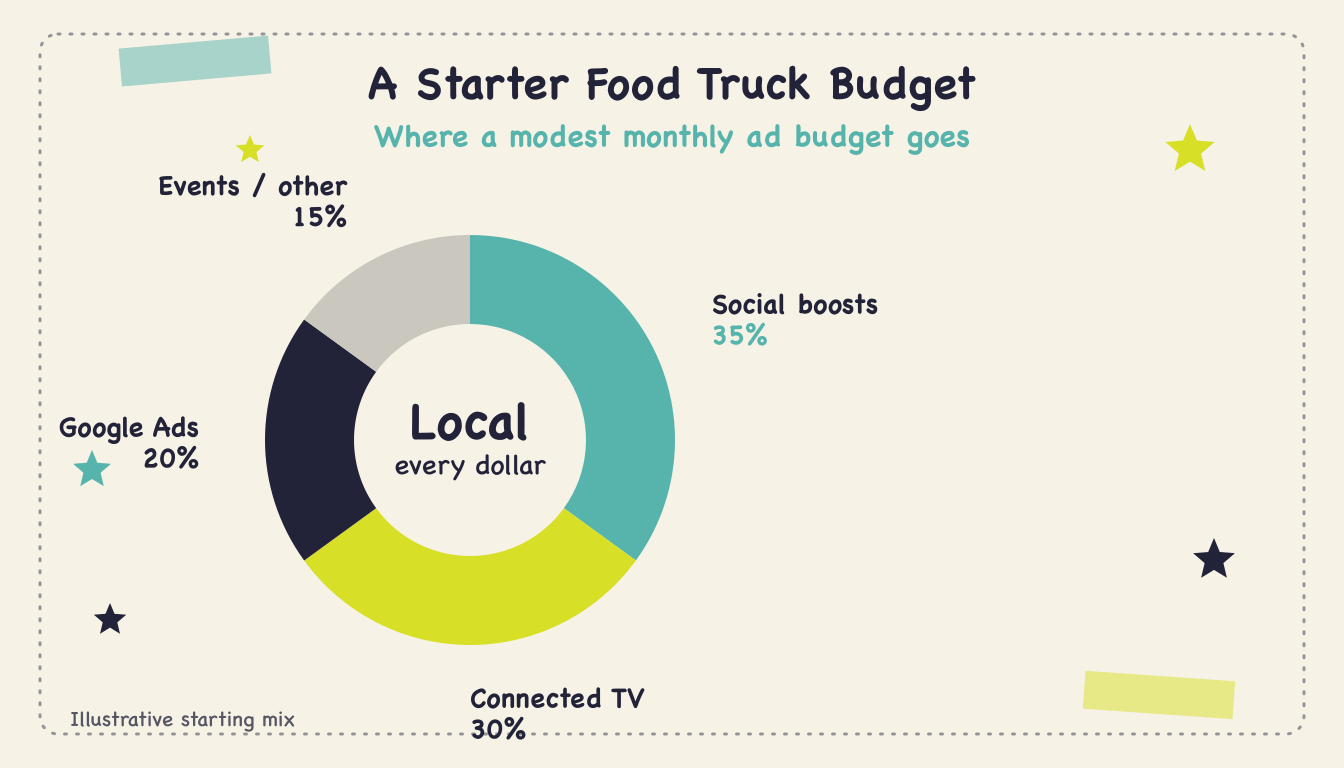
Here's a practical starting mix for most trucks:
Foundation (free): A daily, consistent Instagram and TikTok presence for location and food content, plus a complete Google Business Profile. This is non-negotiable and costs nothing but time.
Local capture (small budget): A modest paid boost on your best social posts and, on high-value days, some targeted Google Ads to catch people searching for food nearby.
In-person growth: Recurring events and partnerships that put you in front of new crowds, with every touchpoint funneling people to your Instagram.
Brand and crave (the differentiator): A geo-targeted connected TV ad to build awareness and appetite across your metro, especially ahead of events or new-neighborhood pushes, with a QR code that turns viewers into followers.
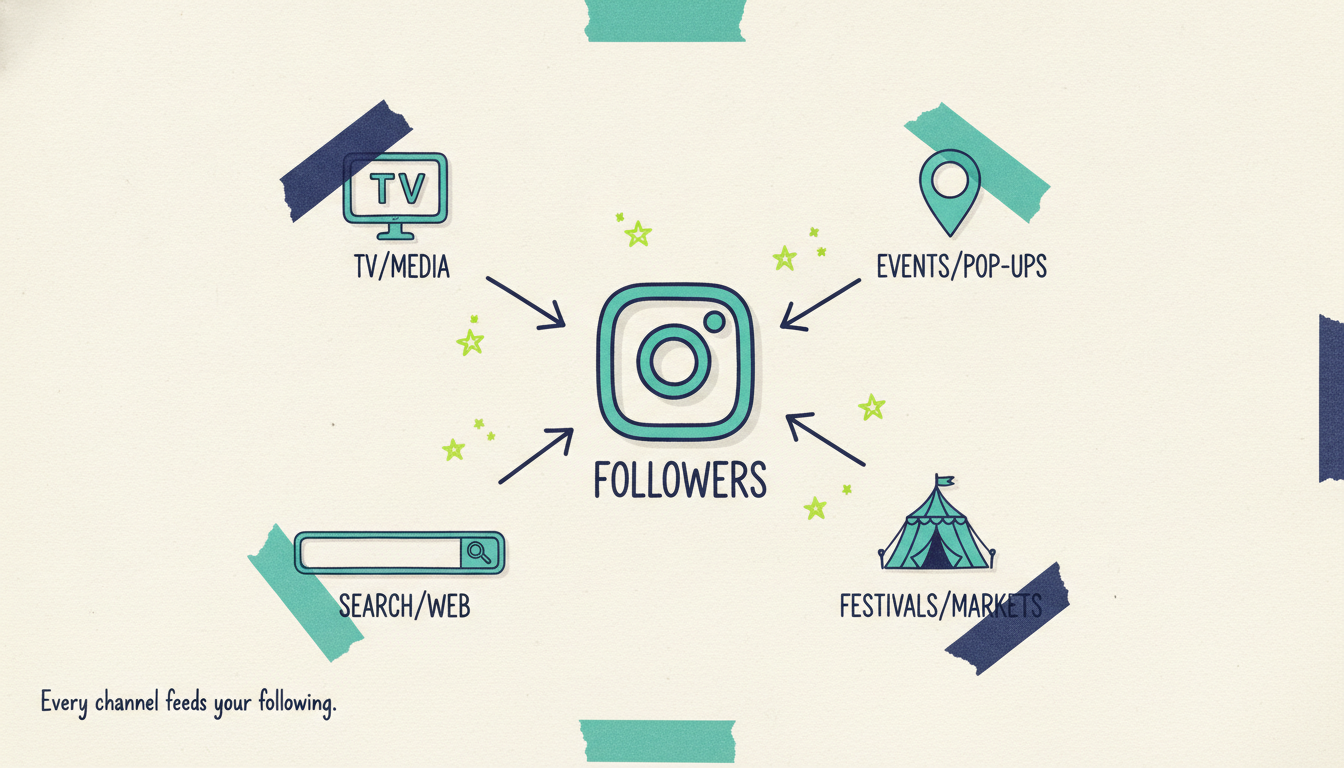
The thread connecting all of it is your following. Every channel should feed your social audience, because that following is the asset that shows up day after day. Advertising brings people in; your Instagram keeps them coming back. This is the same logic behind multi-channel advertising for any small business: each channel plays a role, and together they compound.
Common questions answered
What's the best way to advertise a food truck? For most food trucks, a consistent Instagram and TikTok presence is the foundation, because it handles daily location updates and builds the following that seeks you out. Layer in a complete Google Business Profile so you show up in "near me" searches, targeted Google Ads on high-value days, recurring events and partnerships, and a geo-targeted connected TV ad to build brand and crave across your metro. The best approach combines a few channels, each doing a specific job.
How much should a food truck spend on advertising? It varies, but many trucks run effectively on a modest budget because their most important channel, social media, is free to post on. A common approach is to spend nothing on organic Instagram and Google Business Profile, then add $5 to $15 a day on paid social boosts or Google Ads around key locations and events. Connected TV can be added affordably when you want to build broader brand awareness. Start small, see what drives lines at your window, and scale that.
Food trucks can use streaming TV to reach local viewers before events or expansions. Pair the ad with social posts that give current locations and hours.
How do I let people know where my food truck will be? Post your daily location consistently and early on Instagram and TikTok, using Stories and location tags so nearby people discover you. Keep your Google Business Profile updated, list recurring spots, and consider a schedule on your website. The key is consistency: train your followers to check the same place every day for your location, so finding you becomes a habit.
What social media is best for food trucks? Instagram and TikTok are the top two, because they're visual, local, and built for the frequent updates a mobile business needs. Instagram is ideal for daily location posts, food photos, and Stories, while TikTok excels at short videos that can reach a large local audience fast. Most successful food trucks treat these as their primary marketing channel and feed every other effort back into growing that following.
The bottom line
Food trucks have a unique advertising challenge, a moving location and a daily need to tell people where to find you, but also unique advantages: you're visual, local, and fun to follow. The best plan starts with a consistent, free social presence for daily logistics and following-building, adds targeted local search and events to capture and meet new customers, and uses affordable connected TV to build the brand and crave that keep your window busy.
You don't need a big budget or a marketing team. You need consistency and the right mix of channels, each doing its job. Adwave makes the video part easy: generate a mouth-watering 30-second ad from your photos and website, then run it on connected TV and beyond, all from one place. See how Adwave works, or check pricing to get started from $50.


