

Most small businesses pick one advertising channel, pour everything into it, and wonder why growth stalls. The reason is simple: no single channel does everything. Google captures people already searching for you, but it can't make new people aware you exist. Facebook builds awareness, but it can't reach the person in their living room. Connected TV builds trust at scale, but it doesn't catch the customer at when they're ready to buy. Each channel has a job, and the businesses that grow fastest use several of them together.
This is the complete guide to multi-channel advertising for a small business in 2026. We'll cover the framework that makes multiple channels work as a system, the role each major channel plays, how to allocate a budget across them, and how to run it all without drowning in six different dashboards. The goal isn't to spend more, it's to make every dollar work harder by putting each channel where it's strongest.
The one framework that makes multi-channel work
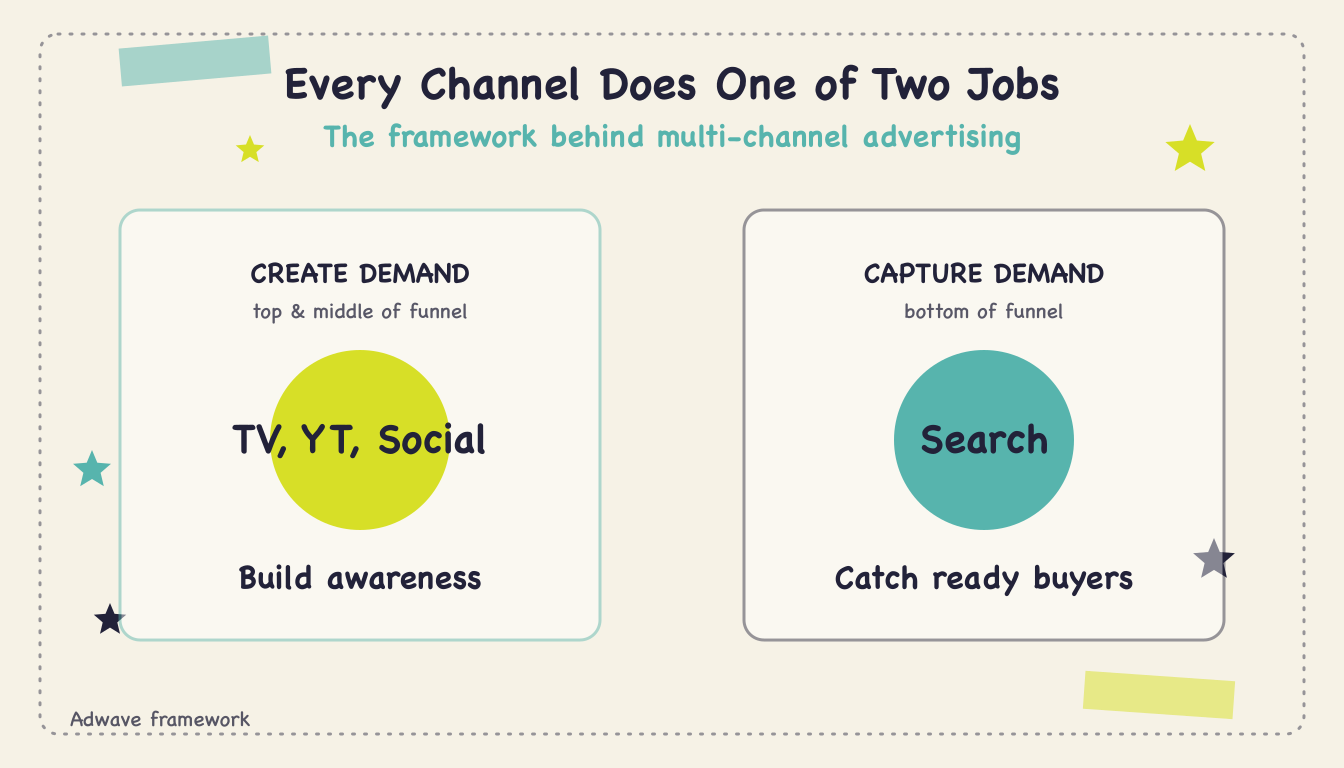
Before listing channels, you need the mental model that ties them together, because without it, multi-channel advertising is just scattered spending. The framework is this: every advertising channel does one of two jobs. It either creates demand or captures demand.
Demand creation makes people aware of your business and plants interest before they're actively shopping. This is the top and middle of the funnel. Connected TV, YouTube, Facebook, Instagram, and Reddit are demand-creation channels, they put you in front of people who weren't looking for you yet.
Demand capture catches people at the exact moment they're ready to act, usually when they search. This is the bottom of the funnel. Google Search and Local Services Ads are demand-capture channels, they meet high-intent buyers at the point of decision.
Here's why you need both. If you only run demand capture, you're limited to the people already searching for you, a finite pool you're fighting competitors for, which is why search costs keep rising. If you only run demand creation, you build awareness but miss people at when they're ready to buy. The magic happens when they work together: demand-creation channels plant the interest, and demand-capture channels harvest it. The customer who saw your connected TV ad converts on your search ad at a higher rate than a cold prospect, because they already know your name.
Every decision in this guide flows from that framework. Match each channel to its job, and your whole program gets more efficient.
The demand-capture channels
Start here, because capturing existing demand is usually the fastest path to results. When someone is actively searching for what you sell, you want to be there.
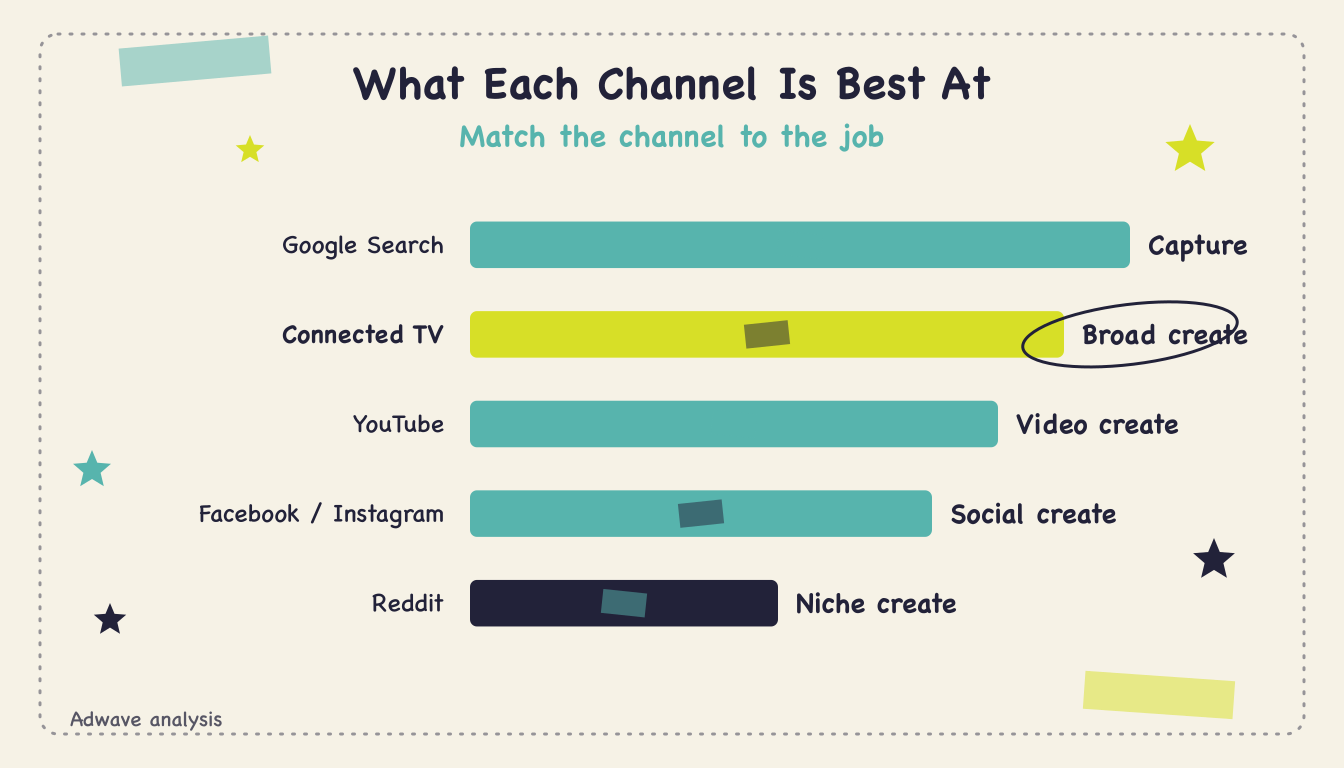
Google Search is the workhorse of demand capture. When someone types "emergency plumber near me" or "best accountant for small business," a search ad puts you in front of them at the moment of highest intent. It's measurable, you pay per click, and it converts well because the intent is already there. The catch is that competitive industries have expensive clicks, so relevance and tight keywords matter. Our full Google Ads for small business guide covers how to run it well.
Google Local Services Ads are a specialized capture tool for service businesses. They sit at the top of search, charge per lead rather than per click, and come with a verification badge that builds trust, especially valuable for businesses like home services and mobile repair where trust is essential.
The limitation of both is the same: they can only capture demand that already exists. If nobody's searching for you, there's nothing to harvest. That's where demand creation comes in.
The demand-creation channels
These channels build awareness and interest, growing the pool of people who will eventually search for you or walk through your door. Each reaches a different screen and audience.
Connected TV is demand creation on the biggest screen in the house. It puts a full-screen, non-skippable ad in front of viewers watching streaming TV, building recognition and trust at scale. Television is the most trusted advertising medium, and connected TV now runs in a single local market on small-business budgets, which used to be impossible. It's the closest thing to the mass-awareness power of traditional TV, but targetable and affordable. Our guide to connected TV advertising explains how it works.
YouTube sits at the intersection of digital video and TV. It's now the most-watched platform on U.S. televisions, so a YouTube ad increasingly plays full-screen in the living room, with Google's precise targeting layered on top. It's excellent for video storytelling at an affordable cost per view. See our YouTube advertising guide for the details.
Facebook and Instagram create demand on the social feed, reaching people on their phones with visual, interruptive ads. Facebook offers unmatched scale and audience targeting; Instagram excels at visual discovery and reaching younger customers. Both are affordable for top-of-funnel reach. Our Facebook advertising guide and Instagram advertising guide go deeper.
Reddit creates demand in niche communities, reaching engaged, high-intent researchers in specific interest groups. It's cheap and precise but works only for the right business, national, niche, ecommerce, or tech brands with a passionate community. Our honest take on whether it fits is in the Reddit advertising guide.
The key insight is that these channels reach the same customer in different contexts: on the TV in the evening, on the phone during a break, in a community they trust. Reaching someone across several contexts builds recognition faster than hammering one channel.
How the channels reinforce each other
Multi-channel advertising isn't just running several channels side by side, it's the way they compound. This is the part most small businesses miss.
Consider a realistic customer journey. Someone sees your connected TV ad during their evening show and files your name away. A few days later, your Facebook ad reinforces it while they scroll. When they finally need what you sell, they search on Google, and there you are at the top, a name they already recognize and trust. They click and convert. No single channel did that, the sequence did.
This compounding shows up in the numbers. Research on TV advertising and search finds that most incremental search activity happens in the minutes after a TV ad airs, TV ads literally drive people to Google. Demand-creation channels make your demand-capture channels more efficient by filling the funnel with warm prospects instead of cold ones. Our look at multi-channel marketing covers the broader strategy.
A few principles govern how the reinforcement works:
Consistency compounds. Same name, logo, and message across every channel means each touchpoint reinforces the others. Fragmented branding wastes the compounding effect.
Frequency matters more than reach. A customer rarely acts on one exposure. Multiple touches across channels build the recognition that drives action.
Creation feeds capture. The more demand you create, the more there is to capture, and the cheaper your capture channels get because you're harvesting warm demand.
How to allocate your budget
Here's the practical question: with a limited budget, how do you split it across channels? There's no universal formula, but there's a sound approach.
Start with capture, then layer in creation. If you're just beginning, put your first dollars into demand capture, Google Search and Local Services Ads, because you're harvesting people already looking for you, which is the fastest return. Get that working, then expand into demand creation to grow the top of the funnel.
A sensible starting allocation for a small business running multiple channels might look like this, though your right mix depends on your industry and goals:
Demand capture (Google Search, Local Services Ads): the largest share early on, often 40 to 50%, since it delivers the fastest, most measurable returns.
Broad demand creation (connected TV, YouTube): a growing share as you scale, often 25 to 35%, building the recognition that makes everything else work.
Social demand creation (Facebook, Instagram): 15 to 25%, for affordable feed reach and retargeting.
Niche channels (Reddit, others): a smaller test budget, 5 to 10%, if your business fits.
Shift budget toward creation as you grow. Early on, capture dominates because it's efficient. As you saturate the available search demand, the growth lever becomes creating more demand, so you reinvest into connected TV and social. A business that only ever runs search hits a ceiling; the one that builds demand keeps growing.
Whatever your split, measure across the whole funnel, not channel by channel in isolation. A connected TV ad that drives more branded searches is working even if it gets no direct clicks. Judge the system, not the silo.
Measuring a multi-channel program
Measurement is where multi-channel advertising gets philosophically tricky, and where a lot of small businesses go wrong. The instinct is to ask "which channel drove this sale?" and assign credit to the last click, usually a search ad. But that badly undervalues the demand-creation channels that made the search happen in the first place.
A better way to think about it is to watch a few signals that reflect the whole system working:
Branded search volume. When your demand-creation channels are working, more people search for your business by name. A rising trend in branded searches is one of the clearest signs your awareness spending is paying off, even though those searches show up as "search" conversions.
Overall cost per customer. Rather than obsessing over each channel's cost per lead, watch your blended cost to acquire a customer across everything. Often, adding demand creation lowers this blended number, because your capture channels convert warm prospects more cheaply.
Direct traffic and "how did you hear about us." People who saw your TV or social ad often type your website directly or mention it when they call. Simple prompts capture attribution that dashboards miss.
Growth itself. The ultimate measure is whether the business is growing faster than it did on one channel. If your revenue is climbing and your blended acquisition cost is holding or falling, the system is working, regardless of how any single channel's isolated metrics look.
The mindset shift is from "attribute every dollar" to "grow the whole system efficiently." Perfect attribution across channels is impossible, and chasing it leads you to cut the awareness spending that quietly powers everything else. Trust the framework, watch the blended numbers, and give demand creation credit for the demand it creates.
Avoiding the common mistakes
Multi-channel advertising fails in predictable ways. Here's what to avoid.
Running channels in silos. If your channels don't share branding and messaging, you lose the compounding effect. Coordinate them.
Judging demand creation on last-click sales. Awareness channels build demand that converts elsewhere. Measure them on branded search lift, traffic, and overall growth, not just direct conversions.
Spreading too thin. You don't need every channel. Pick the ones that fit your business and run them well rather than doing all of them poorly.
Ignoring frequency. A single impression on each of five channels does less than several impressions across two or three. Build enough frequency to be remembered.
Managing six dashboards manually. The operational burden of separate platforms is real, and it's where small businesses give up. This is the practical barrier to multi-channel done well.
The operational reality: running it all
Here's the honest challenge with multi-channel advertising: doing it well means managing Google Ads, YouTube, Facebook, Instagram, Reddit, and connected TV, each with its own dashboard, creative specs, and learning curve. For a small business owner without a marketing team, that's overwhelming, and it's the reason many businesses default to a single channel even though they know multi-channel works better.
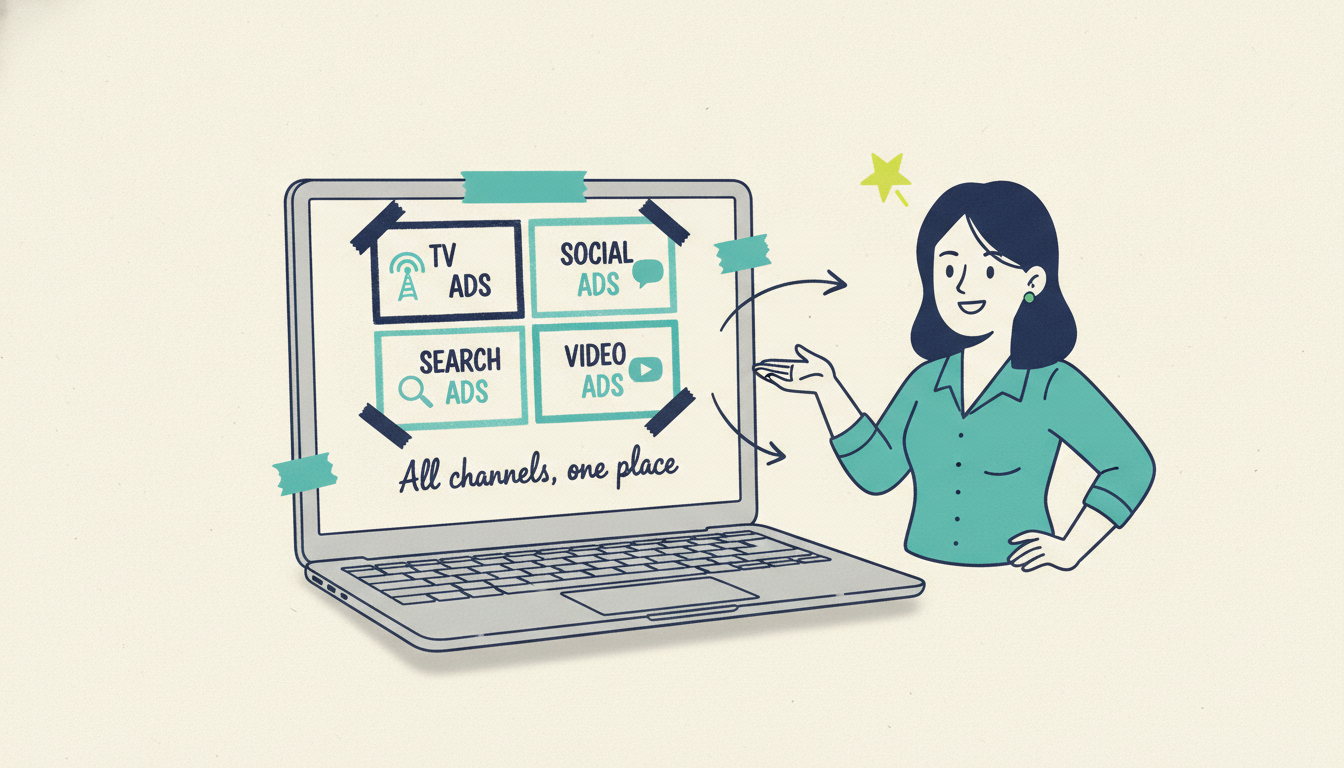
That operational burden is exactly the problem worth solving. When you can run your channels from one place, with shared creative and a unified view of results, multi-channel advertising becomes practical instead of exhausting. You set your strategy once, and the channels work together automatically.
This is the thinking behind Adwave. It runs connected TV plus Google, YouTube, Meta, Reddit, and display from a single platform, and it generates the creative for you, turning your website into a broadcast-quality 30-second ad in about two minutes. For a small business, that means you can execute an awareness and conversion, multi-channel strategy, demand creation on the TV and social feed, demand capture on search, all coordinated, without hiring an agency or juggling six logins. Our comparison of Google Ads vs Facebook Ads vs TV shows how the pieces fit for a smaller mix.
Common questions answered
What is multi-channel advertising? Multi-channel advertising means running ads across several platforms, like Google, connected TV, Facebook, and others, so they work together as a system. The core idea is that different channels do different jobs: some create demand by building awareness, and others capture demand by reaching people ready to buy. Used together, they reinforce each other and outperform any single channel.
Why is multi-channel advertising better than one channel? Because no single channel does everything. Search captures existing demand but can't create it; social and TV create demand but don't catch people at the moment of purchase. Running both means you build awareness and capture it, and the customer who sees your ad on multiple channels converts at a higher rate than a cold prospect. The channels compound.
How should a small business split its advertising budget? Start with demand capture, Google Search and Local Services Ads, for the fastest returns, often 40 to 50% of budget early on. Then layer in demand creation like connected TV, YouTube, and social, shifting more budget toward creation as you grow and saturate search demand. The exact split depends on your industry and goals.
What's the difference between demand creation and demand capture? Demand creation builds awareness and interest before someone is shopping, through channels like connected TV, YouTube, and social. Demand capture reaches people at when they're ready to buy, usually through search. Creation fills the funnel; capture harvests it. You need both, because creation without capture misses the sale, and capture without creation runs out of people to reach.
How can a small business manage multiple advertising channels? The operational burden of separate dashboards is the main obstacle. Platforms that run multiple channels from one place, like Adwave for connected TV plus Google, Meta, Reddit, and display, make it practical by coordinating channels and generating creative automatically, so you can run an awareness and conversion strategy without a marketing team.
The bottom line
Multi-channel advertising isn't about spending more, it's about spending smarter by putting each channel where it's strongest. Demand-creation channels like connected TV, YouTube, and social build awareness and trust; demand-capture channels like search harvest the interest they create. Together, they form a system that compounds, reaching your customer across the TV, the phone feed, and the search bar, and converting them far better than any single channel could.
The framework is simple: create demand, then capture it, and keep your branding consistent across every touchpoint. The hard part has always been execution, running all those channels without a marketing team. That's the problem worth solving.
Adwave runs connected TV plus Google, YouTube, Meta, Reddit, and display from one place, and creates your ads for you. See how Adwave works to build an awareness and conversion strategy, or check pricing to get started from $50.


