
Instagram is where people go to discover, and for a local business, discovery is everything. Someone scrolling Reels on a Saturday morning isn't searching for you, but the right ad can put your cafe, salon, or shop in front of them at the exact moment they're deciding where to go. That's the power of Instagram advertising: it creates demand rather than just capturing it.
This guide is about paid Instagram advertising, running ads to reach new local customers, not growing your organic following. We'll cover how Instagram ads work in 2026, the formats that perform best for local businesses, what they cost, how to target people near you, and how Instagram fits into a smart, affordable marketing mix that increasingly includes the living-room TV screen too.
How Instagram advertising works
Here's the first thing to know: Instagram ads run through the same system as Facebook ads, Meta Ads Manager, because Instagram is owned by Meta. That means everything from targeting to AI optimization works the same way across both platforms, and you can run ads on Instagram, Facebook, or both from a single campaign. If you've read our Facebook advertising guide, the mechanics will feel familiar.
You build a campaign by choosing an objective, and for a local business, the most useful ones are:
Awareness: get your business in front of as many nearby people as possible.
Traffic: drive people to your website, menu, or booking page.
Engagement: get people interacting with your posts, following you, or messaging you.
Leads: collect contact info from interested prospects.
Sales: drive purchases or in-store visits.
In 2026, Meta's AI, called Advantage+, handles most of the optimization automatically, choosing placements, adjusting budget, and finding the people most likely to respond. Your job is to set the right goal, supply strong visual creative, and tell it where you operate. The platform does the rest.
The formats that work for local businesses
Instagram is a visual platform, so your creative matters more here than almost anywhere. authentic, real-looking content often beats polished corporate ads on Instagram, which levels the field for small businesses. Here are the formats to know:
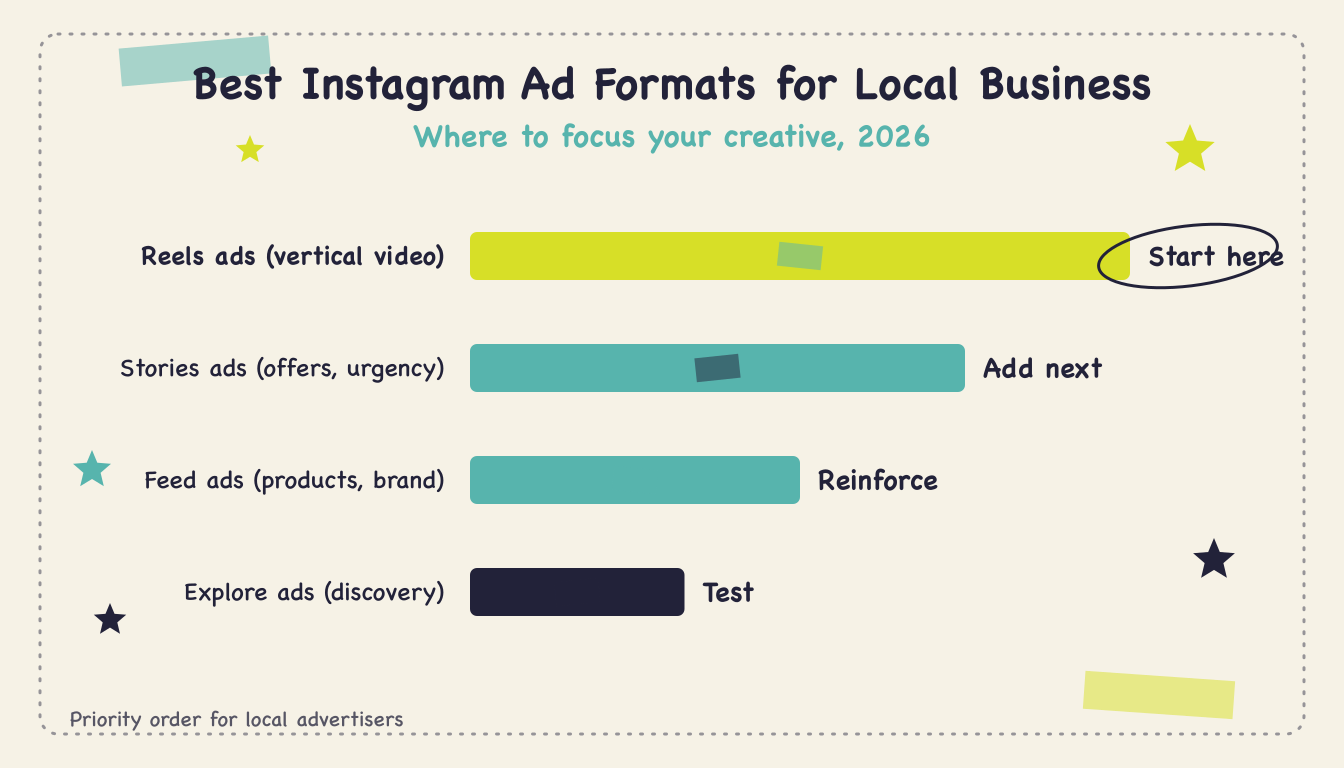
Reels ads: short, vertical video in Instagram's most popular and fastest-growing surface. This is where the discovery happens in 2026, and it's the single best format for a local business to invest in. A 15-to-30-second Reel showing your product, space, or team can travel far.
Stories ads: full-screen vertical ads between people's Stories. Great for time-sensitive offers, events, and driving quick action like a swipe-up to your booking page.
Feed ads: photo or video ads in the main Instagram feed, good for showing products or building brand presence.
Explore ads: appear when people browse the Explore tab looking for new content, a discovery-friendly placement.
For most local businesses, the priority order is simple: start with Reels, add Stories for offers and urgency, and use Feed ads to reinforce. Vertical video is the format that wins on Instagram, so if you make one thing, make short vertical video of your business.
Don't overthink the production. Some of the best-performing local Instagram ads are a phone video of the owner talking about a special, a quick tour of the shop, or a satisfying shot of a product being made. Instagram audiences have grown skeptical of overly polished advertising and respond to content that feels genuine and human. That's a real advantage for a small business: you don't need a studio or an agency to make something that works, you need to show the real thing you do, clearly and with energy, in the first few seconds. If making video still feels like a hurdle, AI tools can now turn your website or a few photos into a short video ad in minutes, removing the last barrier that kept many local businesses from advertising on Instagram at all.
Reaching customers near you
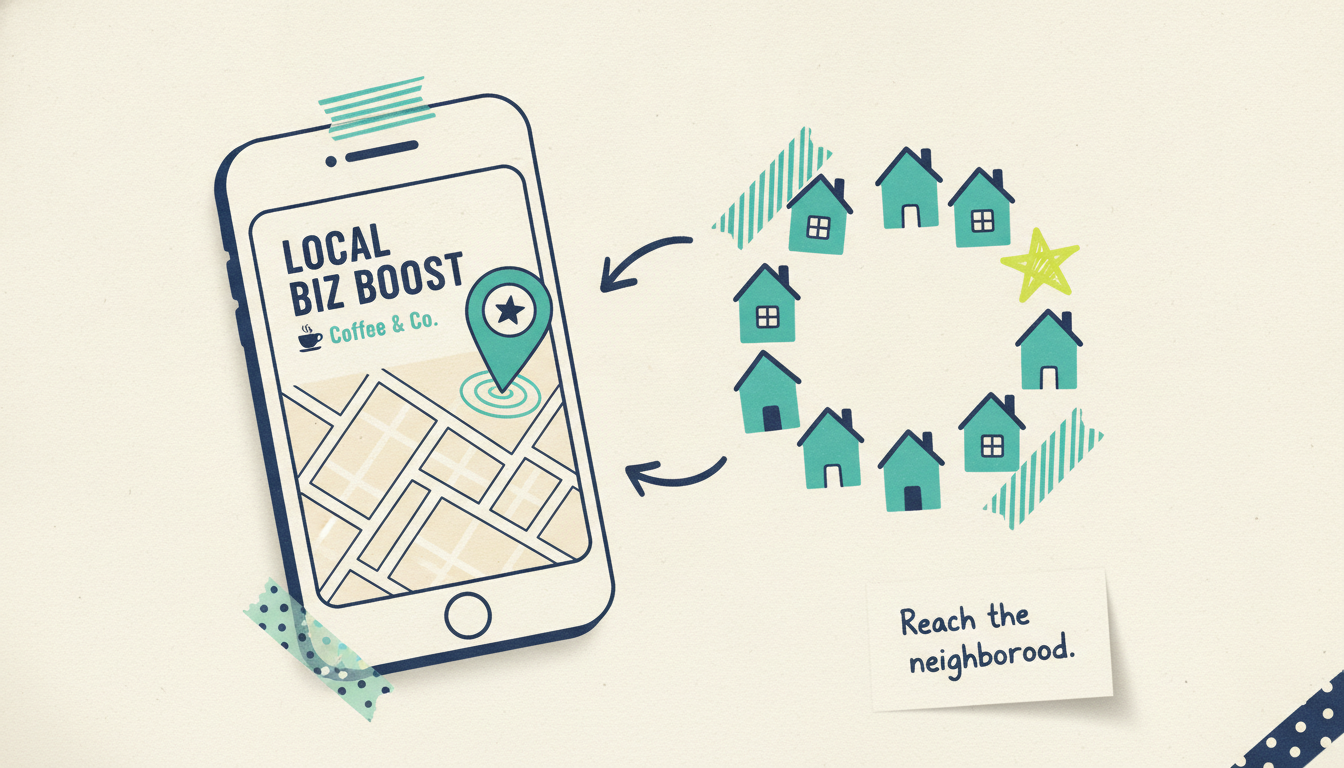
The single most important setting for a local business is location targeting, and Instagram makes it straightforward. You can target people in a specific radius around your business, in particular zip codes, or across a whole city or region. For a local shop, tightening your ads to the area you serve is what turns Instagram from a broad-reach tool into a local-customer machine.
Beyond location, you can layer on targeting that fits a local audience:
Demographics: age, gender, and other attributes that match your typical customer.
Interests and behaviors: reach people who engage with content related to your category, like food lovers for a restaurant or fitness enthusiasts for a gym.
Custom audiences: retarget people who've visited your website or engaged with your profile.
Lookalike audiences: find new people who resemble your existing customers.
A word of advice that surprises people: in 2026, you often get better results by keeping your targeting relatively broad inside your service area and letting Meta's AI find the right people, rather than over-narrowing with lots of interest filters. Set your location tightly, give the algorithm room inside it, and focus your energy on great creative.
What Instagram ads cost
Instagram advertising is affordable, which is why even the smallest local business can use it. Because Instagram runs on the same auction as Facebook, the costs are similar, and these are benchmark estimates that vary by industry, audience, and location:
Cost per click: often in the range of $0.70 to $2, depending on your objective and audience.
Cost per thousand impressions (CPM): roughly $8 to $14, with Stories and Reels frequently on the lower end.
No hard minimum: you can start with a modest daily budget, though you need enough spend for the algorithm to learn.
For a local business, a practical starting point is often $10 to $30 a day, enough to reach a meaningful local audience and gather data on what's working. The beauty of Instagram is that a small budget targeted tightly at your neighborhood can generate real awareness and foot traffic. For the full cost breakdown, since Instagram and Facebook share pricing, our Facebook ad costs guide covers the numbers in depth, and our average CTV CPM page shows how they compare to TV.
Costs rise around busy shopping seasons, so if your budget is tight, be aware that advertising in quieter months stretches your dollars further. And as always, better creative lowers your costs, Instagram rewards ads that engage the people scrolling past.
The honest pros and cons
Instagram advertising is powerful for local businesses, but it's worth knowing where it shines and where it doesn't.
What Instagram ads are great for:
Visual discovery. Instagram excels at putting your business in front of people who weren't looking for it, which is how local businesses grow beyond their existing customers.
Reaching younger audiences. Instagram skews younger than Facebook, making it ideal for reaching Millennial and Gen Z customers.
Authentic, affordable creative. Real, unpolished content often outperforms slick ads, so you don't need a big production budget.
Precise local targeting. You can focus every dollar on the area you serve.
Where Instagram ads get harder:
You need good visual creative. Instagram is a visual platform, so a weak image or video will underperform no matter how good your targeting is. This is the main effort required.
It's demand creation, not capture. Instagram builds awareness and interest, which often shows up as visits and searches later rather than immediate clicks-to-purchase. Judge it on the full picture, not just last-click sales.
Attribution is imperfect. Like all social advertising, proving exactly which customers came from Instagram is harder than with search. Use offer codes, "how did you hear about us" prompts, and branded search lift to gauge impact.
Where Instagram fits in your marketing mix
Instagram is one channel, and the smartest local businesses use it as part of a bigger picture. The key insight is that Instagram is a demand-creation channel, it makes people aware of you and plants interest, on their phone.
That role pairs naturally with other channels:
Search captures the demand Instagram creates, when someone who saw your ad later Googles you.
Connected TV creates demand alongside Instagram, but on the living-room television instead of the phone feed.
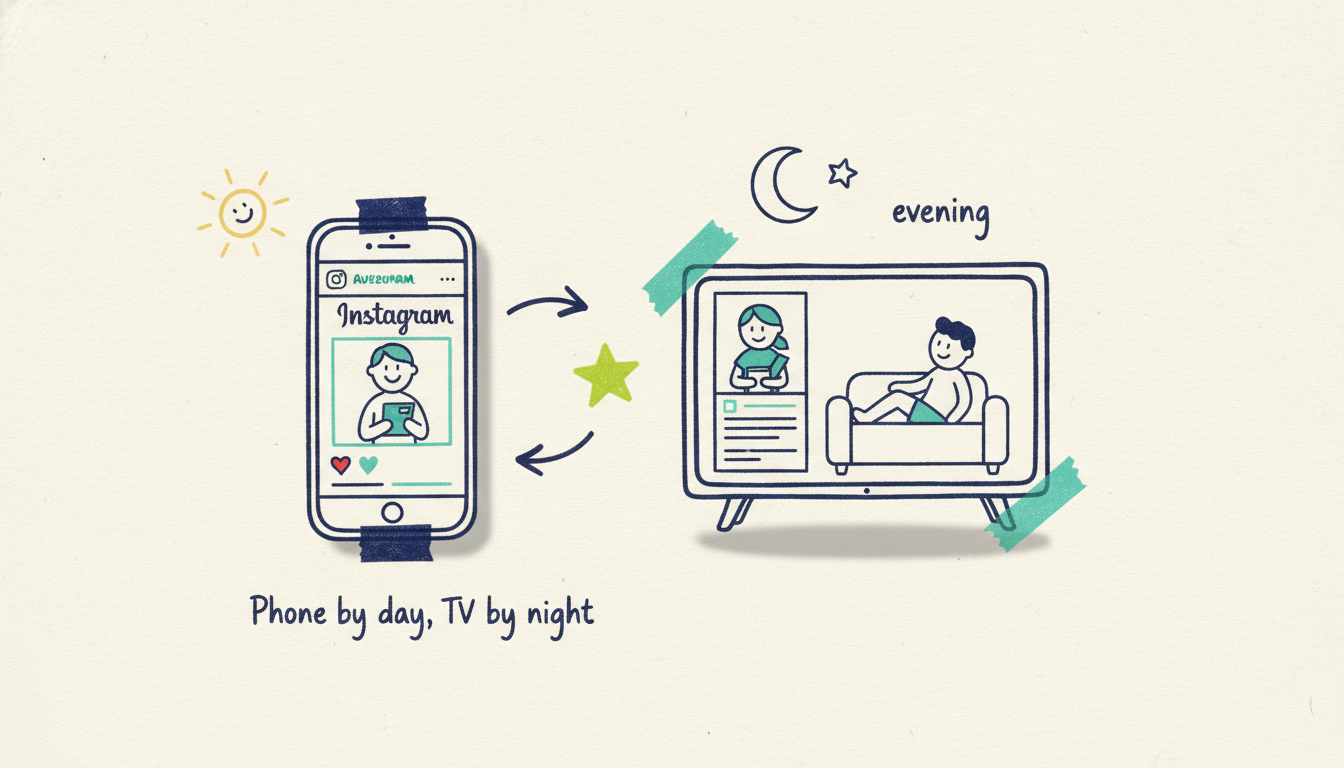
That last pairing is more powerful than most local businesses realize. A customer might see your Reel on Instagram in the morning and your TV ad during their evening show, two touchpoints on two screens, reinforcing each other. Connected TV advertising used to be out of reach for a local shop, but it now starts at small-business budgets, which means you can build demand on both the phone and the TV. Our guide to connected TV advertising explains how the living-room side works.
This is exactly why running channels from one place makes sense. Adwave runs Instagram and Facebook ads alongside Google, YouTube, Reddit, and display, plus TV and connected TV across 100+ premium channels. For a local business, that means you can reach customers on their phone feed and their living-room TV from a single platform, and even generate the video creative automatically from your website.
A practical playbook for local businesses
Here's how to get Instagram ads working for a local business.
Set your location tightly. Target the radius, zip codes, or city you serve. This is the most important setting for a local business.
Lead with vertical video. Make short, authentic Reels showing your product, space, or team. Real beats polished on Instagram.
Pick the right objective. Use Traffic or Leads to drive action, Awareness to build local recognition. Match the goal to what you want.
Start with a modest daily budget. Ten to thirty dollars a day is enough for many local businesses to reach a meaningful audience and learn what works.
Keep targeting broad inside your area. Set location tightly, then let Meta's AI find the right people rather than over-filtering with interests.
Track results your way. Use offer codes, booking links, and "how did you hear about us" prompts to see what Instagram is driving, since attribution is imperfect.
Refresh your creative. Swap in new Reels and Stories regularly so your ads don't go stale with your local audience.
The single biggest factor in your success will be your creative. A compelling 15-second video of your business, targeted at your neighborhood, will outperform a mediocre ad with perfect targeting every time. Instagram rewards content that feels real and stops the scroll.
Common questions answered
How much does it cost to advertise on Instagram? Instagram ad costs are similar to Facebook's, with cost per click often between $0.70 and $2 and CPMs around $8 to $14, though these vary by industry and location. Many local businesses start with $10 to $30 a day, which is enough to reach a meaningful audience in their service area and learn what works.
Is Instagram advertising good for local businesses? Yes, especially for reaching new customers who weren't searching for you. Instagram excels at visual discovery and precise local targeting, letting you focus every dollar on your service area. It works best as a demand-creation channel, building awareness that shows up as visits and searches, paired with search to capture that demand.
What kind of Instagram ads work best for local businesses? Short vertical video in Reels and Stories performs best. Authentic, real-looking content showing your product, space, or team tends to beat polished corporate ads. Start with Reels for discovery, add Stories for time-sensitive offers, and keep your creative fresh to avoid fatigue.
How do I target local customers on Instagram? Use location targeting to focus on a radius around your business, specific zip codes, or your city. Then keep other targeting relatively broad and let Meta's AI find the right people in that area. Tight location targeting plus strong creative is the winning formula for a local business.
Should I run Instagram ads or TV ads? Both, ideally. Instagram reaches people on their phone feed, while connected TV reaches them on the living-room screen, and they reinforce each other. Both are demand-creation channels, and both are now affordable for local businesses. Platforms like Adwave let you run Instagram ads and connected TV from one place.
The bottom line
Instagram advertising gives a local business something valuable: the ability to put your business in front of nearby customers who weren't looking for you, at a budget you can afford. Focus on tight local targeting, authentic vertical video, and a clear goal, and Instagram becomes a genuine engine for new local customers.
The most effective approach treats Instagram as one part of a demand-creation strategy that now includes the TV screen too. Reach people on their phone with Instagram and in their living room with connected TV, then let search capture the demand you've built.
Adwave runs Instagram and Facebook ads plus connected TV across 100+ premium channels from one place, and generates your video creative automatically. See how Adwave works, or check pricing to get started from $50.


