You're not imagining it. Those Facebook campaigns that used to drive consistent leads at predictable costs? They're struggling now. CPMs are up, conversion tracking is broken, and the same audiences that used to respond aren't engaging like before. If you've been wondering whether it's time to diversify your ad spend, you're asking the right question.
Why Facebook Ads Stopped Working (It's Not Just You)
Before we look at alternatives, let's understand what changed. The problems with Facebook ads aren't about your creative or targeting skills. The platform itself has shifted.
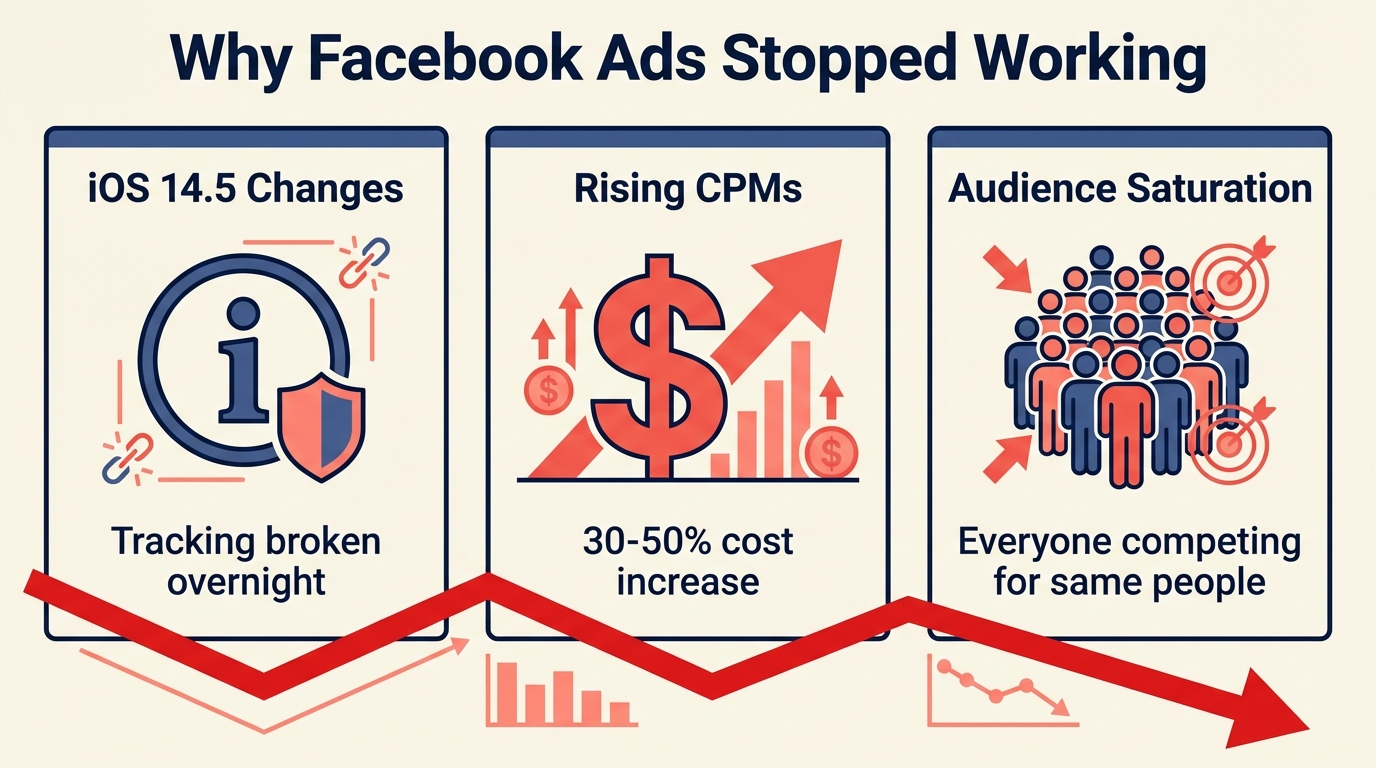
iOS 14.5 broke tracking. When Apple introduced App Tracking Transparency in 2021, it fundamentally changed how Facebook ads work. The platform lost visibility into what users do after clicking ads. Your conversion data became incomplete, making optimization harder and results less predictable.
CPMs have climbed significantly. Competition for Facebook ad inventory has increased while the platform's ability to target has decreased. Many industries report CPM increases of 30-50% compared to pre-iOS 14.5 levels. You're paying more to reach the same audiences.
Audience saturation is real. The same users see ads from countless businesses every day. Ad fatigue sets in faster than it used to. Creative that worked for months now burns out in weeks.
Algorithm changes favor big spenders. Meta's algorithm updates increasingly favor advertisers with larger budgets and more data. Small businesses with limited spend find it harder to compete for quality placements.
Before You Abandon Facebook Entirely
Here's the balanced take: Facebook ads can still work, but they require more effort and investment than before. If you're not ready to diversify yet, try these approaches first.
Refresh your creative more frequently. What used to work for months might burn out in weeks now. Plan for new creative every 2-4 weeks. Test different formats, including Reels and Stories placements.
Broaden your targeting. Paradoxically, narrower targeting often performs worse post-iOS 14.5. Give Meta's algorithm room to find your customers by using broader interest targeting or letting Advantage+ audiences do the work.
Focus on what you can measure. First-party data, email signups, and direct purchases are more reliable than pixel-based conversions. Build your funnel around actions you can track directly.
But if you've tried these approaches and Facebook still isn't delivering, it's time to look elsewhere.
Alternative #1: Google Local Service Ads
Best for: Service businesses (plumbers, lawyers, home services, healthcare)
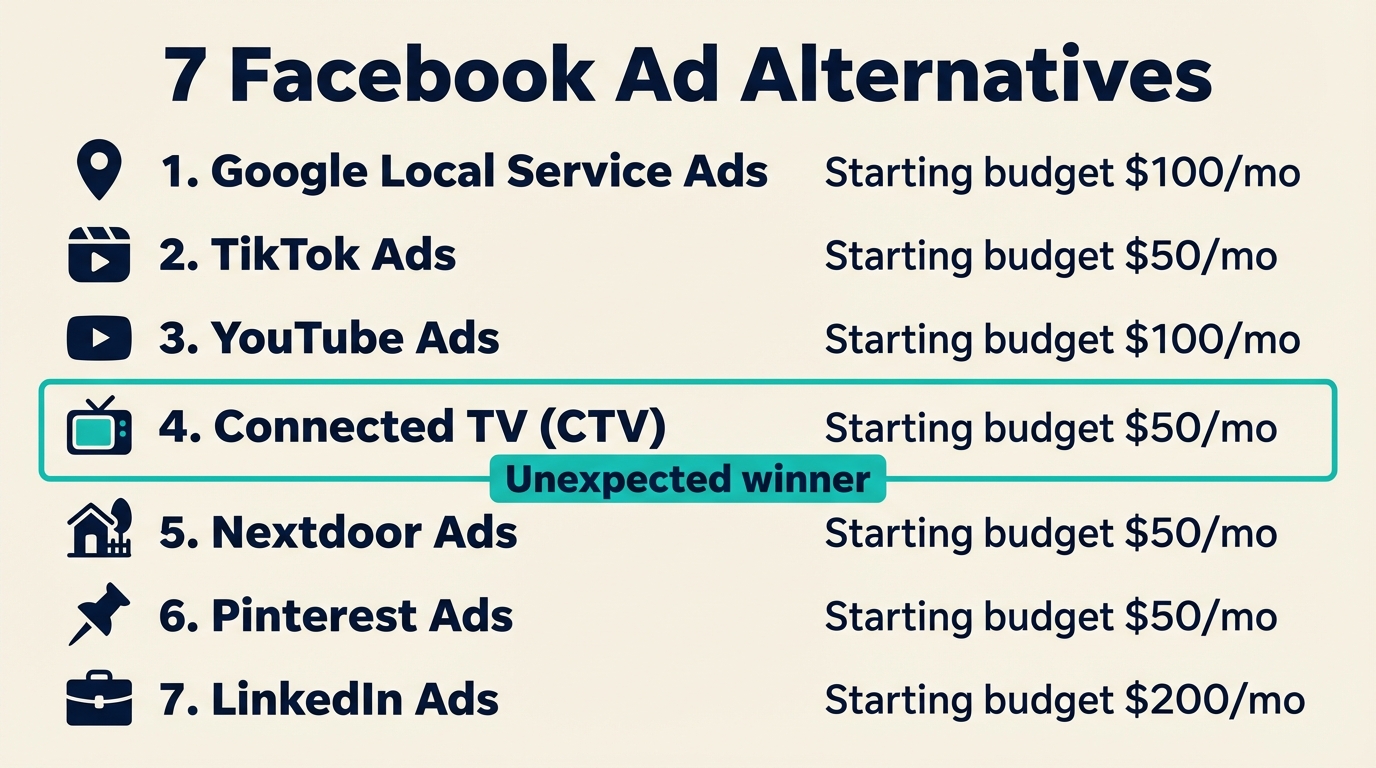
Google Local Service Ads appear at the very top of search results when someone searches for services in your area. Unlike regular Google Ads, you pay per lead, not per click. Leads come through directly with contact information.
Why it works: Intent is everything. Someone searching "plumber near me" needs a plumber right now. You're not interrupting their scroll; you're answering their question. The pay-per-lead model means you only pay for actual inquiries, not clicks that go nowhere.
Starting budget: $100-200/month gets you meaningful data. Costs vary significantly by industry and location.
The catch: Only works for specific service categories. You need to pass Google's screening process. Competition in some markets is intense.
Alternative #2: TikTok Ads
Best for: Visual products, younger demographics, brands comfortable with informal content
TikTok's ad platform has matured significantly. CPMs remain lower than Facebook in most markets, and the audience is highly engaged. The platform rewards authentic, entertaining content over polished advertising.
Why it works: TikTok users expect to be entertained, not sold to. Ads that feel native to the platform perform remarkably well. The algorithm is effective at finding your audience even with limited data.
Starting budget: $50-100/month is enough to test. Minimum daily budget is around $50 for campaigns.
The catch: Creative that works on Facebook usually fails on TikTok. You need platform-native content. The audience skews younger, which isn't right for every business.
Alternative #3: YouTube Ads
Best for: Consideration-stage content, businesses with video assets, B2B
YouTube ads reach users in a different mindset than social platforms. They're actively watching content, more likely to engage with longer messages. Skippable in-stream ads let you pay only for engaged views.
Why it works: You can reach highly specific audiences through content targeting. Someone watching "how to start a restaurant" is a great audience for restaurant equipment suppliers. Google's data makes targeting more reliable than Facebook's post-iOS 14.5.
Starting budget: $100-300/month provides useful data. Costs vary by targeting and placement.
The catch: You need video creative. Production doesn't have to be expensive, but you need something to run. The platform favors longer content, so 6-second bumper ads have limited impact.
Alternative #4: Connected TV (CTV) Advertising
Best for: Local businesses, brand building, businesses tired of fighting for social media attention
Here's the option most small businesses don't realize is available to them. CTV advertising (think Hulu, Roku, streaming services) used to be reserved for big brands with big budgets. That's no longer true.
Why it works: While everyone fights over the same Facebook audiences, your competitors haven't figured out they can be on TV. CTV ads have 94% completion rates (compared to social media's fraction of that). Viewers watch your ad rather than scrolling past.
The brand credibility effect is real. Being on TV creates legitimacy that social media ads don't. When customers see you on their TV, you feel like an established business.
The surprising truth: You can start for $50, and AI creates the ad for you. No production budget required. Platforms like Adwave generate professional commercials from your website in minutes.
CTV also amplifies your other marketing. Customers who see your TV ad are more likely to recognize and engage with your social media and search ads. It creates a halo effect across your entire marketing mix.
Starting budget: $50-500/month. Start small, test, and scale what works.
The catch: TV advertising is primarily for awareness and brand building, not direct response. You won't track conversions the same way you track Facebook leads. But for many businesses, that awareness is exactly what's missing.
Alternative #5: Nextdoor Ads
Best for: Hyperlocal service businesses, neighborhood-focused retailers
Nextdoor's advertising platform reaches users at the neighborhood level. For businesses that serve specific geographic areas, this targeting precision is unmatched.
Why it works: Nextdoor users trust recommendations from their neighbors. Ads appear in a context of local community discussion. For home services, restaurants, and local retailers, this environment is ideal.
Starting budget: $50-100/month can reach meaningful local audiences.
The catch: Limited scale. If you need to reach beyond local markets, Nextdoor won't work. The platform's user base, while growing, is smaller than major social networks.
Alternative #6: Pinterest Ads
Best for: E-commerce, home and lifestyle products, wedding and event businesses
Pinterest users are planners. They're actively saving ideas for future purchases, making them high-intent audiences for the right products.
Why it works: The platform is designed around discovery and purchase planning. Users expect to find products and services. Promoted pins blend naturally with organic content.
Starting budget: $50-150/month provides useful data for most businesses.
The catch: Strong category bias. Pinterest works beautifully for home decor, fashion, food, and wedding-related businesses. It's less effective for B2B or services.
Alternative #7: LinkedIn Ads
Best for: B2B services, professional services, recruiting
If you're selling to businesses or professionals, LinkedIn offers targeting Facebook can't match. Target by job title, company size, industry, and seniority level.
Why it works: The audience is in a professional mindset. They expect business-related content. For B2B lead generation, LinkedIn's targeting precision often justifies higher costs.
Starting budget: $200-500/month. LinkedIn is more expensive than other platforms, but lead quality is often higher for B2B.
The catch: Significantly higher CPMs than other platforms. Not effective for consumer businesses. The audience is smaller and more expensive to reach.
How to Test New Channels Without Blowing Your Budget
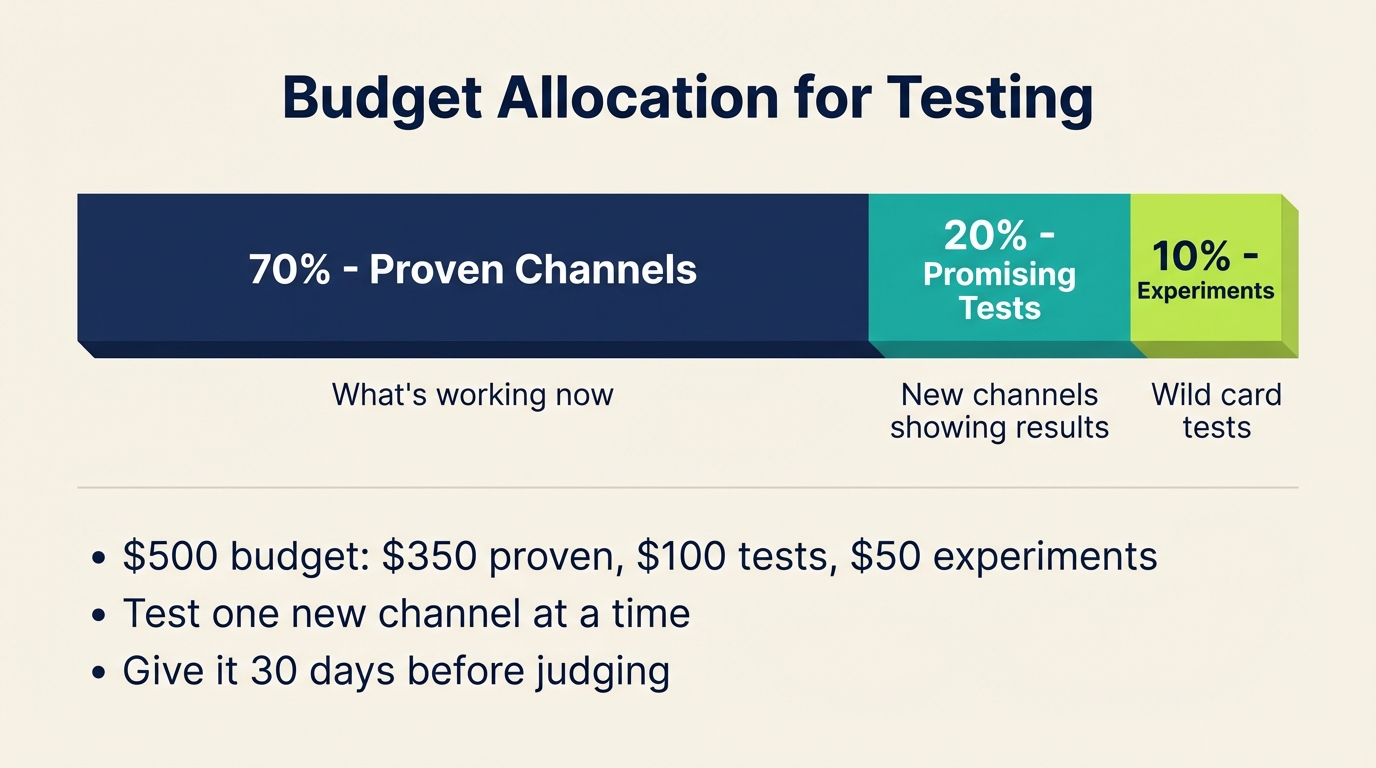
Don't abandon what's working to chase something new. Use the 70/20/10 framework for budget allocation.
70% goes to proven channels. Whatever is working now, even imperfectly, continues to get the majority of your budget. You know what to expect.
20% goes to promising tests. New channels that have shown initial results get room to prove themselves. This is where you validate alternatives.
10% goes to experiments. Wild card tests with channels you're curious about. Low risk, potential high reward.
For a $500 monthly ad budget, that means $350 to your established channels, $100 to test something new, and $50 to experiment. Test one new channel at a time. Give it 30 days before judging results.
Real Talk: Most Businesses Should Use Multiple Channels
The era of relying on a single advertising channel is over. Facebook's challenges highlight the risk of putting all your eggs in one basket.
A multi-channel approach builds resilience. When one platform changes its algorithm or raises prices, you have alternatives generating results. Your marketing doesn't collapse with a single policy update.
TV advertising makes your other marketing work better. Customers who see your brand on TV are more likely to click your search ads, engage with your social content, and remember your business when they need what you sell. The channels reinforce each other.
The goal isn't to find a perfect replacement for Facebook. It's to build a marketing mix that doesn't depend on any single platform's goodwill.
Common questions answered
Why aren't my Facebook ads working as well as they used to?
Several factors have combined to make Facebook advertising more challenging. Privacy changes like Apple's iOS 14 update limited tracking capabilities, making targeting less precise. Competition has increased dramatically, driving up CPMs. Organic reach continues to decline, forcing more businesses to pay for visibility. Algorithm changes favor certain content types that may not suit your business. These aren't temporary issues but structural changes to how the platform operates.
How do I know if it's time to try different advertising channels?
Look for these warning signs: rising cost per acquisition despite optimization efforts, declining return on ad spend over consecutive months, difficulty reaching new audiences who haven't already been exposed to your ads, and fatigue in your target audiences shown by declining engagement rates. If you're spending more time troubleshooting Facebook than running your business, it's worth testing alternatives.
What advertising alternatives work best for local businesses?
For local businesses, consider connected TV advertising for brand awareness, Google Local Services ads for high-intent customers, community sponsorships and local events for grassroots visibility, email marketing to existing customers, and referral programs that turn happy customers into advocates. The best approach combines multiple channels rather than relying on any single platform.
Can TV advertising really replace my Facebook ad spend?
TV advertising serves a different purpose than Facebook, so replacement isn't quite the right framing. TV builds brand awareness and trust at the top of the funnel, which makes all your other marketing more effective. Many businesses find that adding TV to their mix improves Facebook performance because customers recognize and trust brands they've seen on TV. Think of it as diversification rather than replacement.
What's the most cost-effective way to test new advertising channels?
Start with small budgets and clear success metrics for each channel you test. For TV, platforms now allow testing with as little as $50 to $100. For Google Ads, start with high-intent local keywords. For email, use your existing customer list. Run tests for at least two to four weeks before drawing conclusions. Track not just direct response but also lift in other channels, website traffic, and brand awareness indicators.