
Google Ads is one of the most powerful advertising tools a small business can use, and also one of the easiest to waste money on. Here's the honest version, the one that tells you where it shines, where it stings, and how to use it without lighting your budget on fire.
The short story: Google Ads is a demand-capture machine. When someone types "emergency plumber near me" or "best CPA for small business," Google Ads puts you in front of them at the exact moment they're looking to buy. That's valuable. But it only works if people are already searching, and in competitive industries, those clicks have gotten expensive. This guide walks through how Google Ads works in 2026, what it really costs, the AI changes reshaping it, and how to make it pay off for a small business, including how it fits alongside the demand-creation channels like TV that fill the top of your funnel.
How Google Ads works
Google Ads uses an auction to decide which ads appear and in what order. Your bid, ad quality, and other Ad Rank factors affect placement.
Quality Score is a 1-to-10 rating built from three things: your expected click-through rate, how relevant your ad is to the search, and how good your landing page experience is. The practical takeaway is important: a small business with a tightly focused, relevant ad can outrank a big competitor bidding more, simply by being more relevant. Relevance is your edge.
Google Ads offers several campaign types, and in 2026 there are eight active ones. The two that matter most for most small businesses are:
Search campaigns: text ads on high-intent searches. This is the classic "capture people looking to buy" workhorse, and it's where most small businesses should start because you get keyword-level visibility and control.
Performance Max (PMax): an AI-driven campaign that runs on all of Google's inventory, Search, Display, YouTube, Gmail, Maps, and Discover, from a single budget. Google optimizes everything automatically.
The rest, Shopping, Demand Gen, Display, Video, and App, serve more specific goals like ecommerce product feeds, awareness, or app installs. Keywords come with match types too: broad (widest reach), phrase (a sensible default), and exact (tightest relevance, least waste). For a small business starting out, phrase and exact match keep you from paying for irrelevant clicks.
What Google Ads costs in 2026
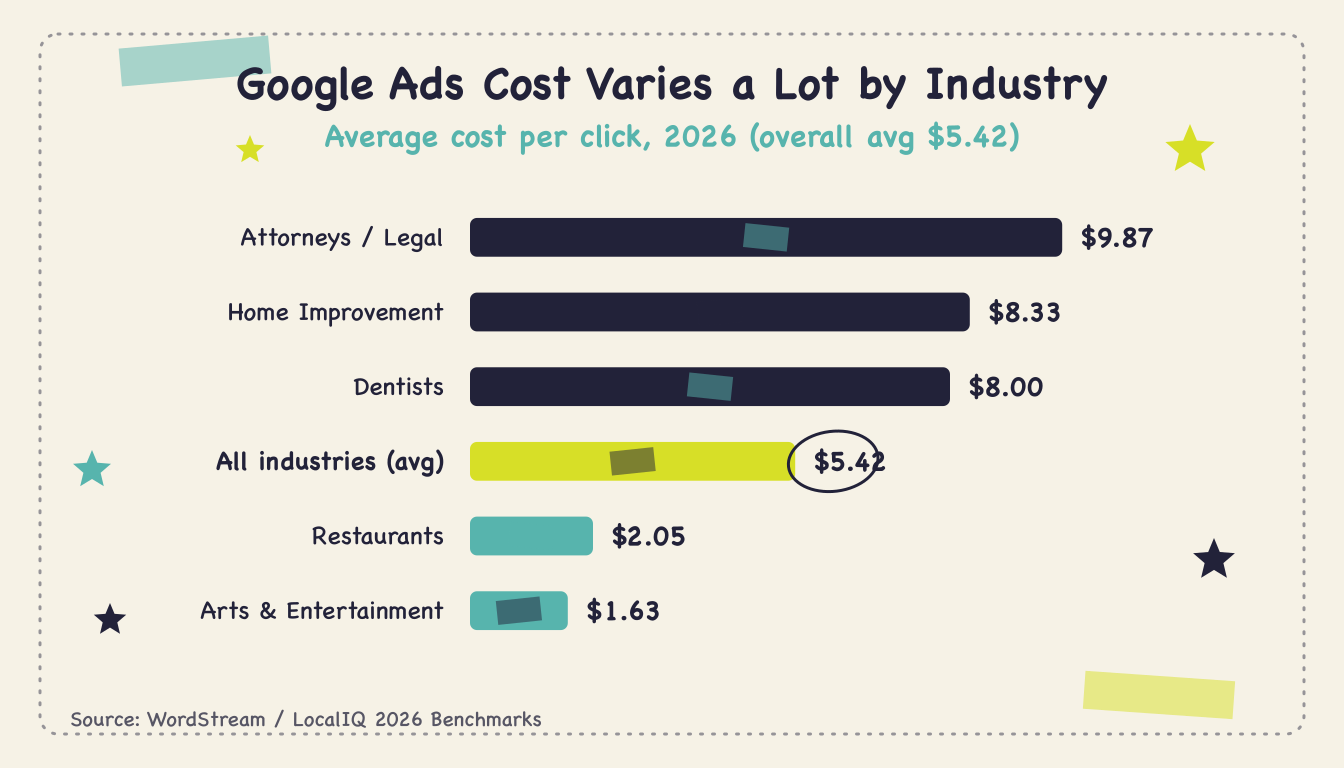
Let's talk real numbers. According to WordStream and LocalIQ's 2026 search advertising benchmarks, drawn from more than 13,000 U.S. search campaigns, here's where costs landed:
Average cost per click (CPC): $5.42
Average click-through rate (CTR): 6.64%
Average conversion rate: 8.18%
Average cost per lead (CPL): $66.69
There's good news in that data: for the first time in five years, the average cost per lead decreased year over year. After a stretch of relentless increases, 2026 costs held relatively stable.
But averages hide huge variation by industry. Some verticals are brutally expensive:
Attorneys and legal services: $9.87 per click
Home and home improvement: $8.33 per click
Dentists and dental services: $8.00 per click
Others are far more affordable:
Arts and entertainment: $1.63 per click
Restaurants and food: $2.05 per click
Travel: $2.14 per click
Individual keywords can go much higher. In legal, terms like "mesothelioma lawyer" or "truck accident lawyer" have historically run into the hundreds of dollars per click. Legal alone accounts for nearly a fifth of the most expensive keywords on Google. If you're in a high-cost vertical, you have to be surgical about which searches you bid on.
One honest warning worth flagging: watch out for the "expensive and low-converting" trap. Finance and insurance combines some of the highest costs with the lowest conversion rate, around 2.64%. High CPCs plus low conversion is the fastest way to burn a budget, so know your industry's numbers before you start. For how these costs stack up against streaming, our average CTV CPM breakdown shows the other side of the ledger.
Most small businesses realistically start at $1,000 to $2,500 a month, enough daily budget to gather real learning data without burning out before you know what works.
It helps to think in terms of cost per lead rather than cost per click. A $10 click sounds expensive until you realize that if one in ten of those clicks becomes a lead, your cost per lead is $100, and if that lead is worth $2,000 to your business, the math works fine. Conversely, a cheap $2 click is a bad deal if it never converts. Always tie your Google Ads spend back to what a customer is worth to you, your average order value or customer lifetime value, because that's the number that tells you whether a given CPC is a bargain or a trap. A plumber closing $500 jobs can afford a very different click price than a coffee shop selling $5 lattes, even though both might be tempted by the same keywords.
The AI takeover: what changed by 2026
If you last looked at Google Ads a few years ago, the biggest change is how much of it AI now runs. Google has pushed automation hard, and by 2026 the platform is built around it.
The headline addition is AI Max for Search, a Gemini-powered feature that automatically generates and tests thousands of ad copy combinations, expands which searches your ads match, and even picks landing pages. Google reports it can lift search conversions by around 14%. Alongside it, Smart Bidding processes billions of real-time signals per auction to set your bids automatically, and Google says its newer bidding tools have delivered conversion lifts approaching 20%.
Google's own pitch, per eMarketer reporting from April 2026, is that AI-powered ads have increased online sales by up to 80% for some brands. Note the "some brands", these are best-case results, not a guarantee.
Here's the honest tension for a small business. AI automation can improve performance and save you hours of manual work. But it also means less transparency and less control. Performance Max and AI Max are, to a degree, black boxes: you often can't see exactly which searches triggered your ads or where your budget went. If your conversion tracking isn't clean, the AI can happily optimize toward the wrong thing, spending your money efficiently on the wrong goal. The rule of thumb: don't hand the keys to the AI until you've given it good data to learn from.
The honest pros and cons
Every guide should be straight with you, so here's the balanced view.
What Google Ads is great for:
Capturing high intent. Nothing beats reaching someone at the exact moment they're searching for what you sell. That intent is why search converts better than almost any other channel.
Measurable ROI. You pay per click, track conversions, and can see what's working. Few channels give you this level of accountability.
Speed and control. You can launch today, adjust budgets daily, and pause anything that isn't working.
Strong results in the right verticals. Some industries convert beautifully, auto repair, pet services, and education all convert above 13%.
Where Google Ads gets hard:
Expensive clicks in competitive industries. If you're a lawyer, dentist, or home-services contractor, you're paying premium prices for every click.
A real learning curve. Quality Score, match types, negative keywords, and bidding strategies all take time to master, and mistakes get costly fast.
AI black boxes. The automation-first defaults can spend budget on low-value placements if you're not careful.
You can only harvest existing demand. This is the big one, and it deserves its own section.
Google Ads captures demand, it doesn't create it
Here's the most important thing to understand about Google Ads, and the thing most guides skip. Google Ads is a harvesting tool. It captures demand that already exists. If someone is searching for your product or service, Google Ads puts you in front of them. But if nobody's searching for you, there's nothing to harvest.
That's a real limitation for a small business trying to grow. Search advertising can only capture the people already looking. It can't create new demand, build your brand, or make people aware you exist in the first place. When you rely on Google Ads alone, you're competing with everyone else for the same finite pool of active searchers, which is exactly why CPCs keep rising in popular categories.
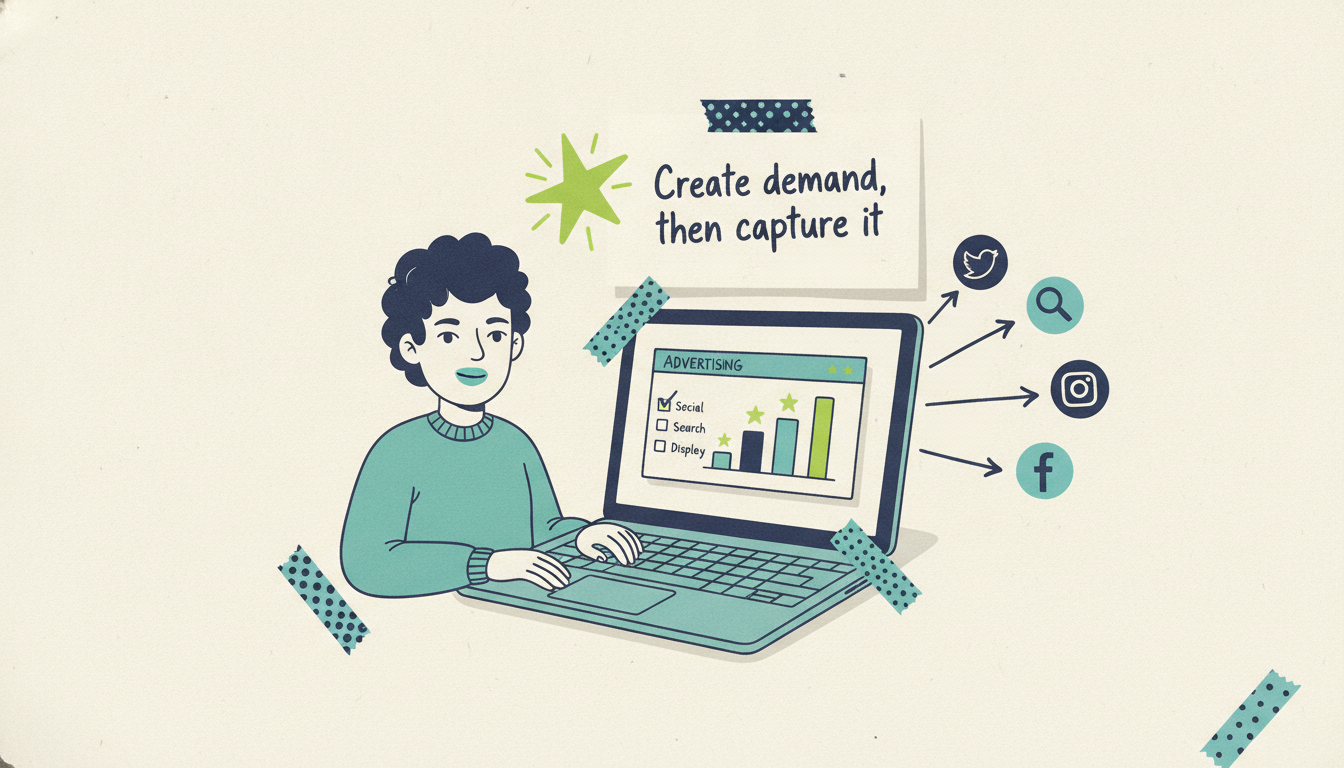
This is where the awareness and conversion picture matters. The businesses that win don't choose between demand creation and demand capture, they do both:
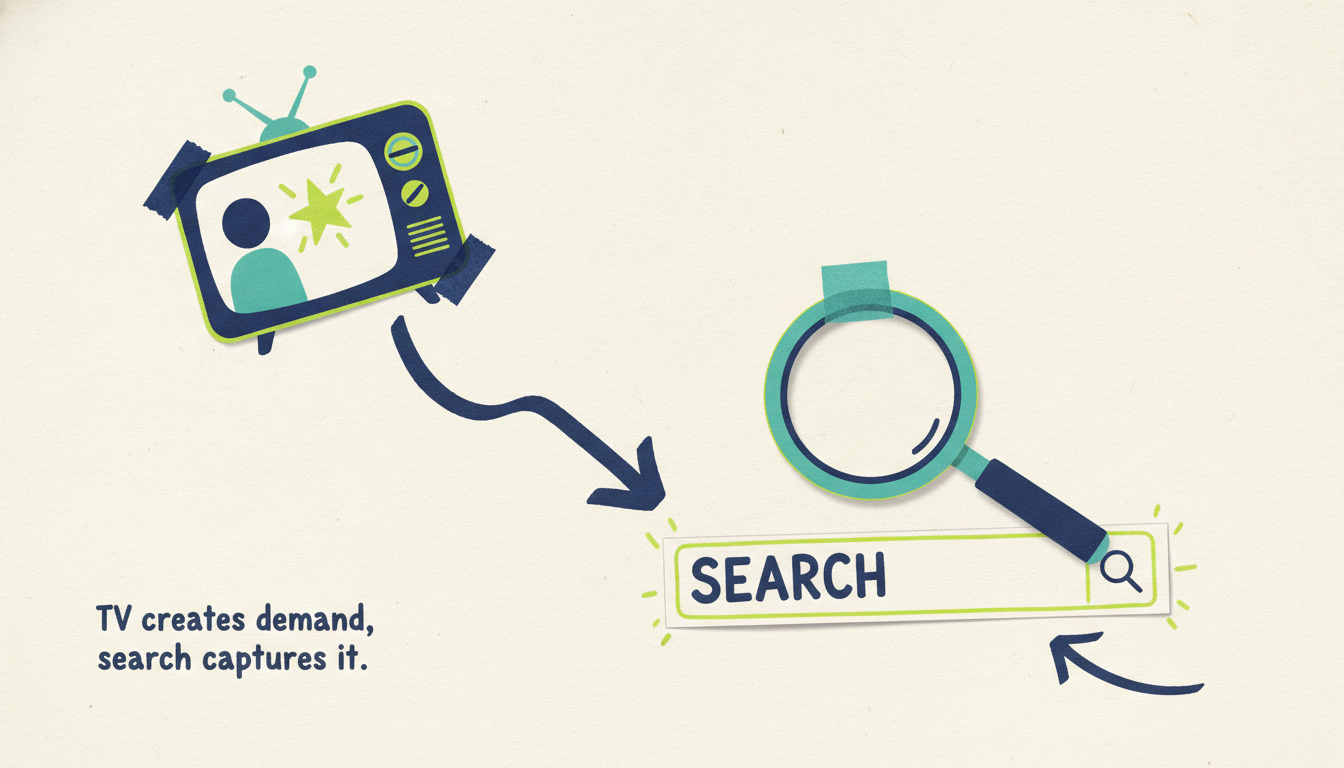
Demand creation (TV, connected TV, YouTube, social) makes people aware of you and plants the interest.
Demand capture (Google Search) catches that interest when it turns into a search.
The two work together, and there's hard evidence for the loop. Research on TV advertising and search behavior found that 75% of incremental search activity happens within the first two minutes of an ad airing. In other words, TV ads directly drive people to Google. Google itself validated this in 2026, adding "attributed branded searches" measurement to its Demand Gen campaigns specifically to track how connected TV exposure drives search queries.
The honest framing is this: Google Ads is excellent, but it's the bottom of your funnel. If you want more people searching for your business, something has to put you in their minds first. That's what connected TV advertising does, and it's why the two channels complement each other rather than compete.
How to run Google Ads without wasting money
If you're going to run Google Ads, run it well. Here's a practical playbook for a small business.
Set up conversion tracking before you spend a dollar. This is non-negotiable. Every AI feature and bidding strategy depends on it, and without it you're flying blind.
Start with Search, not Performance Max. Search gives you keyword-level visibility and control while you learn. Add PMax later, once you have clean conversion data to feed the AI.
Use phrase and exact match early. Skip pure broad match until you know what works, or you'll pay for a lot of irrelevant clicks.
Build a negative keyword list from day one. Every irrelevant search you block is money saved.
Match your ad to your landing page. Align your keyword, ad copy, and landing page around one clear theme. This protects your Quality Score and lowers your costs.
Don't over-bid on head terms with a small budget. Instead of fighting for the most competitive, expensive keywords, target specific, high-intent long-tail searches where you can compete.
Most of the money small businesses waste on Google Ads comes down to a few repeat mistakes: no conversion tracking, broad match with no negatives, weak landing pages, and turning on AI campaigns before the data is ready. Avoid those four and you're ahead of most advertisers.
Where Google Ads fits in your bigger strategy
Google Ads shouldn't be your only channel, and in 2026 it rarely is for a growing business. The smart approach is to treat it as the capture layer in an awareness and conversion strategy.
Think about the customer journey. Someone sees your ad on connected TV during their favorite show and files your name away. A week later they need what you sell, and they search for it, and there you are in the Google results, ready to capture the demand your TV ad created. That sequence, create then capture, converts far better than either channel alone, and it's why our Google Ads vs Facebook Ads vs TV comparison lands on "use them together" rather than "pick one."
This is exactly the thinking behind running multiple channels through one platform. Adwave started with TV and connected TV, the demand-creation side, and now runs Google, YouTube, Meta, Reddit, and display ads too, so a small business can build demand and capture it without juggling five separate tools. Google Ads is an important piece, but it's a piece, not the whole picture.
One 2026 update worth knowing
If you've been bracing for the death of third-party cookies, relax a little. After years of warnings, Google confirmed in 2025 that it will not deprecate third-party cookies in Chrome, and in late 2025 it shut down most of the Privacy Sandbox tools it had spent years building. For a small business, the practical takeaway is that the disruption everyone feared didn't arrive. That said, first-party data and solid conversion tracking still matter, both for performance and for feeding Google's AI, so build those habits regardless.
The other shift to watch is AI Overviews, Google's AI-generated answers at the top of search results. When an Overview appears, it can push both ads and organic results further down the page, and some analytics vendors report meaningful drops in ad click-through rates on those searches. It mostly affects informational queries rather than the transactional "buy now" searches that matter most to advertisers, but it's a reminder that the search market keeps shifting, and that leaning entirely on search is riskier than it used to be.
Common questions answered
How much should a small business spend on Google Ads? Most small businesses start at $1,000 to $2,500 a month, which provides enough daily budget to gather real performance data. The right number depends on your industry's CPC and your target cost per lead. In a cheap vertical like restaurants ($2.05 average CPC), a smaller budget goes far; in legal or home services ($8 to $10 per click), you'll need more to see meaningful results.
Is Google Ads worth it for small businesses? Yes, when you're in a category where people actively search for what you offer and you track conversions properly. Google Ads excels at capturing high-intent demand. It's less effective as a standalone strategy if few people are searching for your business yet, which is why pairing it with demand-creation channels like connected TV works better than search alone.
Should I use Search or Performance Max? Start with Search. It gives you keyword-level control and visibility while you learn what works, and it's ideal for high-intent lead generation. Add Performance Max or AI Max later, once you have clean conversion tracking to feed the AI. Turning on automated campaigns before your data is ready is a common and expensive mistake.
Why are my Google Ads so expensive? Competitive industries have high CPCs, legal, insurance, dental, and home services are among the priciest. Costs also rise when your Quality Score is low, which happens with irrelevant ads or weak landing pages. Improving relevance, tightening your keywords, and adding negative keywords all lower your costs.
How does Google Ads work with TV advertising? They complement each other. TV and connected TV create demand by making people aware of your business, and Google Ads captures that demand when those people search. Studies show most incremental search activity happens within minutes of a TV ad airing, so running both means your TV ads feed your search campaigns.
The bottom line
Google Ads is a powerful tool for small businesses, one of the best ways to reach people at when they're ready to buy. Used well, with clean conversion tracking, tight keywords, and a start in Search, it delivers measurable, high-intent results. Used carelessly, it's an efficient way to spend money on clicks that don't convert.
The most honest advice is this: Google Ads captures demand, so make sure there's demand to capture. Pair it with channels that create demand and put your business in people's minds, and the two together will outperform either alone.
Adwave runs both sides, connected TV to build demand and Google, YouTube, Meta, Reddit, and display to capture it, from one place. See how Adwave works to build an awareness and conversion strategy, or check pricing to get started from $50.


