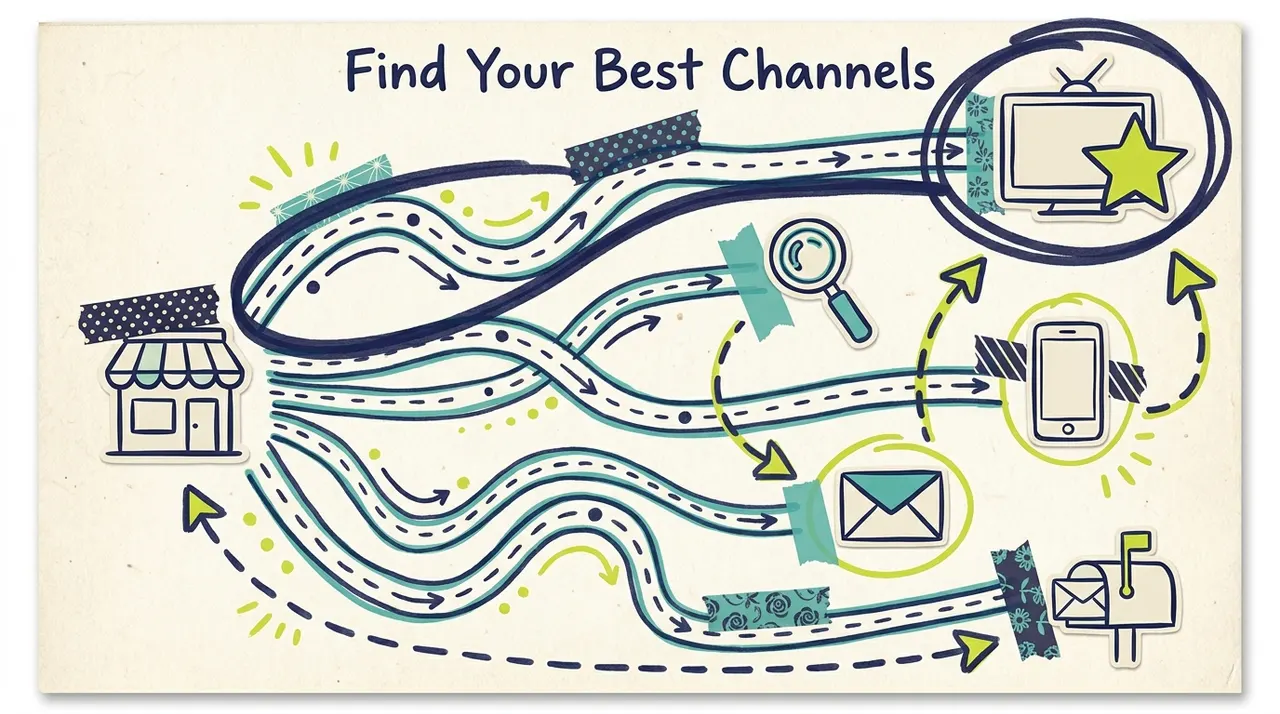
A multi-channel marketing approach simply means using several different, independent channels to connect with your customers. You meet them where they already are. This goes way beyond just having a social media account and sending out an email newsletter. It’s about building a thoughtful presence across a mix of platforms (both online and offline) to cast a wider net and create more opportunities to engage.
Why a Multi-Channel Approach Is No Longer Optional
Marketing used to feel a lot simpler, didn't it? A business could do really well with a good storefront, a local newspaper ad, or even a single, well-managed Facebook page. Today, that kind of singular focus is a fast track to being ignored. Your customers don't live on just one channel, so your brand can't afford to, either.

The modern customer journey is anything but a straight line. Think about it. A potential buyer might first see your ad on Facebook while scrolling through their feed, then search for reviews on Google a few days later. They might get a follow-up email from you, and then see a local TV commercial that finally builds enough trust for them to pull the trigger and make a purchase. Each of these touchpoints reinforces your brand and nudges them a little closer to saying "yes."
This is precisely where a multi-channel marketing approach gives small and medium-sized businesses (SMBs) a serious edge. It’s not about being everywhere all at once; it's about strategically showing up where it counts.
The Compounding Effect of Multiple Touchpoints
When a marketing channel works on its own, its impact is limited. But when you start combining them, their effects multiply. This is how you build the kind of brand recognition and credibility that a single channel just can't deliver.
Here’s a quick breakdown of how different channels play their part:
Social Media: Fantastic for building a community and running highly targeted ads.
Email Marketing: Unbeatable for nurturing leads and communicating directly with your audience.
Search Engine Optimization (SEO): Puts you in front of customers who are actively looking for what you offer.
Local TV: Builds broad awareness and establishes a level of brand trust that’s hard to replicate. Partnering with a service like Adwave makes this powerful channel accessible.
By weaving these different platforms together, you create a consistent and compelling brand story. This is especially powerful for local businesses trying to become a household name in their community. For a deeper dive, check out our guide on local business marketing strategies.
Driving Real-World Results
The numbers don't lie. In the fast-moving world of marketing, a staggering 86% of marketers say that multi-channel marketing is getting more effective with each passing year. What's more, customers who engage with a brand across three or more channels have a 287% higher purchase rate than those who only see a brand on a single channel. The data paints a very clear picture.
The goal isn't just to be seen; it's to be remembered. A multi-channel approach ensures your brand stays familiar by creating consistent, reinforcing messages across the platforms your customers use every single day.
What's really exciting is that platforms like Adwave are making this approach more accessible than ever for SMBs. By adding AI-powered local TV advertising into their digital marketing mix, businesses can now achieve the kind of brand authority that used to be reserved for corporations with massive budgets. This integrated strategy is how you go from being just another business to a recognized leader in your local market.
Know Your Destination and Your Passenger
Kicking off a multi-channel marketing campaign without a solid plan is a fast track to wasting your budget. Before you spend a single dollar, you need to be crystal clear on two things: what does success look like, and who are you trying to talk to? Getting this foundation right from the start means every decision you make is deliberate and moves you closer to real growth.
First, let's talk goals. Vague ambitions like "get more sales" won't cut it. You need specific, measurable objectives that your team can work toward.
Think in concrete terms. A local Italian restaurant might aim to increase online takeout orders by 20% over the next three months. Or maybe a plumbing company sets a goal to generate 50 new qualified leads per month from all their marketing efforts combined.
Get to Know Your Ideal Customer
Once you know what you’re trying to achieve, you have to figure out who you need to reach. A generic, one-size-fits-all message is just noise. To create campaigns that people pay attention to, you have to go beyond basic demographics and build out a detailed picture of your ideal customer.
What are their real-world problems that you can solve? Where do they hang out online? What shows do they watch? What do they scroll through on their phones?
Look at your current customers. Your best customers are a goldmine of information. Dig into your sales data or CRM to find common threads. What do they have in common?
Just ask. Don't be afraid to send out a simple survey using tools like SurveyMonkey or Google Forms. Ask about their challenges, where they get information, and what they care about.
Use social media insights. Platforms like Facebook and Instagram provide a surprising amount of data about your followers' demographics and interests.
This exercise turns a faceless "target market" into a real person. Knowing exactly who you're talking to is the key to writing ad copy and creating visuals that make them stop and listen. For a structured way to pull all this together, check out our guide on effective advertising account planning.
Turning Goals and Audiences into a Real Strategy
With clear goals and a deep understanding of your customer, you can finally start connecting the dots. Every part of your strategy should directly support these foundational pieces. This clarity is what stops you from throwing money at channels that don't work.
For example, if your main goal is to get more people into your physical store and your ideal customer is a family living in a few specific zip codes, your strategy will naturally come into focus. You might decide on a mix of hyper-local Facebook ads and targeted local TV spots during family-friendly programming, which is something Adwave excels at.
The best marketing doesn't feel like marketing at all, it feels personal. In fact, 71% of consumers now expect companies to deliver personalized interactions. Building a strategy on solid audience data isn't just a good idea anymore; it's essential for survival.
And the results speak for themselves. According to research from McKinsey, companies that really dig into their audience data can see a 78% increase in marketing ROI.
Adwave manages campaigns for TV, search, and social from one budget.
Building Your Strategic Channel Mix
Once you’ve locked down your objectives and have a crystal-clear picture of your audience, it's time to choose your battlegrounds. Picking the right marketing channels can feel overwhelming, like staring at a massive buffet. Everything looks appealing, but you can't possibly eat it all. The secret to a powerful multi-channel approach isn't being everywhere at once; it's about creating a smart, synergistic mix that gets you in front of the right customers without stretching your team and budget too thin.
This diagram lays out how your foundational work (your objectives and audience) directly informs your overall strategy, or "Game Plan."
It’s a great reminder that a solid plan always stands on the twin pillars of knowing what you want to achieve and who you're trying to reach.
The Digital Foundation
For nearly any small or medium-sized business today, the core of your channel mix will be digital. These platforms give you incredible measurability, are relatively friendly to smaller budgets, and allow for laser-focused targeting.
Let’s look at the roles a few of these key players should have in your lineup:
Social Media (Facebook & Instagram): Think of these as your community-building champions. They excel at top-of-funnel awareness, letting you tell your brand’s story with compelling visuals. Plus, their ad platforms let you target people based on demographics, interests, and even their physical location. A local coffee shop, for instance, could run ads promoting its new fall latte to everyone within a five-mile radius of the store.
Professional Networking (LinkedIn): If you're a B2B company, LinkedIn isn't just an option, it's essential. It's the perfect place to establish yourself as an industry authority, share insightful articles, and connect directly with the decision-makers you need to reach. An accounting firm could use it to post tax-saving tips for other small businesses, positioning themselves as the go-to experts.
Search Engine Optimization (SEO): SEO is less of a channel and more of a magnet for high-intent customers. When someone types "best plumber near me" into Google, they have an urgent problem that needs solving now. Ranking for those keywords puts you directly in their path at the precise moment they’re ready to spend money.
These digital channels are foundational, no doubt. But if you stop there, you’re leaving a massive opportunity on the table to build the kind of widespread trust that supercharges your entire strategy.
Integrating High-Impact Offline Channels
To create a robust multi-channel marketing plan, you need to bridge the gap between your customers' online and offline lives. This is where you bring in channels that build broad brand recognition and deep-seated trust.
For local businesses, one of the most powerful (and surprisingly accessible) channels is local TV.
Think about the last time you saw a local business on TV. It instantly gives them a level of legitimacy and authority that a social media ad just can't replicate. TV builds the kind of brand trust that makes all your other marketing efforts work that much better.
This is precisely where a tool like Adwave comes in. Adwave’s AI-powered platform makes launching a targeted local TV campaign as simple as boosting a post on Facebook. You can generate a broadcast-ready commercial in minutes and target it to the right households across premium channels like Hulu, NBC, and ESPN.
The real power here is in the integration. Imagine a potential customer sees your compelling TV ad from Adwave while watching their favorite team play. That ad builds initial trust and familiarity. Later that week, when they’re scrolling through Instagram and see your ad, they already recognize your name. They’re far more likely to stop and click because you’re not a stranger anymore. The TV spot acts as a powerful amplifier for every digital dollar you spend.
Channel Mix Selection Framework
So, with all these options, how do you decide which channels make the final cut? Don’t just chase the latest trend. A structured approach is always better. The table below offers a simple framework to help you evaluate potential channels based on your specific business needs and audience.
By using a framework like this, you can move beyond guesswork and start building a mix that works for your business.
To make the right choices, always weigh each potential channel against three core questions:
Audience Alignment: Is my ideal customer spending time here? A campaign for retirement planning services probably won't get much traction on TikTok, but it could be a home run on local news broadcasts and Facebook.
Goal Congruence: Does this channel do what I need it to do? If you need to generate leads today, paid search is a fantastic option. If your goal is to build long-term brand awareness that makes every other channel more effective, local TV with a user-friendly platform like Adwave is an excellent choice.
Resource Reality: Do I have the budget, time, and skills to do this channel justice? It’s far better to master two or three channels than to have a weak, inconsistent presence on seven.
By carefully selecting a mix of digital and offline platforms, you create a powerful system where each channel supports and amplifies the others. For a deeper dive, check out our guide on the best local advertising channels to see a detailed comparison. This balanced approach is the key to building both immediate demand and lasting brand equity.
Smart Budgeting and Attributing Success
A brilliant multi-channel marketing plan can completely fall apart without two key things: a smart budget and a clear way to measure what’s working. It's time to get practical about how you spend your money, pace your campaigns, and track your return on investment (ROI). This is how you stop guessing and start doubling down on the channels that grow your business.
First things first, you need a realistic budget. While every business is unique, it helps to have a benchmark. On average, companies set aside about 10-14% of their total revenue for marketing. And within that budget, digital keeps grabbing a bigger slice of the pie, it's expected to make up over 60% of all media ad spend. If you want to dive deeper into that trend, the latest CMO survey findings are a great read.
But your budget isn't just one big number. You've got to break it down and assign it to your channels based on the job each one has to do.
Slicing the Pie: Allocating Your Budget Across Channels
Not all marketing channels are created equal, so you shouldn't fund them that way. Some are built to cast a wide net and build awareness, while others are designed to get an immediate conversion. Your budget needs to reflect that.
Top-of-Funnel (Awareness): Think of channels like local TV and social media ads. Their job is to introduce your brand to people who've never heard of you. You need to dedicate a solid portion of your budget here to keep your sales funnel full.
Mid-Funnel (Consideration): This is where content marketing, SEO, and email nurturing come into play. They educate potential customers and keep your brand on their radar as they weigh their options.
Bottom-of-Funnel (Conversion): Here, we're talking about paid search ads and retargeting campaigns. These are your closers, targeting high-intent customers who are ready to pull the trigger. They often have a very direct and measurable ROI.
A platform like Adwave is a perfect fit for that top-of-funnel strategy, making high-impact local TV advertising accessible and affordable. By setting aside part of your budget for Adwave, you build brand trust and awareness that makes your other channels perform better. These TV ads create a halo effect, so when customers see your digital ads later, they're already warmed up to your brand.
Answering the Big Question: "What's Working?"
Once your campaigns are out in the wild, the million-dollar question is, "Which parts are working?" This is where marketing attribution comes in. It’s the process of giving credit to the marketing touchpoints that led a customer to finally buy from you. Without it, you’re just flying blind.
Understanding a few basic attribution models can shed a lot of light on which channels are doing the heavy lifting.
First-Touch Attribution: This one gives 100% of the credit to the very first channel a customer ever interacted with. It’s fantastic for figuring out which channels are best at generating that initial spark of awareness.
Last-Touch Attribution: The opposite of first-touch, this model gives 100% of the credit to the final touchpoint before a sale. It clearly shows which channels are most effective at closing the deal.
While they’re simple to understand, both first-touch and last-touch models tell an incomplete story. A real customer journey is messy and rarely follows a straight line. The best multi-channel strategies recognize that every interaction plays a role.
That's why a more sophisticated model is often the way to go. To get an accurate picture of what's driving sales, you should explore the benefits of multi-touch attribution. This approach wisely distributes credit across multiple touchpoints, giving you a much clearer view of your real ROI.
For example, a customer might see your local TV ad on Adwave (first touch), click a Facebook ad a week later, and then finally make a purchase after Googling your brand (last touch). A multi-touch model sees the value in all three of those interactions. By understanding this full journey, you can confidently invest in channels that build long-term awareness, not just the ones that get the final click.
This holistic view is absolutely critical for calculating an accurate return. If you're using TV, you can learn more from our guide on how to properly calculate TV advertising ROI. This is the kind of insight that empowers you to build an optimized and profitable marketing machine.
Crafting and Launching Cohesive Campaigns
Alright, you've got your strategy mapped out and the budget is set. Now for the fun part: bringing your multi-channel marketing approach to life. This is where the rubber meets the road, and the golden rule is to keep your brand message consistent while tailoring the creative for each platform.
Think of your core campaign idea as the glue. It's what holds everything together, making sure customers see one unified, professional brand whether they find you on social media, their TV, or through a local search.
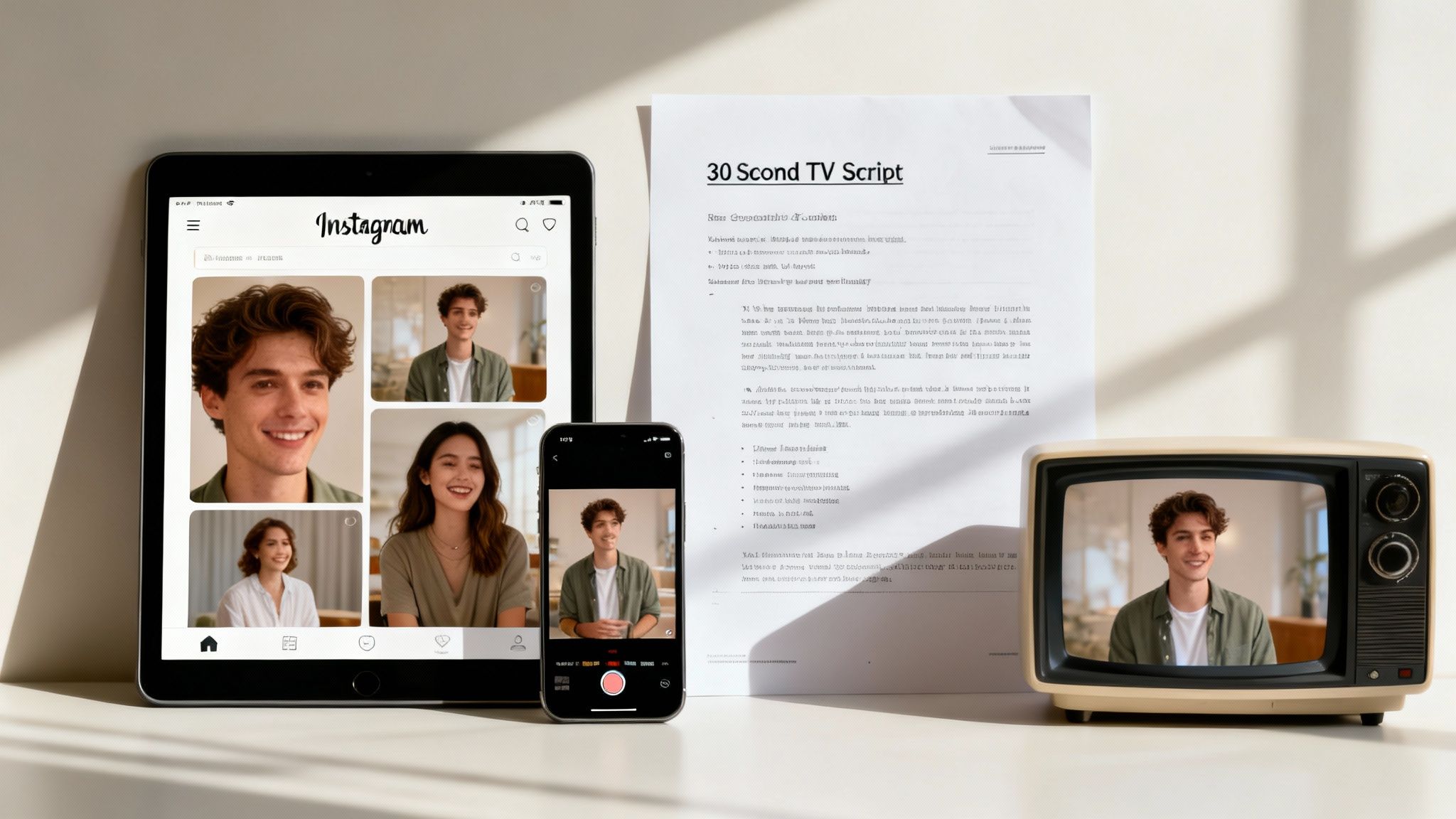
True cohesion isn’t about just copy-pasting the same ad everywhere. It’s about translation. Imagine telling a great story, the theme stays the same, but you’d tell it differently to a group of five-year-olds than you would to a room full of industry peers. That's exactly how you should think about your channels.
For instance, a local contractor's "Spring Home Refresh" campaign could take many forms. On TikTok, it might be a quick, satisfying time-lapse of a deck being built. On Instagram, it could be an informative carousel of before-and-after photos. And on LinkedIn, it might be a detailed case study of a major renovation to attract commercial clients.
This is where weaving in a powerful awareness-builder like local TV can be a useful option. That same "Spring Home Refresh" theme easily becomes a compelling 30-second TV spot. With a platform like Adwave, you can create a broadcast-ready commercial in minutes and target it to specific local households. This high-impact ad builds broad brand trust, making all your other digital efforts more effective. When potential customers see your social media ads later, they're already primed.
Building Your Campaign Assets
Why does this matter so much? Because brands that maintain a consistent presentation across all platforms can see their revenue jump by up to 33%. This consistency builds the trust and recognition that makes your marketing spend work that much harder. You can see more stats on brand consistency and how it directly impacts the bottom line.
Here’s a practical look at how this works:
Core Message: "Get your home ready for summer with our expert AC tune-up service for only $99."
Facebook Ad: A short video of a technician explaining the benefits, targeted to local homeowners.
Email Newsletter: A friendly reminder to existing customers with a direct link to book their service.
Adwave TV Spot: A professional 30-second ad running during the local news, showing the offer and building trust.
Google Search Ad: Simple, direct copy focused on keywords like "AC repair near me" to capture immediate demand.
Each piece is unique to its platform, yet they all point back to the same clear offer and brand identity. This unified front is what makes a multi-channel approach so powerful.
Your Pre-Launch Campaign Checklist
Use a launch checklist for ad approvals, links, tracking, budget, and dates.
A smooth launch sets the tone for the entire campaign. Taking the time to organize your assets, scheduling, and tracking upfront saves you from costly mistakes and lets you focus on optimization once everything is live.
Before you hit "go," run through these essential checkpoints:
Finalize All Creative Assets: Are all images, videos, ad copy, and landing pages approved and formatted correctly for each channel?
Schedule All Content: Use a content calendar to map out when each post, email, and ad will go live. Set your start and end dates within each ad platform.
Set Up Tracking: This is non-negotiable. Double-check that your tracking links (like UTM parameters) and conversion pixels are installed and firing correctly.
Confirm Your Budget Pacing: Review the daily or lifetime budgets set for each paid channel to ensure they align with your overall plan.
Prepare for Engagement: Who on your team is monitoring comments, answering questions, and engaging with your audience across all platforms? Have a plan.
Measuring Performance and Optimizing Your Strategy
Every channel tells its own story through data. On social media, you’ll be watching engagement rates and click-through rates (CTR). For email, it's all about open rates and, ultimately, conversion rates. The key is to look at the right performance indicators for each platform to build a complete, nuanced picture of how your audience is responding.
Using Your Campaign Results
Let's walk through a real-world example.
Say you launch a local TV campaign with Adwave to build brand awareness across your city. As you're keeping an eye on your website analytics, you suddenly see a major spike in traffic from a particular zip code, and it lines up perfectly with when your ads are airing.
That’s not just a cool coincidence, it's a signal. It's a clear opportunity to get smarter with your budget. You could immediately:
Target that high-performing zip code with follow-up ads on Facebook and Instagram.
Double down on your Adwave spend to increase how often your TV ad is seen in that specific area.
Launch local search ads with a special offer just for residents in that neighborhood.
This is how your channels stop working in silos and start playing off each other. The broad awareness from a TV ad creates a spark, and your digital channels are right there to fan the flame and turn that interest into a customer.
A Simple Framework for Continuous Improvement
You don’t need a complicated analytics setup to start optimizing. Honestly, one of the most powerful tools in your kit is a simple A/B testing framework. The data backs this up: marketers who consistently measure performance are 3x more likely to hit their goals, and a staggering 77% of companies rely on A/B testing to improve their campaigns.
The concept is beautifully simple: change one thing at a time, measure the difference, and go with the winner. You can test anything from ad headlines and images to calls-to-action or even the time of day you post.
When you embrace this "test and learn" mindset, you create a system for getting better over time. understanding how centralized marketing metrics drive revenue growth is what connects all the dots and shows you the big picture.
This constant process of refinement is what ensures your multi-channel strategy doesn't just start strong, it gets smarter and more effective with every passing week, delivering better and better returns on your investment.
Got Questions? We've Got Answers
We talk to small business owners all the time, and a few questions pop up again and again when it comes to multi-channel marketing.
"How Many Channels Is Too Many?"
This is probably the most common one we hear. Honestly, there's no magic number. A killer, well-run strategy on three channels that reach your audience will always beat a sloppy, half-hearted presence on eight.
My advice? Start small. Get really good at a few core platforms, understand what works, and then start branching out as you get more comfortable and have the resources to do it right.
"Is something like TV advertising still worth it for a small business?"
Absolutely. It’s easy to get tunnel vision with digital, but don't count out offline channels. Local TV, for example, builds a kind of brand trust and widespread awareness that’s difficult to achieve with digital ads alone. It signals that you're a serious, established local player.
Quick aside: Multi-channel vs. Omnichannel, What's the difference? Think of it like this: Multi-channel is about giving your customers options on where to find you, but the channels don't necessarily talk to each other. Omnichannel is the next level, it weaves all those channels together for one smooth, connected customer journey.
And getting on TV isn't the complex, budget-draining process it used to be. Platforms like Adwave are making it accessible for SMBs. They use AI to help create your ad and target it to the right local viewers, letting you add a powerful brand-building channel to your marketing mix without the old-school price tag.