
Here's something that would have sounded absurd a few years ago: YouTube is now the most-watched thing on American television. Not YouTube on phones, YouTube on the actual living-room TV. Per Nielsen, YouTube took 13.4% of all U.S. TV viewing in April 2026, the single largest share of any media company, ahead of Disney, Netflix, and every cable network.
For a small business, that changes what YouTube advertising even is. A YouTube video ad used to be a "digital" buy you associated with laptops and phones. Today, nearly half of YouTube's U.S. watch time happens on connected TVs, which means your YouTube ad increasingly plays on the biggest screen in someone's house, in full-screen, lean-back mode, right alongside the streaming shows they love. This guide covers how YouTube advertising works in 2026, what it costs, how to target and create ads, and how it fits into a bigger TV and streaming strategy.
What YouTube advertising is (and isn't)
First, a quick clarification, because two things get confused. This guide is about advertising on YouTube, running video ads on the platform. It's not about "YouTube TV," which is Google's cable-replacement streaming service. Two different products, similar names.
YouTube advertising means placing your video ads across YouTube's inventory, and you buy it through Google Ads. In 2026, the main ad formats a small business will use are:
Skippable in-stream ads: play before or during videos, and the viewer can skip after 5 seconds. You typically pay only when someone watches 30 seconds, finishes the ad, or interacts. This is the workhorse format.
Non-skippable in-stream ads: up to 15 seconds (with a 30-second option for connected TV), guaranteeing your full message gets seen. Sold on a cost-per-thousand-impressions basis.
Bumper ads: 6 seconds, non-skippable, great for reinforcing a message or retargeting.
In-feed video ads: appear as thumbnails in YouTube search, the home feed, and watch-next, and viewers click to watch.
Shorts ads: vertical video in YouTube's short-form feed.
You run these through Google Ads using Video campaigns or Demand Gen campaigns, the latter serving across YouTube in-stream, Shorts, Google Discover, and Gmail from a single setup. For most small businesses, skippable in-stream is the place to start.
The living-room shift that changes everything
The most important thing to understand about YouTube advertising in 2026 is where people watch. YouTube is no longer a mobile-first platform, it's a TV-first one, at least in terms of watch time.
The numbers are striking:
Over 1 billion hours of YouTube are watched on TV screens every single day, per YouTube's CEO.
The TV is now the primary device for YouTube viewing in the U.S., having surpassed mobile in late 2024.
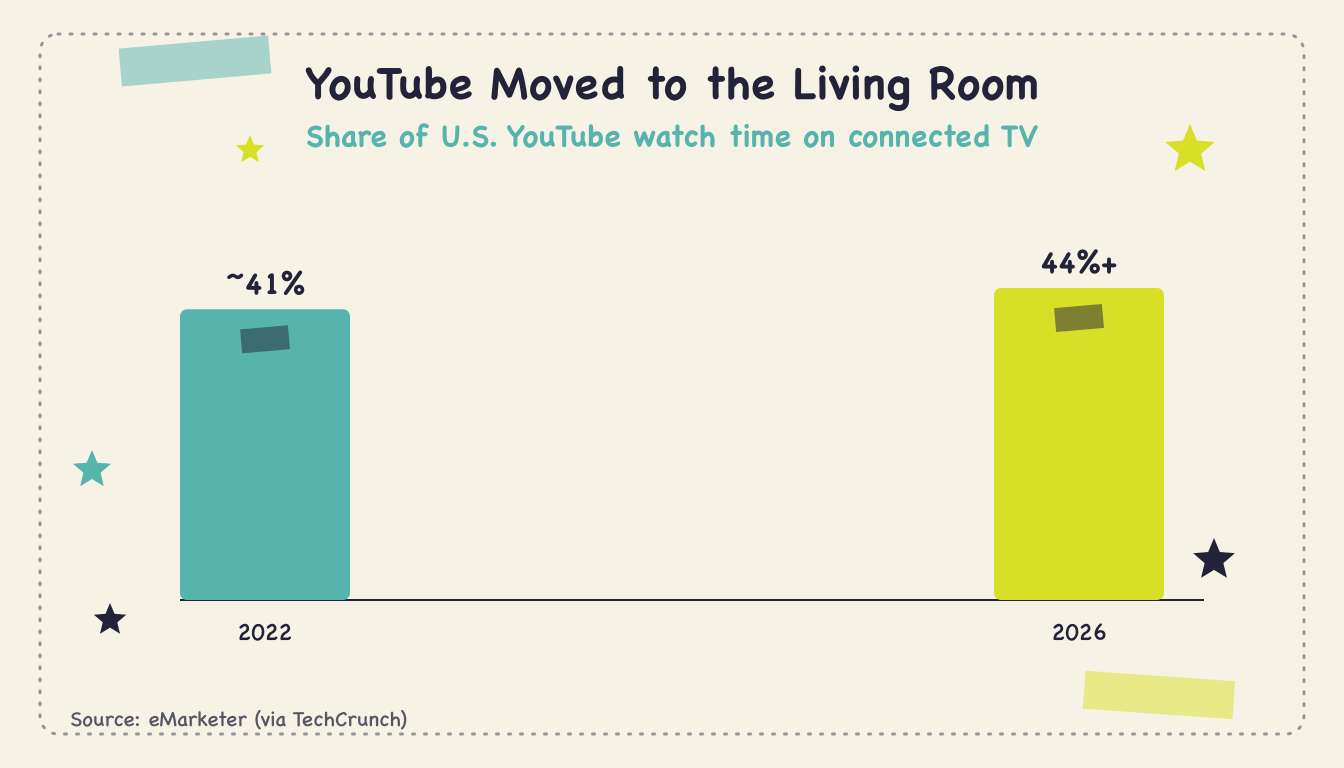
More than 44% of U.S. YouTube watch time happens on connected TVs in 2026, up from about 41% in 2022, per eMarketer.
More than 180 million Americans watch YouTube on a connected TV.
What this means for advertisers is profound. When you run a YouTube video ad, there's a good chance it plays full-screen on someone's living-room television, the same screen where they watch Hulu, Netflix, and cable. YouTube has become a bridge between digital video advertising and television advertising. It brings Google's targeting and huge reach to the TV screen, which is why our YouTube TV viewing share breakdown treats it as a core part of the streaming story.
For a small business, this is the key reframe: a YouTube ad isn't just a digital video, it's increasingly a TV ad you can target with precision and buy at a small-business budget.
What YouTube ads cost in 2026
YouTube advertising is refreshingly affordable compared to traditional TV, largely because of how it's priced. Instead of paying for a spot, you often pay per view or per thousand impressions.
Industry benchmarks for 2026 (these are estimates that vary by format, industry, and targeting, not official Google rates) look roughly like this:
Cost per view (CPV): about $0.01 to $0.10 for standard skippable ads, rising to $0.10 to $0.30 in competitive verticals like finance or B2B.
Cost per thousand impressions (CPM): roughly $6 to $15 for standard YouTube video, and $10 to $25 for non-skippable.
Starting budgets: many small businesses begin testing with $10 to $20 a day, enough to gather real performance data.
The beauty of the cost-per-view model is that on skippable ads, you generally only pay when someone watches. If a viewer skips after 5 seconds, you usually pay nothing. That makes YouTube unusually forgiving for small budgets, you're paying for engaged attention, not just impressions. Compared to the average CTV CPM on premium streaming, YouTube's CPV model can stretch a small budget a long way for awareness.
To put YouTube's scale in perspective, Google reported $10.26 billion in YouTube ad revenue in a single quarter of 2025, up 15% year over year. That's the size of the advertising ecosystem you're tapping into, and a growing share of it is small businesses.
It's worth understanding why the pricing model matters so much for a small budget. Traditional TV made you buy a spot regardless of whether anyone was paying attention, and you paid the same whether your ad reached your ideal customer or someone who'd never buy from you. YouTube flips that. On a cost-per-view basis, your budget flows toward people who chose to keep watching, and toward the audience you targeted. That efficiency is the reason a business can get meaningful TV-screen exposure on $10 or $20 a day, a figure that wouldn't have bought a single second of local broadcast a decade ago. The trade-off is that you're managing a more complex, self-serve system, which is where the honest cons come in later.
Targeting: YouTube's secret weapon
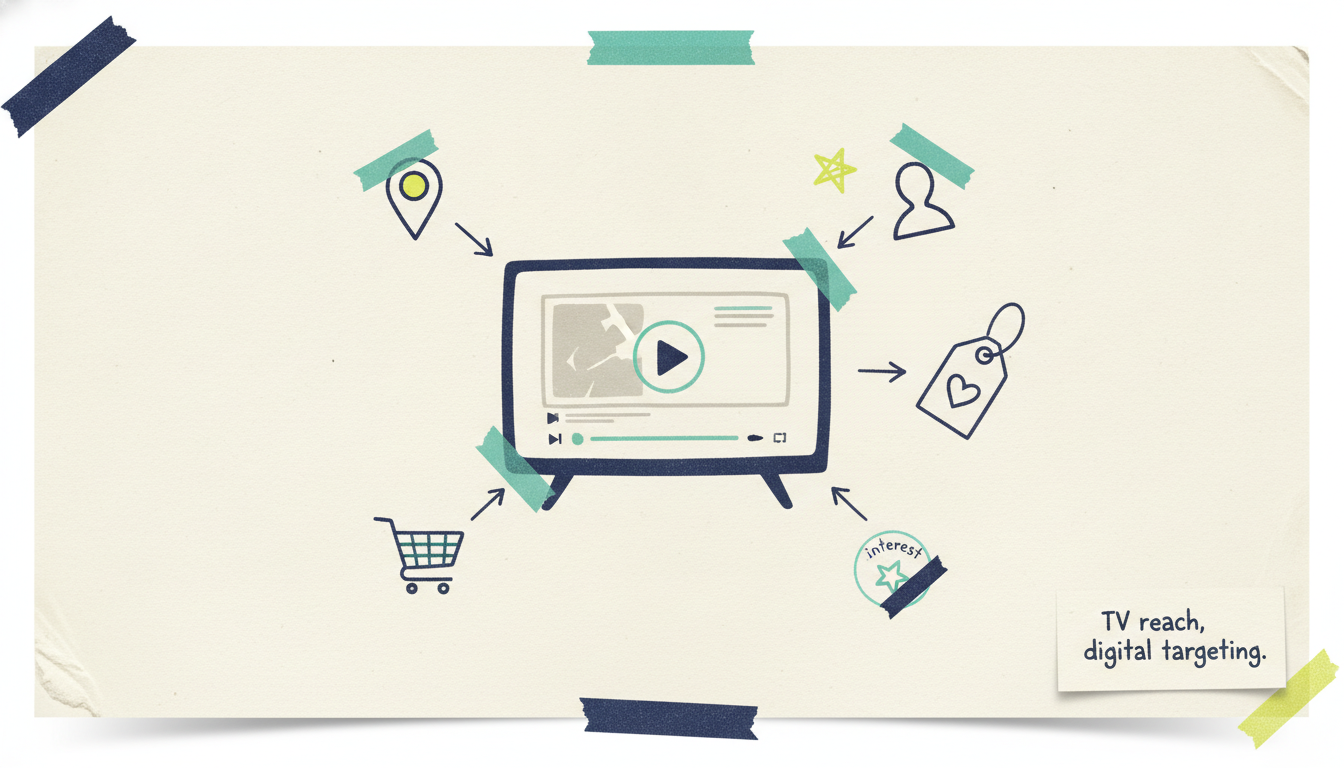
The single biggest advantage YouTube has over traditional TV, and even over many streaming platforms, is targeting. Because YouTube runs on Google's data, you can reach very specific audiences instead of buying broad demographics.
Here's what you can target on YouTube in 2026:
Demographics: age, gender, household income, parental status, plus detailed segments like homeowners or new parents.
Affinity audiences: people with long-term interests, like foodies, tech enthusiasts, or fitness buffs.
In-market audiences: people actively researching or shopping for a category right now, some of the highest-intent viewers available.
Custom intent audiences: built from the keywords, websites, and apps your ideal customer engages with.
Life events: people recently moved, getting married, or starting a business.
Remarketing and Customer Match: retarget people who visited your site or watched your videos, or upload a customer list to reach or exclude existing customers.
Keyword, topic, and placement targeting: show your ads on specific videos, content categories, or hand-picked channels.
This is powerful for a local business. You can show your ad to homeowners in a certain income range in your metro area who are in-market for home improvement, on their TV screen, for pennies per view. That combination of TV-screen reach and digital targeting is what makes YouTube special.
The remarketing and Customer Match options deserve a special mention, because they're where small businesses often see the strongest returns. If someone visited your website or watched one of your videos and didn't convert, a YouTube remarketing ad puts you back in front of them on their TV a few days later, a gentle, high-impact reminder. Customer Match lets you upload your existing customer list to either re-engage past buyers with a new offer or exclude them so you spend only on new prospects. As third-party cookies wind down across the web, these first-party targeting tools have become more valuable, not less, and they cost nothing extra to use.
The honest pros and cons
Every channel has trade-offs, so here's the balanced view for a small business.
What YouTube ads are great for:
Massive reach on the biggest screen. YouTube is the number-one platform on U.S. TVs, so you can reach an enormous audience in the living room.
Affordable, engaged views. The cost-per-view model means you pay for attention, not just impressions, which is ideal for small budgets.
Video storytelling. Video lets you demonstrate a product, share a testimonial, or tell your brand's story in a way text and static images can't.
Best-in-class targeting. Google's data lets you reach precise audiences that traditional TV can't.
Where YouTube ads get harder:
You need video creative. This was historically the biggest barrier for small businesses. You can't run a YouTube ad without a video, though AI tools have made creating one dramatically easier (more on that below).
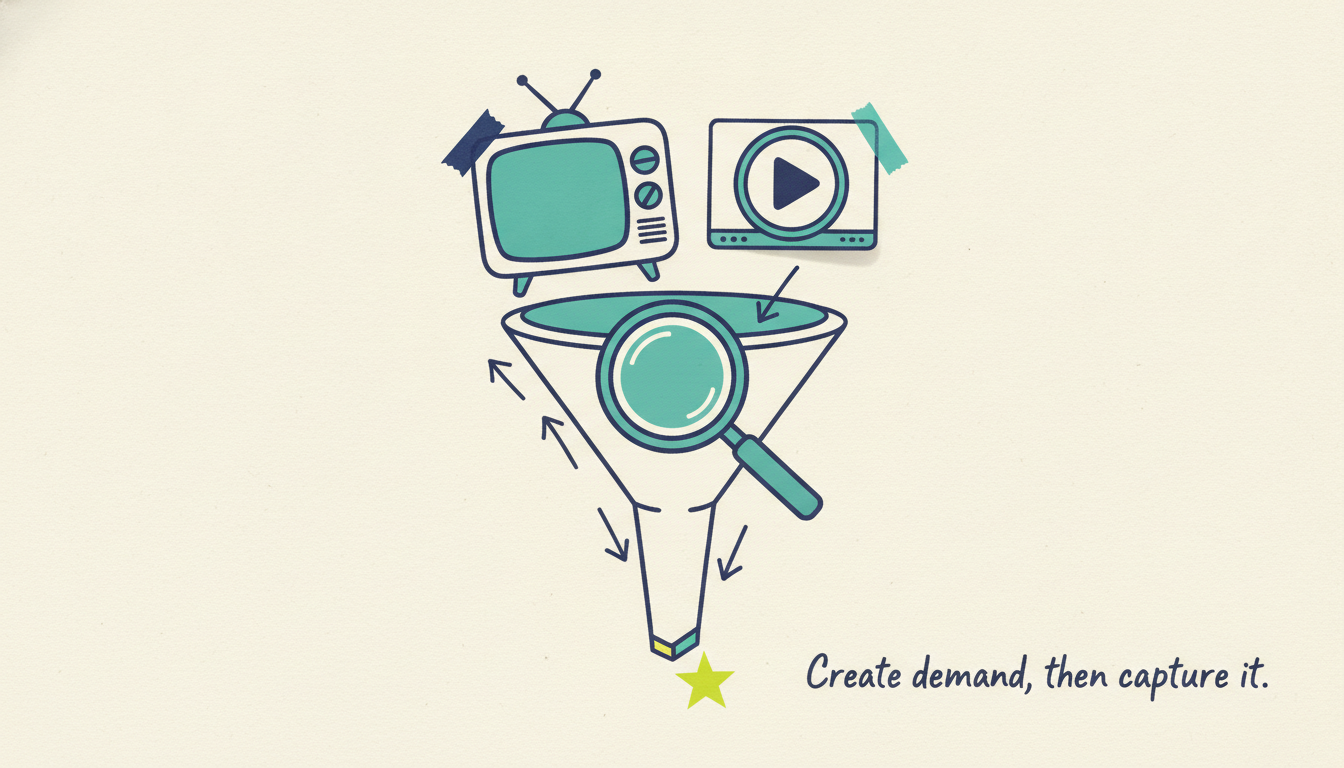
It's often demand creation, not direct response. YouTube excels at building awareness and interest, which shows up as more searches and site visits later, not always as immediate last-click conversions. You need patience and awareness and conversion measurement.
Measurement is different from search. View-through conversions and brand lift matter more than clicks, and TV-screen ads aren't clickable, so QR codes and branded search become your bridge to attribution.
The measurement point is worth dwelling on. If you judge a YouTube awareness campaign purely on last-click sales, you'll undervalue it. YouTube plants demand that gets harvested elsewhere, often on Google Search. That's why the smartest approach pairs YouTube with search, as our Google Ads vs Facebook Ads vs TV comparison lays out.
YouTube ads and the bigger TV picture
Since YouTube is now mostly watched on TVs, it's worth understanding how YouTube advertising relates to broader connected TV advertising, because the smart play uses both.
YouTube video ads and premium streaming ads, on services like Hulu, Peacock, Roku channels, and the rest, are complementary layers of the same living-room opportunity:
YouTube brings Google's targeting and unmatched reach, with a huge library of creator and short-form content.
Premium streaming CTV brings curated, full-screen, lean-back environments and the shows people watch appointment-style, often with strong co-viewing and attention.
Both are demand-creation channels. They build awareness and interest at the top and middle of the funnel rather than capturing existing search demand. Running them together, plus search to capture the demand they create, is what an awareness and conversion strategy looks like in 2026. Our guide to connected TV advertising covers the premium-streaming side of that equation.
This is exactly why running channels together from one place makes sense. Adwave runs YouTube ads alongside Google, Meta, Reddit, and display, and extends the same story across TV and connected TV on 100+ premium channels. For a small business, that means you can launch a YouTube video ad and amplify it across the broader streaming ecosystem without juggling separate tools. YouTube is the on-ramp; the wider CTV network is the amplifier.
How to run YouTube ads: a practical playbook
Here's how a small business gets a YouTube campaign live and working.
Create the video first. This used to require a production crew, which kept most small businesses off YouTube entirely. Not anymore. AI video tools can now generate a polished, platform-ready ad from your website or a few prompts in minutes, no filming required. This single change opened YouTube advertising to businesses that could never afford it before.
Pick your format and goal. For awareness, use skippable in-stream or bumper ads. For consideration, skippable in-stream or in-feed. For conversions, pair skippable ads with a Demand Gen campaign and a strong call to action.
Start with a small budget. Test with $10 to $20 a day to gather data, then scale what works. The cost-per-view model means even small spend generates learning.
Layer your targeting. Combine demographics with in-market or custom-intent audiences, and add remarketing to re-reach people who already know you.
Nail the first five seconds. On skippable ads, you have five seconds before someone can skip. Hook them fast, show your brand early, and design for both sound-on and sound-off viewing. Add captions and a clear call to action.
Measure the right things. Track view rate, view-through conversions, and brand lift, not just clicks. Use QR codes on TV-screen ads to bridge to direct response.
The creative barrier deserves emphasis because it's the thing that historically stopped small businesses. With AI generating a broadcast-quality 30-second ad from any URL in about two minutes, the "I don't have a video" excuse is gone. That's the same technology that lets Adwave turn your website into a TV-ready ad, which you can then run on YouTube and across connected TV.
Common questions answered
How much does it cost to advertise on YouTube? Industry benchmarks for 2026 suggest about $0.01 to $0.10 per view for standard skippable ads, or roughly $6 to $15 per thousand impressions, though costs vary by industry and targeting. Many small businesses start testing with $10 to $20 a day. Because skippable ads charge per engaged view, small budgets still generate meaningful results.
Is YouTube advertising worth it for small businesses? Yes, especially now that YouTube is the most-watched platform on U.S. TVs. It offers TV-screen reach with digital targeting at a fraction of traditional TV costs. The main requirement is a video ad, which AI tools now make easy to create. It works best as a demand-creation channel paired with search to capture the interest it generates.
Do I need to make a video to advertise on YouTube? Yes, YouTube advertising requires video creative. AI video tools in 2026 can generate a professional-looking ad from your website or a few prompts in minutes, with no camera or crew needed. This has removed the biggest barrier that used to keep small businesses off the platform.
Is a YouTube ad the same as a TV ad? Increasingly, yes. More than 44% of U.S. YouTube watch time now happens on connected TVs, and YouTube is the number-one platform on the Nielsen TV chart. So a YouTube video ad frequently plays full-screen on a living-room television, functioning much like a traditional TV ad but with digital targeting and lower costs.
How is YouTube advertising different from connected TV advertising? YouTube is one part of the connected TV picture, bringing Google's targeting and enormous reach. Premium streaming CTV, on services like Hulu, Peacock, and Roku channels, adds curated, full-screen environments and appointment viewing. Both create demand, and running them together, plus search, is the awareness and conversion approach. Platforms like Adwave let you do both from one place.
The bottom line
YouTube advertising in 2026 is one of the best opportunities available to a small business, because YouTube quietly became the most-watched name on American television while keeping the affordability and targeting of digital. Your ad can play on the biggest screen in someone's home, reach a precisely targeted audience, and cost pennies per view.
The one requirement, a video, is no longer the barrier it once was, thanks to AI creative tools. And YouTube works best not in isolation but as part of an awareness and conversion strategy: build demand with YouTube and connected TV, then capture it with search.
Adwave runs YouTube ads plus connected TV across 100+ premium channels, and generates the video for you from any URL. See how Adwave works to build an awareness and conversion strategy, or check pricing to get started from $50.


