
For most businesses, advertising's job is to build awareness. For a mobile mechanic, advertising has to do something harder: convince someone to hand you their keys in their own driveway. There's no shop to walk into, no sign on a busy road, no waiting room to reassure people you're legitimate. The entire relationship is built before you arrive, which means trust isn't a nice-to-have, it's the whole product.
That changes how you should think about advertising. A mobile mechanic needs to be findable at the exact moment someone's car won't start, and trusted enough that they'll let you into their driveway. This guide compares the best advertising channels for mobile mechanics and mobile auto repair in 2026, what each costs, and how to build a plan that captures urgent demand while earning the trust this business runs on. Here's some good news to start: auto repair is one of the best-performing industries in all of paid advertising.
Who hires a mobile mechanic, and how they find you
Before comparing channels, it helps to understand your customer, because a mobile mechanic serves a few distinct types of people:
Convenience seekers and busy professionals who don't want to lose half a day in a waiting room. This is your core value proposition.
Stranded, won't-start emergencies, a dead battery or a no-start in the driveway. High urgency, "call the first credible option" behavior.
People without a second vehicle, for whom dropping a car at a shop is a real logistics problem.
Fleet and small-business accounts, contractors and delivery operators who need vehicles kept running on-site. These are repeat, higher-value relationships.
How do they find you? Mostly through urgent local search, "mobile mechanic near me," "mechanic that comes to you", plus neighbor recommendations and your Google Business Profile. "Near me" searches have surged, and more than half lead to a call or visit. That tells you something important: your business has two demand modes at once. Part of it is high-intent capture (someone needs you today and wants to find you now), and part is awareness (most people don't even know mobile mechanics exist until they need one, so the name they already recognize gets the call). A good ad plan does both.
It's worth separating those two demand modes, because they call for different channels. Emergency demand, the dead battery, the no-start before work, is pure capture: the customer is searching in the moment and will call whoever shows up credible and available. You win that with search and Local Services Ads, where being at the top with a trust badge is everything. Planned demand, the overdue brake job or the person who's been meaning to deal with a warning light, is slower and more considered. Those customers weigh their options, read reviews, and lean toward names they recognize. You win that with awareness and reputation, built over weeks through connected TV, social, and a strong review base. Most mobile mechanics chase only the emergency demand and leave the larger pool of planned demand to competitors who invested in being known. The businesses that grow fastest do both: capture the emergencies today and build the recognition that wins the planned jobs tomorrow.
The best advertising channels, compared
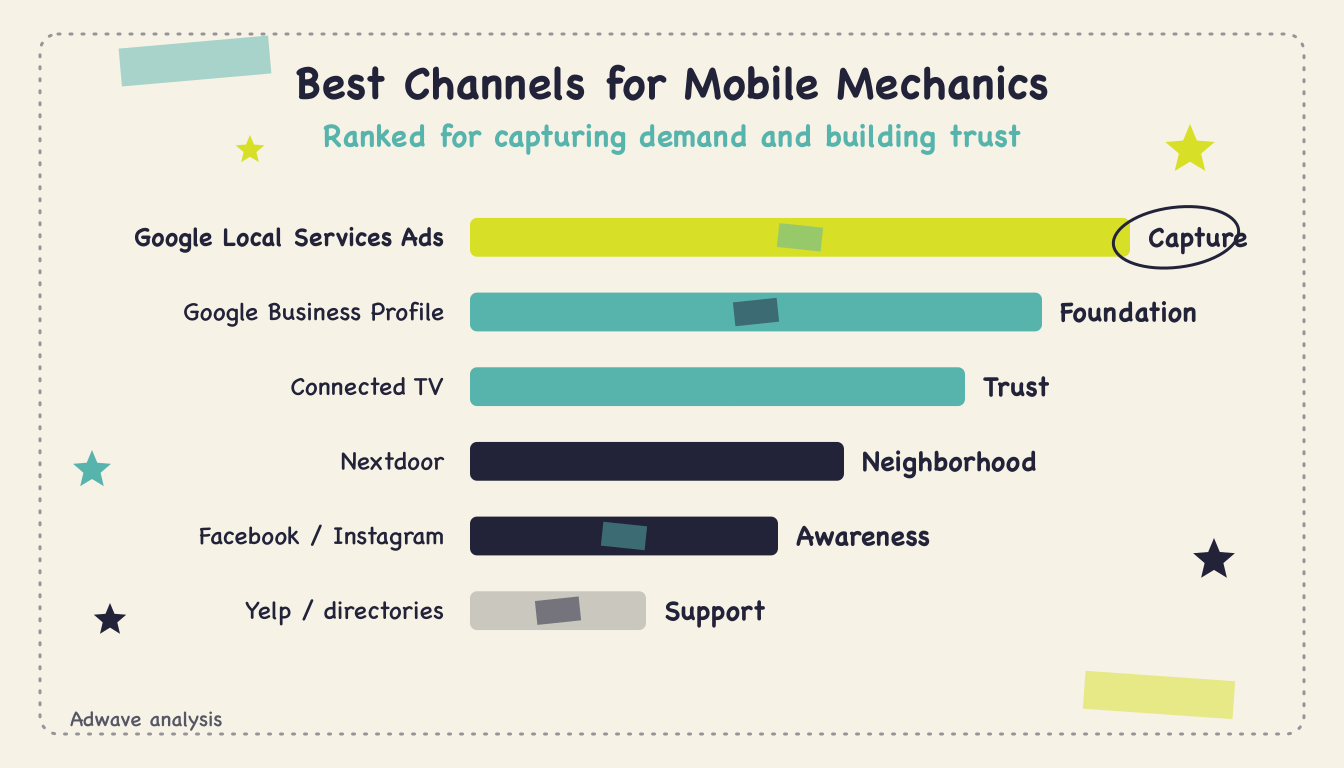
Here's how the major channels stack up for a mobile mechanic, ranked by how well they fit this specific business.
1. Google Local Services Ads (the top pick for capturing demand)
Google Local Services Ads, or LSAs, are the single best channel for capturing urgent mobile-mechanic demand, and automotive services are an eligible category. LSAs sit at the very top of the search results, above regular ads, and you pay per lead rather than per click, so your budget maps directly to phone calls from people who need service now.
But the real advantage is trust. LSAs come with the Google Guaranteed badge, a green checkmark that requires Google to verify your license and insurance. If a customer who booked through an LSA is unsatisfied, Google may reimburse them, up to a lifetime cap. For a business built entirely on "will you let me into your driveway," that verification badge is worth more than the placement itself. One honest caveat: LSA availability for auto categories varies by market, so confirm it's offered in yours and that service-area setup is supported.
2. Google Business Profile and local SEO (the free foundation)
Your Google Business Profile is free and non-negotiable. It's the backbone of every "mobile mechanic near me" result and Map pack ranking, and it's where your reviews live. Nearly half of Business Profile views come from discovery searches like "mechanic near me" rather than people looking for you by name. Set it up as a service-area business, hide the address, define your radius, and start collecting reviews immediately.
3. Connected TV (the trust and awareness play)
Here's where it gets interesting for a mobile mechanic. Search captures the people already looking. Connected TV advertising creates the demand and builds your local brand, so that when someone's car won't start, yours is the name they already recognize. And it does something no other channel does as well: it builds trust.
Television is the most trusted advertising medium. Trust in TV ads sits around 46%, well ahead of online ads (31%), social (27%), and influencers (25%). For a business where trust literally is the product, that matters more than for almost any other type of company. A mobile mechanic seen on TV is perceived as more established and legitimate, exactly the perception that gets someone to hand over their keys. Our psychology of TV advertising trust page digs into why the screen carries that credibility.
The old barrier, TV being national-brand-only, is gone. Connected TV now runs in a single metro on small budgets, which is why a local mobile mechanic can finally buy the credibility that TV confers.
4. Nextdoor (neighborhood-level trust)
Nextdoor is uniquely suited to a business that works in driveways. Neighbors are far more likely to trust a small business recommended by another neighbor, and Nextdoor ads score clearly higher on trust than most platforms. Both paid ads and organic recommendation threads work well here.
5. Facebook and Instagram (local awareness and retargeting)
Meta's platforms are best for radius-targeted awareness, reaching car owners in your service area, community-group presence, and retargeting people who visited your website. Lower intent than search, but cheap reach and a great place to show the mechanic's face and work, which builds trust. A strong complement to connected TV, not a replacement for search capture.
6. Yelp and directories (supporting, not primary)
A slice of auto-repair researchers still start on Yelp, and directory listings support your local SEO citations. Treat these as claim-and-maintain channels rather than primary spend. For what it's worth, consumers trust Google reviews more than Yelp reviews by a wide margin, so prioritize your Google presence.
What each channel costs
Here's the part every mobile mechanic wants, real cost expectations. These are U.S. averages that vary by market and competition, so treat them as reference points.
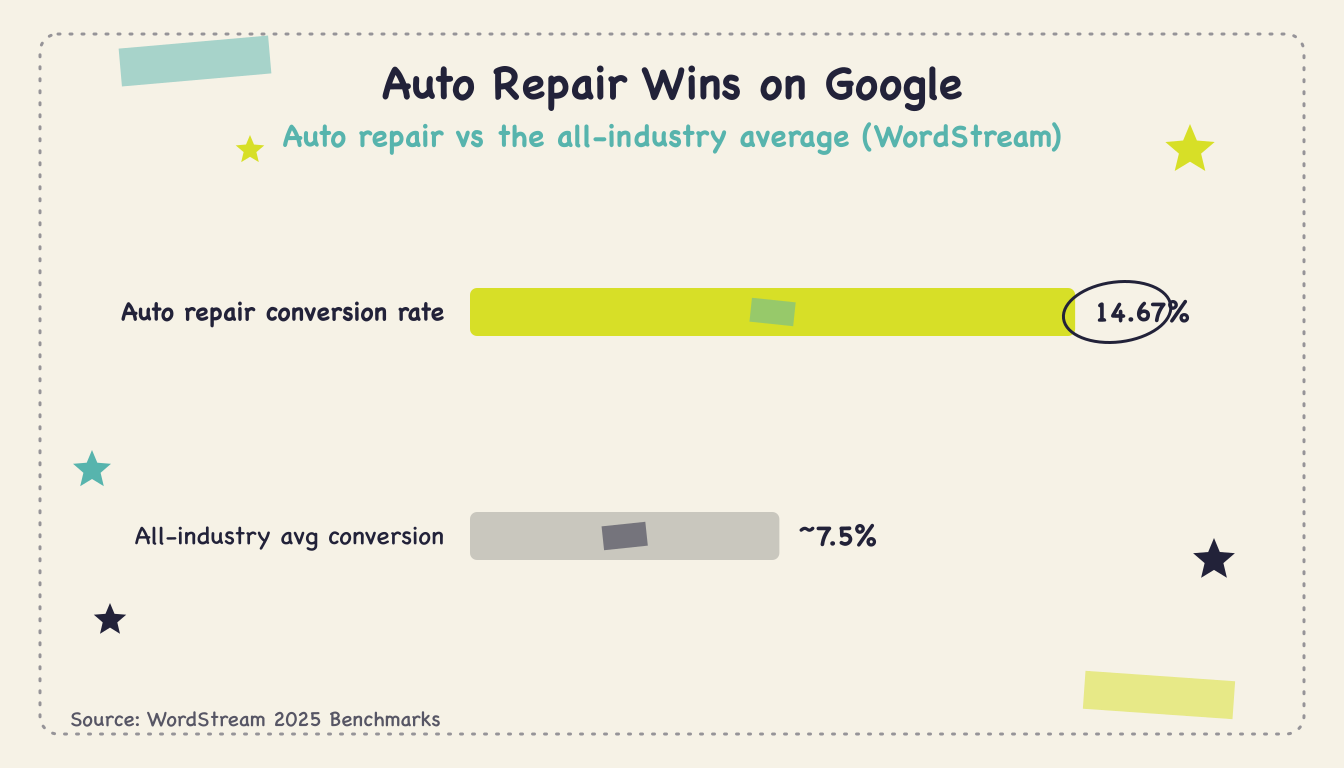
The headline is great news for your business. According to WordStream's benchmarks across more than 16,000 campaigns, auto repair has:
The lowest cost per lead of all 23 industries studied, at about $28.50
The highest conversion rate of all 23 industries, at 14.67%
An average cost per click around $3.90 on Google Search
Read that again: of every industry advertising on Google, auto repair converts the best and generates leads the cheapest. That's because the intent is so high, someone searching "mobile mechanic near me" is ready to book. If you do nothing else, capturing that search demand is one of the best returns in all of advertising.
For the other channels:
Local Services Ads: priced per lead. Home-services LSAs benchmark around $53 per lead; auto-specific figures aren't publicly benchmarked, but given auto's low search costs, they tend to run reasonably. Confirm rates in your market.
Google Business Profile and local SEO: free, just your time.
Connected TV: runs on small local budgets now. The overall CTV market is growing fast, projected near $38 billion in 2026, with local CTV a meaningful and growing slice. Our average CTV CPM page shows what the impressions cost.
Facebook and Instagram: cheap reach, typically well under a couple of dollars per click for awareness.
Many mobile mechanics start in the $500 to $1,500 a month range across channels, weighted toward capture. That's guidance, not a rule, your right number depends on your market and how fast you want to grow.
Why trust matters more for you than almost anyone
It's worth pausing on the trust factor, because it's what makes a mobile mechanic's advertising different. Your transaction ends with a stranger at someone's home, working on a vehicle worth tens of thousands of dollars, often when the customer is already stressed from a breakdown. Advertising's job here isn't just visibility, it's credibility.
Each channel earns trust differently:
The Google Guaranteed badge gives you third-party verification and a reimbursement guarantee, the strongest single trust signal available.
Reviews are read by 97% of consumers before choosing a local business, and most won't consider anything under four stars. Your review base lifts every channel at once.
Connected TV presence makes an unfamiliar mobile brand look established, borrowing the credibility of the medium itself.
Neighbor recommendations on Nextdoor carry the weight of a personal referral.
Consistent branding across everything, same name, logo, mechanic's face, and truck wrap, compounds recognition. The person who saw your TV ad and then finds your LSA listing converts at a higher rate than a cold prospect.
The through-line is that reach alone doesn't win a mobile mechanic customers. Trust does, and the best channels for you are the ones that build it.
There's a compounding effect worth understanding. A customer rarely decides based on a single touchpoint. They might see your connected TV ad during a game, notice your truck in the neighborhood a week later, then search when their car acts up and find you at the top with a Google Guaranteed badge and dozens of five-star reviews. By that point, you're not a stranger asking for their keys, you're the mechanic they already half-know and trust. Each channel makes the others work harder. That's why a mobile mechanic gets more from a coordinated presence across a few channels than from pouring everything into one. The reviews make the search ad convert; the TV ad makes the review base feel legitimate; the consistent branding ties it all into one recognizable business. Trust isn't built by any single ad, it's built by showing up credibly, again and again, everywhere your customer looks.
A recommended plan for a mobile mechanic
Here's how to sequence your advertising: capture first, then layer on awareness and trust.
Stage 1, capture the urgent demand. Set up your Google Business Profile as a service-area business and start collecting reviews right away, both free. Turn on Google Local Services Ads if available in your market, for the pay-per-lead capture and the Google Guaranteed badge. Add a small Google Search campaign on "mobile mechanic near me" terms, since auto's cheap cost per lead and high conversion make this a strong bet.
Stage 2, add trust and awareness. Once capture is running, invest in connected TV to build the local brand so you're the recognized name before the breakdown happens. Add Nextdoor for neighborhood trust and Facebook or Instagram for radius awareness and retargeting.
Stage 3, maintain and expand. Claim your Yelp and directory listings, pursue fleet and business accounts, and keep the review engine running.
For a modest monthly budget, an illustrative split might put roughly half toward capture (LSAs and search), a quarter toward connected TV for trust and awareness, and the rest across social, Nextdoor, and reputation. The rule of thumb: spend on capture first until it's saturated, then reinvest incremental budget into awareness to grow the top of your funnel. Our comparison of advertising for auto repair shops covers the fixed-location side of the industry if you also run a shop.
The channel that ties it together
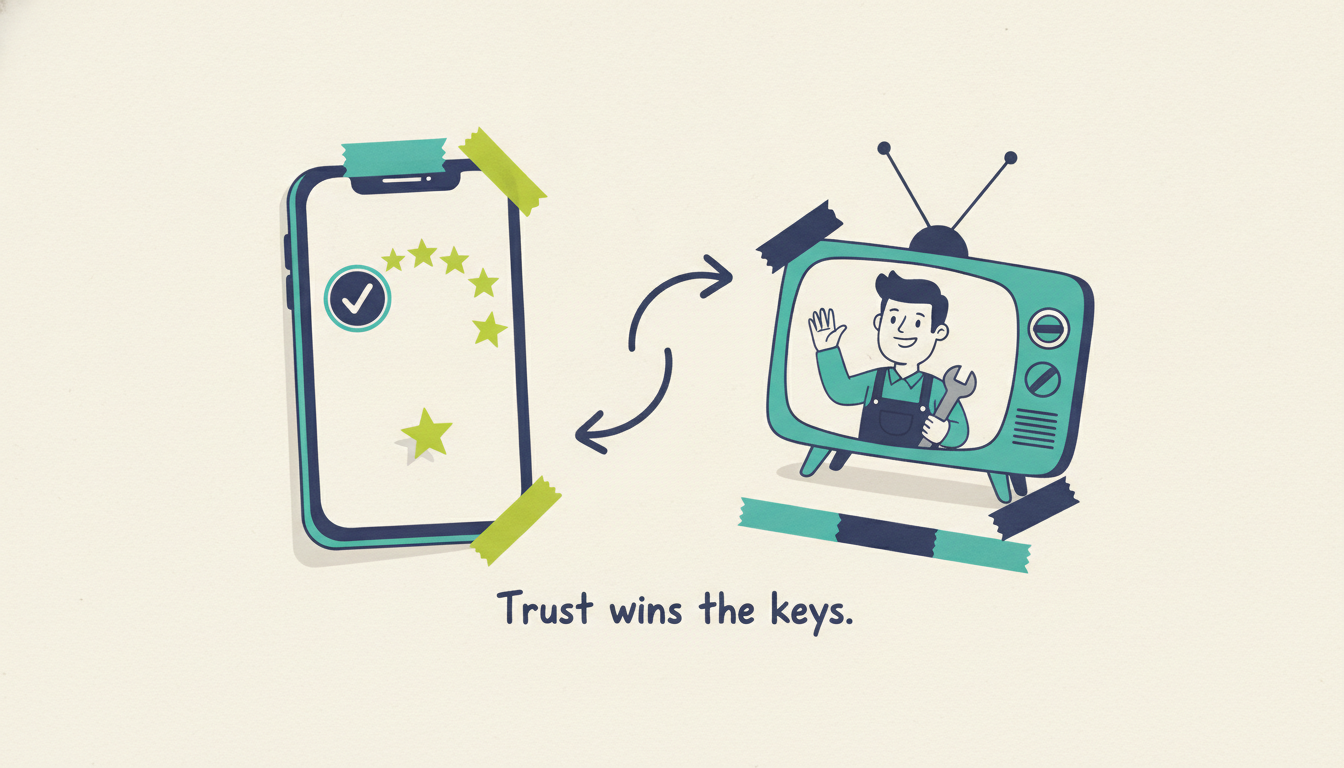
Notice how the strongest plan uses several channels that each do a different job: search and LSAs to capture, connected TV to build trust and awareness, social and Nextdoor to reinforce locally. The person who sees your TV ad, recognizes your name in the search results, and reads your reviews converts far better than someone encountering you cold.
That's the case for running your channels together rather than in silos. Adwave runs connected TV plus Google and social from one place, generates a broadcast-quality 30-second ad from your existing website in about two minutes, and launches it across 100+ premium channels. For a mobile mechanic, that means you can build the local trust that TV confers and capture the search demand it creates, without stitching together separate tools or hiring an agency. Our page on TV advertising for auto repair covers the automotive angle in more depth.
Common questions answered
What's the best way to advertise a mobile mechanic business? Start with Google Local Services Ads and Google Business Profile to capture urgent "mobile mechanic near me" searches, since auto repair has the lowest cost per lead and highest conversion rate of any industry on Google. Then add connected TV to build local trust and brand recognition, since trust is critical when customers let you work on their car at home.
How much should a mobile mechanic spend on advertising? Many mobile mechanics start in the $500 to $1,500 a month range, weighted toward search capture, though the right number depends on your market and growth goals. Because auto repair converts so well on Google, capturing search demand tends to deliver the strongest early returns, then you reinvest into awareness channels like connected TV.
Are Google Local Services Ads worth it for mobile mechanics? Yes, when available in your market. LSAs put you at the top of search, charge per lead rather than per click, and come with the Google Guaranteed badge that verifies your license and insurance. For a business built on trust, that verification is especially valuable. Confirm auto category availability and service-area setup in your area.
Why would a mobile mechanic advertise on TV? Because trust is the priority, and TV is the most trusted advertising medium. Connected TV builds recognition and credibility so that when someone's car won't start, they already know your name and feel comfortable calling. It creates the demand that search then captures, and it now runs affordably in a single local market.
How do I build trust as a mobile mechanic through advertising? Combine the Google Guaranteed badge, a strong base of four-plus-star reviews, connected TV presence that makes you look established, and consistent branding everywhere. Each reinforces the others. Reach alone won't do it, the channels that build credibility are what get customers to hand you their keys.
The bottom line
Mobile mechanics have an unusual advertising challenge, you have to be findable in an emergency and trusted enough to work in someone's driveway, but you also have an unusual advantage: auto repair is one of the best-converting, lowest-cost verticals in all of paid advertising. Capture that high-intent search demand first, then build the local trust and recognition that turns you into the name people call before they even search.
You've already got the skills and the mobile setup. The missing piece is making sure your neighborhood knows your name before their check-engine light comes on. Adwave runs connected TV plus Google and social from one place, and creates your ad for you. See how Adwave works, or check pricing to see how far $50 goes.


