There's a reason a 30-second TV spot for a local roofer feels more credible than a Facebook ad for the same business. The TV ad isn't necessarily better produced. It isn't backed by more data. It probably costs more per impression. And yet, when a consumer watches it on their living room screen, something psychological happens that almost never happens on a phone: they take the business seriously.
Trust is the part of advertising most marketers underestimate, and TV is the channel where trust gets built faster than anywhere else. This article looks at why. We'll dig into the cognitive research, the social-context effects, and the practical implications for any small business deciding where to put advertising dollars in 2026.
The "lean-back" brain works differently
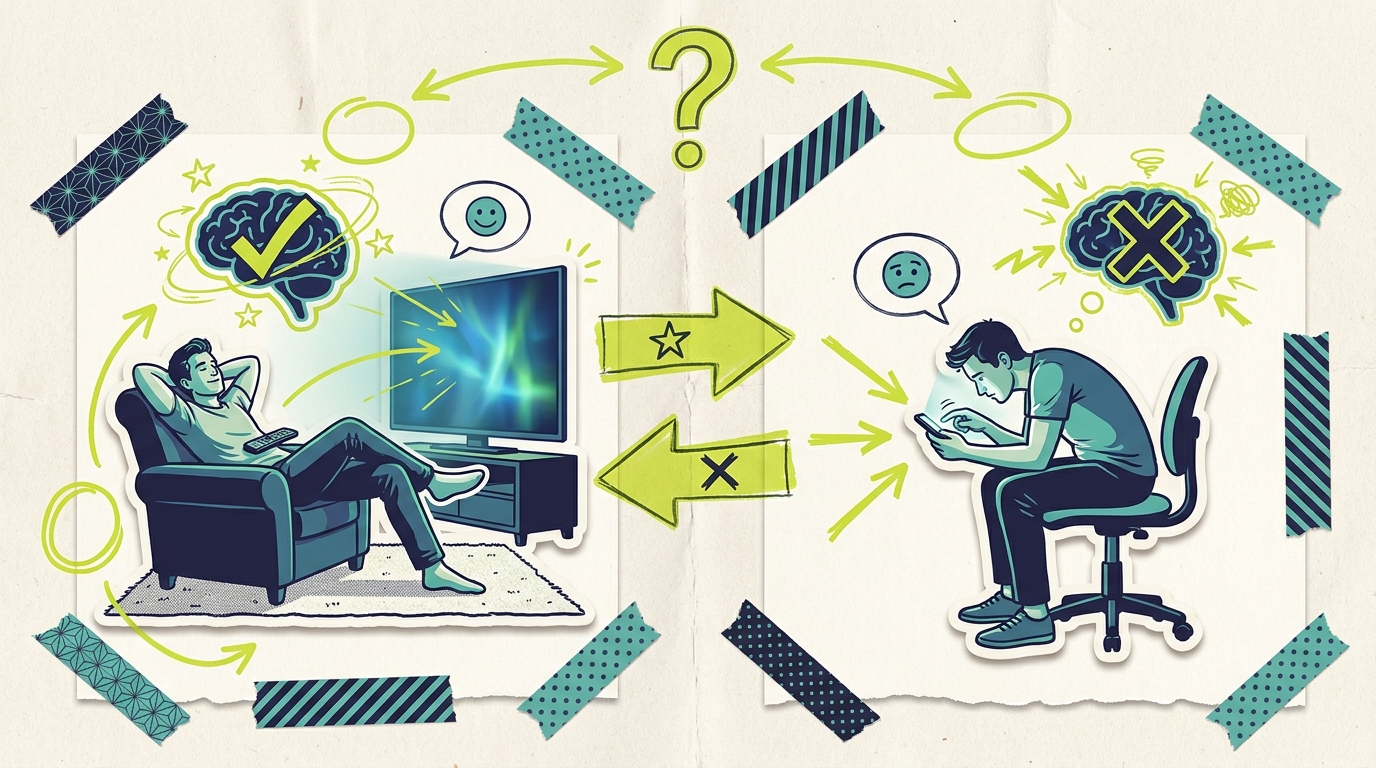
Cognitive scientists have a useful distinction between "lean-forward" and "lean-back" media. Lean-forward media (phones, laptops, gaming) requires active attention and choice. The viewer is hunting, scrolling, deciding. Lean-back media (TV, radio, a movie theater) is passive. The viewer surrenders attention to the content.
That distinction matters because lean-back attention is the cognitive state where viewers are most receptive to brand messages. The defenses are down. The viewer isn't comparing your ad to nine other things on the screen. They're absorbing it.
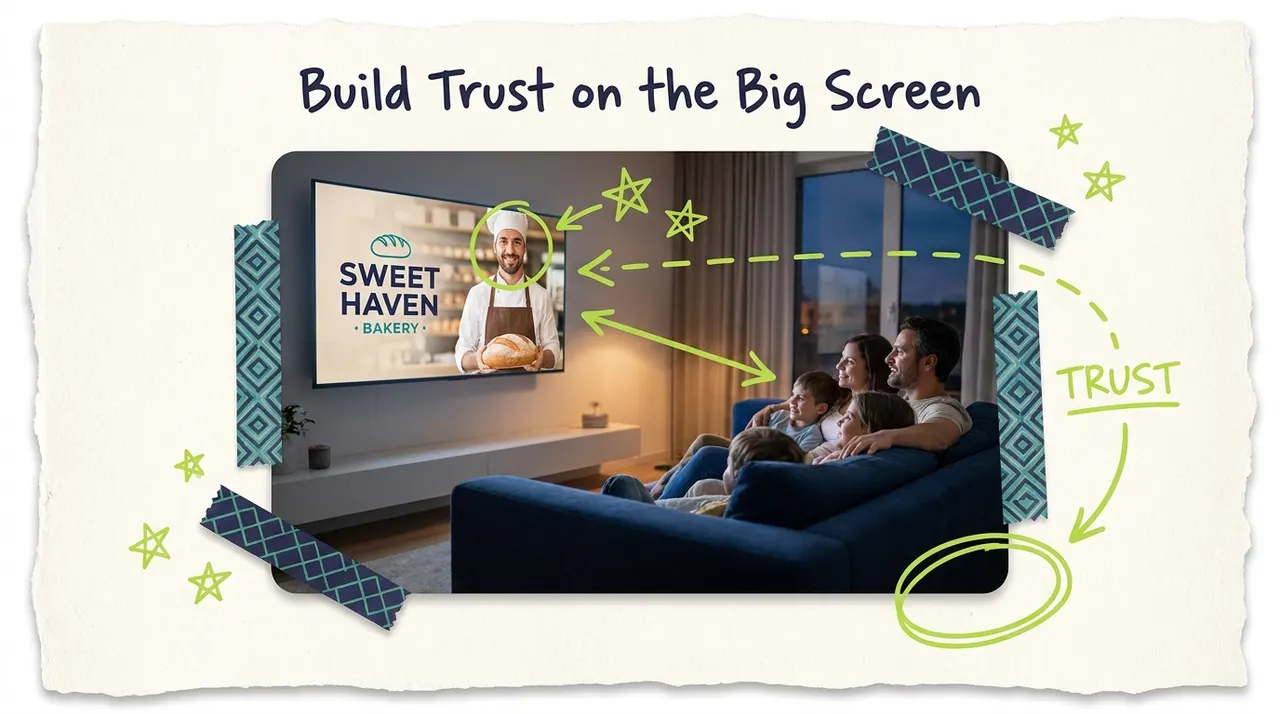
When a viewer watches your CTV ad during their evening streaming session, they're in the same emotional state they're in when watching the show itself. They're settled. They're with family or alone in their living room. Their guard is down. Your ad doesn't have to fight for attention; it inherits the attention the show already commanded.
That's a state Meta, Google, and most digital channels never get. Phone attention is fragmented by design. Even when someone "watches" a 6-second YouTube pre-roll, half their brain is still oriented around what they were trying to do (find a video, kill time at a stoplight). TV attention is whole-body in a way digital almost never is.
The "endorsement effect" of premium content
The second psychological lever is borrowed credibility. Where your ad runs shapes how viewers feel about your business, often without them being aware of it.
A small home services brand running ads on NBC during prime time gets borrowed credibility from NBC. The viewer's brain processes the ad in the same context as the news anchor they trust, the show they're invested in, the network they associate with quality. The ad doesn't say "we're a legitimate, established business," but it implies it by association.
The technical name for this is the "media context effect." Studies going back decades have shown the same ad performs differently depending on what runs around it. An ad surrounded by trusted, premium content inherits trust. An ad surrounded by low-quality content inherits suspicion. Connected TV inventory on premium streaming networks gives small businesses access to the same trust-inheritance that used to be reserved for Fortune 500 brands with seven-figure media budgets.
This is one of the reasons a $1,500 monthly CTV campaign for a local HVAC company often outperforms a $1,500 Facebook campaign in lead quality. The Facebook ad reaches more eyeballs, but the CTV ad reaches eyeballs in a more trust-rich environment.
Production value as a credibility signal
The third lever is the implicit "we exist" signal that television sends. Most consumers, especially older consumers and those with higher disposable income, still associate TV advertising with established, legitimate businesses.
This is partly a generational holdover and partly a structural truth. For decades, TV was prohibitively expensive for fly-by-night operators. Anyone advertising on TV had to be substantial enough to afford it. The cost was a filter, and that filter trained generations of consumers to treat TV advertisers as more legitimate by default.
CTV has democratized the channel, but the credibility signal hasn't yet eroded in the consumer's mind. A viewer watching streaming TV doesn't think "this advertiser must have raised a Series A to afford this." They think "this is a real business, like the other businesses I've seen on TV." That perception is doing meaningful work for every small business running TV ads in 2026.
The other piece of production value: the ad itself looks like a TV ad. Even AI-generated 30-second CTV spots match the visual grammar and pacing of broadcast television, which signals professionalism in a way a phone-shot vertical Instagram reel can't. The grammar is doing trust-building work before the words even start.
Familiarity, then trust
There's a deep body of psychology research on what cognitive scientists call the "mere exposure effect." First documented by Robert Zajonc in 1968, the finding is simple and consistent: people develop preferences for things they've seen before, even when they don't remember seeing them.
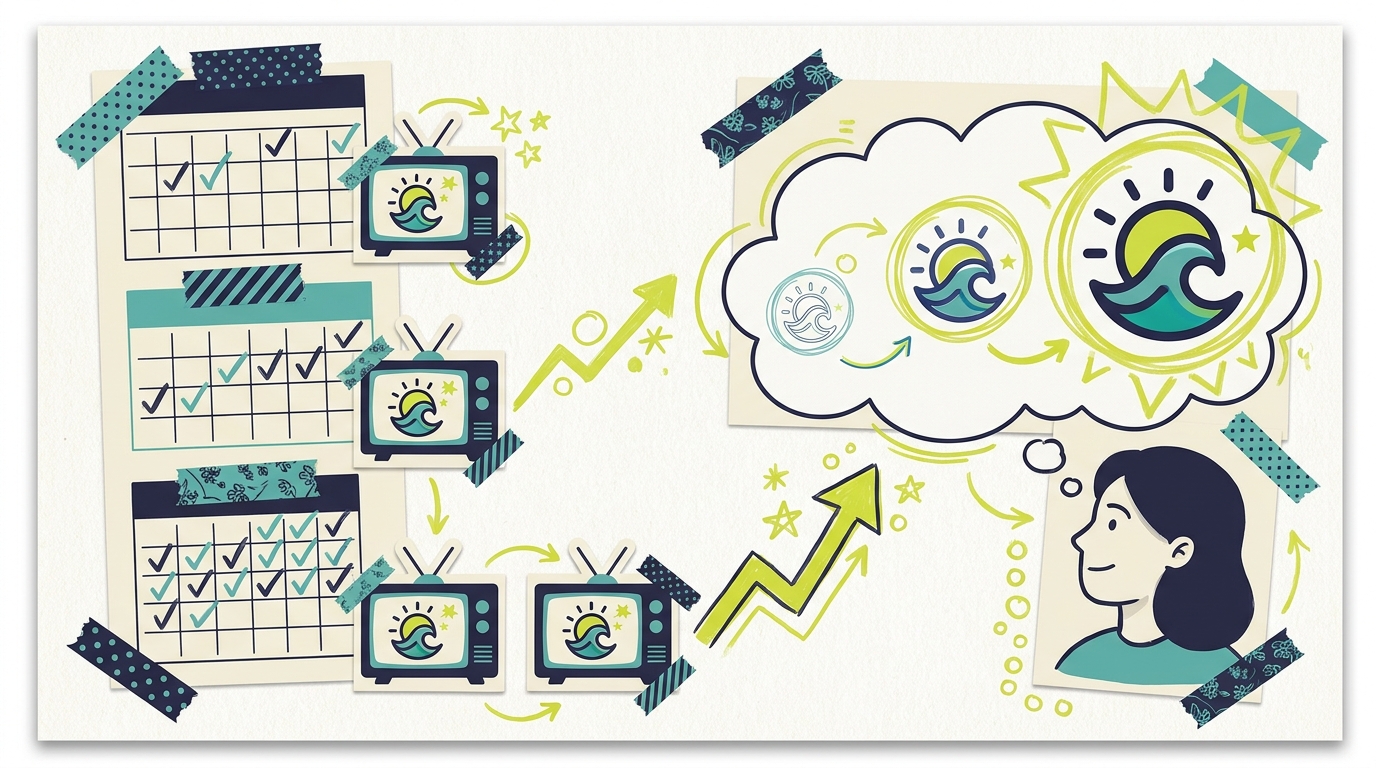
Translated to small business advertising, the implication is clear. A consumer who sees your TV ad five times over three weeks doesn't have to consciously remember the ad to feel more positively about your brand. The repetition does the work even when the viewer can't articulate why your business feels familiar by the time they need a plumber, a dentist, or a wedding venue.
This is why frequency matters so much in TV. One impression rarely moves a viewer. Three to five impressions, spaced over a few weeks, builds the unconscious familiarity that translates into "I'll call them" when the need arises. Most small businesses underestimate how much of TV's effect happens in this unconscious familiarity layer rather than in the explicit, decision-driving "I saw an ad, I'm calling now" layer.
The mere exposure effect also explains a pattern small business owners often see in their TV data: bookings or calls don't spike on day one of the campaign, but they tick up steadily in weeks three, four, and beyond. That ramp is the familiarity layer doing its work.
The "household witness" effect
A subtle psychological factor that almost no marketing book talks about: TV is watched socially. Even when it's "just me watching," there's often a partner in the room, kids passing through, a dinner guest catching the tail end of a commercial break. Phones, by contrast, are nearly always single-viewer.
Small businesses serving households (real estate agents, contractors, restaurants, healthcare providers, family entertainment) get an outsized return on TV because their decisions are usually made by the household, not the individual. Reaching one decision-maker on Facebook reaches one person. Reaching them on the family TV reaches the decision-maker plus the spouse plus the parent who happens to be visiting. The "household witness" effect compounds into faster shared decisions.
How emotion drives recall
A practical question for any small business owner: what should the actual ad say to maximize trust?
Emotion can help viewers remember an ad. They may recall the feeling associated with your business even when they forget individual claims.
Three emotional registers tend to outperform for small business TV:
Reassurance. Particularly powerful for service businesses (medical, legal, home services). The viewer's anxiety about the problem (a tooth pain, a leaking roof, an estate-planning question) gets resolved by your spot's reassuring tone. The brand becomes the calm voice they remember when the problem occurs.
Belonging. Local pride, community connection, "businesses like ours support businesses like yours." Works especially well in mid-sized markets where local identity is strong.
Aspiration. Picture-of-the-better-life framing. Effective for fitness studios, beauty services, financial advisors, anyone whose service is in the "version of yourself you want to be" category.
The mistake most small business spots make is leaning too hard on "here are the facts about my business" rather than "here is how you'll feel after working with us." Fact-heavy spots are forgotten. Emotion-anchored spots get remembered, and remembered businesses get the call.
The 30-second sweet spot
The IAB and most major media buyers settled on 30 seconds as the standard TV ad length for good reasons rooted in psychology. The first 3-5 seconds are pattern recognition (what is this? Is it an ad? Is it relevant to me?). The next 15-20 seconds carry the emotional payload and the brand message. The final 5-7 seconds are the call to action and brand lock-in.
Shorter spots (6, 10, 15 seconds) feel jumpy and can't build emotional resonance. Longer spots (60+ seconds) lose attention before payoff. The 30-second format earned its dominance by matching how viewers process attention during a commercial break.
This is also why Adwave standardizes on 30 seconds. The format is psychologically optimized, the inventory across premium networks is built for it, and the production grammar (AI-generated or otherwise) is calibrated for that length.
What this means for small businesses choosing channels
The psychology research has practical implications for how any small business should think about its 2026 ad budget.
If your goal is direct response in 24-48 hours, digital still wins. Search ads catch people at when they're already looking. Meta ads catch impulse decisions. TV is rarely a "see ad, call within an hour" channel for most categories.
If your goal is to be the business people think of when they need your category, TV wins. That's the trust-and-familiarity game, and TV's psychological levers (lean-back attention, premium context, mere exposure, emotional registration, household witness) all point in the same direction.
For most small businesses, the answer is both. Run digital to catch active demand. Run TV to build the unconscious familiarity that makes your business the default choice when need arises. Together they compound; alone they leave money on the table.
The mistake we see most often is small businesses running digital-only, then wondering why their cost per acquisition keeps climbing. The reason isn't that digital "broke." It's that they never invested in the trust layer that makes digital work harder. Every channel converts better when the brand is already familiar and trusted before the click.
The trust dividend
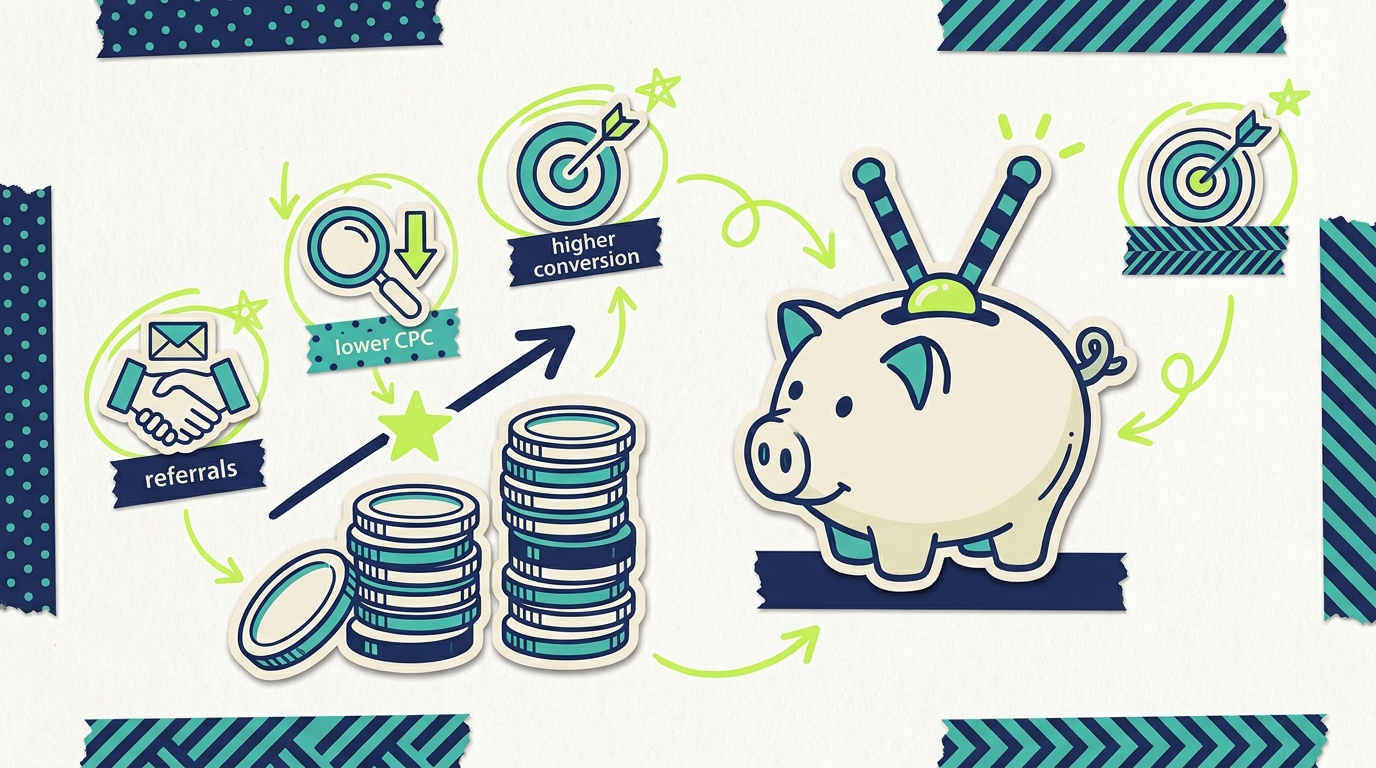
There's a phrase in financial planning called the "trust dividend," meaning the cumulative payoff of being someone people already trust before you need them to act. Brands that invest in trust early get a trust dividend later: lower CPCs, higher conversion rates, more referrals, less price sensitivity.
Attention, program context, repetition, and production quality can affect how viewers perceive a business advertised on TV.
Common questions answered
Why does a TV ad feel more credible than a Facebook ad for the same business?
A mix of factors: lean-back attention (the viewer isn't multitasking), borrowed credibility from premium content surrounding the ad, generational association of TV with established businesses, and the production grammar of 30-second spots which signals professionalism. The combined effect is that viewers process TV ads in a more trust-rich cognitive state than scrolling-based digital ads.
How many times does a viewer need to see my ad before they'll act?
Most advertising research suggests 3-5 impressions before a viewer takes action, with familiarity-building (the "mere exposure effect") happening from the very first impression onward. For most small businesses, a frequency between 3 and 5 over a few weeks is the sweet spot. Frequency below 2 doesn't drive enough familiarity; frequency above 7 starts saturating without producing more conversions.
Does the "trust effect" of TV apply to AI-generated CTV ads too?
Yes. The trust signal comes from the channel context (premium networks, 30-second format, lean-back viewing) rather than from who produced the ad. Viewers don't distinguish between agency-produced and AI-generated spots when both follow the same production grammar. AI-generated CTV ads on premium inventory inherit the same credibility as agency-produced ads.
Is TV still effective for younger demographics, or is it just for older audiences?
Younger audiences have shifted to streaming, but TV viewing (especially on CTV platforms like Hulu, Peacock, and YouTube TV) is now strong across all adult age brackets. The trust psychology applies to streaming TV just as much as to broadcast TV. The 25-44 demographic is one of the heaviest CTV viewing groups and shows the same trust-and-familiarity response patterns.
How does emotion in a TV ad drive business outcomes?
Emotion is the binding agent for brand recall. Viewers forget the facts in an ad but remember how it made them feel, and that feeling gets associated with the brand name. When the viewer later faces a relevant need, the emotion-anchored brand surfaces in memory faster than a fact-heavy competitor. That faster memory retrieval is what translates into the call or visit.
Can a small business afford the kind of TV that builds trust?
Yes, much more easily than five years ago. CTV ad platforms now make premium streaming inventory accessible at small business budgets, often starting around $50 in subscription cost. The credibility effects discussed here apply at any spend level, since they're driven by the channel context and production format rather than the size of the campaign.
Putting trust to work
Trust isn't a soft metric. It's a quantifiable advantage that translates into lower cost per acquisition, higher conversion rates, and more referrals. The small businesses winning in 2026 are the ones investing in trust early, before they need it, so the trust dividend compounds.
TV is one of the most efficient trust-building channels available, and CTV makes it accessible to businesses of every size. If your 2026 budget is heavy on digital and light on TV, you're optimizing for the click without building the brand familiarity that makes every future click cheaper.