
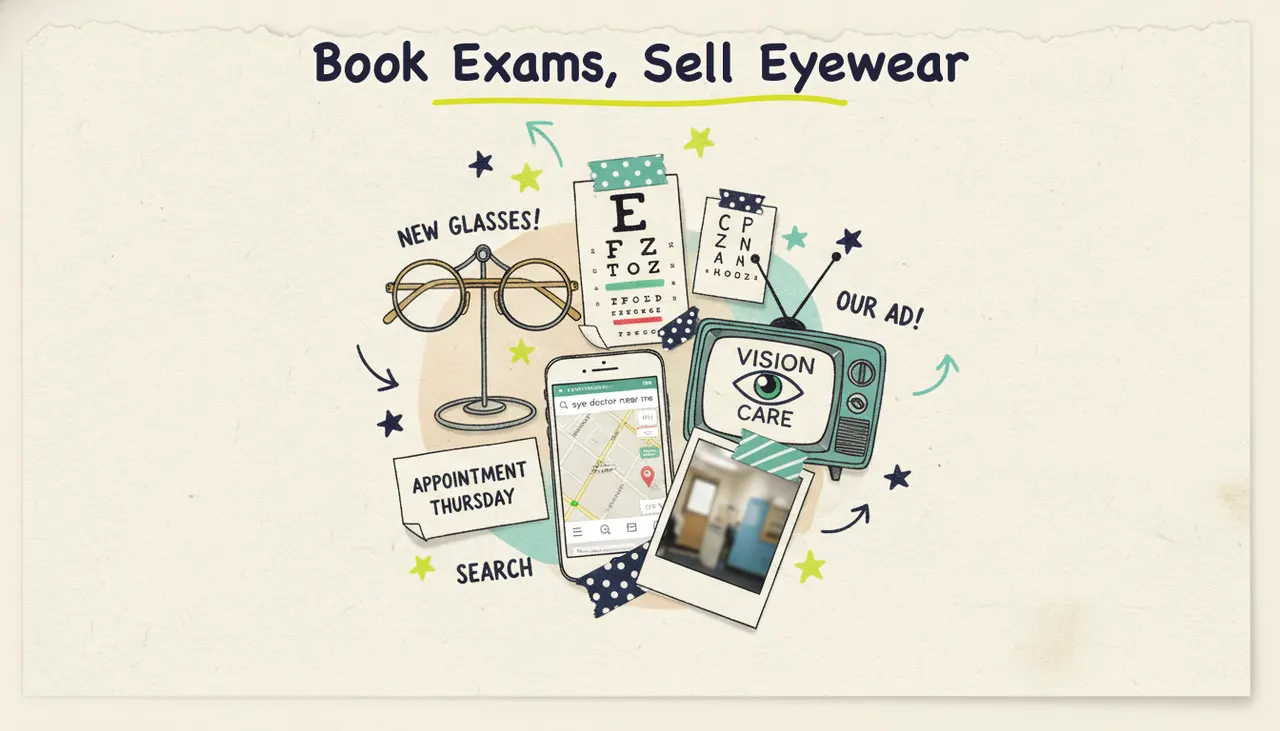
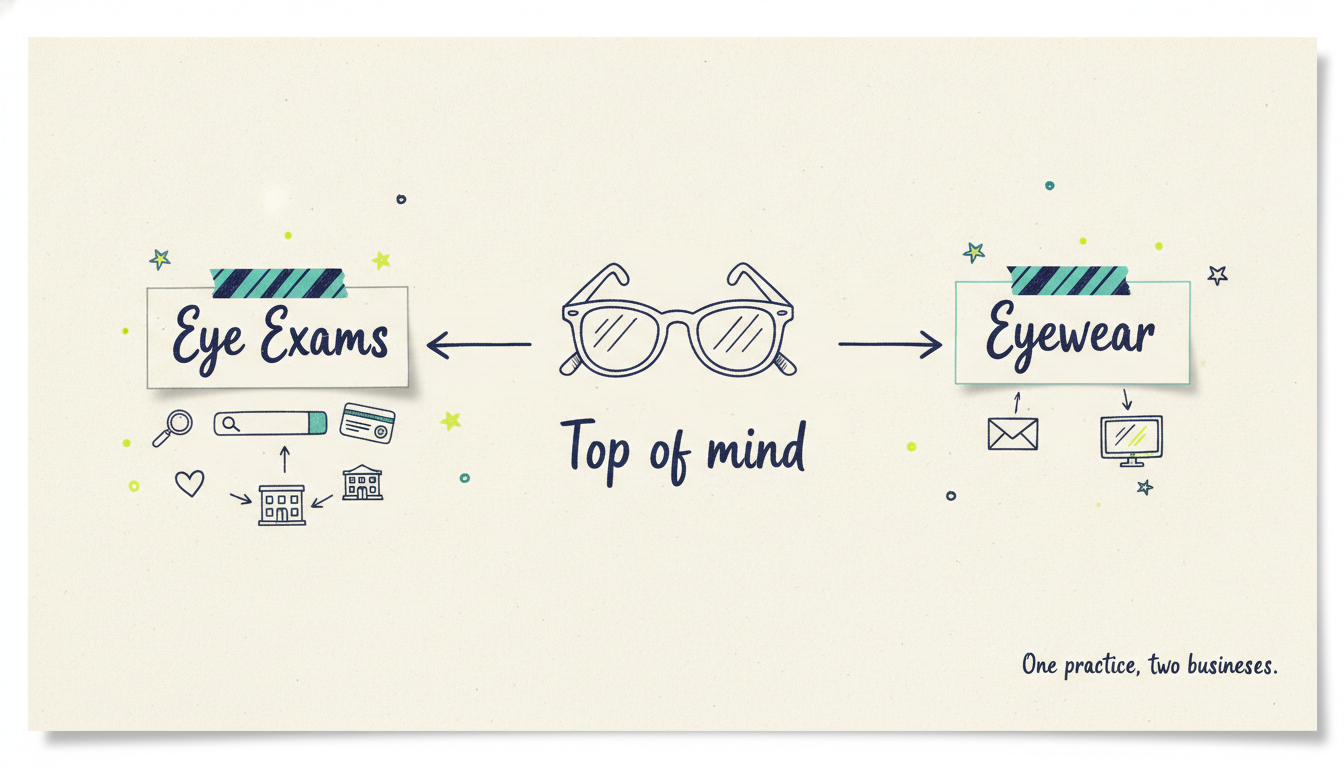
An optometry practice is really two businesses in one. There's the medical side, eye exams, vision health, and care, and there's the retail side, glasses, contacts, and designer frames. That dual nature shapes everything about how you advertise. You need to reach people due for an exam, people shopping for new glasses, and people who don't yet realize they should see an eye doctor, all while competing with big-box optical chains, online eyewear retailers, and every other practice in town.
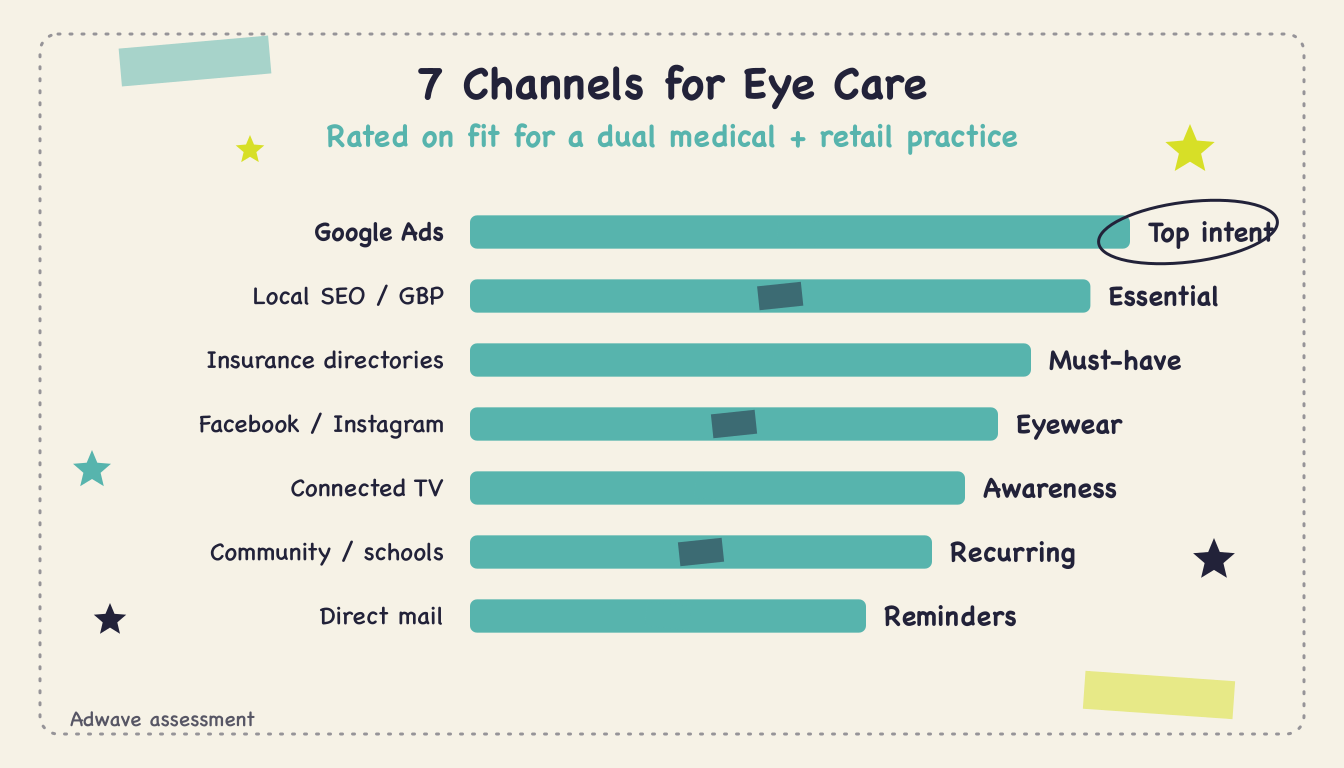
Compare seven advertising channels for optometry practices, including local targeting, costs, and appointment booking.
What makes optometry advertising unique
Before the channels, it helps to understand what you're advertising, because eye care has a few distinct traits that shape strategy.
You're serving recurring, appointment-based demand. People need eye exams regularly, and much of your business is about staying familiar so patients book with you when it's time, and choosing you over the big chains. That makes local visibility and trust central.
You're also selling a visual retail product. Eyewear is fashion as much as function, which means your advertising can lean on visual, aspirational content, the frames, the styles, the look, in a way a purely medical practice can't. And you're navigating insurance: many patients search based on vision coverage, so being findable and clear about insurance matters. Keep those traits, recurring appointments, visual retail, and local trust, in mind as we compare channels.
Channel 1: Google Ads and search
When someone needs an eye exam or new glasses, they search: "eye doctor near me," "optometrist [city]," "eye exam near me," "glasses [neighborhood]." Google Ads put you at the top of those results at the exact moment someone is ready to book or buy. For an eye care practice, this is often the highest-return channel, because the intent is immediate and local.
Search captures both sides of your business. Medical searches ("eye exam near me," "optometrist accepting new patients") reach people ready to book, while retail searches ("designer glasses [city]," "contact lenses near me") reach eyewear shoppers. You can run tailored campaigns for each.
To make Google Ads work for an optometry practice:
Target local, high-intent terms. Bid on searches combining your service and area: "eye doctor [city]," "eye exam near me," "optometrist [neighborhood]." These convert far better than broad terms.
Highlight what matters to patients. Insurance accepted, new-patient availability, same-week appointments, designer brands, use ad copy and extensions to stand out.
Use location and call extensions. Many appointments start with a call or a maps visit. Make it effortless to reach or find you.
Send clicks to relevant pages. A search for "eye exam" should land on a page about exams and booking, not a generic homepage.
Google Ads costs are controllable, you set a daily budget, and even $10 to $25 a day can capture meaningful local demand. The limitation is that search only reaches people already looking, which is why it pairs best with channels that build awareness and keep you familiar for recurring visits.
Channel 2: Facebook and Instagram
Meta's platforms are ideal for the retail and brand side of an eye care practice, because eyewear is so visual. Frames, styles, and the transformation of a new look are the kind of content that performs on Instagram and Facebook, and social is excellent for building your local brand and staying familiar.
Social media does several jobs at once. It showcases your eyewear selection and styles to local shoppers, it lets you run affordable, precisely targeted local ads and promotions, and it builds the friendly, trustworthy brand image that makes patients choose you and remember to come back.
To use Facebook and Instagram well:
Show your frames and styles. Photos and short videos of your eyewear selection, new arrivals, and styled looks are engaging content that drives retail interest.
Run targeted local ads. Boost your best posts and run ads to your area promoting exams, eyewear, and seasonal offers, targeting by location and demographics.
Promote reminders and offers. Back-to-school eye exams, year-end insurance-benefit reminders, and new-frame promotions all play well on social.
Build a friendly brand. Show your team, your office, and happy patients to build the trust that keeps people coming back.
Meta ads are budget-friendly, meaningful campaigns start at a few dollars a day, and eyewear's visual nature makes organic content engaging. The trade-off is that social requires consistent posting, but the visual material is easy to produce in an eyewear business.
Channel 3: Local SEO and Google Business Profile
A huge share of eye care discovery happens on Google Maps and in the local "map pack." When someone searches "eye doctor near me," those three map listings at the top capture most of the clicks. Ranking there is free, and for a recurring, local business like optometry, it's one of the highest-return things you can do.
Your Google Business Profile is the centerpiece. A complete, active profile, with accurate hours, services, insurance information, photos, and a steady flow of reviews, is what gets you into that map pack. Because results are location-based, a well-run local practice can outrank chains for nearby searches.
To strengthen your local SEO:
Claim and fully complete your Google Business Profile. List your services (exams, eyewear, contacts), hours, insurance accepted, and photos, and keep everything current.
Make reviews a habit. Reviews drive both ranking and trust. Ask satisfied patients, especially after a positive visit, and respond to every review.
Optimize your website for local terms. Clearly state your services, insurance, and service area, with dedicated pages so Google understands what you offer and where.
Keep listings consistent. Ensure your name, address, and phone are identical across the web.
Local SEO is mostly effort rather than money, making it one of the best values on this list. The limitation is that it takes ongoing attention and strong reviews to rank in a competitive area.
Channel 4: Yelp, directories, and insurance networks
Many patients researching an eye doctor turn to review-driven directories, and importantly for eye care, to their vision insurance provider directories to find in-network practices. Being present and accurate on these matters a great deal.
These platforms reach people actively choosing a provider, often filtered by insurance, so being findable and well-reviewed directly influences who books.
To make the most of directories and networks:
Ensure accurate insurance network listings. Make sure you're correctly listed in the provider directories of the vision plans you accept, since many patients start there.
Claim and complete your Yelp listing. Add photos, services, hours, and respond professionally to reviews.
Maintain healthcare directory profiles. Keep profiles on relevant healthcare and local directories accurate and complete.
Encourage reviews across platforms. Being well-reviewed everywhere builds cumulative trust with cautious healthcare shoppers.
Costs range from free listings to paid enhancements. The main limitation is reduced control compared to your own channels, but for eye care, accurate insurance-network listings are essential rather than optional, since coverage often drives the choice.
Channel 5: Community, schools, and partnerships
Some of the most effective eye care marketing comes from local relationships and community presence, especially partnerships that put you in front of people who need vision care.
Community and referral channels are valuable because they build trust and reach people at natural moments of need, like children starting school or seniors needing regular care.
Ways to build this channel:
Partner with local schools. Offer vision screenings or back-to-school eye exam information. Children's vision is a major, recurring source of appointments.
Build referral relationships. Connect with local physicians, pediatricians, and senior centers who can refer patients needing eye care.
Get involved in community events. Health fairs, local sponsorships, and community events build visibility and position you as the local eye care expert.
Create a patient referral program. Encourage satisfied patients to refer family and friends, which drives high-trust new appointments.
This channel costs little beyond time and produces loyal, high-trust patients. Its limitation is that it builds gradually rather than instantly, so it complements faster paid channels.
Channel 6: Direct mail and local print
For a recurring, local healthcare business, direct mail and local print still work well, especially for appointment reminders and reaching specific neighborhoods.
Physical mail works for eye care because it's local and can be timed to recurring needs. A reminder postcard when a patient is due for an exam, or a promotion sent to nearby households, reaches people effectively, and healthcare reminders by mail have a natural, expected feel.
To use direct mail and print effectively:
Target your local area and existing patients. Reach nearby households with new-patient offers, and remind existing patients when they're due for an exam.
Lead with a clear reason. An exam reminder, a "use your insurance benefits before year-end" nudge, or an eyewear promotion gives people a reason to act.
Advertise in community publications. Local papers and newsletters reach engaged local readers, including older demographics who value eye care.
Include clear next steps. Your phone, website, and a QR code make it easy to book.
Direct mail has real per-piece costs, but its fit with recurring exam reminders makes it especially useful for eye care. Used selectively, it drives well-timed appointments.
Channel 7: TV and connected TV advertising
Here's the channel most eye care practices assume is out of reach: television. It used to be, when TV meant expensive production and buying an entire market. But connected TV, the ads that run on streaming services like Hulu, Roku, and Peacock, has changed that, and it's now an affordable way to build broad local awareness and trust for your practice.
Connected TV lets you run a genuine 30-second video ad, showing your welcoming office, your team, and your eyewear selection, on premium streaming channels, targeted to just your local area. For a recurring, trust-based business, its value is building broad awareness so your practice is the familiar name when someone realizes it's time for an exam or new glasses. Video on the TV screen conveys professionalism and warmth, reaching families and individuals across your market at once, both the medical and the eyewear sides. Pair it with a QR code viewers can scan to book or browse frames, and you turn awareness into appointments. Because you can now generate a broadcast-quality ad from your existing photos in minutes and run it on a local budget, connected TV finally fits a single practice. For more on how the medium works, see our guide to connected TV advertising, and explore our healthcare industry advertising resources for related guidance.
Use TV alongside search and social to introduce your practice to local households.
How to combine channels: an eye care plan
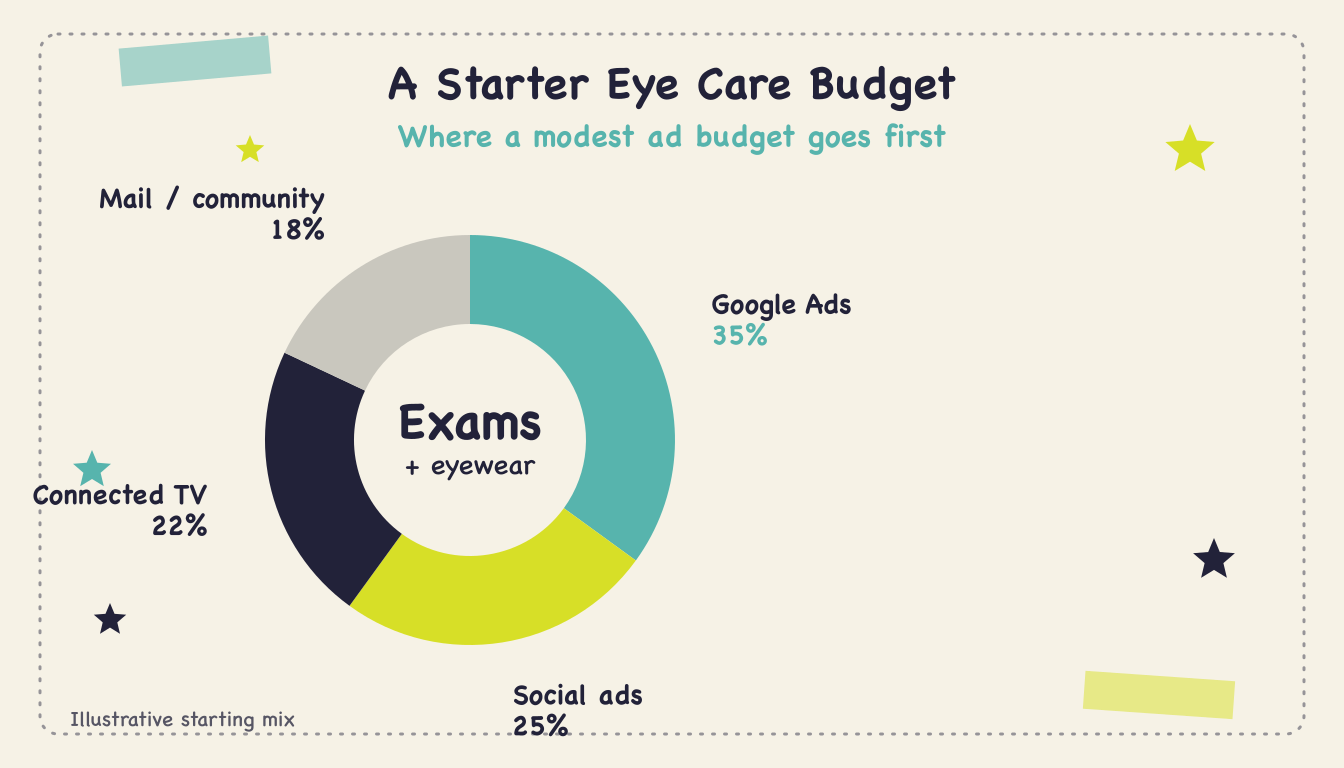
You don't need all seven channels at once. The best approach layers them by budget and stage, each doing its job for your dual medical-and-retail business.
Here's a practical way to prioritize:
Start with the free foundations. Nail your Google Business Profile and local SEO, ensure accurate insurance-network listings, and build a consistent, visual Facebook and Instagram presence. These cost time, not money, and they drive both exams and eyewear.
Add high-intent capture. Layer in Google Ads targeted to local exam and eyewear searches to catch people ready to book or buy right now.
Build recurring demand. Use direct mail for exam reminders, and community and school partnerships to build a pipeline of trust-based, recurring patients.
Amplify with brand-building. As budget allows, add connected TV to build broad awareness across your area, so your practice is the familiar choice when it's time for an exam.
The thread through all of it is local trust and familiar presence. For a recurring business like eye care, the goal is to be the practice people think of when it's time, whether they find you through search, insurance, a school screening, or a streaming ad. That coordinated, reinforcing approach is the heart of effective multi-channel advertising.
Common questions answered
What's the best way to advertise an optometry practice? For most eye care practices, the foundation is free: a complete Google Business Profile and strong local SEO to get found in "near me" searches, accurate insurance-network listings, and a visual Facebook and Instagram presence showing your eyewear. Layer in Google Ads for exam and eyewear searches, direct mail for exam reminders, community and school partnerships for recurring patients, and connected TV to build broad awareness. The best approach combines several channels, each serving your medical and retail sides.
How much should an optometry practice spend on advertising? It varies by market and goals, but many practices start effectively on a modest budget because their most important channels, local SEO, Google Business Profile, insurance listings, and organic social, are free to run. From there, $10 to $25 a day on Google Ads and a small social budget can drive meaningful appointments and eyewear sales. Direct mail and connected TV can be layered in affordably. Start with the free foundations, then scale what drives bookings.
How do I advertise both eye exams and eyewear? Run tailored messages for each. Medical searches ("eye exam near me," "optometrist accepting patients") and exam-reminder mailers reach people ready to book appointments, while eyewear content, frame photos and style promotions on social, reaches retail shoppers. Broad-awareness channels like connected TV reach both at once by presenting your practice as a welcoming place for care and great eyewear. Tailoring the message to each side makes every channel more effective.
Why do insurance directories matter for eye care advertising? Because many patients choose an eye doctor based on their vision coverage, and they often start by searching their insurance provider's directory for in-network practices. If you're not listed accurately in the directories of the plans you accept, you're invisible to those patients at the exact moment they're choosing. Keeping your insurance-network listings correct and complete is an essential, often overlooked, part of eye care advertising.
Does TV advertising make sense for a single optometry practice? Yes, more than most owners expect. Connected TV now lets you run a local, targeted 30-second video ad on streaming services for a small-business budget, building broad awareness so your practice is the familiar name when someone needs an exam or new glasses. Combined with AI tools that generate the video from your photos in minutes, connected TV has become a practical, affordable way to build trust and stay familiar, even for one location.
The bottom line
Advertising an eye care practice means serving two businesses at once, medical exams and eyewear retail, while staying familiar for recurring, local demand. The winning plan starts with the free foundations of local SEO, Google Business Profile, and accurate insurance listings, captures high-intent search with Google Ads, drives recurring visits with exam-reminder mail and community partnerships, and builds broad awareness with affordable connected TV.
You don't need all seven channels at full blast, and you don't need a big budget. You need the right mix for your stage, each channel keeping your practice the trusted, familiar local choice for both exams and eyewear. Adwave makes the TV part simple: generate a professional 30-second ad from your photos, then run it on connected TV and beyond, all from one place. See how Adwave works, or check pricing to get started from $50.


