
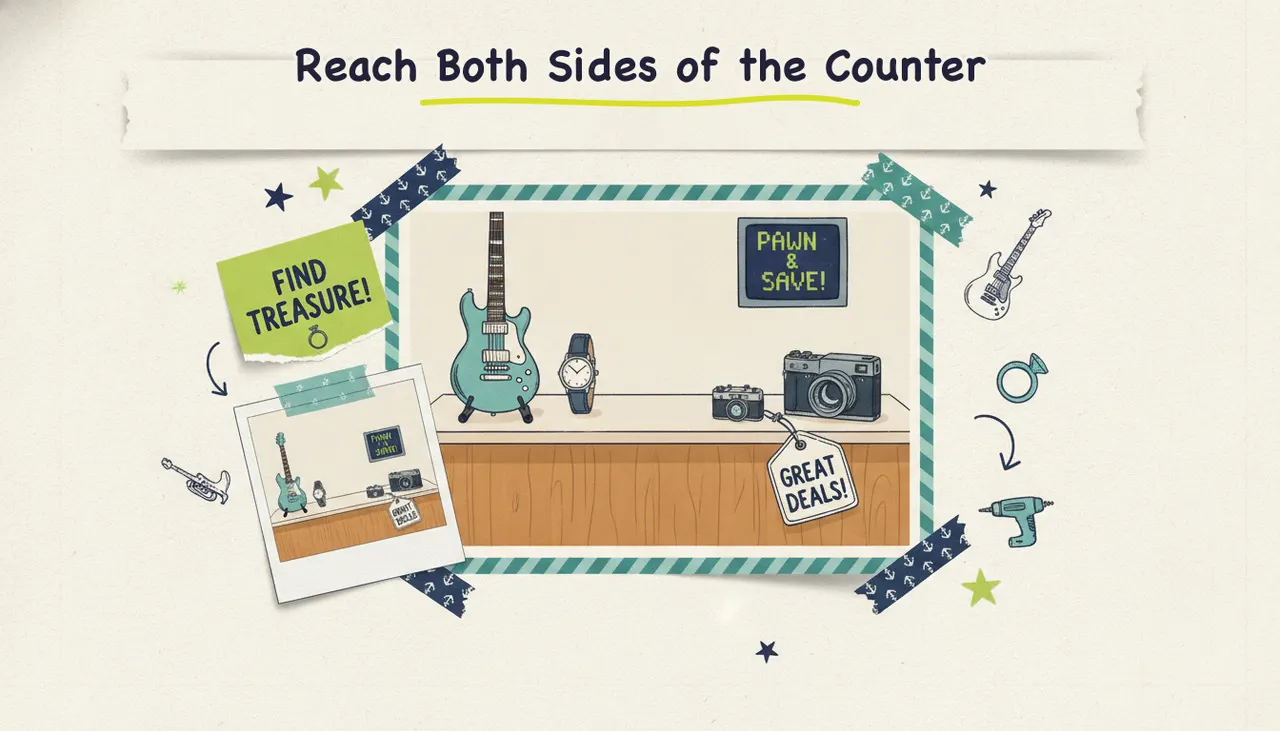
Pawn shops occupy a unique spot in local business. You serve two very different customers at once: people who need quick cash against their valuables, and bargain hunters looking for great deals on jewelry, tools, electronics, and instruments. You compete with buy-here-pay-here lenders, big-box retailers, online marketplaces, and every other shop in town. And you're working against an outdated stereotype that good advertising can quietly dismantle. The pawn shops that grow are the ones that show up professionally, everywhere their customers look, and make people feel comfortable walking through the door.
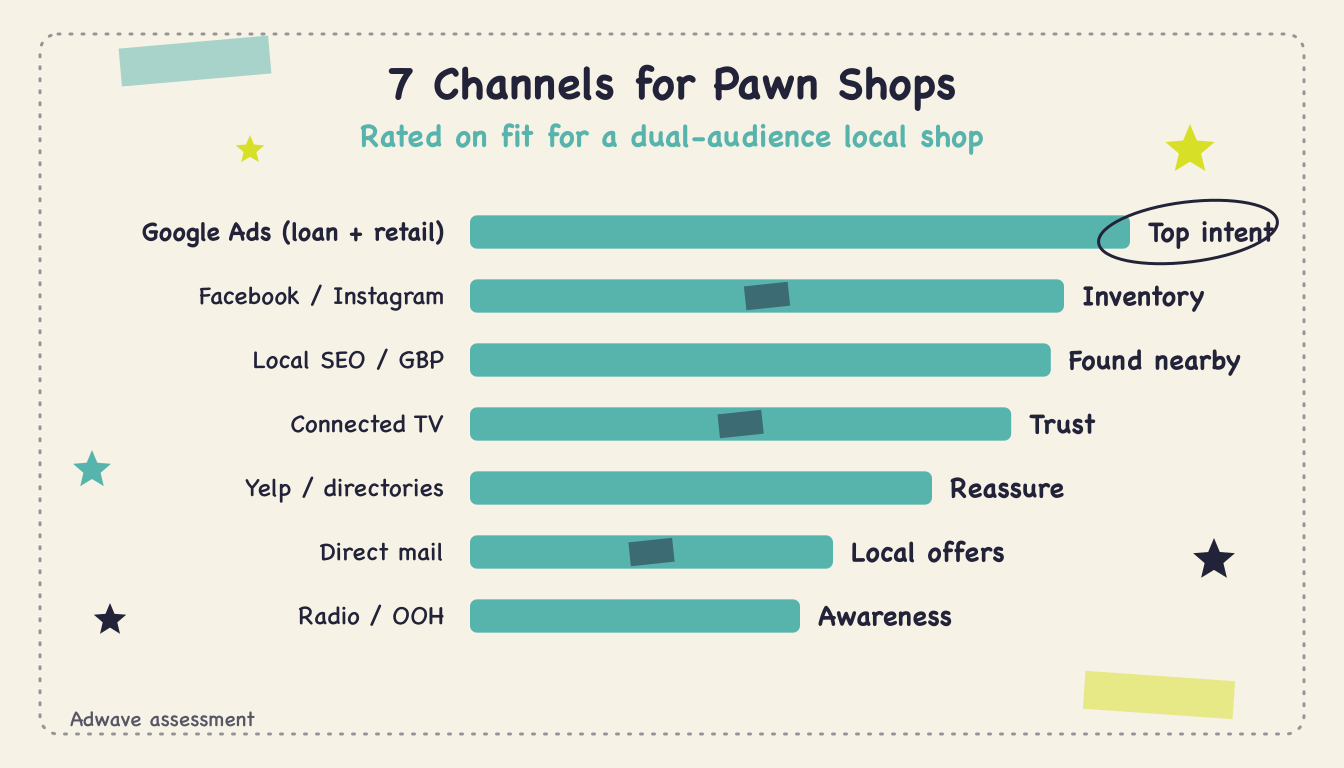
Compare seven advertising channels for pawn shops, including ways to promote loans and retail inventory.
What makes pawn shop advertising unique
Before the channels, it helps to understand what you're really advertising, because a pawn shop has a dual nature that shapes your strategy.
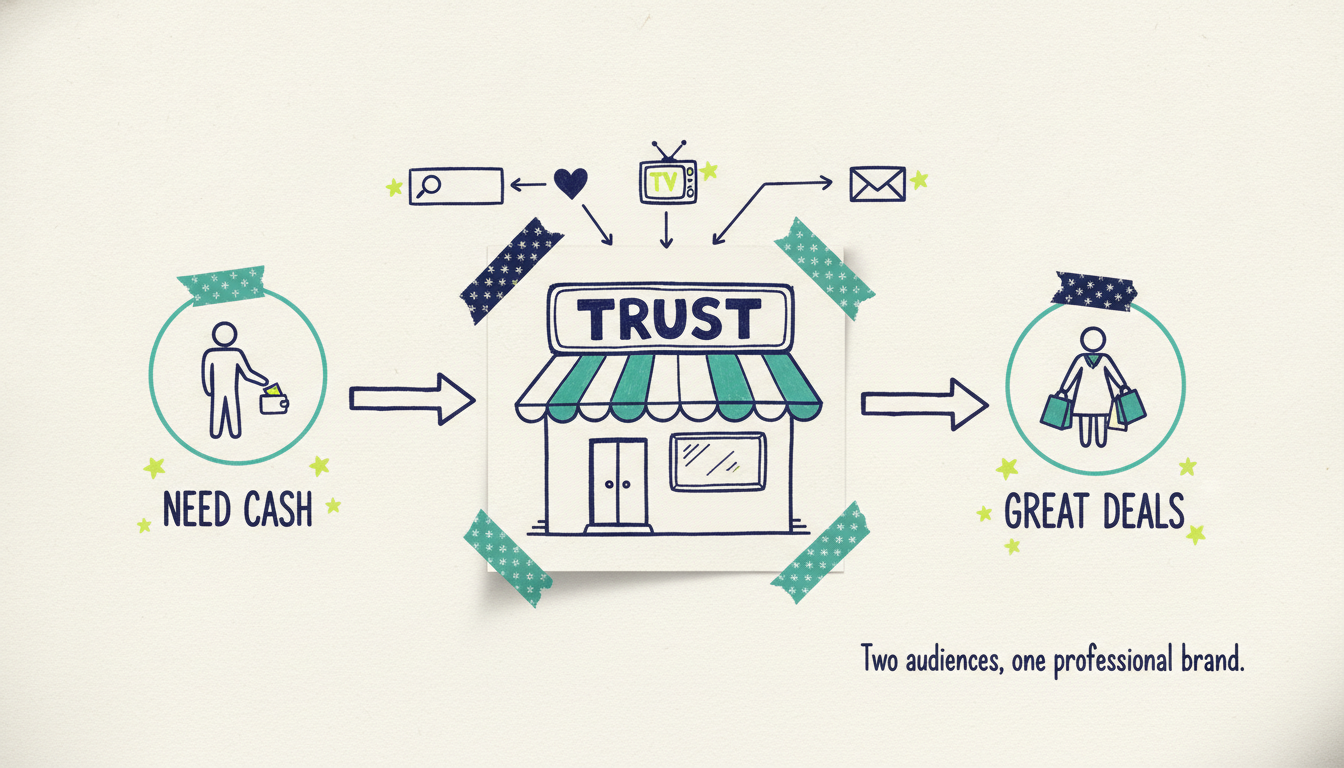
You have two distinct audiences with different needs. One group needs money now and is searching urgently for a pawn loan or a place to sell gold, tools, or electronics. The other is shopping for value, browsing for deals on quality secondhand goods. Your advertising has to speak to both, sometimes in the same channel, sometimes in separate campaigns.
You're also fighting perception. Professional, welcoming advertising, clean visuals, real inventory, friendly faces, does a lot of quiet work to reassure people that your shop is reputable, safe, and worth visiting. Every ad is a chance to replace an old stereotype with trust. Keep both ideas, dual audience and trust-building, in mind as we go through the channels.
Channel 1: Google Ads and search
When someone needs cash fast or wants to sell something, they search, and they search with urgency. "Pawn shop near me," "sell gold [city]," "pawn loan," "where to sell tools." Google Ads put you at the top of those results at the exact moment someone is ready to act. For a pawn shop, this is often the highest-return channel, because the intent is immediate.
Search advertising captures both sides of your business. Loan-and-sell searches ("pawn my watch," "cash for electronics") reach people who need money now, while retail searches ("used tools [city]," "pre-owned jewelry") reach bargain hunters. You can run separate campaigns for each intent.
To make Google Ads work for a pawn shop:
Target high-intent local terms. Bid on searches combining your services and your area: "pawn shop [city]," "sell gold near me," "pawn loan [neighborhood]." These convert far better than broad terms.
Split loan and retail campaigns. Your two audiences want different things. Separate campaigns let you tailor the message and budget to each.
Use call and location extensions. Many pawn interactions start with a call or an in-person visit. Make it effortless to reach you or find you.
Send clicks to relevant pages. A search for "sell gold" should land on a page about selling gold, not your homepage, with clear information and a reason to choose you.
Google Ads costs are controllable, you set a daily budget, and even $10 to $20 a day can capture meaningful local demand. The limitation is that search only reaches people already looking, which is why it pairs best with channels that build awareness before the need arises.
Channel 2: Facebook and Instagram
Meta's platforms are ideal for the retail side of a pawn shop and for building your brand. Pawn inventory is visual and constantly changing, and few things drive foot traffic like a steady stream of "just in" posts showing the cool, valuable, and unusual items on your shelves.
Facebook and Instagram do three jobs at once. They showcase your ever-changing inventory to local bargain hunters, they let you run affordable, precisely targeted local ads, and they build the professional, trustworthy brand image that reassures both audiences. A well-run pawn shop page becomes a destination people check for deals.
To use Facebook and Instagram well:
Post your inventory constantly. Photos and short videos of new arrivals, especially interesting or high-value items, are your best content. "Just in" posts create urgency and bring people in.
Run targeted local ads. Boost your best posts and run ads targeted to your area, promoting both deals and your buy/loan services. You can target by location, interests, and demographics.
Build a trustworthy image. Show your clean store, your friendly staff, and satisfied customers. Consistent, professional content dismantles old stereotypes.
Use marketplace and local groups. Facebook Marketplace and local buy-sell groups are natural places for a pawn shop to list retail inventory and reach nearby shoppers.
Meta ads are budget-friendly, meaningful campaigns start at a few dollars a day, and the visual, always-changing nature of pawn inventory makes organic content engaging. The trade-off is that it requires consistent posting, but with new inventory arriving daily, you'll never run short of material.
Channel 3: Local SEO and Google Business Profile
A huge share of pawn shop discovery happens on Google Maps and in the local "map pack." When someone searches "pawn shop near me," those three map listings at the top capture most of the clicks. Ranking there is free, and it's one of the highest-return things a pawn shop can do.
Your Google Business Profile is the centerpiece. A complete, active profile, with accurate hours, services, photos of your store and inventory, and a steady flow of reviews, is what gets you into that map pack. Because results are location-based, a well-run local shop can outrank competitors for nearby searches.
To strengthen your local SEO:
Claim and fully complete your Google Business Profile. List your services (pawn loans, buying gold, retail), hours, and plenty of photos, and keep everything current.
Make reviews a habit. Reviews drive both ranking and trust, and they're especially powerful for a business fighting perception. Ask satisfied customers and respond to every review professionally.
Optimize your website for local terms. Clearly state your services and service area, with dedicated pages for your main offerings, so Google understands what you do and where.
Keep your listings consistent. Ensure your name, address, and phone are identical everywhere online.
Local SEO is mostly effort rather than money, making it one of the best values on this list. The limitation is that it takes ongoing attention and strong reviews to stand out from other local shops.
Channel 4: Yelp and online directories
Many people researching a pawn shop, especially for the first time, turn to review-driven directories to find and vet options. Yelp remains significant for local services, and a strong presence there functions as both advertising and reassurance.
Being well-reviewed on directories matters because it reaches people actively comparing shops and leaning on reviews to decide who to trust with their valuables or their business.
To make the most of directories:
Claim and complete your Yelp listing. Add photos, services, hours, and respond professionally to all reviews.
Encourage reviews across platforms. A cautious customer may check several sources, so being well-reviewed everywhere builds cumulative trust.
Keep information accurate. Correct hours and services across directories prevent frustration and lost visits.
Consider paid enhancements selectively. Test any paid placements, but track whether they drive visits before committing.
Directory costs range from free listings to paid placements. The main limitation is that you control these platforms less than your own channels, so treat them as one part of the mix, especially valuable for trust, rather than your foundation.
Channel 5: Local radio and out-of-home
Traditional local media still has a place for a pawn shop, especially for building broad awareness and reaching people who aren't heavy internet users. Local radio, signage, and out-of-home advertising can keep your shop's name in the community's mind.
These channels work because they build general local awareness and reinforce your presence. A memorable radio spot or well-placed signage keeps you familiar so that when someone needs quick cash or wants to browse for deals, your shop comes to mind first.
To use local radio and out-of-home effectively:
Consider local radio sponsorships or spots. A presence on a popular local station builds broad awareness, especially for your loan services.
Invest in strong signage. Clear, professional signage on your building and in your area drives walk-in traffic and reinforces legitimacy.
Explore local out-of-home. Billboards or transit ads in your immediate area can build awareness among nearby residents.
Costs vary widely by market, and results are harder to measure precisely, so these channels work best as supporting awareness layers rather than your primary, trackable drivers of business.
Channel 6: Direct mail and local print
For a hyper-local business like a pawn shop, direct mail and local print can still pull their weight, reaching households in your immediate area with tangible offers.
Physical mail works because it's local and concrete. A postcard promoting your buy prices for gold, a seasonal loan offer, or your latest retail deals can land directly in the homes nearest your shop.
To use direct mail and print effectively:
Target your immediate neighborhoods. Focus on the areas closest to your shop, where convenience matters most.
Lead with a clear offer. Highlight competitive buy prices, a loan promotion, or standout retail deals to give people a reason to visit.
Advertise in community publications. Local papers and community newsletters reach engaged local readers at reasonable cost.
Include clear next steps. Your address, phone, hours, and a QR code make it easy to respond.
Direct mail has real per-piece costs and is harder to measure than digital, so it works best as a supporting, neighborhood-level tactic used selectively around your shop.
Channel 7: TV and connected TV advertising
Here's the channel most pawn shop owners assume is off-limits: television. It used to be, when TV meant expensive production and buying an entire market. But connected TV, the ads that run on streaming services like Hulu, Roku, and Peacock, has changed that, and it's now an affordable, powerful way for a pawn shop to build broad awareness and, importantly, trust.
Connected TV lets you run a genuine 30-second video ad, showing your professional, welcoming store and your quality inventory, on premium streaming channels, targeted to just your local area. For a business fighting an outdated stereotype, video on the TV screen is uniquely persuasive: seeing a clean, friendly, professional shop on the same screen as national brands does more to build trust than any other medium. It reaches both your audiences at once, planting your name for the person who'll need cash next month and the bargain hunter who loves a deal. Pair it with a QR code viewers can scan to see inventory or your location, and you turn awareness into visits. Because you can now generate a broadcast-quality ad from your existing photos in minutes and run it on a local budget, connected TV finally fits a single-location pawn shop. For a deeper look at how the medium works, see our guide to connected TV advertising.
Use TV alongside search and social to introduce your shop to local households.
How to combine channels: a pawn shop plan
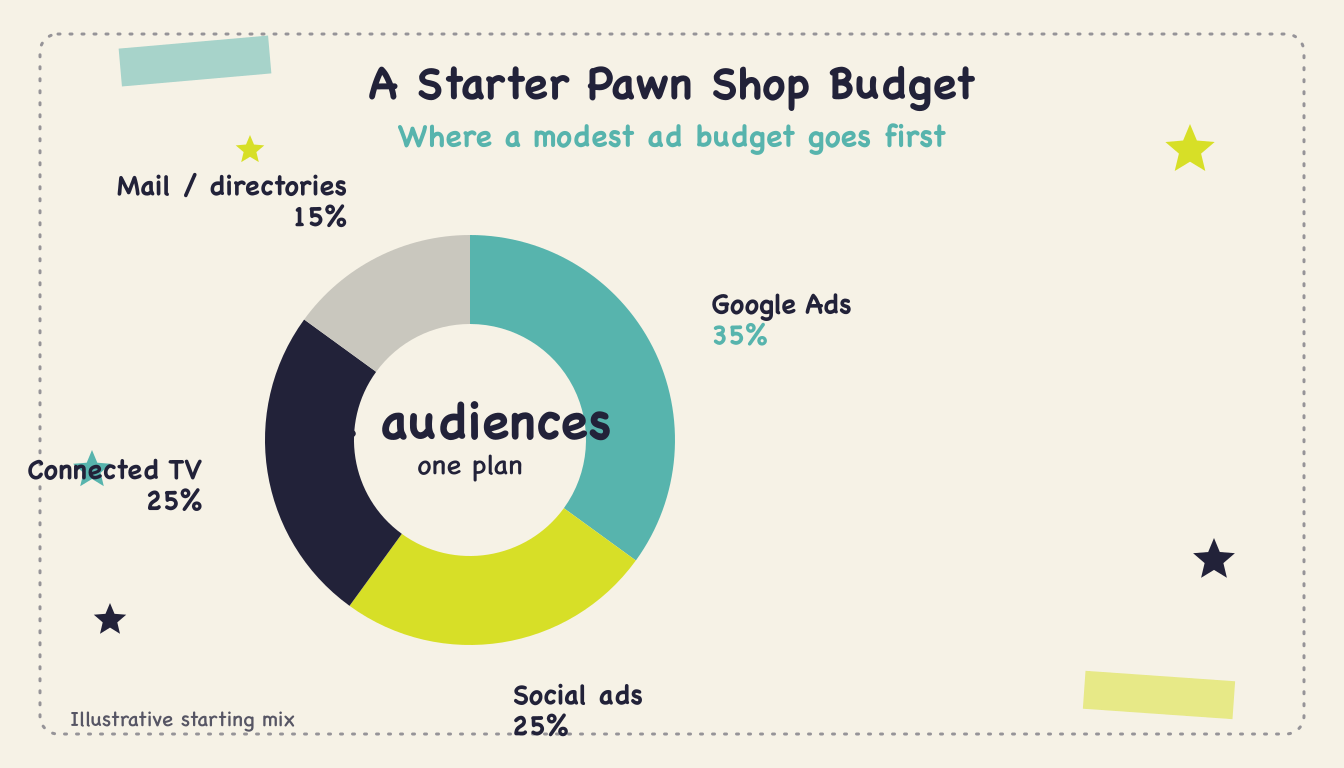
You don't need all seven channels at once. The best approach layers them by budget and stage, each doing its job for your dual audience.
Here's a practical way to prioritize:
Start with the free foundations. Nail your Google Business Profile and local SEO, and build a consistent, professional Facebook and Instagram presence full of new-inventory posts. These cost time, not money, and they drive both loans and retail.
Add high-intent capture. Layer in Google Ads with separate campaigns for your loan/sell and retail audiences, catching people ready to act right now.
Build trust and reach. As budget allows, add connected TV to build broad awareness and dismantle stereotypes, and use targeted direct mail and local radio in your immediate area.
Reinforce everywhere. Keep your directory listings strong and your reviews flowing, since trust is the currency that turns awareness into visits.
The thread through all of it is professionalism and trust. Every channel should present your shop as clean, reputable, and welcoming, so that whether someone finds you through search, a friend, or a streaming ad, they feel comfortable walking in. That coordinated, reinforcing approach is the heart of effective multi-channel advertising.
Common questions answered
What's the best way to advertise a pawn shop? For most pawn shops, the foundation is free: a complete Google Business Profile and strong local SEO to get found in "near me" searches, plus a professional Facebook and Instagram presence full of new-inventory posts. Layer in Google Ads, with separate campaigns for your loan/sell and retail audiences, to capture urgent searches, keep your directory reviews strong for trust, and add affordable connected TV to build broad awareness and dismantle old stereotypes. The best approach combines several channels, each doing a specific job for both of your audiences.
How much should a pawn shop spend on advertising? It varies by market and goals, but many shops start effectively on a modest budget because their most important channels, local SEO, Google Business Profile, and organic social, are free to run. From there, $10 to $20 a day on Google Ads and a small social ad budget can drive meaningful traffic. Connected TV, direct mail, and radio can be layered in affordably as you grow. Start with the free foundations, then scale what drives loans and sales.
How do I advertise to both loan customers and retail shoppers? Run separate campaigns and messages for each. Loan and sell customers search with urgency ("pawn loan," "sell gold near me"), so target those terms with dedicated Google Ads and pages, while retail shoppers respond to inventory: showcase new arrivals and deals on social media and Facebook Marketplace. Broad-awareness channels like connected TV can reach both at once by presenting your shop as professional and welcoming. Tailoring the message to each audience makes every channel more effective.
Does TV advertising make sense for a single-location pawn shop? Yes, more than most owners expect. Connected TV now lets you run a local, targeted 30-second video ad on streaming services for a small-business budget, and for a business fighting an outdated stereotype, showing a clean, professional, welcoming shop on the TV screen builds trust like nothing else. Combined with AI tools that generate the video from your photos in minutes, connected TV has become a practical, affordable way to build awareness and reputation, even for one location.
How can advertising help overcome the pawn shop stereotype? Professional, consistent advertising does a lot of quiet work to rebuild perception. Clean visuals, real inventory, friendly staff, and strong reviews across Google and Yelp reassure people that your shop is reputable and safe. Connected TV is especially powerful here, because seeing a welcoming, professional store on the same screen as national brands directly counters the outdated image. Every well-crafted ad replaces an old assumption with trust.
The bottom line
Advertising a pawn shop comes down to two things: reaching your dual audience and building trust. You're serving people who need quick cash and people hunting for deals, and you're doing it against an outdated stereotype that professional advertising can steadily dismantle. Start with the free foundations of local SEO, Google Business Profile, and constant inventory posts, capture urgent demand with targeted Google Ads, keep your reviews strong, and use affordable connected TV and direct mail to build broad awareness and reputation.
You don't need all seven channels at full blast, and you don't need a big budget. You need the right mix for your stage, each channel presenting your shop as the reputable, welcoming, local choice. Adwave makes the TV part simple: generate a professional 30-second ad from your photos, then run it on connected TV and beyond, all from one place. See how Adwave works, or check pricing to get started from $50.


