

Pet parents don't hand over their dog to just anyone. Choosing a boarding facility or daycare is an emotional, trust-heavy decision, closer to picking a babysitter than booking a service. That's both the challenge and the opportunity in advertising a pet boarding or daycare business: you're not just competing on price or convenience, you're competing on trust. The businesses that win are the ones that show up everywhere a worried pet parent looks, and feel warm, safe, and familiar when they do.
Compare seven advertising channels for pet boarding and daycare, including costs, local targeting, and ways to encourage repeat bookings.
What makes pet boarding advertising unique
Before the channels, it helps to understand what you're really selling, because it shapes where you should advertise.
You're selling peace of mind. A pet parent leaving town wants to know their dog will be safe, happy, and cared for. Every piece of your advertising should reduce anxiety and build confidence: clean facilities, happy dogs, real staff, real reviews. That means visual proof and social trust matter more here than in almost any other local business.
You're also serving a mostly local, repeat-driven market. People board pets near home, and a good experience turns into years of repeat holidays, weekends, and daycare visits, plus referrals to every other dog owner they know. So your advertising isn't just about the first booking, it's about becoming the trusted default in your area. Keep those two ideas, trust and locality, in mind as we go through the channels.
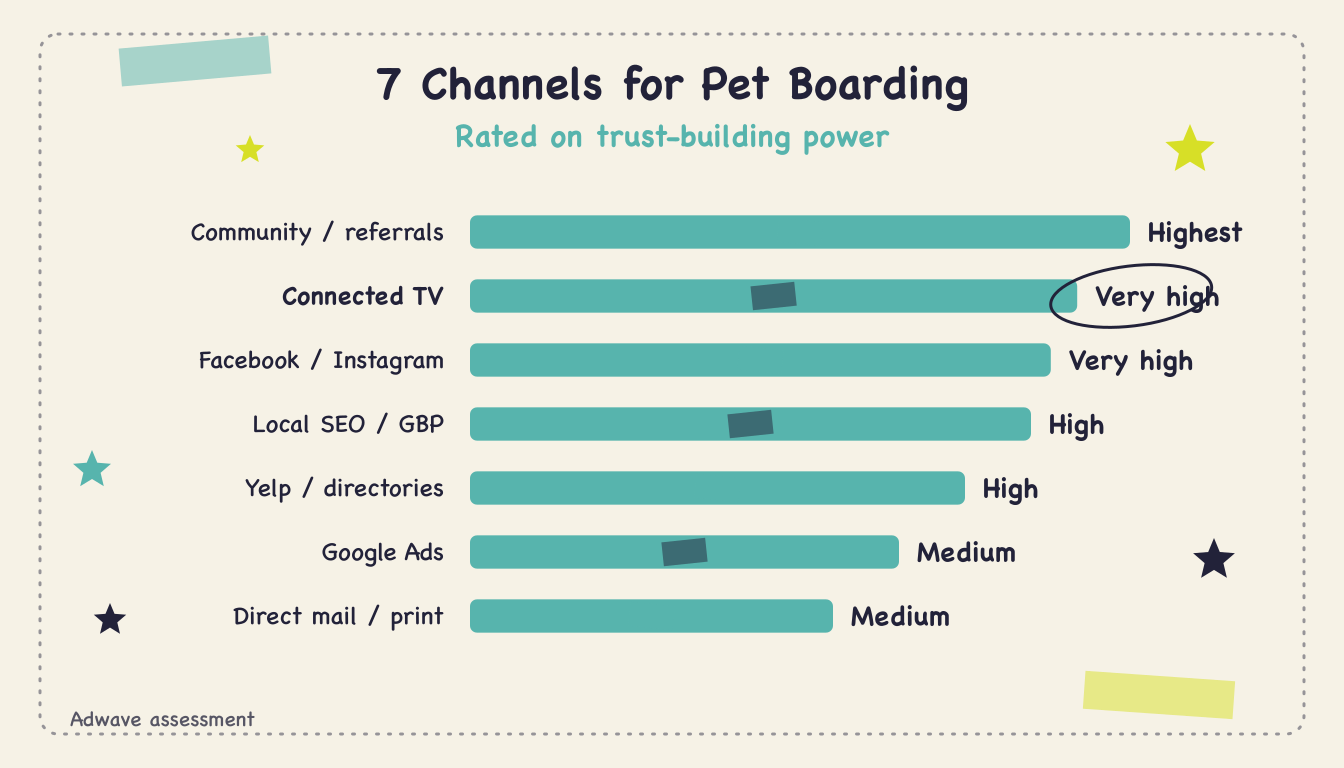
Channel 1: Google Ads and search
When a dog owner realizes they need boarding for an upcoming trip, most start the same way: they search. "Dog boarding near me," "pet daycare [city]," "overnight dog kennel." Google Ads put you at the very top of those results, above the organic listings, at the exact moment someone is ready to book.
This is high-intent advertising, and for pet boarding it's often the single best place to start. Someone searching "dog boarding this weekend" isn't browsing, they have a trip and a deadline, and they're comparing a few options right now. Showing up first, with a clear message and an easy way to book, captures that demand before your competitors do.
To make Google Ads work for a boarding or daycare business:
Target local, high-intent terms. Bid on searches that combine your service and your area: "dog boarding [city]," "doggy daycare near me," "cat boarding [neighborhood]." These convert far better than broad pet-related terms.
Use location and call extensions. Make it effortless for a searcher to see you're nearby and to call or book in one tap. Many boarding bookings start with a phone call.
Match your ad to the anxiety. Lead with reassurance: "Safe, supervised boarding," "Webcams so you can check in," "Trusted by [X] local families." Speak to the worry, not just the service.
Send clicks to a focused page. Don't drop searchers on your homepage. Send them to a page about boarding specifically, with photos, hours, pricing guidance, and an obvious booking button.
Google Ads costs are controllable, you set a daily budget, and pet-service keywords are generally far cheaper than cutthroat categories like legal or insurance. Even $10 to $20 a day can capture meaningful local booking demand. The main limitation is that search only reaches people already looking, which is why it works best paired with channels that build awareness before the need arises.
Channel 2: Facebook and Instagram
If Google captures demand, Meta's platforms, Facebook and Instagram, are where you build it. And for a pet business, they're close to perfect, because the product is adorable. Photos and videos of happy dogs playing, napping, and getting belly rubs are exactly the content people love to see and share.
Social media does three jobs for a boarding or daycare business at once. It builds your brand and trust through a steady stream of joyful, behind-the-scenes content. It lets you run affordable, precisely targeted local ads to dog owners in your area. And it gives current clients a place to tag, share, and recommend you, turning your happy customers into a marketing engine.
To use Facebook and Instagram well:
Post the joy. Daily or near-daily photos and short videos of the dogs in your care (with owner permission) are your best content. A "camper of the day" post or a play-group video builds more trust than any ad copy.
Run local awareness and booking ads. Boost your best-performing posts and run targeted ads to pet owners in your service radius. You can target by location, interests (dog owners, pet lovers), and even life events like upcoming travel.
Use retargeting. Show ads to people who visited your website but didn't book. A gentle reminder featuring a happy dog often brings them back.
Encourage tagging and reviews. Make it easy and appealing for clients to tag your business and leave a review. Their networks are full of other dog owners, exactly who you want to reach.
Meta ads are budget-friendly, you can start meaningful local campaigns for a few dollars a day, and the visual, shareable nature of pet content means your organic posts can extend your reach for free. The trade-off is that social requires consistent posting to stay effective, but for a business this photogenic, that's more opportunity than chore.
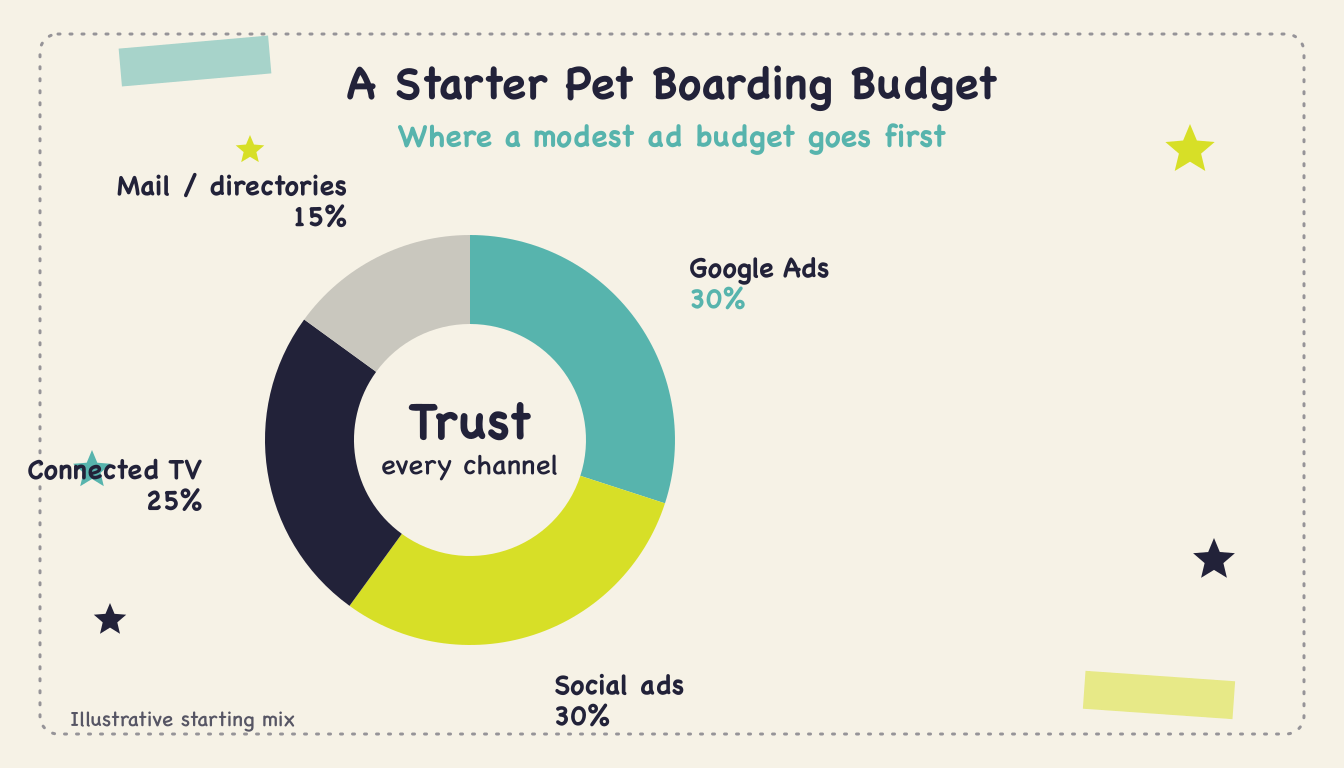
Channel 3: Local SEO and Google Business Profile
A huge share of pet boarding searches happen on Google Maps and in the local "map pack," those three business listings that appear at the top of local searches. Ranking there is free, and it's one of the highest-return things a boarding or daycare business can do.
Your Google Business Profile is the centerpiece. A complete, active profile, with accurate hours, services, plenty of photos, and a steady flow of reviews, is what gets you into that map pack when someone searches "dog boarding near me." Because the results are location-based, a small local business can outrank national chains for nearby searches.
To strengthen your local SEO:
Claim and fully complete your Google Business Profile. Add services (boarding, daycare, grooming), hours, photos of your facility and the dogs, and keep everything current.
Make reviews a habit. Reviews are the single biggest driver of local ranking and trust for pet services. Ask every happy client, ideally at pickup when they've just seen their happy dog, and respond to every review.
Optimize your website for local terms. Make sure your site clearly states your services and service area, with dedicated pages for boarding and daycare, so Google understands what you offer and where.
Get listed consistently. Ensure your name, address, and phone number are identical across the web, which reinforces your local relevance.
Local SEO is mostly a matter of effort rather than money, which makes it one of the best values in this whole list. The limitation is that it takes consistent attention to build and maintain, and it competes with the other well-run facilities in your area, so reviews and activity are what set you apart.
Channel 4: Yelp and pet-specific directories
Many pet parents, especially those new to an area or especially cautious, turn to review-driven directories to find and vet a boarding facility. Yelp remains significant for local services, and there are pet-specific platforms and marketplaces where dog owners search for and book care.
Being present and well-reviewed on these platforms matters because they attract high-intent users who are actively comparing options and leaning heavily on reviews. A strong presence here functions as both advertising and social proof.
To make the most of directories:
Claim and complete your Yelp listing. Add photos, services, hours, and respond professionally to reviews, both positive and negative.
List on pet-specific platforms. Depending on your market, booking marketplaces and pet-care directories can send you qualified leads. Evaluate which are active in your area.
Encourage reviews across platforms, not just Google. A cautious pet parent may check three or four sources. Being well-reviewed everywhere builds cumulative trust.
Consider paid enhancements selectively. Some directories offer paid placement or enhanced listings. Test them, but track whether they drive bookings before committing.
Directory costs range from free listings to paid placements and marketplace commissions. The main limitation is that you have less control over these platforms than your own channels, and marketplace fees can eat into margins, so treat them as one part of the mix rather than your foundation.
Channel 5: Community, referrals, and partnerships
Some of the most powerful advertising for a pet business isn't paid media at all, it's the network of local relationships and word-of-mouth that surrounds pet ownership. Dog owners talk to each other constantly, and they trust recommendations from people and businesses they already rely on.
Referrals and partnerships are especially valuable here because they come pre-loaded with trust, the exact currency your business runs on. A recommendation from a vet or a fellow dog owner clears the anxiety hurdle in a way an ad can't.
Ways to build this channel:
Partner with complementary pet businesses. Veterinarians, groomers, dog trainers, and pet stores all serve the same customers and can refer clients to you (and vice versa). Build genuine relationships and referral arrangements.
Create a referral program. Reward current clients for referring friends, a free daycare day or a discount on the next boarding stay. Happy clients are glad to spread the word when nudged.
Get involved locally. Sponsor a local dog park cleanup, host an adoption event with a rescue, or show up at community pet events. Visibility in the pet community builds your reputation as the local expert.
Work with rescues and shelters. Supporting local rescues builds goodwill and puts you in front of exactly the people adopting new dogs who'll soon need care.
This channel costs little beyond time and the occasional incentive, and it produces some of the highest-quality, most loyal clients you'll get. Its limitation is that it builds slowly and can't be switched on overnight, which is why it complements, rather than replaces, your faster paid channels.
Channel 6: Direct mail and local print
It's tempting to write off direct mail and local print as outdated, but for a hyper-local, trust-based business like pet boarding, they can still pull their weight, especially for reaching pet owners in specific neighborhoods.
Physical mail and local print work because they're tangible and local. A well-designed postcard with a photo of happy dogs and a new-client offer can land on the kitchen counter of every dog-owning household in your area, and community newsletters or local magazines reach engaged local readers.
To use direct mail and print effectively:
Target dog-owning neighborhoods. Use mailing lists filtered for pet owners, or blanket the residential areas nearest your facility where convenience matters most.
Lead with a photo and an offer. A joyful dog image and a clear first-time offer (a free daycare trial day, a discounted first boarding stay) give people a reason to act.
Advertise in community and pet publications. Local magazines, neighborhood newsletters, and pet-event programs reach engaged local audiences at reasonable cost.
Include a clear next step. A phone number, a website, and a QR code that leads straight to booking make it easy to respond.
Direct mail has real per-piece costs and is harder to measure precisely than digital, so it works best as a supporting, neighborhood-level tactic rather than your primary channel. Used selectively around your facility, it can be a steady source of local awareness.
Channel 7: TV and connected TV advertising
Here's the channel most pet boarding owners assume is out of reach: television. It used to be, when TV meant expensive production and buying an entire market. But connected TV, the ads that run on streaming services like Hulu, Roku, and Peacock, has changed that completely, and it's now an affordable, powerful option for a local pet business.
Connected TV lets you run a genuine 30-second video ad, showing your happy dogs, clean facilities, and caring staff, on premium streaming channels, targeted to just your local area. For a trust-driven business, video on the TV screen is uniquely persuasive: nothing builds confidence like seeing dogs thriving in your care on the big living-room screen. It's the fastest way to build the brand awareness and emotional trust that turn a stranger into a booking. Pair your spot with a QR code viewers can scan to book or follow you, and you turn TV awareness into action. Because you can now generate a broadcast-quality ad from your existing photos in minutes and run it on a local budget, connected TV finally fits a single-location pet business. For a deeper look at how TV works for pet businesses specifically, see our guide to TV advertising for pet businesses.
Use TV alongside search and social to introduce your pet care business to local households.
How to combine channels: a pet boarding plan
You don't need all seven channels blasting at once. The best approach layers them by budget and stage, each doing its job.
Here's a practical way to prioritize:
Start with the free foundations. Nail your Google Business Profile and local SEO, and build a consistent, joyful Facebook and Instagram presence. These cost time, not money, and they're the backbone of a trust-based local business.
Add high-intent capture. Layer in Google Ads targeted to local boarding and daycare searches to catch people ready to book right now.
Build the trust network. Start referral partnerships with vets and groomers and a client referral program. This compounds over time into your best source of clients.
Amplify with brand-building. As budget allows, add connected TV to build awareness and trust across your area, and use targeted direct mail in your closest neighborhoods.
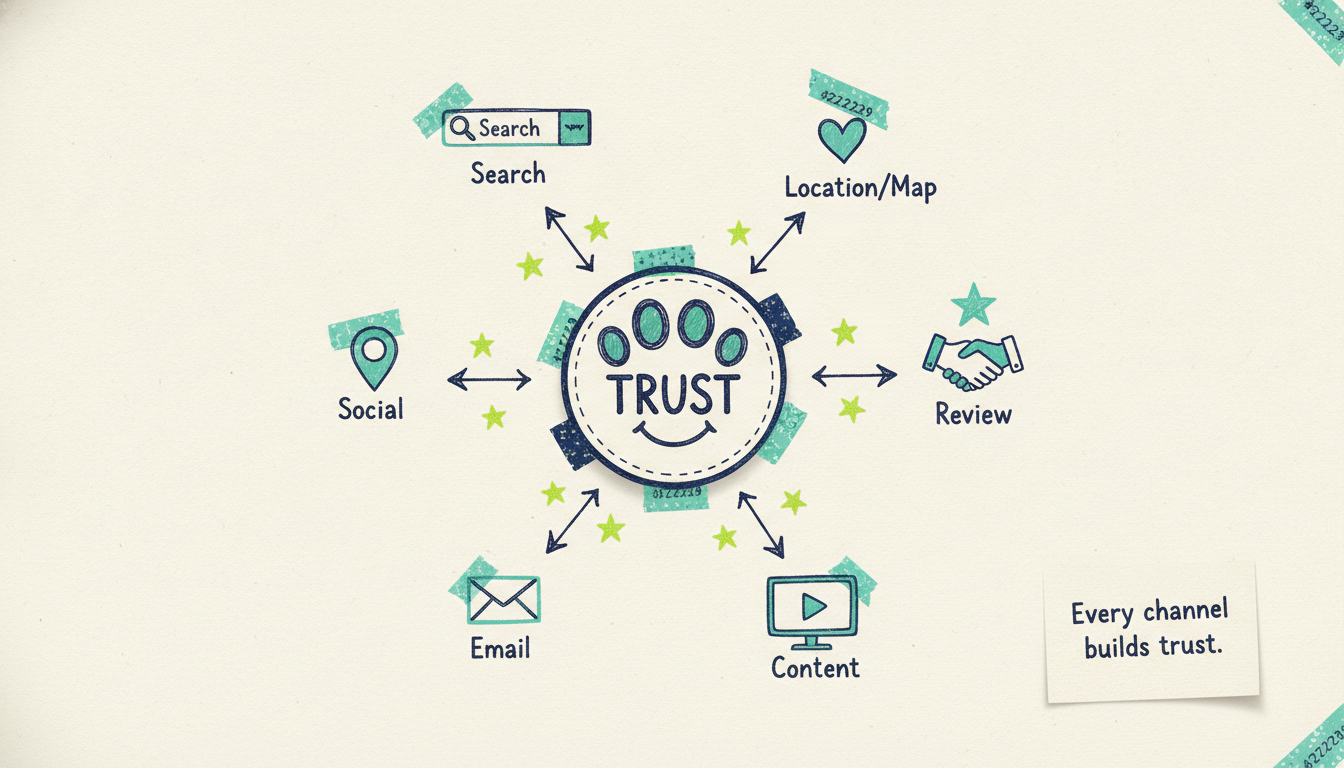
The thread through all of it is trust. Every channel should reinforce that you're the safe, caring, local choice, so that whether a pet parent finds you through search, a friend, or a streaming ad, they arrive already feeling confident. That coordinated, reinforcing approach is the heart of effective multi-channel advertising.
Common questions answered
What's the best way to advertise a pet boarding or daycare business? For most facilities, the foundation is free: a complete Google Business Profile and strong local SEO to get found in "near me" searches, plus a consistent Facebook and Instagram presence full of happy-dog content. Layer in Google Ads to capture people ready to book, referral partnerships with vets and groomers for pre-trusted clients, and connected TV to build brand and trust across your area. The best approach combines several channels, each doing a specific job, all reinforcing that you're the safe, local choice.
How much should a pet boarding business spend on advertising? It varies by market and goals, but many facilities start effectively on a modest budget because their most important channels, local SEO, Google Business Profile, and organic social, are free to run. From there, adding $10 to $20 a day on Google Ads and a small social ad budget can drive meaningful bookings. Connected TV and direct mail can be layered in affordably as you grow. Start with the free foundations, then scale what drives bookings.
Why are reviews so important for pet boarding advertising? Because choosing pet care is a trust decision, and reviews are the clearest proof that other pet parents trusted you and were happy. Reviews drive your ranking in Google's local map pack, influence which facility a cautious owner picks on Yelp, and reassure people considering you for the first time. Making review collection a habit, especially at happy-dog pickup moments, is one of the highest-return things you can do.
Does TV advertising make sense for a single-location pet business? Yes, more than most owners expect. Connected TV now lets you run a local, targeted 30-second video ad on streaming services for a small-business budget, and for a trust-driven business, seeing happy dogs thriving in your care on the TV screen is uniquely persuasive. Combined with AI tools that generate the video from your photos in minutes, connected TV has become a practical, affordable option for building trust and brand fast, even for one location.
How do I get more repeat bookings and referrals? Deliver a great experience, then make it easy for happy clients to come back and spread the word. Stay familiar with consistent social content and occasional email or text reminders, run a referral program that rewards clients for sending friends, and build partnerships with local vets and groomers. Because pet care is repeat-driven and referral-heavy, turning each happy client into a repeat customer and an advocate is the most valuable growth you can create.
The bottom line
Advertising a pet boarding or daycare business comes down to one word: trust. Pet parents are handing you their family, and every channel you use should make them feel confident they've chosen well. Start with the free foundations of local SEO, Google Business Profile, and joyful social content, capture ready-to-book demand with Google Ads, build a referral network that runs on trust, and use affordable connected TV and direct mail to make your name familiar before the need arises.
You don't need all seven channels at full blast, and you don't need a big budget. You need the right mix for your stage, each channel reinforcing that you're the safe, caring, local choice. Adwave makes the TV part simple: generate a heart-warming 30-second ad from your photos, then run it on connected TV and beyond, all from one place. See how Adwave works, or check pricing to get started from $50.


