
For a tutoring or test prep center, the calendar runs your business. Enrollment doesn't trickle in evenly across the year, it surges in a few predictable windows, and the biggest one is back-to-school. When families shift from summer mode to school mode, they start worrying about grades, upcoming tests, and the classes their kids struggled with last year. That's when they go looking for help, and it's the moment your advertising has to be in front of them.
About seasonal demand: the businesses that win the back-to-school rush aren't the ones that start advertising in September. They're the ones who built awareness in August, so that when a parent finally decides "we need a tutor," your center is the name they already recognize. This guide breaks down how to time and run a back-to-school advertising push for a tutoring or test prep center, which channels to use, and how to make sure you capture the enrollment surge instead of missing it.
Why back-to-school is your Super Bowl
Every industry has a peak season, and for tutoring and test prep, back-to-school is it. Understanding the shape of that demand is the first step to advertising against it well.
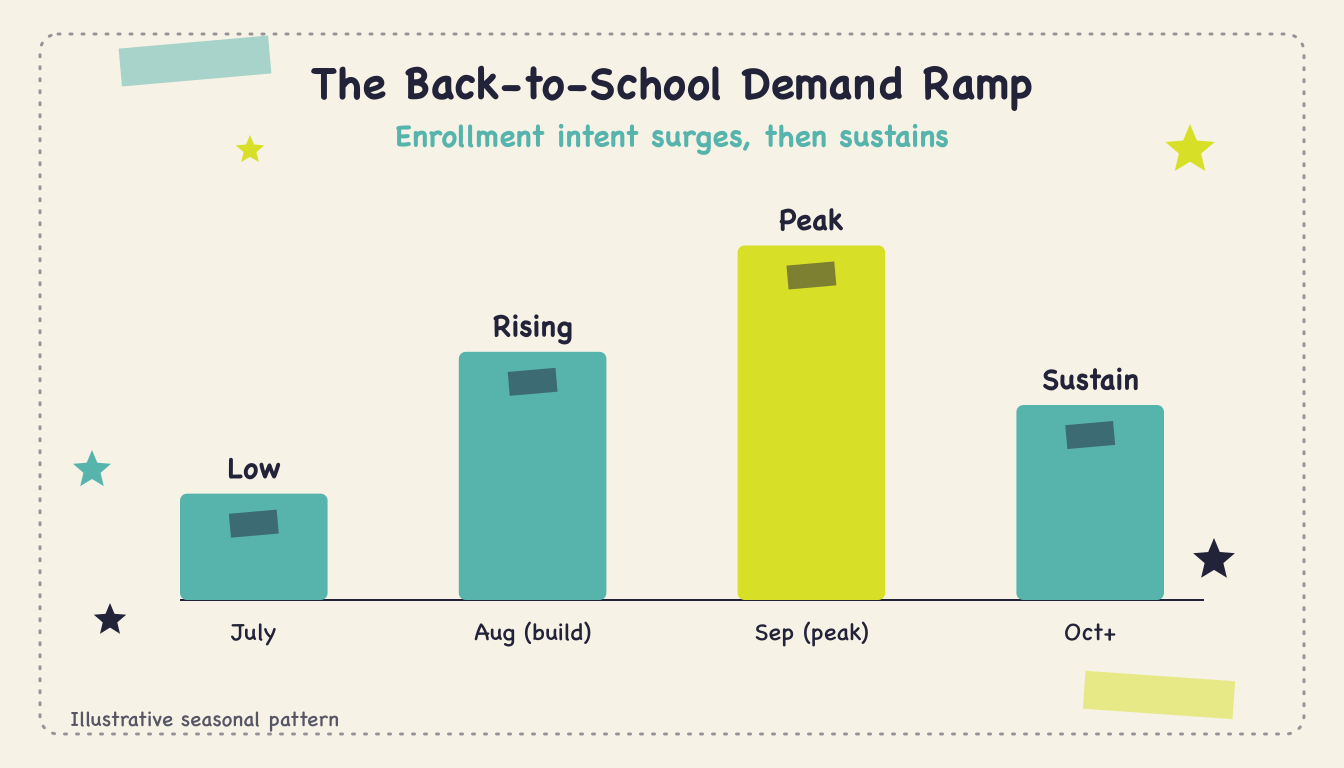
The back-to-school window isn't a single day, it's a ramp. It starts in late summer as parents anticipate the year, builds through the first few weeks of school as report cards and early quizzes reveal where kids are struggling, and extends into fall as standardized test dates approach. For test prep specifically, demand often spikes again ahead of major exam windows, but the back-to-school period sets the tone for the whole year's enrollment.
Two things make this season uniquely valuable. First, intent is high: a parent looking for a tutor in September isn't browsing, they've decided their child needs help and they're ready to act. Second, the decision has a deadline: nobody wants to wait until midterms to get support in place. That combination of urgency and intent makes back-to-school the highest-return advertising window of your year, which is exactly why you want to plan it deliberately.
The timing mistake most centers make
The single most common back-to-school advertising mistake is starting too late. It feels intuitive to launch ads in September when demand peaks, but by then you're competing for attention at the most expensive, most crowded moment, and you've missed the chance to be the familiar name.
Advertising works in two stages: creating demand and capturing it. Demand capture, like search ads that catch a parent typing "math tutor near me," only works if that parent is already searching. Demand creation, like a video ad a family sees during their evening streaming, plants your name before they're actively looking, so that when they do search, they recognize you and choose you. You can read more about how these two stages work together in our guide to multi-channel advertising.
For a seasonal business, this means your awareness advertising should lead the peak, not chase it. Here's a simple way to think about the calendar:
Early-to-mid August (awareness build): Launch video and social awareness ads. Families are thinking about the coming year but haven't chosen a tutor yet. This is when to plant your name.
Late August through September (peak capture): Add or increase search advertising to catch parents now actively looking. Your earlier awareness spending makes these ads convert better and cost less.
October and beyond (sustain): Keep a lighter presence running to catch the second wave, including test-prep families targeting fall and winter exam dates.
The centers that build awareness in August consistently get more from their September search spend, because they're harvesting warm, familiar demand instead of cold clicks.
The channels that work for back-to-school
A strong back-to-school push uses more than one channel, because each does a different job in the parent's decision. Here's how the main options fit a tutoring or test prep center.
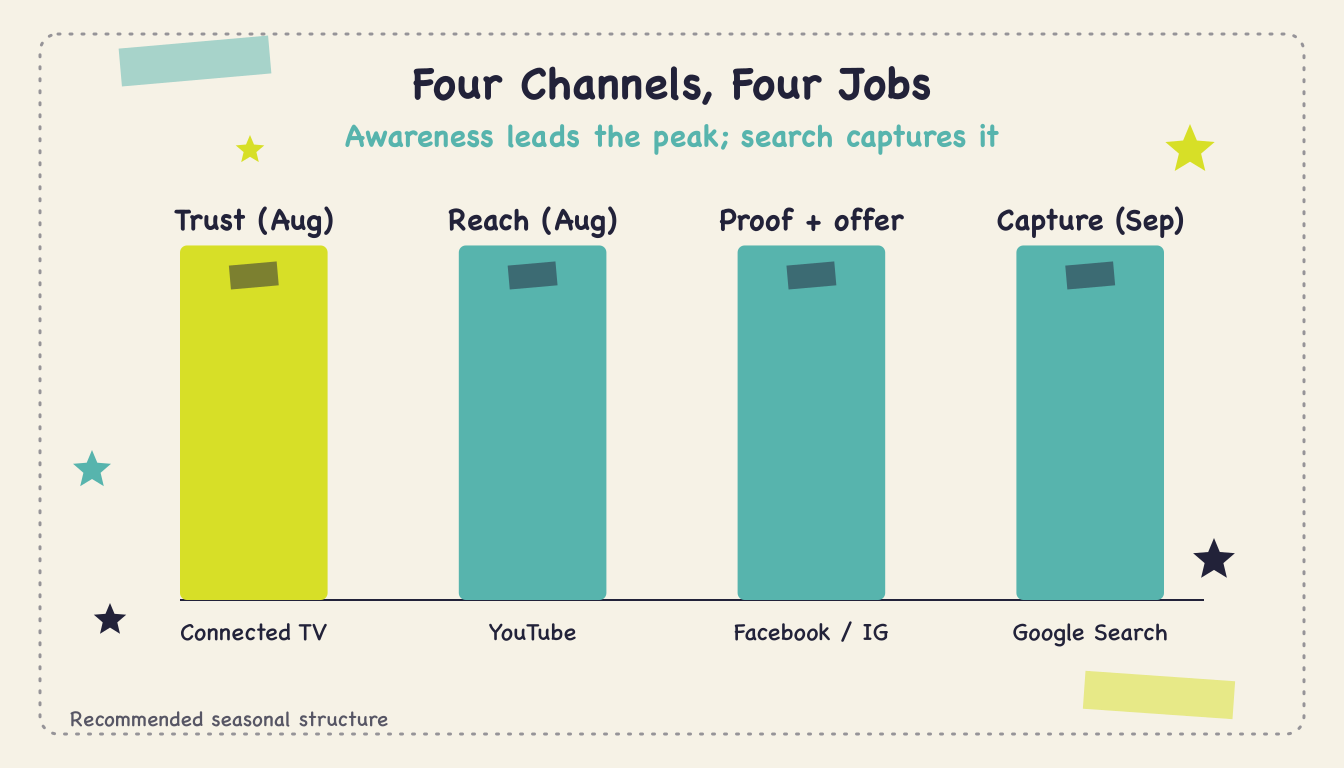
Connected TV (streaming) for trust and awareness. Choosing who helps your child is a trust decision, and nothing builds trust like seeing a real, warm video ad on the living-room TV. Connected TV lets you run a 30-second spot on premium streaming channels, targeted to families in your area, at a cost that finally fits a local center's budget. Running it in August gets your name in front of parents before the rush. For the vertical specifics, our page on TV advertising for tutoring centers and test prep goes deeper.
YouTube for affordable video reach. The same video can run on YouTube to reach parents on their phones and TVs, extending your awareness message cheaply. Because you often pay only when someone watches, it's efficient even on a modest seasonal budget.
Facebook and Instagram for local targeting and proof. Social is ideal for reaching parents in specific zip codes with proof: student success stories, score improvements, and a clear back-to-school offer. A "reserve your fall spot" message with a deadline plays perfectly to the season's urgency.
Google Search for capture. When a parent decides to act and searches "SAT prep near me" or "reading tutor for 3rd grader," you want to be there. Search is your capture layer, and it converts far better when your other channels have already made your name familiar.
Local and community presence. Don't overlook school-adjacent opportunities: local sponsorships, community boards, and partnerships. These complement your paid advertising and reinforce the local-trust angle.
Building your back-to-school creative
Seasonal advertising rewards seasonal creative. A generic "we offer tutoring" ad works far less well than one that speaks directly to the back-to-school moment.
A few principles for tutoring and test prep creative this season:
Name the pain and the deadline. Parents respond to specifics: "Worried about this year's math?" or "SAT in the fall? Start now." Tie your message to the season's real anxieties.
Lead with outcomes. Score improvements, grade turnarounds, and confidence are what parents are buying. Show results, not features.
Make the next step obvious. A clear, low-friction offer, a free assessment or a reserved fall spot, converts far better than "call us." On TV, a QR code lets interested parents act instantly.
Show real faces. Trust drives this decision. Video of actual tutors and a warm, welcoming center does more than any list of subjects.
Creating a professional video ad no longer requires a production budget. AI tools can generate a broadcast-quality 30-second ad from your website in minutes, which means even a single-location center can run polished video across streaming and YouTube for the season. That removes the biggest barrier that used to keep local centers off the TV screen.
Putting it together: a back-to-school plan
Here's how a tutoring or test prep center can structure a back-to-school push without a marketing team or a huge budget.
Start in early August by launching connected TV and social awareness ads across your local area, using video generated from your website. The goal is recognition: get your name and results in front of every family in your service area before they start looking. In late August, layer in Google Search and increase social with a deadline-driven offer, catching the parents who are now actively deciding. Through September and into fall, sustain a lighter presence and lean into test-prep messaging for families targeting upcoming exams.
The key is coordination: the same branding and message across every channel, so each touchpoint reinforces the others. A parent who saw your ad on their TV in August, then your post on Instagram, then your name in search results in September, is far more likely to enroll than one who only saw a single search ad at the last minute. For the seasonal timing playbook across any local business, our guide to back-to-school TV advertising covers the broader strategy.

Common questions answered
When should a tutoring center start back-to-school advertising? Start your awareness advertising in early-to-mid August, before demand peaks. This lets you build recognition so that when parents actively search in late August and September, your center is already the familiar name. Waiting until September means competing at the most expensive, crowded moment without the advantage of prior awareness.
How much should a tutoring or test prep center budget for back-to-school? It depends on your market and goals, but the season's high intent makes it your best-return window, so it's worth weighting your annual advertising budget toward it. A common approach is to run a testing budget on awareness channels in early August, then scale spending toward what's working as the peak arrives. Because connected TV and YouTube now run on local budgets, even small centers can afford a video presence.
Which channels work best for tutoring advertising? A coordinated mix works best: connected TV and YouTube for trust-building video awareness, Facebook and Instagram for local targeting and proof, and Google Search to capture parents actively looking. Each does a different job, and together they cost less per enrollment than any one channel alone, because awareness makes your search ads convert better.
Is connected TV really affordable for a single-location tutoring center? Yes. Connected TV now runs in a single local market on small-business budgets, so a single-location center can put a 30-second video ad in front of local families during their streaming shows. Combined with AI-generated creative, the cost of running professional video advertising has dropped to a point that fits a local center.
What makes good back-to-school tutoring creative? Speak to the season's real anxieties, name the deadline, and lead with outcomes like score improvements and grade turnarounds. Show real tutors and a welcoming center to build trust, and make the next step obvious with a low-friction offer like a free assessment. Tie everything to the back-to-school moment rather than running a generic year-round message.
The bottom line
Back-to-school is the highest-intent window of the year for tutoring and test prep centers, and the businesses that win it plan ahead. Build awareness in August with video on connected TV, YouTube, and social, then capture the surge in September with search and deadline-driven offers. Coordinate the message across every channel so each touchpoint reinforces the others, and your center becomes the name parents already trust when they decide to act.
Adwave makes this practical: generate a 30-second video ad from your website, then run it across connected TV, YouTube, Google, Meta, and more from one place. See how Adwave works, or check pricing to get started from $50 before the back-to-school rush.


