
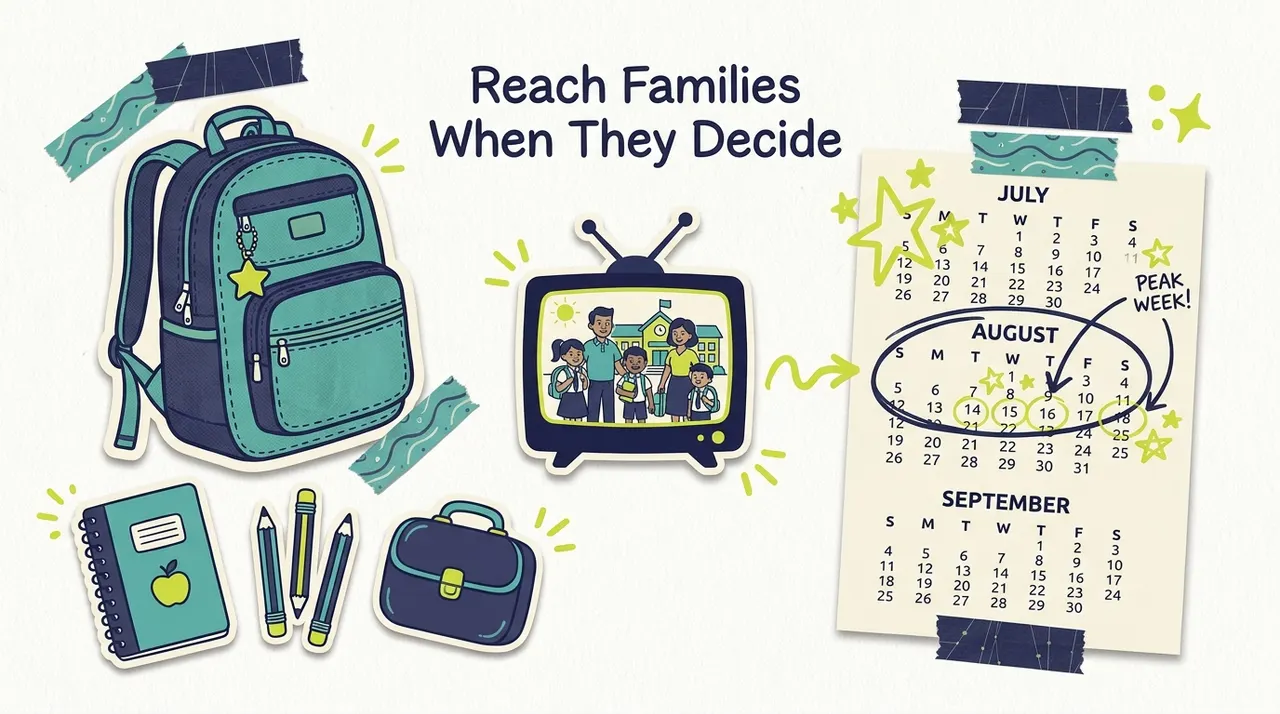
Back-to-school season is one of the most concentrated buying windows in the U.S. retail calendar, and it's expanded well beyond traditional retail in recent years. Local businesses across categories now see meaningful demand bumps tied to the school calendar: clothing and supply retailers, family-oriented restaurants, fitness studios with youth programs, pediatric dental practices, tutoring services, after-school enrichment programs, and even home services businesses targeting families settling in for the school-year routine.
The window has also extended. Back-to-school spending in 2026 starts earlier each year, with mid-July now being the start of meaningful consumer activity in most markets. For local businesses with anything to offer families gearing up for the school year, a coordinated TV campaign timed to the back-to-school window can produce some of the strongest seasonal lift of the year.
This guide walks through how to plan, build, and measure a back-to-school TV campaign that captures the buying window while respecting how families make decisions during this period.
Why TV matters during back-to-school
Three factors make TV especially effective during the back-to-school window:
1. Family-decision dynamics. Most back-to-school decisions are made by families together. The household-level reach of TV is exactly the right format. A parent watching streaming TV with a teenager in the evening sees your ad together; the conversation about "where should we get fall clothes" or "should we sign up for the after-school program" happens organically.
2. Concentrated decision-making windows. A household decides about back-to-school in fairly short windows: the first signs of August, the week after schools post supply lists, the weekend before school starts. TV reaches families during the evening decision-making hours when these conversations happen.
3. Cross-category compounding. Back-to-school isn't just retail. Families are simultaneously deciding about clothing, supplies, fall activities, restaurants for family dinners during the busier school week, fitness programs, tutoring, and routine services they may have neglected over summer. A small business that establishes presence during the early back-to-school window gets in front of multiple decision-making moments.
When the back-to-school window starts
The traditional "back-to-school" framing in marketing used to be mid-to-late August. That framing is outdated. The 2026 reality:
Mid-to-late July. Early back-to-school awareness begins. Retailers start lightweight back-to-school marketing. Some early-bird shoppers begin purchasing supplies and clothing.
Early August. Active decision-making accelerates. School supply lists are typically posted by this point in most districts. Family conversations about fall activities and routine services intensify.
Mid-August. Peak back-to-school shopping and decision-making in most markets. The 2 weeks before the first day of school is the heaviest spend window.
Late August through Labor Day. Final-week shopping and routine-setting decisions. Restaurants and family-oriented service businesses see strong activity.
First two weeks of September. Activity continues for service-related decisions (tutoring, after-school programs, fitness) as families settle into the school-year routine and identify gaps.
For most local businesses, the right campaign window is mid-July through early September, with the heaviest weight in the 3-week window from August 1 through approximately August 21.
Building the back-to-school TV plan
A typical back-to-school TV campaign runs across four phases tied to the season calendar.
Phase 1: Early awareness (mid-July through July 31)
The first phase establishes presence before active decision-making begins. Creative is awareness-focused with soft framing tied to the approaching season.
Creative emphasis: General "back-to-school is almost here" framing. Brand and offer awareness. Soft CTAs. Example: "Get ready for the new school year at [your business]."
Targeting: Standard service area, no specific daypart concentration.
Daily cap: Modest. Goal is steady presence rather than concentrated weight.
Phase 2: Active decision window (August 1 through August 15)
The campaign's heaviest spend phase. Active family decision-making is happening, and creative shifts to specific offer-driven framing.
Creative emphasis: Specific products, specific services, specific offers. Example: "Back-to-school sale on kids' clothing" or "Schedule your child's back-to-school dental check-up." Slightly harder CTAs.
Targeting: Standard service area, with potential evening daypart push when family decision conversations happen.
Daily cap: Elevated. This is the campaign's peak window.
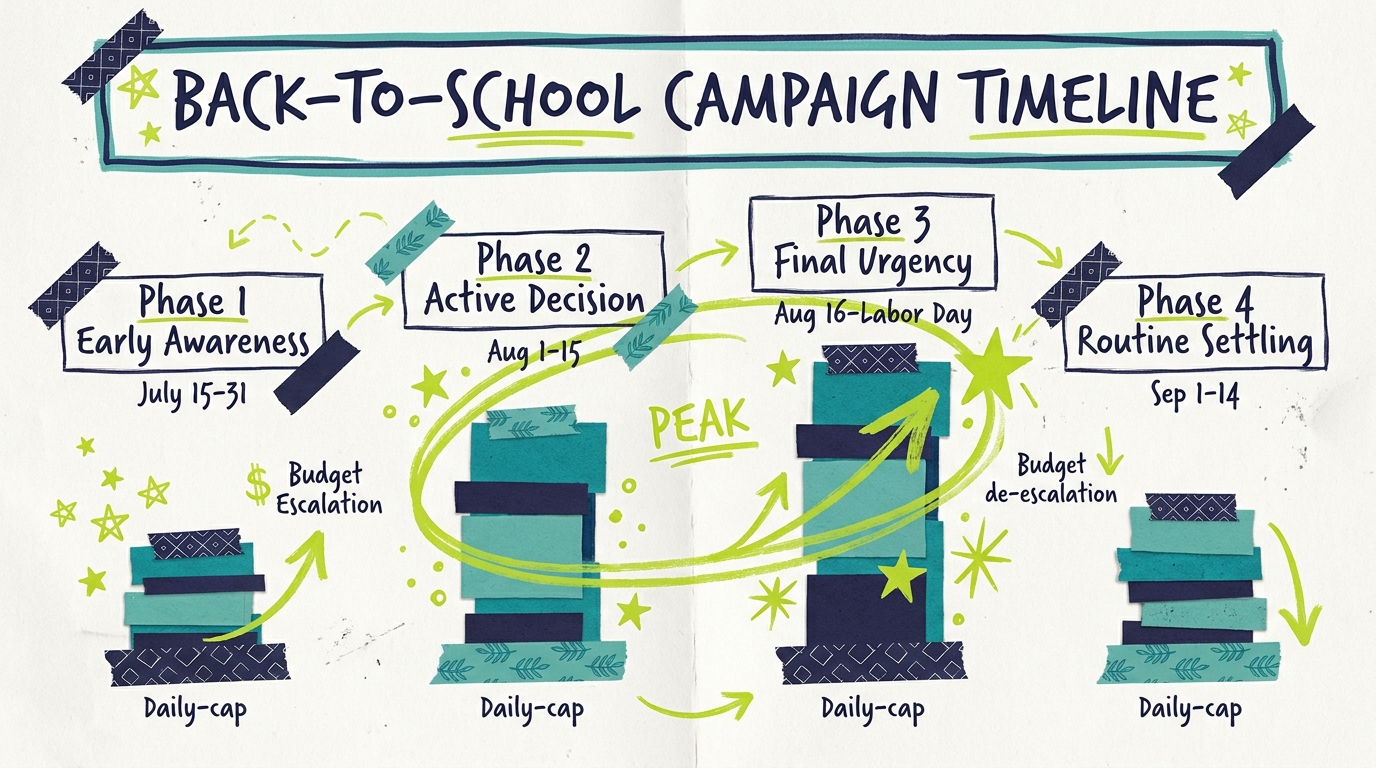
Phase 3: Final-week urgency (August 15 through Labor Day)
The third phase emphasizes immediacy and the closing window before school starts.
Creative emphasis: Time-bound urgency. "Before school starts" framing. Specific time-limited offers. CTAs are direct.
Targeting: Maintain standard service area. Push toward early-evening dayparts when last-minute family decisions happen.
Daily cap: Sustained at phase 2 levels through Labor Day weekend.
Phase 4: School-year routine settling (first two weeks of September)
A smaller fourth phase for service categories whose demand extends into the first weeks of the school year. Fitness studios, tutoring services, after-school programs, and family restaurants often see continued momentum here.
Creative emphasis: Routine-establishing framing. "Now that school's started, let's set up the rest of the year." Service-specific CTAs.
Targeting: Reduced daily cap. Focused on service categories rather than retail.
Category-specific approaches
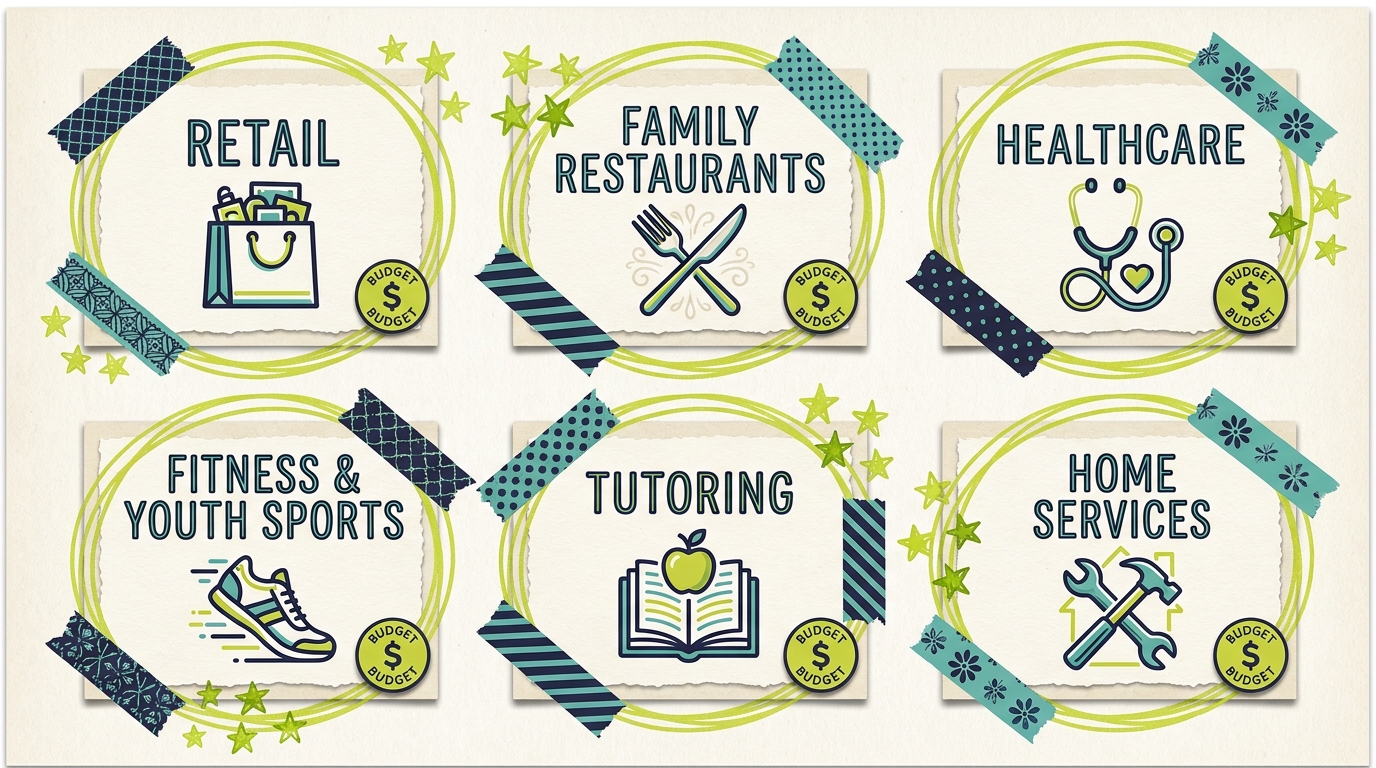
Retail (clothing, supplies, electronics, accessories)
The most direct back-to-school category. Campaigns should emphasize specific product callouts and time-bound offers. Creative grammar: tension-and-resolution structure (the moment when a child is excited about a new outfit, the relief of finishing the supply list).
Recommended budget for back-to-school window: $1,500-$3,500 across 4-6 weeks. Heaviest weight in early-to-mid August.
Family restaurants and quick service
Back-to-school changes family dinner patterns. Families that ate later or out more frequently during summer often shift to earlier, more routine weeknight dinners during the school year. Restaurants positioned for "family dinner during the busy school week" see strong response.
Recommended budget: $1,000-$2,500 across the campaign window. Push toward weekday evening daypart concentration.
Healthcare and dental practices
Pediatric dental, family medicine, sports physicals, and vision practices all see back-to-school demand. Many schools require physicals or specific screenings before the school year starts.
Recommended budget: $1,200-$2,500 across the window, with heaviest weight in late July through mid-August.
Fitness studios and youth sports
Youth programs (fall sports, dance, gymnastics, martial arts, music lessons) see their highest enrollment windows during back-to-school. Adult fitness studios also see increased demand from parents returning to routines.
Recommended budget: $1,500-$3,000 across the window, with continued spend through September for routine-establishment messaging.
Tutoring and academic enrichment
The back-to-school window is the highest-conversion period for tutoring services. Many families decide on academic support either pre-emptively (before school starts) or in the first 4-6 weeks (after seeing early-year struggles).
Recommended budget: $1,500-$3,000 across the campaign window, with extended September spend to capture early-year decisions.
Home services
Less obvious but increasingly relevant. Families settling into school-year routines often decide on cleaning services, lawn maintenance, HVAC tune-ups (before winter), and similar services they may have neglected over summer.
Recommended budget: $1,000-$2,000 across the window, with positioning around "set up the routine that makes the school year easier."
What to put in your 30-second back-to-school spot
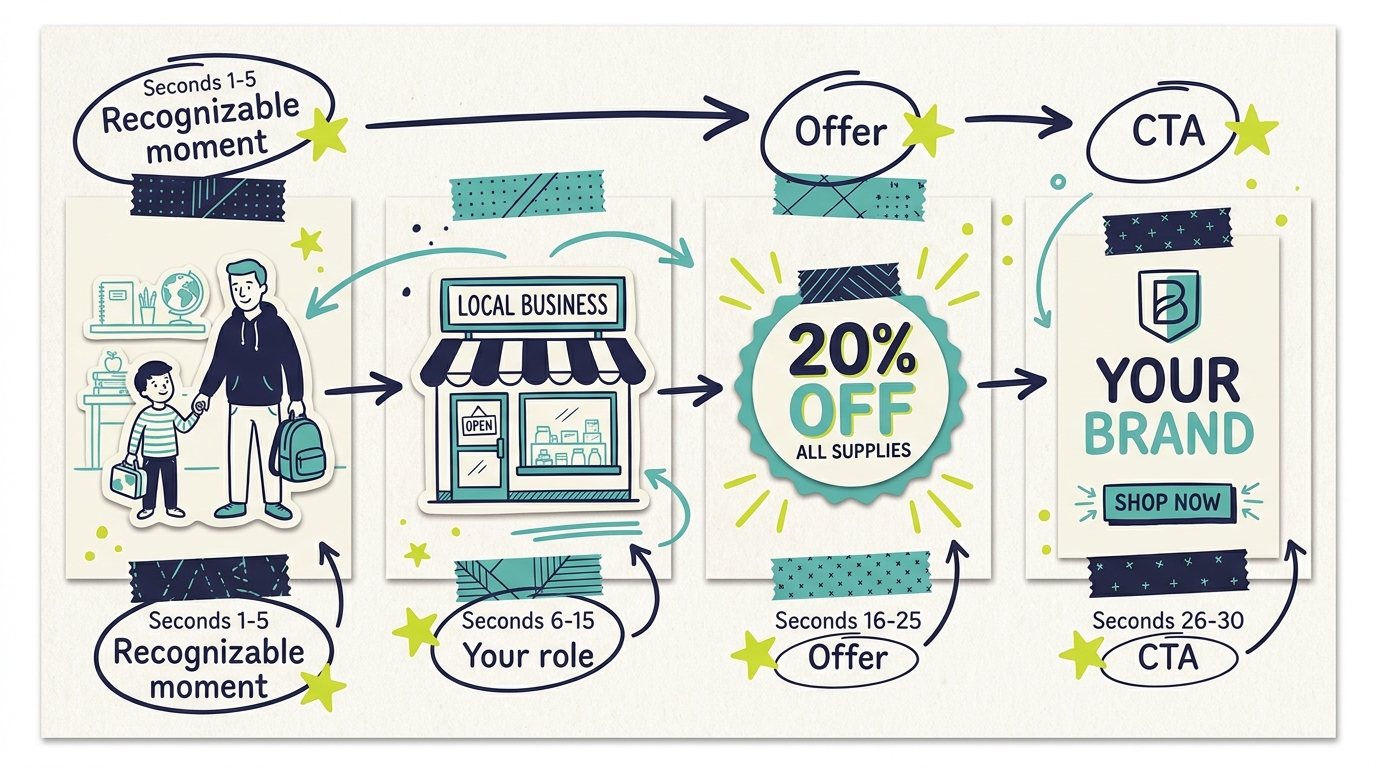
A practical structure for a 30-second spot in the back-to-school window:
Seconds 1-5: The recognizable moment. Open on a recognizable back-to-school scene: a parent and child looking at supplies, a backpack going on, the first day of school feeling. Establishes the seasonal context immediately.
Seconds 6-15: The transition to your business's role. Move from the scene to your specific role in the family's back-to-school preparation. "As you get the school year ready" or "before the first day arrives" or "set the routine that makes the year easier."
Seconds 16-25: The offer or value proposition. Your specific promotion, your specific service, your specific value. Be specific. "20% off all kids' clothing through August 15" or "Back-to-school dental checkups available all August" or "First month of tutoring free with a 3-month enrollment."
Seconds 26-30: The CTA and brand lock-in. Direct, time-bound CTA. "Visit us before school starts at [address]" or "Schedule your child's appointment online at [URL]." Brand name and URL on screen.
A few creative principles to avoid:
Don't overuse the "first day of school" trope. Every back-to-school spot has it. Differentiate by showing your specific business context.
Don't ignore the parent perspective. A spot focused entirely on children can miss the parent who's making the purchase decision.
Don't run generic "back-to-school savings" without specific offer detail. Specific offers (with specific products, services, or discount amounts) outperform generic seasonal framing.
Targeting decisions that matter
A few specific moves separate strong back-to-school TV campaigns from average ones:
School-district-aware geographic targeting. Public school start dates vary by district. If your service area covers multiple districts with different start dates (some August 15, some August 22, some after Labor Day), consider campaign timing that respects the variation. A creative that says "before school starts" needs to match when school starts in the viewer's district.
Family-household targeting. Most CTV platforms allow targeting weighted toward households with children. This is one of the few seasonal campaigns where demographic targeting precision dramatically improves return.
Evening daypart concentration. Family decision-making happens in evening hours when both parents are home with children. Pushing your daily cap toward 6-10 p.m. delivery improves conversion meaningfully.
Cross-channel coordination with Meta and Google. Back-to-school is one of the most Meta-active windows of the year for family categories. Coordinating CTV with Meta retargeting and Google search produces dramatically better combined results than any channel alone.
Sample 6-week back-to-school plan
A worked example for a family-oriented business (could be retail, restaurant, fitness studio, or service):
July 15-31 (Phase 1):
Two creative variations live in rotation: general "school year ahead" awareness + specific offer-tied creative
Daily cap $60
Geographic targeting to standard 8-mile radius around location
Demographic weighting toward households with children
August 1-15 (Phase 2):
Active decision window
Daily cap raised to $100
Maintain creative rotation; pause weaker performer if data warrants by Aug 10
Evening daypart concentration
August 16 through Labor Day (Phase 3):
Final-week urgency
Daily cap $100
New "before school starts" or "this weekend only" creative variation
Push toward early-evening dayparts (5-9 p.m.)
September 1-14 (Phase 4):
Optional routine-establishment messaging for service-relevant businesses
Daily cap reduced to $50
Soft CTA focused on year-establishing decisions
Total campaign spend across the 6-week window: roughly $2,500-$3,500 depending on phase length.
Measuring the campaign
Back-to-school campaign measurement follows the same framework as other seasonal campaigns:
Pre-campaign baseline. Capture 4 weeks of pre-campaign business performance (sales, foot traffic, inquiries, signups) for clean comparison.
Campaign-window comparison. Compare campaign weeks against baseline. Total lift over baseline is the campaign's contribution.
Cross-channel signals. Branded search lift, direct traffic lift, Meta and Google conversion-rate changes during the campaign window all matter.
Year-over-year comparison if possible. If you ran a back-to-school campaign last year, compare year-over-year performance to isolate the campaign's contribution from broader seasonal trends.
For most categories running a well-built back-to-school TV campaign, a 25-45% lift over baseline during the peak weeks is typical, with cross-channel lift adding meaningful additional value.
Common questions answered
When should I launch my back-to-school TV campaign?
For most local businesses, mid-to-late July is the right launch window. Earlier than that and you're spending on awareness before active decision-making begins; later and you miss the early decision-makers and the build-up phase that establishes familiarity.
How does back-to-school differ from other seasonal campaigns?
Back-to-school has a longer active window (6-8 weeks vs the 2-3 weeks of holidays like Memorial Day) and a higher household-decision component than most other seasonal moments. The longer window allows for clearer phased creative; the household dynamic makes TV especially effective.
Should non-family businesses skip back-to-school?
Mostly yes, with exceptions. Categories with no logical back-to-school connection (professional B2B services, niche specialty retail not tied to schools, businesses serving only senior demographics) should skip the back-to-school framing entirely. Most family-relevant local businesses benefit from at least some back-to-school positioning, even if it's modest.
How much should I spend on a back-to-school TV campaign?
Most local small businesses running back-to-school TV land in the $1,500-$3,500 range across the 4-6 week campaign window. The exact budget depends on geographic size, competitive pressure, and category demand pattern.
Should I coordinate back-to-school TV with my Meta and Google campaigns?
Yes. Back-to-school is one of the most coordinated multi-channel windows for family categories. CTV builds household familiarity; Meta drives visual decision-making in family social media use; Google catches active research. The combined effect dramatically outperforms any single channel.
What if school start dates in my market are very different across districts?
Stagger your "urgency" creative or run multiple creative variations tied to different start-date windows. The platform's geographic targeting can isolate the ZIPs with each district, allowing different urgency creative for households whose schools start at different times.
Can I run back-to-school CTV at a smaller budget (under $1,500)?
Yes, with limitations. Smaller budgets produce less local frequency, which reduces the campaign's recall power. For businesses with smaller service areas (3-5 mile radius) or modest competitive pressure, $800-$1,500 campaigns can produce meaningful results. For competitive metros or larger service areas, $1,500-$3,500 is the typical effective starting point.
Make back-to-school work for your business
Back-to-school season is one of the most concentrated and most reliable buying windows in the year for family-relevant local businesses. The combination of recognizable triggers (school start dates), concentrated decision-making (early-to-mid August), and household-level dynamics (families deciding together) makes the window especially well-suited to TV-anchored campaigns coordinated with digital.
For retailers, restaurants, healthcare practices, fitness studios, tutoring services, home services, and any other local business with family relevance, the back-to-school window deserves real planning rather than passing thought. The campaigns that produce the strongest results in this window are the ones planning by mid-June, launching by mid-July, peaking in early August, and measuring against clean pre-campaign baselines.


