

You already know the feeling. The revenue target looked smart in the planning meeting, then reality showed up. Leads got slower, the best rep went on leave, the busiest season didn't land where you expected, and now the number on the whiteboard feels more like a threat than a plan.
That's why realistic sales goals matter. Not motivational goals. Not boardroom goals. Realistic goals are the ones you can defend with actual sales history, actual capacity, and actual funnel math, then review without making excuses. If the number can't survive a basic stress test, lower it.
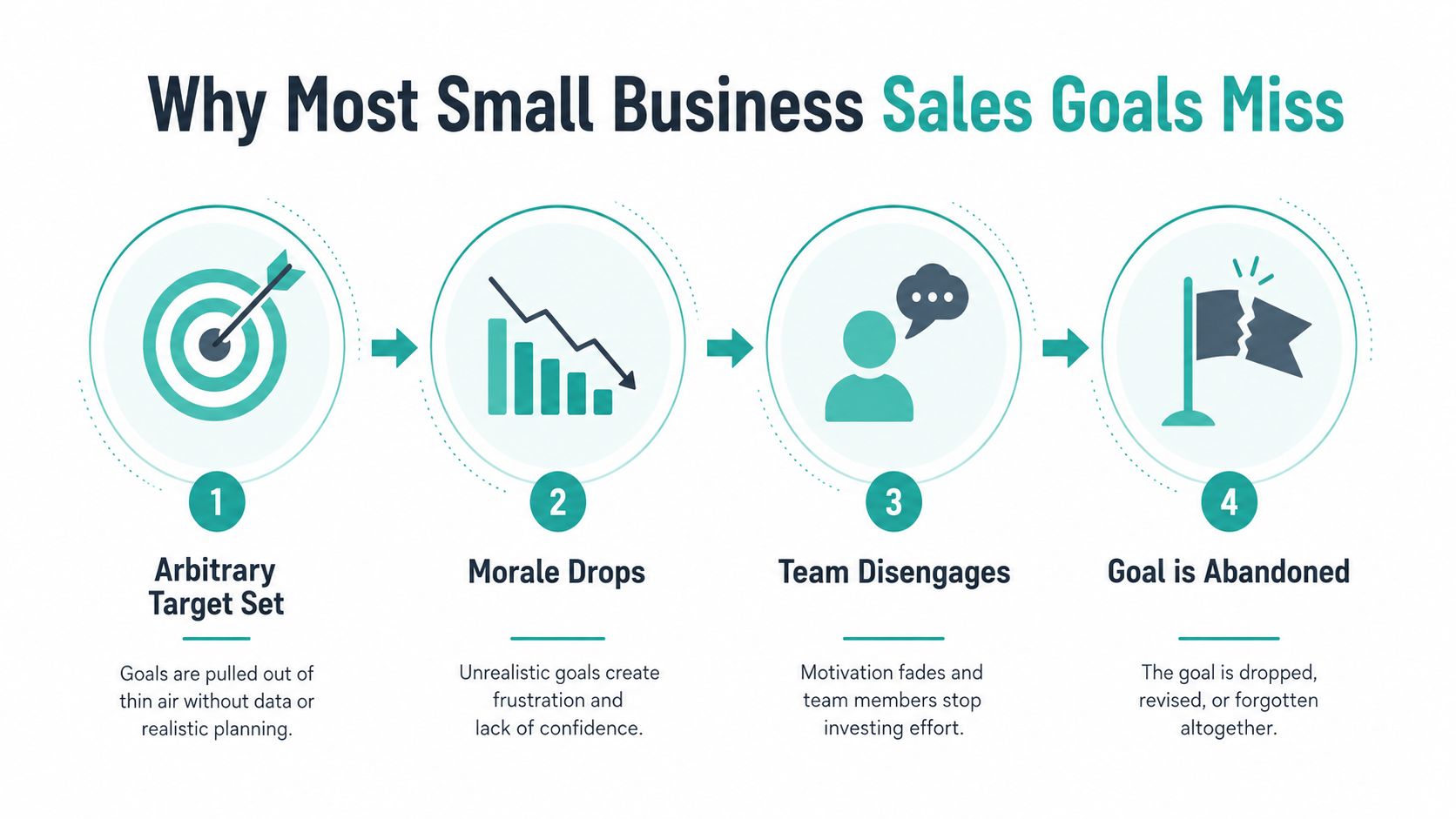
Why Most Small Business Sales Goals Miss
The most common failure mode is simple. A founder picks a number that sounds ambitious, the team nods along, and nobody asks whether the business can produce that result with current capacity, seasonality, and pipeline quality. Two months later, the goal is still there, but morale is gone.
A better goal is mathematically reachable and strategically honest. That sounds less exciting in a meeting, but it's far more motivating in practice because the team can see the path. Pipedrive recommends working backward from revenue and cost data, then breaking the result into measurable monthly or quarterly targets using inputs like deal size and win rate rather than arbitrary growth percentages, and that's the right starting point for a small business. Pipedrive's sales target guidance
Pull the right history, not the flattering version
Start with at least 24 months of sales data. That gives you enough history to spot seasonality, year-over-year change, and one-off spikes without mistaking noise for momentum. The point is to read the last two years like a report, not a highlight reel, because a good month can hide a weak pattern and a bad month can hide real demand.
Capture the basics in one place:
Revenue, so you know what the business produced.
Deal count, so you can see whether growth came from more deals or larger ones.
Average order value, so you can estimate how many sales the goal requires.
Win rate, because a target means nothing if the close rate can't support it.
Sales-cycle length, since slower cycles shrink what you can close in a given period.
Source and seasonality flags, so you can separate repeatable demand from a temporary spike.
Base each sales target on past performance, conversion rates, and your team's capacity.</p>
Here's the kind of baseline that helps. If a business sold $120,000 last year with an average order value of $600, that's about 200 sales for the year, or roughly 16 to 17 sales per month as a starting cadence. That number is much easier to monitor than a vague annual revenue target, and it gives the founder something real to inspect every month. Pipedrive's sales target guidance
Realistic beats impressive
The reason this matters is capacity. Small businesses usually don't have spare bandwidth to chase arbitrary growth numbers, especially when staffing is thin and the pipeline is uneven. A goal tied to actual sales history, conversion rates, and sales cadence is easier to defend in front of a lender, an investor, or your own team.
If your current number came from optimism, cut it down and rebuild it from evidence. That's not pessimism. That's management.
Working Backward From Revenue You Need
The cleanest way to set a sales goal is to stop starting with the goal. Start with the money the business needs to survive, then add the money it needs to grow. That's the difference between a target you can manage and a target you just hope for.
A practical, expert-level method is to begin with break-even revenue, layer in the profit you want for growth, then convert that annual number into monthly and weekly milestones grounded in deal size, win rate, and sales-cycle length. Anaplan's guide to realistic sales targets says that approach keeps the goal tied to capacity and funnel math instead of a top-down revenue wish.
Build the number from the bottom up
Here's the sequence I'd use:
List fixed costs for the year.
Add variable costs that scale with sales.
Add the profit you need for growth or owner pay.
Convert that annual total into monthly and weekly floors.
Test the number against deal size, win rate, and sales-cycle length.
That gives you a goal that traces back to a line item. If someone asks why the target is what it is, you can answer without hand-waving.
A useful internal check is customer acquisition cost, because revenue goals and acquisition economics have to agree. If you need a tighter view of that tradeoff, use Adwave's customer acquisition cost resource alongside your target model so you're not scaling spend blindly.
A worked example that holds up
Use a service business with $360,000 in annual costs and a target of $60,000 in profit. That produces a required revenue figure of $420,000 for the year. Break that down and you get a monthly floor of $35,000.
That's useful because it changes the conversation. Instead of saying, “We need to grow,” you're saying, “We need to clear $35,000 a month before we can call the month successful.” The team can track that. The owner can budget against it. The number becomes operational instead of inspirational.
If the business can't support that floor with the current pipeline, lower the target now. Don't wait until the quarter is already broken.
Reverse Engineering the Pipeline You Need
Revenue targets only matter if the pipeline can carry them. A founder can say $420,000 all day, but that number has to turn into closed deals, qualified opportunities, and enough leads to make the math work. If it doesn't, the target is too high.
The right way to stress-test a sales goal is to reverse the funnel. Expert guidance recommends analyzing 4 to 6 quarters of historical performance, including win rates, average deal size, and conversion rates by segment, before assigning targets, because using only the most recent quarter can hide real volatility. Salesforce on sales goals That's the level of discipline small businesses need if they want targets that survive contact with reality.
Turn revenue into required activity
Start with the annual revenue target. Then divide by average deal size to estimate how many closed deals you need. Divide that by win rate to estimate the number of qualified opportunities required. Then work backward again through lead-to-opportunity conversion to estimate lead volume.
For a business targeting $420,000 a year with a $1,400 average deal size, the math says it needs 300 closed deals. If the win rate is 25%, that means 1,200 qualified opportunities. If lead conversion is 20%, the business needs 6,000 leads over the year. That turns into a monthly lead requirement you can manage.
If the funnel math feels ugly, good. Ugly math is usually honest math.
Defend each input before you defend the goal
Do not use old conversion rates just because they're convenient. If the average deal size has slipped, if the sales cycle is longer, or if the lead quality has fallen, the old target is already wrong. That's why pipeline reverse engineering is useful, it forces each assumption to earn its place.
A related planning tool is journey mapping, especially when lead quality depends on awareness, nurturing, and delayed demand. If that's part of your model, keep Adwave's customer journey mapping framework in your stack so you're not pretending every lead behaves the same way.
Choosing Between SMART Goals and OKRs
Frameworks don't matter unless they change behavior. For a small business, the right choice is usually the one that creates the least ceremony and the most clarity.
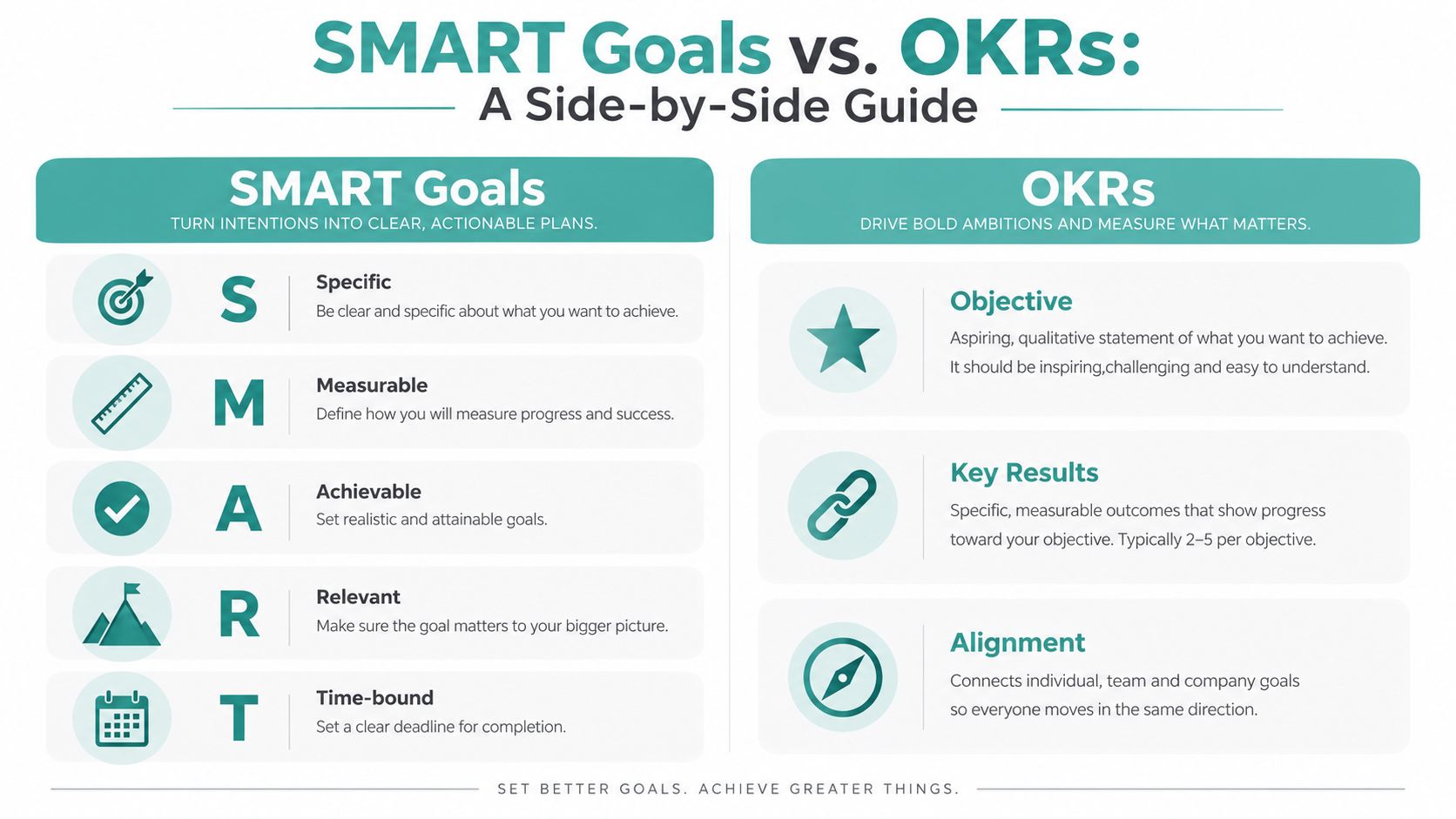
SMART goals are Specific, Measurable, Achievable, Relevant, and Time-bound. OKRs are Objectives and Key Results. Both can work, but they don't behave the same under pressure. SMART is cleaner for a small team that needs a direct sales target, while OKRs are better when multiple people need visibility into a small number of bold bets.
Pick the framework that matches your team size
For solo operators and teams under ten people, SMART goals usually win. They force you to say what the target is, how it will be measured, and when it has to happen, without adding extra management overhead. That matters because small teams need clarity more than process theater.
OKRs make more sense when you've got several people contributing to the same outcome and you need shared alignment across functions. They're useful, but they can become bureaucracy fast if the team is too small to benefit from them. A founder should not spend half a day writing OKRs for a business that still needs to answer the phone faster.
Multiple sales sources agree that goals should be Specific, Measurable, Achievable, Relevant, and Time-bound, and tied to measurable inputs like deal volume, pipeline value, conversion rates, and rep capacity rather than only end-of-period revenue. Salesforce on sales goals That's the real filter, not the label on the framework.
Use the framework as a decision rule
Use SMART if you need a clear number and a clear deadline. Use OKRs if you need a broader objective with several supporting results, and the team can keep those results visible.
The wrong move is picking a framework because it sounds modern. The right move is picking the one that makes the sales target easier to execute and easier to review. If the team can't name the next action, the framework failed.
Adjusting for Seasonality, Capacity, and Channel Mix
A baseline is not a goal. A baseline is the starting point before reality gets its vote. If you sell through seasonal demand, a busy quarter can carry a slow one, and a flat monthly target will make the wrong months feel broken.
Start with last year’s sales, then account for capacity, demand, and seasonality when setting the next target. (Close on sales goals)
Flatten the year only after you understand the peaks
If your business historically generates a large share of revenue in one quarter, don't force each month to behave the same. Spread the annual number across the year using actual seasonal weights, then put heavier expectations where demand normally lands.
Here's the practical rule. Keep the annual target intact, but stop pretending every month contributes equally. A business with a strong year-end cycle should not be judged by January's output the same way it judges December's.
Lower the target when capacity changes
This is the part most guides skip, and it's the part founders need most. If capacity drops, if a rep is still ramping, or if pipeline quality weakens, the realistic target should go down. That is not failure. That's a proper forecast.
Use this test:
Team capacity shifted, so the same volume can't be worked.
Demand softened, so top-of-funnel flow no longer supports the old number.
Sales-cycle length increased, so deals that used to close this quarter now slip.
Channel mix changed, so the old conversion rate no longer applies.
If one or more of those changed, lower the target and say why. A team handles a revised number better than a fake one.
Building a Tracking Cadence That Catches Problems Early
Goals fail when they're reviewed too late. By the time a quarterly target looks bad, the problem has already had weeks to spread through the pipeline. That's why the cadence matters more than the spreadsheet.
Annual goals should be audited against current market conditions, relevant industry trends, and historical sales data, with quarterly milestones and monthly leading indicators used to catch gaps early. Peasy on realistic sales goals That's the discipline most small businesses skip, then act surprised when the year closes short.
Review the right indicators every week
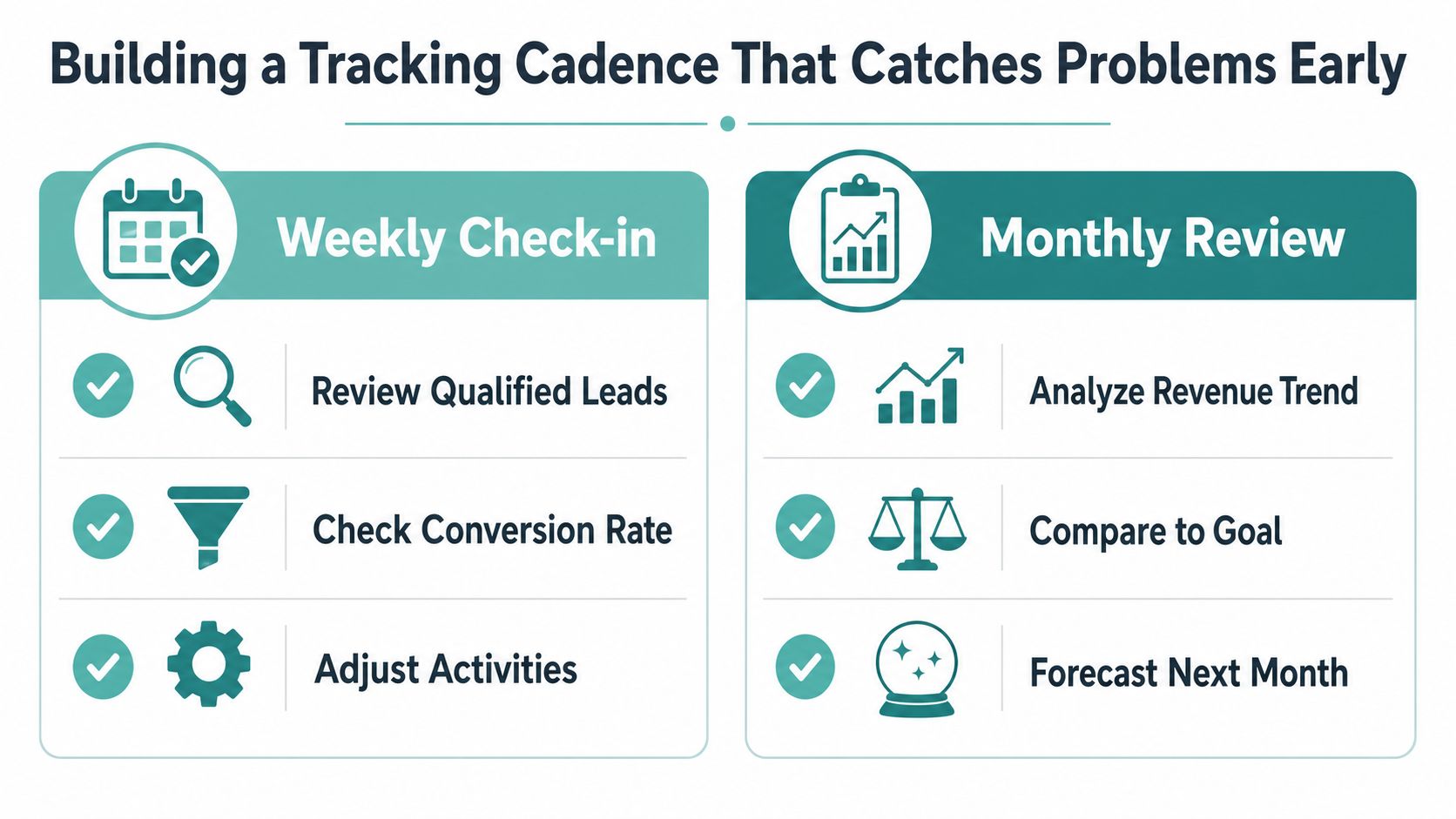
A good weekly review takes about 30 minutes and should focus on activity that predicts revenue, not just revenue itself.
Review qualified leads, because the pipeline starts there.
Check conversion rate, because lead volume without conversion is just motion.
Adjust activities, because the week after a miss is where you recover ground.
A monthly review should be more blunt. Compare revenue against the target, update the forecast, and decide whether the number still fits current capacity and pipeline quality. If the data says the target is no longer reachable, lower it before the team burns another month trying to save a bad assumption.
For teams that want a sharper measurement layer, Adwave's GA4 walkthrough is a practical companion for tracking traffic and conversion behavior alongside sales activity.
Adjust the target on facts, not pride
The strongest founders don't cling to a broken number. They change the number when the evidence changes. That's how you keep the team focused on what can still be won instead of forcing them to chase a target that the business already missed.
You'll know it's time to revise when qualified opportunities slow, conversion softens, and the month's remaining volume can't mathematically get you back on track. At that point, the professional move is to lower the target, reset the plan, and communicate the reason in plain language.
Tying Awareness Channels Like TV Into Your Goal System
Not every business closes from a hot inbound lead the same week the marketing runs. Local service companies, retail brands, restaurants, and real estate teams often live with delayed demand. That makes goal-setting harder, because the main output is often attention first, revenue later.
The fix is to give the awareness channel a measurable role in the goal system. Set a budget cap, choose one tracking metric per channel, and connect the channel to a monthly sales target that can survive a lag between exposure and conversion. If the business is buying attention, the goal should reflect that reality instead of pretending every dollar turns into a same-week close.
Give the channel one job
A channel only gets useful when it has a clear job. For example, TV might be there to raise local awareness and feed future demand, while search captures the resulting intent. If you try to make every channel do everything, you'll never know what worked.
That's where Adwave fits neatly. Its campaigns start at $50, the system uses automatic pacing so spend does not exceed the set budget, and reporting tracks performance in real time, which makes it easier to tie ad spend to a defined monthly target. It's a straightforward fit for businesses that want measurable sales goals without turning media planning into a guessing game.
Match lagged demand to a realistic review cycle
A delayed-demand channel needs a longer evaluation window. If the effect usually lands later, don't judge the campaign too early. Give it a monthly review rhythm, watch whether the leading indicators are moving, and keep the budget capped until the data justifies a change.
A clean way to manage it is to set three things up front.
Budget ceiling, so the channel can't outrun the plan.
Primary success metric, so you aren't chasing vanity signals.
Review date, so you know when to cut, hold, or expand.
If the numbers don't support the current target, lower the target for the channel before you touch the whole business goal. That keeps the overall plan realistic while letting the awareness play prove itself on its own timeline.
For teams using connected TV as part of that mix, Adwave's connected TV guide is a useful reference for understanding how the channel fits into a broader local growth strategy.
If you want a sales goal that holds up under real capacity, real seasonality, and real pipeline quality, build it with Adwave in mind and use the math before the optimism. Visit Adwave to turn your target into a measurable plan, then watch the pacing and reporting against the number you need.


