
Somebody in your business is asking a question you probably can't answer cleanly.
Why did one customer call right after seeing your name somewhere, while another visited your site three times, vanished, and never came back? Why do some first-time buyers become regulars, while others go quiet after what seemed like a perfectly fine experience? If you run a local business, this gets even harder because the path often isn't fully digital. A customer might notice your brand on TV, search for you later, read reviews on their phone, then walk into your store or call your office.
That's why customer journey mapping for small business matters. It gives you a practical way to see the experience from the customer's side, not from your internal process chart. Done effectively, it helps you find friction, fix weak handoffs, and make smarter decisions about where to spend your limited time and budget.
Why Customer Journey Mapping Is a Small Business Superpower
Small businesses don't get the luxury of wasting demand. When a customer drops off, it usually isn't because of one dramatic failure. It's more often a stack of smaller misses: a vague offer, a slow callback, a confusing booking page, a front-desk interaction that feels flat, or a follow-up that never happens.
Gladly's customer journey research reports that 61% of small businesses receive more than half their revenue from repeat customers. Include repeat purchases and post-purchase support in your journey map. (Gladly's look at customer journey mapping for SMBs)
What a journey map does
A customer journey map is just a working picture of how people move from first awareness to repeat business and referral. Not a corporate poster. Not a branding exercise. A tool.
It helps you answer practical questions like these:
Where do people first hear about us
What makes them hesitate
What part of the buying process feels harder than it should
Where does service break trust after the sale
What turns a satisfied customer into a loyal one
Practical rule: If you can't point to the step where people get stuck, you'll keep fixing the wrong problem.
For local businesses, this is even more useful because the journey often crosses physical and digital spaces. Someone might hear about you offline, compare options online, then buy in person. If you only look at website analytics, you're seeing part of the story.
Why small teams benefit more from simplicity
Big companies can afford bloated process documents. Small businesses can't. The best journey maps I've seen for local brands usually fit on one page or one spreadsheet tab. They focus on key handoffs that affect sales and retention.
That's the superpower. A simple map gives you clarity fast. And clarity lets a small team move faster than a larger competitor that's buried in meetings.
Start with Who Your Customer Persona
Start your customer journey map with the need that brings someone to your business. Focus on the information they look for and the decisions they make before buying.
You don't need that. You need a minimum viable persona.

Build a persona with three pieces
Use a local home service business as an example. Let's say you own an HVAC company.
Demographics Keep this light. Age range, homeowner or renter, family situation, service area, and whether they're price-sensitive or convenience-driven.
Goals What are they trying to get done right now? In this example, it's rarely “buy HVAC services.” It's “fix the air conditioning fast,” “get a fair quote,” or “find someone reliable who shows up.”
Pain points What frustrates them before they contact you and while they evaluate you? Slow response times, unclear pricing, fear of getting oversold, and not knowing who to trust are common ones.
If you need a helpful reference for tightening this up, this guide to an ideal customer definition is a useful way to separate real buying traits from guesswork.
Don't confuse audience volume with audience clarity
Many owners say, “My customer is everyone in town.” That sounds practical, but it makes messaging vague. A better starting point is one profitable, common customer type. You can add more later.
This is also where segmentation helps. If your business serves more than one audience, review a simple breakdown of audience segmentation and split your map by customer type instead of forcing different journeys into one messy diagram.
Customers don't expect mind reading. They do expect signs that you understand what they're trying to do.
That point matters because 68% of customers abandon a business due to perceived indifference, based on Opiniator's analysis of customer journey mapping pitfalls. In practice, “indifference” often looks ordinary: generic website copy, robotic intake questions, canned emails, or a staff member who answers the question but misses the concern behind it.
A simple persona test
Your persona is good enough if your team can answer these questions without debating for ten minutes:
If you can answer those clearly, move on. Don't stall in persona-building mode.
Mapping Your Journey Stages and Touchpoints
Most journey maps fail because they become static diagrams nobody uses. That's a known risk. 67% of customer journey maps fail to drive organizational change because they're created as static artifacts without clear objectives, as noted in Harvard Business School Online's customer journey map guidance.
The fix is straightforward. Map the journey around decisions your team can improve.
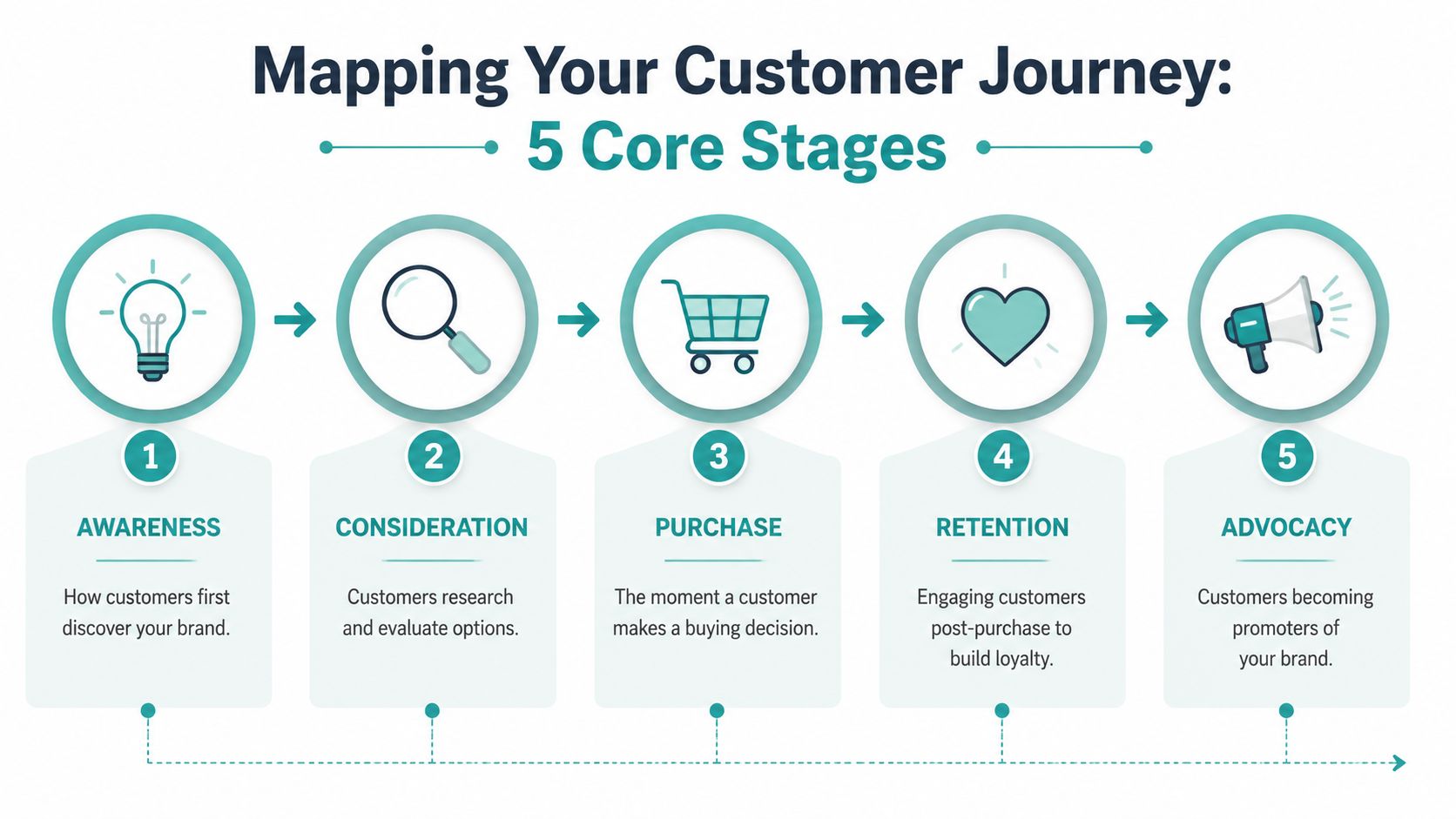
Use five stages, not fifteen
For most local businesses, five stages are enough:
Write this in a whiteboard, spreadsheet, or shared doc. Fancy software isn't required.
What to list under each stage
For every stage, capture four things:
Customer action What they do. Search your business name, ask a friend, call, request a quote, visit the store.
Customer question What they want answered. Can I trust you? Are you close by? Is this worth the price?
Customer emotion Curious, skeptical, rushed, relieved, annoyed, reassured.
Touchpoint TV ad, Google Business Profile, website, review site, front desk, phone call, estimate email, receipt, follow-up text.
A lot of teams focus only on actions and touchpoints. That misses the underlying reason people abandon or continue. Emotions tell you where the experience feels smooth and where it feels cold.
A practical example for a local service brand
Take a neighborhood dental office.
Awareness might begin with a local ad, a recommendation, or search. Consideration happens on the website, in review reading, and during a first phone call. Purchase is booking the appointment. Service includes the reminder flow, front-desk greeting, wait time, and chairside communication. Loyalty depends on whether the patient feels remembered, informed, and comfortable returning.
Useful lens: Your internal process may be efficient while the customer experience still feels disjointed.
That's why it helps to think in omnichannel terms. If you want a practical explanation of how channels should work together, BEDHEAD's article on understanding omnichannel strategy is worth a read.
Keep feedback tied to specific moments
Don't ask for generic feedback like “How did we do?” tied to the whole relationship. Ask about the exact interaction you're trying to improve. Better questions produce better maps, which is why it helps to use a tighter survey approach like these customer feedback survey questions that get honest answers.
A map starts becoming useful when each row leads to a decision. If “consideration” shows confusion about pricing, rewrite the pricing page. If “service” shows anxiety before an appointment, improve reminders and intake instructions.
Integrating Modern TV Advertising into Your Map
Most generic journey mapping advice falls short for local businesses.
A lot of guides assume the customer path is fully trackable and mostly digital. But that's not how many local buying journeys work. People often hear about a business through broadcast media, then act later through search, social, or direct visit. If your map starts at the website visit, you've already missed the first important trigger.
The offline-to-online handoff is real
One of the clearest examples is TV. 45% of local customers use TV ads as an initial awareness trigger but complete the journey via search or social media within 3 days, according to this analysis on mapping customer journeys for small business owners.
That means your customer may:
See your TV ad on a local or streaming channel
Remember your name later
Search for your business on Google
Visit your site or profile
Call, book, or stop by
If your map only records step three onward, you'll over-credit search and under-credit awareness.
How to map TV without making it complicated
Add TV as a touchpoint in the Awareness stage, then connect it to the next likely digital action. Don't treat channels like separate tunnels. Treat them like linked moments in one buying path.
For a small business, this can be as simple as adding questions like:
Did many branded searches rise after the ad flight
Did callers mention they had “seen you somewhere”
Did direct traffic, search activity, or social engagement pick up shortly after airing
Did first-time buyers reference the ad in conversation or intake
You should also note delayed action. Broadcast rarely behaves like a click ad. It often plants the brand in memory first.
Why Adwave fits this part of the process
Adwave proves to be a strong fit for local businesses. It gives smaller advertisers a practical way to run and measure TV campaigns without turning the process into an enterprise reporting project. If you want a grounded overview of how this channel works, Adwave's guide to connected TV advertising is a solid starting point.
The value here isn't just access to TV. It's being able to place TV where it belongs on your journey map: as an awareness trigger that often leads to later digital behavior.
A local customer doesn't care whether your channel reporting is neat. They care whether your brand shows up clearly enough that they remember you when they're ready to act.
Choosing Metrics That Matter
A good journey map should change what you measure. If you only watch surface-level activity, you'll optimize for noise. Small businesses do this all the time. They celebrate impressions, likes, or vague “reach” while missing the signals that tell them whether the journey is producing revenue and repeat business.
The better approach is to tie each stage to a small set of useful metrics.
Focus on decision-making metrics
Here's the distinction that matters:
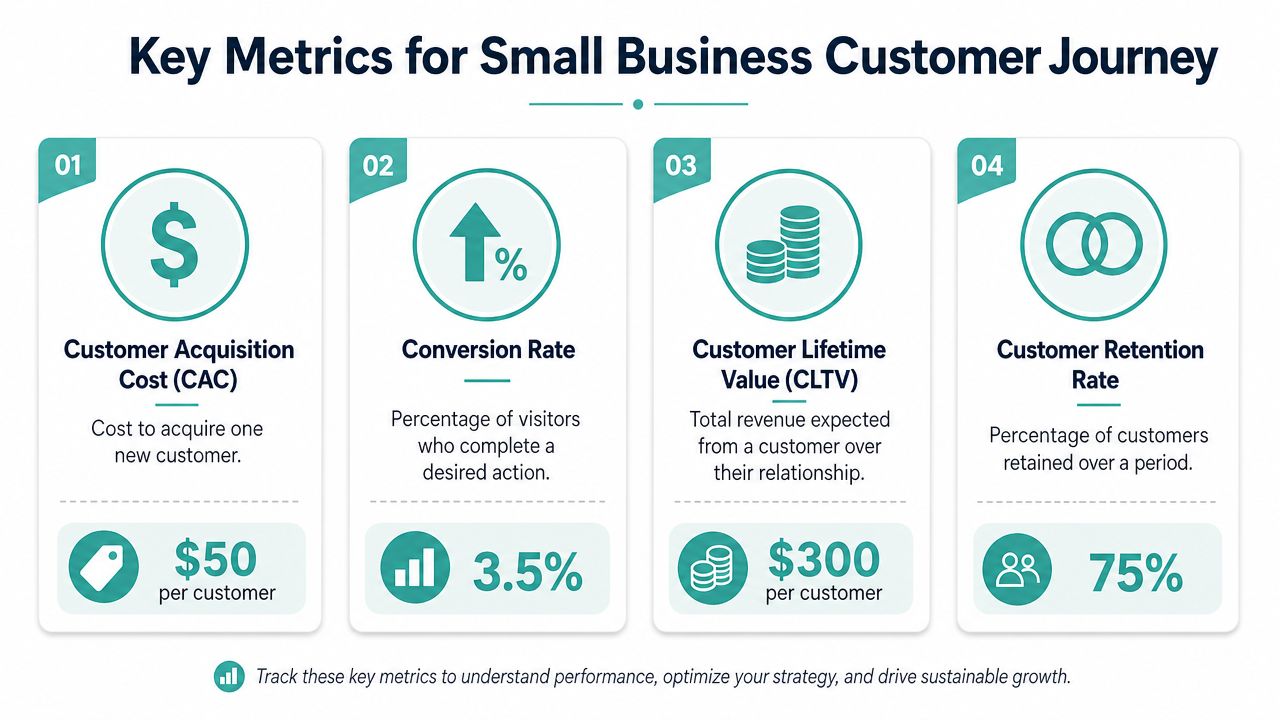
For journey mapping, the most useful metrics are the ones that tell you whether movement happened between stages.
Conversion rate tells you whether people move from consideration to purchase.
Retention rate tells you whether the post-purchase experience is strong enough to bring people back.
Customer acquisition cost helps you judge whether a channel is efficient enough to keep.
Customer lifetime value helps you avoid underinvesting in channels that bring better long-term customers.
Use ROAS when you need a hard financial answer
When you want a direct revenue view of campaign performance, use Return on Ad Spend. The formula is simple: divide the total revenue generated by the campaign cost. That's the benchmark Adwave explains in its guide to advertising effectiveness measurement.
ROAS matters because it forces discipline. It asks the question owners care about: did this spend produce revenue worth keeping?
For broadcast and video-based awareness, two other metrics can also help if they fit your campaign setup:
View-Through Rate (VTR) helps you understand whether people completed the ad, not just had the chance to see it.
Gross Rating Points (GRPs) help you evaluate campaign exposure through reach and frequency.
Those metrics are useful, but they shouldn't replace business outcomes. They support them.
Keep your dashboard lean
Most small teams don't need more metrics. They need fewer, chosen better.
Field note: If a metric doesn't help you change a budget, improve a page, adjust a script, or fix a handoff, it's probably clutter.
A practical dashboard for a local business might include only the essentials for each stage, plus short notes on what changed. That's enough to spot patterns without burying yourself in reporting.
Putting Your Customer Journey Map into Action
A customer journey map only earns its keep when it changes something your customer can feel.
The mistake I see most often is this: an owner identifies ten problems, then fixes none because the list feels too big. Don't do that. Pick one friction point. Fix it this week.
Choose one weak point and make it easier
Good first targets are usually cheap and visible:
Clarify your pricing page if people call with the same cost question over and over.
Tighten your booking flow if prospects start but don't finish.
Rewrite your welcome email if new customers seem unsure about what happens next.
Improve your phone script if staff answer questions but fail to create confidence.
Add better directions, parking notes, or arrival instructions if in-person visits start with avoidable stress.
Ask for feedback right after a key interaction while the experience is still fresh.
Don't aim for a perfect map
Your first version will be incomplete. That's fine. What matters is whether it leads to a better experience at one real touchpoint.
Try this simple test over the next week:
Pick one persona.
Pick one stage where people hesitate or disappear.
Make one low-cost change.
Watch what happens.
Keep the fix if it reduces confusion or improves follow-through.
Review the customer journey regularly to find obstacles, fix them, and check whether fewer customers drop out.
If you want to connect broadcast awareness with the rest of your customer journey, Adwave is a strong option. It gives local businesses a practical way to launch TV advertising, reach targeted viewers, and measure performance without turning the process into a major production or enterprise media buy. For owners who know their customers discover them across both offline and digital touchpoints, Adwave makes that first awareness stage easier to activate and easier to understand.


