

Audience segmentation is really just a smart way of organizing your customer base. Instead of treating everyone the same, you break them down into smaller, more defined groups of people who share common traits. It’s the difference between yelling one message to an entire stadium and having a meaningful conversation with a few rows at a time. This focus makes your marketing more relevant, efficient, and a whole lot more effective.
Understanding Audience Segmentation
Think about a local coffee shop. The owner doesn't see a faceless crowd; they see distinct groups of people. You’ve got the morning rush of commuters grabbing a quick espresso, students camped out with laptops in the afternoon, and families stopping by for a treat on the weekend. Each of these groups wants something a little different and will respond to different offers.
That’s audience segmentation in a nutshell. You stop using a one-size-fits-all message and start tailoring your communication to fit the unique profile of each subgroup. This simple shift from broadcasting to narrowcasting lets you speak directly to what your customers care about, which makes them feel like you really get them.
From Broad Concepts to Focused Strategy
By breaking down a large, varied audience into smaller, more coherent groups, businesses can create targeted campaigns that resonate on a deeper level, ultimately driving better engagement and a higher return on investment.
This targeted approach isn't just a trend; it's a fundamental part of modern marketing. The numbers back it up, too. The global audience analytics market, which is all about segmentation, was valued at USD 4.73 billion in 2023 and is expected to rocket to USD 12.70 billion by 2032. This explosive growth proves that businesses are all-in on turning data into razor-sharp advertising. You can read the full research about audience analytics market trends on polarismarketresearch.com.
The Four Pillars of Audience Segmentation
Use customer records and research to choose relevant audience segments. Our glossary explains common advertising terms.
To help you get started, here's a quick breakdown of the main types of segmentation. Think of these as the four core ways to understand your customers.
The Four Pillars of Audience Segmentation
Each of these pillars gives you a different lens through which to view your audience, helping you build a more complete and actionable picture of who you're talking to.
The 4 Core Types of Audience Segmentation
To really get a handle on audience segmentation, you need to understand its four main pillars. Think of these as different lenses you can use to look at your potential customers, turning a massive, anonymous crowd into smaller, more manageable groups.
Each type of segmentation answers a different question about your audience: who they are, where they are, why they buy, and how they act. When you put them all together, you get a crystal-clear picture of the people you want to reach. This is precisely what powerful platforms like Adwave are built to do: use these segmentation types to deliver ads with unparalleled accuracy.
This diagram lays it all out, showing how a broad audience breaks down into these four key categories.
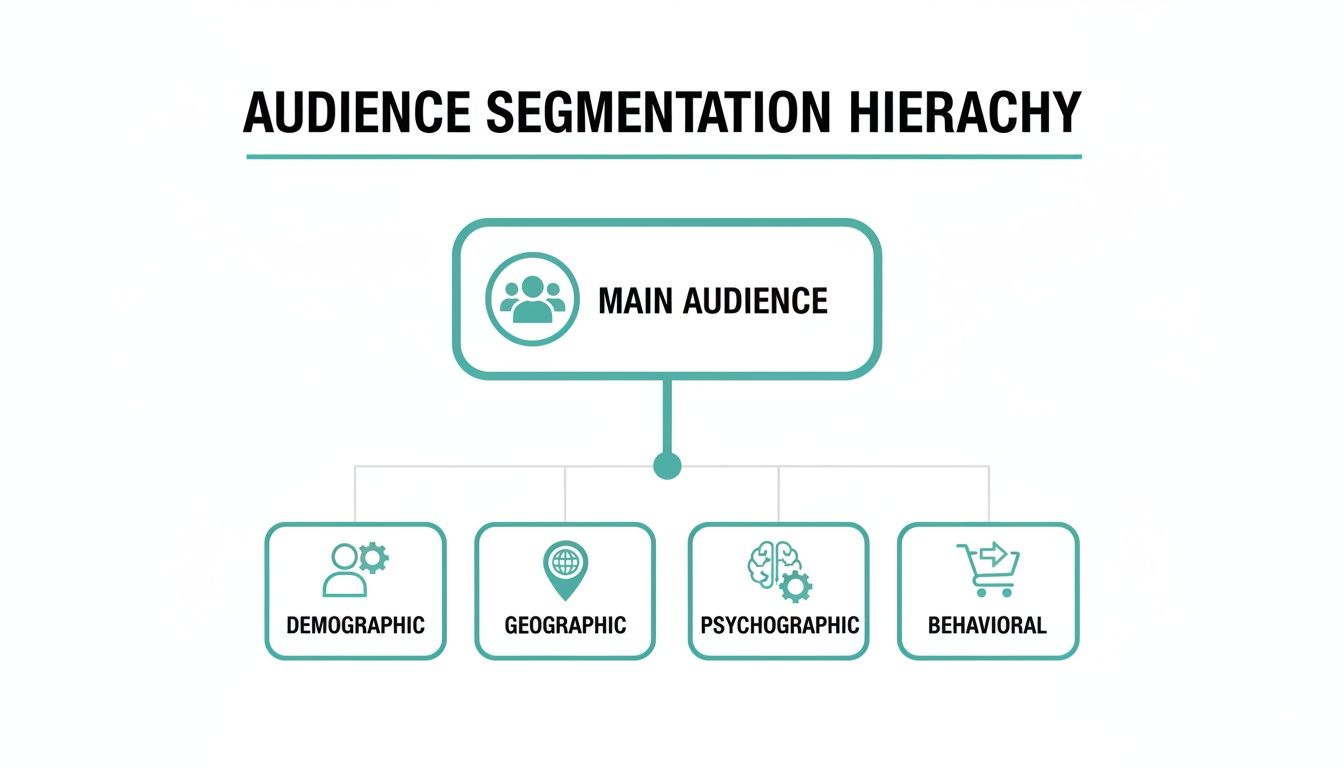
As you can see, you start with your general audience and then slice it into more focused groups using demographic, geographic, psychographic, and behavioral data. This is the secret to creating marketing that connects.
1. Demographic Segmentation: The "Who"
Demographic segmentation is usually the first stop for most marketers, and for good reason. It's the most straightforward way to group people, using objective, factual data about them. This is the basic "who" of your audience.
This data is powerful because it’s often tied directly to what someone needs, wants, and can afford. A local car dealership, for example, needs to know the average age and income of the people in their town. It helps them decide whether to run TV ads for family-friendly SUVs or for pricey two-seater sports cars. Getting this right is important.
Key demographic data points include:
Age: Are you talking to Gen Z, Millennials, or Baby Boomers?
Gender: Does your product or service naturally appeal more to one gender?
Income Level: Is this an affordable, everyday item or a luxury purchase?
Education: What's the typical educational background of your customer?
Occupation: Are you targeting people in a specific industry?
2. Geographic Segmentation: The "Where"
Next up is geographic segmentation, which is all about where your customers live. You can go as broad as a country or as specific as a single zip code. For any business with a physical location or a defined service area, this is non-negotiable.
Think about a local plumbing service. Their success depends entirely on their local reputation. It would be a total waste of money for them to advertise three towns over. Instead, they use geographic segmentation to focus every single ad dollar on the neighborhoods they serve. If you want to go deeper on this, check out our detailed guide on geo-targeting.
This is where platforms like Adwave are a useful option for TV advertising. You can draw a precise boundary for your service area and know that your commercial will only be shown to households within that zone. That means maximum impact and zero wasted spend.
3. Psychographic Segmentation: The "Why"
This is where things get interesting. Psychographic segmentation moves past the "who" and "where" to explore the "why" behind your customers' decisions. This approach groups people based on their psychological traits, things like their lifestyle, values, interests, and personality.
It’s what adds color and personality to your customer profiles. Knowing you're targeting a 35-year-old woman is demographic. Knowing she's a 35-year-old woman who values sustainability, practices yoga, and follows wellness influencers, that's psychographic.
Imagine you’re opening a new yoga studio. Using psychographics, you can find people who have already shown an interest in mindfulness, wellness, or organic living. Your message won't just be about "getting a good workout." It'll be about "finding your balance" and "joining a community", language that speaks directly to their values and resonates on a much deeper level.
4. Behavioral Segmentation: The "How"
Finally, we have behavioral segmentation. This method is all about what people do. It divides your audience based on their actual actions and interactions with your business, focusing on their habits rather than just their identity.
E-commerce stores are masters of this. A store can track purchase history and easily spot a group of "loyal customers" who have bought from them three or more times in the last six months. They can then send that specific group a targeted campaign with an exclusive 20% discount as a thank-you. This not only drives another sale but also makes those customers feel seen and appreciated, strengthening their loyalty.
Common behavioral data points include:
Purchase History: What have they bought before, and how often?
Brand Loyalty: Are they a first-time buyer or a long-time fan?
Engagement Level: How often do they open your emails or visit your site?
Benefits Sought: Are they driven by quality, a low price, or convenience?
By weaving these four types of segmentation together, you can stop shouting into the void with generic marketing. Instead, you can start having meaningful conversations with the right people, on the right channel, at exactly the right time. Platforms like Adwave excel at this, combining these data layers to ensure your message reaches the most receptive audience.
Why Segmentation Is a Game-Changer for Small Businesses
Knowing how to slice and dice your audience is one thing, but the real question is why bother? For a small business, where every dollar and every customer relationship is precious, audience segmentation isn't just another marketing tactic, it's a core strategy for survival and growth. It’s what turns marketing from an expensive guessing game into a precise, results-driven science.
Think of it this way: instead of casting a wide, costly net and just hoping for the best, segmentation lets you focus your resources with laser precision. This is about working smarter, not harder, and making your marketing budget stretch further than you thought possible.
Maximize Your Marketing ROI
For a small business, every wasted ad dollar hurts. Segmentation stops the bleeding by making sure your message is delivered only to the people most likely to care about what you're selling. You stop paying to reach audiences who were never going to buy from you anyway.
This targeted approach gives your return on investment (ROI) a serious boost. Every dollar you spend works harder because it’s aimed at a receptive audience, which naturally leads to higher conversion rates and a lower cost to acquire each new customer.
There's a reason the entire marketing and advertising world, which powers the $2.92 billion global audience intelligence platform market, is built on segmentation. The data doesn't lie: segmented campaigns consistently pull in 2-3 times higher engagement than generic ones. It just goes to show that a message that resonates is a message that works.
Forge Stronger Customer Connections
Modern consumers expect more than a sales pitch; they want to feel understood. Generic, one-size-fits-all messaging feels impersonal and is easy to tune out. Segmentation is the key to crafting messages that speak directly to the specific needs, pain points, and desires of each group.
When a customer feels like a brand is speaking directly to them, it builds a powerful sense of connection and loyalty. This isn't just marketing; it's relationship-building at scale.
This personalized touch makes your audience feel seen and valued. A message that acknowledges their unique situation (whether it’s their neighborhood, their lifestyle, or their past buying habits) will always grab more attention and build more trust than a bland, generic ad ever could.
Gain a Competitive Edge
Many of your larger competitors are stuck using mass-market campaigns that feel distant and impersonal. As a small business, your agility is your superpower. Audience segmentation lets you uncover and serve niche markets that those bigger companies completely overlook.
By zeroing in on these underserved segments, you can position your business as the go-to solution for a specific need. For a great look at how this plays out in the real world, check out how industries are using Audience Segmentation for Real Estate Marketing. This sharp focus helps you build a loyal customer base that won't be easily swayed by the broad-stroke advertising of your larger rivals.
This is exactly where a platform like Adwave comes in. It brings the power of sophisticated audience segmentation to TV advertising, a channel that used to be off-limits for anyone without a massive budget. Adwave uses precise data to get your ads in front of the most relevant local viewers. It makes advertising more accessible, letting you compete by reaching the right people, every single time.
Putting Audience Segmentation into Action with TV Ads
Okay, so we’ve covered the "what" and "why" of audience segmentation. Now for the fun part: putting it to work. Moving this strategy from the whiteboard to the real world is where you'll see a real impact on your bottom line. For many small businesses, the idea of using this kind of precision for TV advertising sounds intimidating, maybe even out of reach. But it’s a lot more straightforward than you think, especially with today's tools.
The whole process really just boils down to a few practical steps. It’s not about becoming a data scientist overnight. It’s about knowing your customers and using smart technology to find them where they are.

Step 1: Define Your Core Business Goals
First things first: what do you want to achieve? Before you can find your audience, you need to know exactly what you want them to do. A clear goal is the bedrock of any good ad campaign. Are you trying to get more people to walk into your store? Drive sales on your website? Or maybe just get your name out there in a new part of town?
Each of these goals points to a different group of people. If you’re trying to boost foot traffic for a grand opening, your main segment is geographic, people who live within a reasonable drive of your new location. On the other hand, if you want to sell a premium product online, you’ll be looking at demographic and psychographic data around income, lifestyles, and spending habits.
Your business goal is the destination. Your audience segments are the specific roads you take to get there. Without a clear destination, you'll just be driving in circles.
Step 2: Identify Your Ideal Customer Profiles
Once your goal is set, it’s time to sketch out who your ideal customers are using those segmentation types we talked about. This is where you get to play detective, combining demographic, geographic, psychographic, and behavioral clues to build a rich profile of the person you want to reach.
A great place to start is with the customers you already have. Who are your best ones?
What’s their general age range and income? (Demographic)
Where do they tend to live? (Geographic)
What do they care about? What are their hobbies or values? (Psychographic)
Do they buy from you repeatedly, or are they mostly one-time shoppers? (Behavioral)
Answering these questions helps bring a few core customer profiles into focus. For instance, a local furniture store might have two key segments: "Young Families" looking for durable, budget-friendly pieces, and "Empty Nesters" ready to upgrade to more luxurious, high-end furniture. These two groups need completely different messaging, visuals, and offers.
Step 3: Use Adwave AI to Reach Your Segments
This is where technology really steps in to do the heavy lifting. In the past, this kind of targeted TV advertising was a complex, expensive game reserved for huge corporations with deep pockets. But platforms like Adwave have flipped the script, using AI to give any small business the power of precision TV advertising.
The process is refreshingly simple. Instead of spending weeks researching viewership data or trying to negotiate with TV networks, you just give the Adwave platform your website URL. That’s it. The AI immediately gets to work, analyzing your site to understand your products, services, and who your ideal customer is.
The analysis goes deep, identifying the key demographic, geographic, and psychographic traits of the people most likely to buy from you. For that furniture store we mentioned, Adwave's AI would pinpoint the specific zip codes where "Young Families" live and figure out which TV shows and channels they’re watching.
But it doesn't stop there. The platform then automatically creates a broadcast-quality TV commercial for you and places it on top-tier channels like NBC, ESPN, or Hulu. Your ad runs at the exact times your target segments are tuned in, so every dollar of your ad spend works as hard as it possibly can. To learn more about the different ways to target viewers, check out our complete guide to CTV targeting options.
By taking care of the complex data analysis and media buying, Adwave allows a small business to launch a razor-sharp TV ad campaign in minutes, not months, and at a fraction of the old-school cost. That’s the power of putting audience segmentation into action.
How to Measure the Success of Your Segmented Campaigns
Getting your segmented campaign out the door is a great first step, but it’s really just the beginning. The magic happens when you start to understand what's working (and what isn’t) so you can fine-tune your strategy for even better results.
Think of it this way: effective audience segmentation isn't a one-and-done project. It's a continuous cycle of launching, measuring, and refining.
Without tracking performance, you’re basically flying blind. You might be reaching the right people, but are they doing what you want them to do? Measuring your campaign’s success is how you turn good guesses into hard data, proving that your marketing budget is delivering a real return.
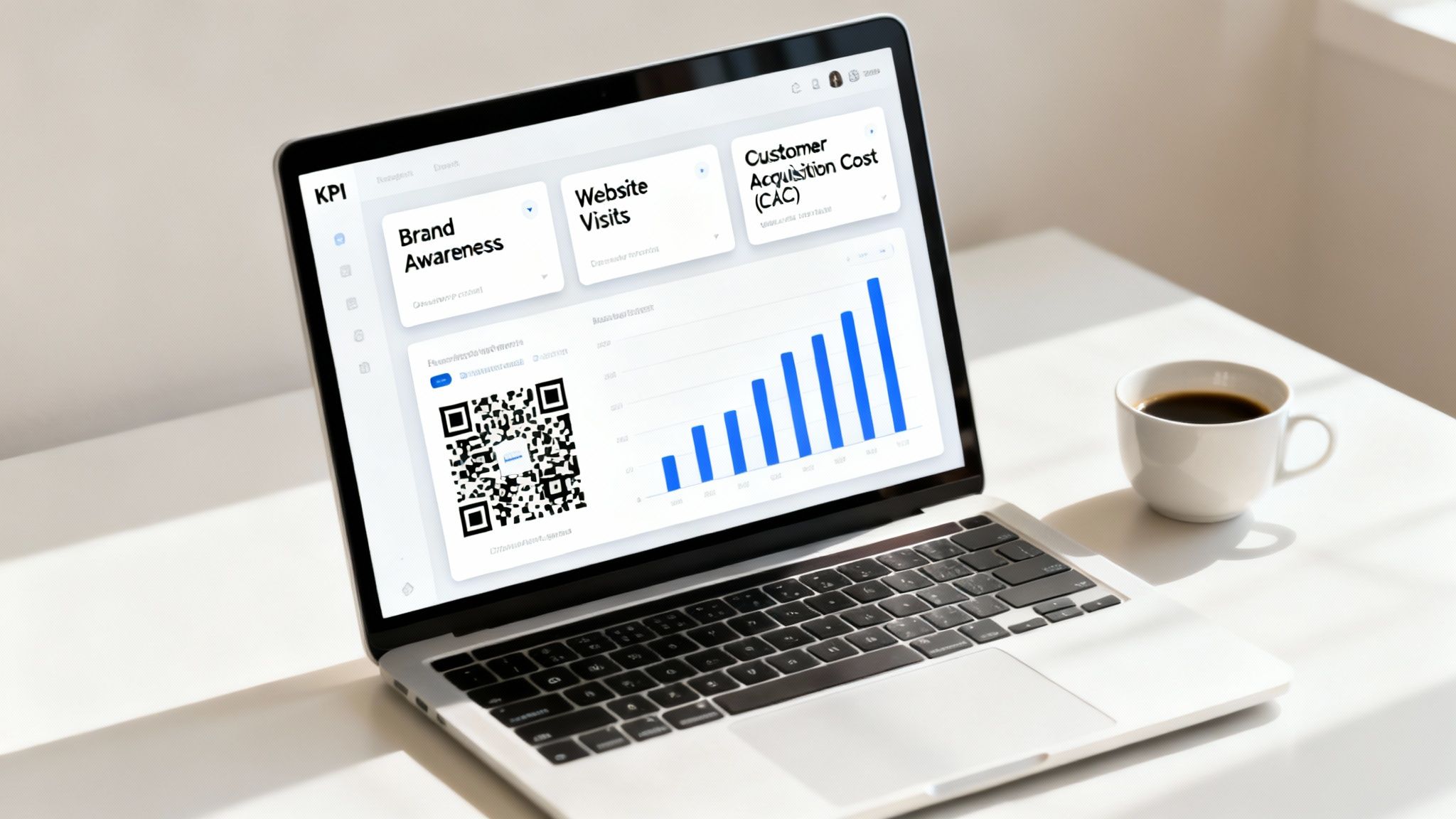
Key Performance Indicators for TV Advertising
For small businesses diving into TV advertising, it’s easy to get lost in a sea of confusing metrics. The good news is you don't have to. Focusing on just a few key performance indicators (KPIs) will give you a clear picture of how your segmented campaigns are really doing. These are the numbers that connect your ad spend directly to business growth.
Here are the essential KPIs you should be watching:
Brand Awareness Lift: This is all about how much more recognizable your brand becomes after a campaign. You can spot this by looking for an increase in direct website traffic (people typing your URL right into their browser) or a jump in branded search queries.
Website Visits from QR Codes: Putting a QR code in your TV ad is a brilliant way to connect the broadcast world with your digital doorstep. Tracking those scans gives you a direct, measurable link between a specific ad airing and a spike in website visitors.
Customer Acquisition Cost (CAC): Simply put, this is what it costs you to land a new customer. You calculate it by dividing your total campaign spend by the number of new customers you gained. A well-executed segmented campaign should absolutely lower your CAC over time.
By zeroing in on these core metrics, you can see the real-world impact of your TV ads. This isn't about vanity numbers; it's about understanding how your investment is driving tangible outcomes like more leads and sales.
Simplifying Measurement with the Adwave Dashboard
Tracking all these KPIs might sound like you need a full-time analytics expert, but platforms like Adwave are designed to make it simple. The whole point is to make data accessible and easy to digest, so any business owner can make smart decisions without feeling overwhelmed.
The Adwave platform features a real-time performance dashboard that brings all your most important data together in one spot. No more patching together reports from different sources or squinting at confusing charts. It's a clean, at-a-glance view of your campaign's health.
This means you can see in an instant how many people are seeing your ad, who is visiting your site via the QR code, and which of your segments are responding the best. This immediate feedback is what makes all the difference. It lets you quickly spot what’s resonating and make adjustments on the fly. For a deeper look, check out our guide on how to measure advertising effectiveness.
Got Questions About Audience Segmentation?
Diving into audience segmentation is exciting. It's one of those strategies that just clicks once you see it in action. But like anything new, it's natural to have a few questions before you start. Let's tackle some of the most common ones I hear from business owners.
Think of this as your quick-start FAQ. The goal here isn't to be overly academic but to give you straightforward, practical answers so you feel confident putting this to work for your own business.
Audience Segmentation vs. Target Audience: What's the Difference?
This is easily the biggest point of confusion, and for good reason, the terms sound almost interchangeable. But the distinction between an audience segment and a target audience is important for running effective campaigns.
Your target audience is the big picture. It's the entire universe of people you want to reach. If you're a local real estate agent, your target audience might be "homeowners in the Springfield area." It's a solid starting point, but it's still pretty broad.
Audience segmentation is where the magic happens. It’s the process of taking that massive crowd and carving it into smaller, more specific groups based on what they have in common.
I like to think of a target audience as a whole pizza. Segmentation is how you slice it up. Each slice is still pizza, but now you can hand one to the person who loves pepperoni and another to the person who only eats veggie.
Let's go back to our real estate agent. They could segment their broad "homeowners in Springfield" target audience into a few high-potential groups:
Segment 1: Retirees in large, older homes who are likely thinking about downsizing.
Segment 2: Young families in starter homes who are probably running out of space.
Segment 3: People who’ve owned their homes for over 10 years, putting them in a prime position to sell.
Each of those groups needs a totally different conversation. You'd talk to the retirees about low-maintenance living, while the young families need to hear about school districts and big backyards. Segmentation is what makes that kind of relevant, personalized messaging possible.
Do I Need Expensive Tools to Get Started?
Not too long ago, this kind of deep-dive analysis was reserved for the big players. It meant shelling out for expensive software, buying access to massive consumer databases, and hiring data scientists to make sense of it all. This left a lot of small businesses thinking segmentation was out of their league.
Thankfully, those days are over. Technology has leveled the playing field, and you absolutely do not need a six-figure budget to get started.
This is exactly why we built Adwave. We wanted to take the power of advanced audience segmentation and build it right into a platform that any business could use. Our AI does all the heavy lifting for you, automatically.
When you set up a campaign, Adwave’s AI looks at your business and customer profile to pinpoint your most valuable audience segments. It identifies the right demographics, locations, and even TV viewing habits to put your ad in front of the people most likely to buy from you. You get all the benefits of a sophisticated segmentation strategy without any of the old-school cost or complexity.
How Often Should I Update My Audience Segments?
Review your audience segments as your products, customers, and service areas change.
I tell my clients to think of their segments like plants in a garden. You can't just plant them and walk away, expecting a great harvest. They need regular attention to keep thriving.
So, what does "regular attention" look like? Here’s a good rhythm to follow:
Quarterly Reviews: For most businesses, checking in every quarter is a solid practice. It’s long enough to spot meaningful trends but frequent enough to catch important shifts before they start hurting your campaign performance.
After Major Business Changes: Always revisit your segments when something big happens. This could be launching a new product, expanding to a new city, or making a major pivot in your marketing strategy.
When the Market Moves: Keep an eye on the world outside your business, too. A new competitor, a change in the local economy, or a new consumer trend are all great reasons to take a fresh look at who you're talking to.
Keeping your segments up-to-date ensures your marketing stays sharp and relevant. It stops your campaigns from going stale and, ultimately, delivers a much better return on your investment.


