Trying to measure the effectiveness of your TV advertising can feel like you're just throwing money into a black box and hoping for the best. I've seen it time and time again with businesses that are new to the space. They run a campaign, feel a slight bump, but can't really explain why or how it happened.
The secret isn't some complex analytics tool or a mountain of data. It's about building a simple, solid framework before your ad ever hits the screen. This is what separates a smart, profitable investment from a costly guess.
This framework boils down to three common-sense stages: defining your goals, choosing the right Key Performance Indicators (KPIs) to track those goals, and establishing a baseline so you know what "normal" looks like. Getting this right from the start is the only way to prove your ad spend is moving the needle. It's fundamental to understanding How to Calculate Marketing ROI That Proves Value and making a real business case for your campaigns.
This simple flow is your roadmap to a measurement plan that works.
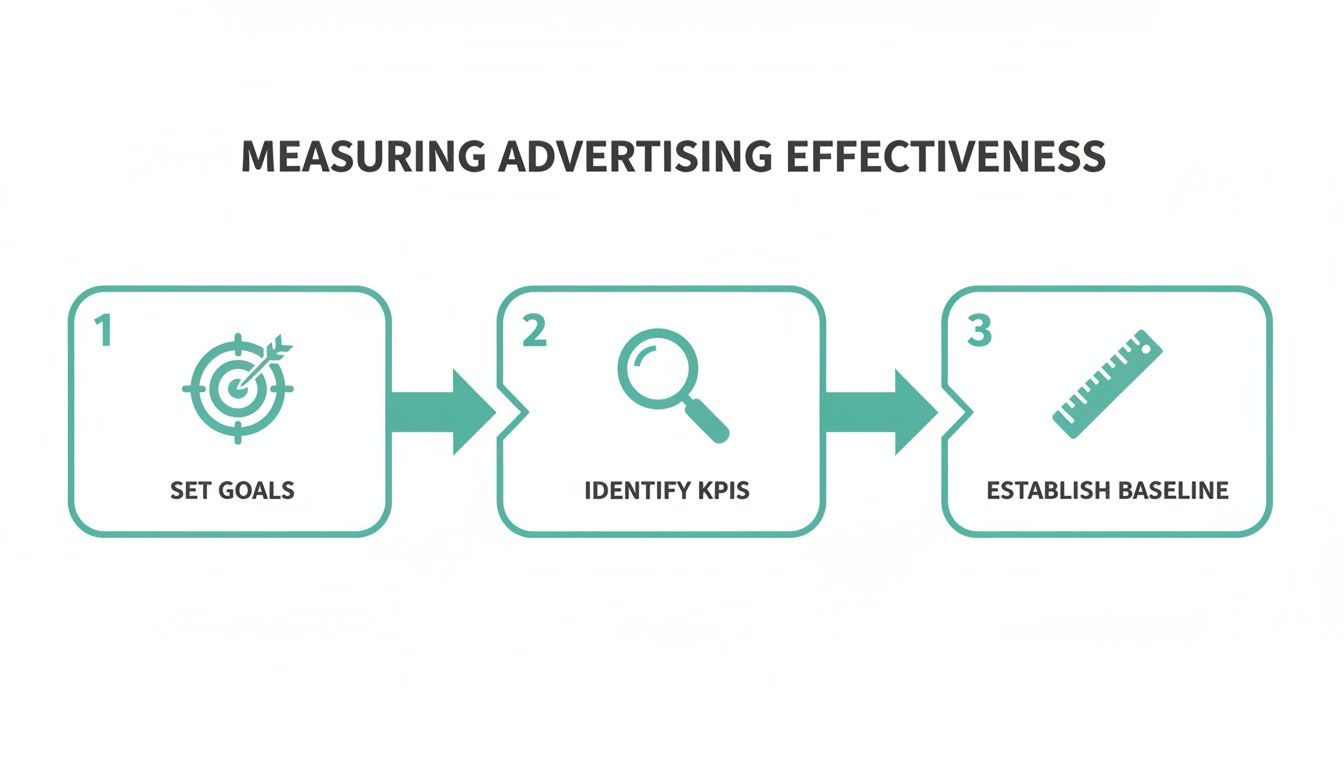
As you can see, a successful strategy doesn't begin when you start crunching numbers. It starts with a clear, honest conversation about what you want to achieve.
Your Framework for Measuring Advertising Success
To make this practical, let's break down how you can apply this to your own business.
Defining Your Core Objectives
First things first: what are you trying to accomplish? Before you even think about metrics, you need a clear, primary goal. Are you trying to get your brand name out there, drive immediate sales, or get people to book a consultation? Each of these goals requires a completely different measurement strategy.
For instance, a local dental practice launching a new campaign with Adwave might be focused purely on brand awareness. Their main objective isn't to get 100 people to book a cleaning tomorrow, but to make sure more households in their zip code know their name. A platform like Adwave is ideal for this, allowing precise geographic targeting to ensure the message hits the right local audience.
Key Takeaway: Your advertising goals must mirror your business goals. If your company’s top priority is generating more qualified leads this quarter, your ad campaign's main objective should be lead generation, not just vague "visibility."
Identifying Your Key Performance Indicators
Once you have a goal, you can pick the specific, measurable metrics (your KPIs) that will tell you if you're on track. These are the numbers you'll be watching.
Let's stick with our dental practice example. Since their goal is awareness, their KPIs would be things like:
Reach: The total number of unique households that saw their ad. This tells them how widely their message spread.
Frequency: The average number of times each household was exposed to the ad. This is important for memory and recall.
Branded Search Lift: A noticeable increase in people searching on Google for the clinic's specific name after the campaign starts.
Now, imagine a different business, like a home services company that needs to book jobs right away. Their goal is lead generation, so their KPIs would look very different. They'd be tracking things like website form fills, calls from a unique tracking number in the ad, and conversions on a specific landing page.
Understanding the difference between metrics is key. For awareness campaigns, for example, knowing what reach is in advertising is absolutely fundamental to setting goals that are both ambitious and realistic.
Luckily, you don't have to track all this manually. Modern platforms like Adwave give you a real-time dashboard that keeps an eye on these delivery metrics automatically. This makes it easy to monitor those top-of-funnel KPIs without getting tangled up in complicated setups, letting you focus on the results.
Key Metrics for Measuring TV Ad Effectiveness
To help you get started, here's a quick-reference table that breaks down the essential metrics. Think of this as your cheat sheet for connecting the right numbers to the right goals.
Using a table like this helps keep your team aligned and ensures everyone understands what "success" looks like for a given campaign. It turns a vague objective into a clear, measurable target.
Choosing the Right Attribution Models
Once you've locked in your goals, the next piece of the puzzle is figuring out which ads get the credit for your success. This is what attribution modeling is all about. Think of it as drawing a map of your customer's journey to see which stops (like catching your TV ad on Hulu or clicking a social media post) pushed them along the path to buying from you.
For the longest time, many businesses just used a "last-click" model. It's simple: whatever a customer clicked on right before a purchase gets 100% of the credit. But this is a seriously flawed way of looking at things. It’s like giving all the praise to the striker who scored the goal, while completely ignoring the incredible pass from the midfielder that set it all up.
TV advertising, in particular, gets the short end of the stick in a last-click world. A customer might see your ad, remember your brand, and then Google you a week later to make a purchase. With last-click, Google gets all the glory, making your TV spend look like a waste, even though it was the real catalyst.
Moving Beyond Last-Click
To get a true picture of your campaign's impact, you need to see the whole field. This means looking at the entire path to conversion and distributing credit more fairly across all the touchpoints that influenced the customer.
This more holistic approach is why attribution modeling now dominates the global Advertising Effectiveness & ROI Measurement market, holding a 23.9% market share. It works because it tracks every customer interaction across channels like TV, digital video, and social. In fact, major advertisers have seen their median profit ROI jump from 1.9:1 to 2.5:1 just by using these smarter measurement tools.
For a small business using a platform like Adwave, this is a huge deal. You can finally connect the dots between someone seeing your ad and later visiting your website. To do this right, you really need to look at models like multi-touch attribution.
A customer journey is rarely a straight line. It’s a series of nudges, reminders, and interactions across multiple channels. A good attribution model recognizes and values each of these steps, giving you a far more accurate picture of what's working.
Comparing Attribution Models for SMBs
There isn't a one-size-fits-all "best" model. The right choice really hinges on your sales cycle, your marketing mix, and how complicated your customer's journey is. The key is to pick a model that reflects how your customers behave. For a deeper dive into this, our complete guide on CTV Measurement & Attribution is a fantastic resource.
To help you get started, here’s a quick comparison of the most common attribution models. Think about your own business as you read through them.
For many small businesses just starting out with TV advertising, I've found that a U-Shaped model strikes a great balance. It gives proper credit to your TV ad for sparking that initial awareness, while also recognizing the final action that sealed the deal. Adwave helps facilitate this by providing the clear delivery data you need to identify that first touchpoint accurately.
This approach helps you avoid the common mistake of cutting your budget for top-of-funnel channels that are quietly doing the heavy lifting to build your brand.
Running Experiments to Uncover True Ad Impact
Here’s a hard truth: correlation isn't causation. Just because sales spiked while your TV ad was on the air doesn’t prove the ad was the reason. This is one of the toughest hurdles in measuring advertising effectiveness. To get to the real answer, you need to run controlled experiments.
That might sound intimidating, but the concept is simple. It's all about comparing what happens when people see your ad versus what happens when they don't. The difference between those two outcomes? That's the true, causal impact of your campaign.

Understanding Incrementality and Lift
The whole point of these experiments is to measure incrementality, often called lift. Think of it as the boost in sales, website visits, or brand recall that happened only because of your ad. You’re trying to answer the critical question: "How many of these sales would we have gotten anyway?"
Without this insight, you risk giving your ads credit for business that was already coming your way. Worse, you might cut a campaign that’s quietly driving significant growth just because its impact isn't immediately obvious on a spreadsheet.
For this reason, incrementality testing has become the gold standard. It pits a test group (people who see your ads) against a control group (people who don't), revealing the genuine lift your campaign creates. Top-tier marketers often combine this with other methods, like Marketing Mix Modeling (MMM). An always-on MMM approach can lead to daily adjustments that deliver up to a 10% ROI uplift by dynamically shifting budgets to what's working best.
Designing a Simple Geo-Test
For most small and medium-sized businesses, a geo-test is one of the most practical experiments you can run. The logic is straightforward and doesn’t demand a team of data scientists.
You start by picking two (or more) similar geographic markets, think two cities with comparable populations and customer demographics.
Test Market: In this city, you run your TV ad campaign exactly as you planned.
Control Market: In the other city, you hold back and run no TV advertising at all.
You then track your key metrics (website traffic, inbound calls, sales) in both locations throughout the campaign. The difference in performance between the test city and the control city is your incremental lift.
Imagine a local home services company uses Adwave to run a campaign in Dallas while keeping Houston (a similar market) as a control. If leads from Dallas jump 30% but Houston only sees a 5% increase, they can confidently say their Adwave campaign delivered a 25% lift.
Pro Tip: When choosing your markets, go deeper than just population size. Look for similarities in average income, local competition, and even weather patterns if they impact your business. The closer the match, the more reliable your results.
Executing a Lift Study
Another powerful method is the lift study, which is often managed directly within modern ad platforms. Instead of using geography, this approach creates test and control groups based on user or household data.
Here’s the typical breakdown:
Group Division: The platform identifies your target audience and randomly splits it into a test group (who can see your ads) and a control group (who are blocked from seeing them).
Campaign Execution: Your ad campaign runs as normal, but the ads are only served to people in the test group.
Conversion Tracking: The platform tracks actions like website visits or purchases from people in both groups.
Lift Calculation: By comparing the conversion rate of the test group to the control group, the platform calculates the exact percentage lift your ad generated.
A platform like Adwave can handle this by controlling ad delivery right down to the household level. That precision gives you a clean read on how much your TV ads are influencing what viewers do next. The insights from these studies are gold; you can see how this plays out in our collection of ad analysis examples.
By running these kinds of experiments, you finally move from guessing to knowing. You can prove your ad spend is working with hard data, optimize your budget with confidence, and build a marketing engine that delivers predictable, measurable growth.
Getting Your Hands on the Right Campaign Data
Alright, you've got your goals locked in and your testing strategy mapped out. Now for the fun part: rolling up your sleeves and digging into the data. This is where the rubber meets the road, where you start collecting the actual numbers that will tell you if your TV ad is really working.
We're not just collecting data for the sake of it. The key is to gather the right information, the metrics that tie directly back to the business goals you set earlier. I like to split this into two buckets: first, the data that shows if your ad was delivered properly, and second, the data that shows what people did after they saw it.

First Things First: Did Your Ad Run?
Before you can even think about sales or sign-ups, you have to know if your ad reached the people you intended it for. These are your foundational "delivery" metrics. They answer the most basic but important questions: Did people see my ad? How many saw it? How often did they see it?
Here are the core numbers you absolutely need to be watching:
Reach: This is the total number of unique households that saw your ad at least once. Think of it as the breadth of your campaign.
Frequency: On average, how many times did each of those households see your ad? This is all about message reinforcement.
Impressions: The grand total of times your ad was shown. It's simply Reach x Frequency.
Cost Per Mille (CPM): How much did it cost you for every 1,000 impressions? This is your go-to metric for measuring cost-efficiency.
If you're using a platform like Adwave, this part is pretty painless. Their dashboard gives you a live look at these metrics, so you can see exactly how your budget is turning into eyeballs on premium channels. You can quickly check your CPM, see how many households you've reached, and make sure you're getting your message out there without wasting money.
Connecting the Dots to Real Business Results
Delivery metrics are important, but they don't pay the bills. The real test of an ad's effectiveness is its power to make people act. This is where you connect the ad on the screen to a tangible business outcome, and it requires a bit of smart setup.
The priority is about building a clear, measurable bridge from the TV ad to your website or store.
My Two Cents: The best measurement strategies I've seen create a direct line from someone seeing the ad to them taking a specific action. If you don't build that connection, you're just guessing what drove your results.
So, how do you build that bridge? Here are a few battle-tested methods:
Unique Promo Codes: This is a classic for a reason. Mention a special discount code, say, "TV20", that exists only in your TV commercial. Every time that code is used, you have undeniable proof that the sale came from your ad.
Dedicated Landing Pages: Send viewers to a specific URL that you don't link to from anywhere else (e.g., www.yourbusiness.com/tv-offer). By tracking traffic and conversions on this page, you get a clean read on who is responding directly to the ad.
Vanity URLs: These are memorable, easy-to-type URLs you feature in your ad creative (like "Go to MyTVDeal.com"). That URL just redirects to a page on your main site with tracking parameters, giving you a simple way to attribute that traffic.
These methods are so effective because they take the guesswork out of attribution. You create a clear paper trail from the ad to the action.
Beyond these direct tactics, you should also be watching your website analytics for secondary signals. Keep an eye out for spikes in direct traffic (people typing your URL straight into their browser) and branded search queries (people googling your company name). These often jump right after an ad airs. A tool like Adwave can show you exactly when your ads ran, making it much easier to line up those airtimes with surges in your site traffic and paint a full, compelling picture of your campaign's impact.
Turning Insights Into Action and Future Growth
Compare results with your campaign goal, then decide what to change in the next campaign.
Answering the "Why" Behind Your Data
With your campaign data laid out, it's time to dig in and find the story. Let's say one of your ad creatives outperformed another by a massive margin. Was it the one with a customer testimonial? Maybe that connected with viewers far better than the ad that just listed product features.
What about timing? Perhaps you see a huge spike in website visits every time your ad runs during evening prime time, while the midday slots were a ghost town. These are the kinds of insights that let you stop guessing and start strategizing.
Start by asking these critical questions:
Creative Performance: Which ad variations drove the most action? Was it the messaging, the visuals, or the specific call-to-action that tipped the scales?
Time Slot Effectiveness: Were there specific days or times when your ad was a home run, driving a flood of traffic or leads?
Audience Response: Did you notice that certain neighborhoods or demographic groups were way more responsive? This is gold for sharpening your targeting.
This is where a platform like Adwave really helps. Instead of getting buried in spreadsheets, the dashboard lays out your campaign data clearly. You can quickly see which creatives are getting the most airtime and instantly correlate that with your website analytics, making it much easier to spot these important patterns.
Thinking Beyond the First Sale with Customer Lifetime Value
CLV isn't just another acronym; it's a measure of the total profit you can expect from a single customer over the entire course of their relationship with you. It forces you to look past the initial Return on Ad Spend (ROAS) and see the brand-building power of your TV ads. That ad might not have just made a $50 sale today, it might have created a loyal fan who spends $500 with you over the next three years.
This long-term view is everything. Brands that get this right (focusing on loyalty metrics tied to CLV) report 25% higher profitability by concentrating on acquiring high-value local customers. You can find more insights on this from industry reports on platforms like G2.com.
Calculating CLV gives you a much more complete financial picture to justify your ad spend. It proves that TV advertising isn't just a lever you pull for short-term sales; it’s a long-term investment in building a sustainable, profitable customer base.
Optimizing Your Next Adwave Campaign
Armed with these insights, you can now make data-driven tweaks to your future campaigns. This creates a powerful feedback loop where you're constantly getting smarter and more efficient. For a deeper dive into the math, check out our guide on how to calculate your TV advertising ROI.
Here’s how to put your findings into practice with your next Adwave campaign:
Refine Your Creative: If one message or visual style was a clear winner, double down on it. Use the underperformers as a valuable lesson in what doesn't resonate with your audience.
Adjust Your Targeting: Did your ads kill it in a specific part of town or with a certain age group? Sharpen your focus and put your budget where you know it will have the biggest impact.
Optimize Your Budget Allocation: If you found that weekend ads drive twice as many leads, it's a no-brainer, shift more of your budget to Saturdays and Sundays. Reallocate funds from those quiet time slots to your proven winners.
When you methodically analyze your results and apply those lessons, advertising stops feeling like an expense and starts becoming a predictable engine for your business's growth.
Common Questions About Measuring Your Ad's Impact
Even with the best plan, you're bound to have questions as you start digging into the data. Here are the answers to a few of the most common ones we get from businesses diving into TV advertising.
What’s the single most important metric to track?
Honestly, there isn't one. The "best" metric is always the one that ties directly back to what you wanted to achieve in the first place.
But if you’re trying to get people to act now, you'll want to watch for a Website Lift, a spike in people searching for your brand by name (Branded Search Volume), or how many people use a special promo code from the ad. The real trick is to pick one primary Key Performance Indicator (KPI) that reflects your campaign's main goal and focus on that.
How can a small business measure TV ads without a huge budget?
You absolutely can. Affordable measurement is all about using the tools you already have at your disposal. Google Analytics is a fantastic, free starting point for spotting jumps in website traffic that happen right after your ad airs.
Simple, creative tracking methods work wonders, too. Think about including a unique, TV-only discount code or a specific URL (like yourbrand.com/tv) in your ad. These are effective ways to see direct results.
And don't forget, platforms like Adwave are built for this. Our dashboards give you real-time data on core metrics like impressions and reach right out of the box, so you get important performance insights without spending an extra dime.
How long until I see results?
You'll likely see two different kinds of results on two different timelines. The direct response (that immediate surge in website visitors and branded searches) can happen within minutes or hours of your ad hitting the screen. It's exciting and a great sign that people are paying attention.