At its most basic, advertising reach is the total number of unique people who see your advertisement at least once. It’s a foundational metric that measures the size of your audience, not the total number of times your ad was shown.
Reach counts distinct people exposed to your ad. Someone who sees it ten times still counts once toward reach.
Defining Advertising Reach in Plain English

Let's say you own a local bakery and decide to hand out 500 flyers for a new croissant special. If 250 different people each take one flyer, your reach is 250. It doesn't matter if one especially enthusiastic person grabbed a handful of five flyers, reach only counts unique individuals.
This simple concept is the bedrock of any successful brand awareness campaign. Grasping what reach is in advertising helps you understand the true breadth of your campaign's exposure. It directly answers the question, "How many distinct people did my message connect with?"
Why Reach Is a Vital Metric
Reach isn't just a number; it's a direct signal of your campaign's potential to grow your customer base. A broad reach introduces your brand to new people who might have never heard of you before. This is absolutely critical for small businesses trying to build local recognition and carve out some market share.
Focusing on reach helps you:
Build Brand Awareness: Introduce your products or services to the largest possible group of potential customers.
Enter New Markets: See how effectively you are penetrating new neighborhoods or demographic segments.
Maximize Ad Spend: Make sure your budget is spent getting in front of new eyeballs, not just repeatedly showing ads to the same small group.
For businesses that want to make a big local splash, platforms like Adwave are designed to maximize this very metric. Adwave helps small businesses get affordable ads on major TV channels, connecting them with a wide, engaged local audience that might otherwise be impossible to access. By focusing on reaching new households, Adwave makes every dollar count.
The core question to ask isn't just "how many people saw our ad," but rather, "what did that reach achieve for our brand?" This shift in perspective turns reach from a simple metric into a strategic advantage for growth.
The Evolution of Reach From Television to TikTok
To really get what "reach" means for advertisers today, it's worth taking a look at where it came from. The idea itself isn't new, but how we track and act on it has been completely turned on its head, moving from educated guesses to razor-sharp data on individual people.
Decades ago, TV was the undisputed king. Advertisers chased huge, captive audiences glued to their sets for primetime shows or the Super Bowl. Success was all about Nielsen ratings and Gross Rating Points (GRPs), which were basically estimates of how many households saw your commercial. It was the golden age of broadcasting one message to millions all at once. An intelligent platform like Adwave can now deliver that same powerful TV reach to local businesses with more precision than ever before.
The history here shows an incredible explosion, going from millions to billions of potential eyeballs. Back in the 1950s, a hit radio soap opera might pull in 80,000 unique listeners. Flash forward to 1984, and the Los Angeles Olympics broadcast reached a mind-boggling cumulative audience of 2.6 billion people worldwide. This was TV flexing its muscles, showing it could connect with a massive slice of the global population.
The Shift to Digital Precision
Then the internet happened. Social media platforms like Facebook, Google, and eventually TikTok followed, and everything changed. The game shifted from broadcasting to narrowcasting. Instead of guesstimating how many households were watching, advertisers could now track individual users with pinpoint accuracy.
This new digital era brought a few useful shifts:
Granular Targeting: Suddenly, you could build an audience based on demographics, what people were interested in, and how they behaved online. Your message could land in front of only the most relevant people.
Real-Time Measurement: The days of waiting for weekly ratings reports were over. Digital platforms gave you instant feedback on how many unique users saw your ad.
Democratized Access: For the first time, small businesses could jump into the ring and compete for attention right alongside giant corporations, targeting niche audiences on smaller budgets.
The core principle of reach (connecting with unique individuals) has never changed. What has evolved is our ability to define, measure, and optimize that connection with unparalleled precision.
Modern Reach in a Fragmented World
Today's advertising landscape is more fragmented than ever. A single person's attention is splintered across traditional TV, streaming services, social media feeds, and a million different websites. This is where modern advertising solutions really have to prove their worth. For example, understanding what is Connected TV advertising is essential for getting in front of people who've cut the cable cord.
Platforms like TikTok and YouTube have also thrown new formats into the mix, where reach can skyrocket overnight through viral content and clever targeting. To get seen on these newer formats, it pays to know things like the best hashtags for YouTube Shorts to boost reach.
For businesses trying to make sense of it all, you need tools that can bring these scattered channels together. That’s where Adwave comes in. We bridge the gap, giving businesses the massive scale of TV advertising but with the smart, targeted precision of a digital campaign. This way, your message finds the right local households, no matter what screen they're watching.
Decoding The Metrics That Power Your Campaigns
While reach tells you how many unique people saw your ad, it doesn't paint the whole picture. To really get a handle on your campaign's performance, you need to look at two other key metrics that go hand-in-hand with reach: impressions and frequency.
Think of it like handing out flyers in a busy town square. Reach is the number of individual people who took a flyer from you. Impressions, on the other hand, are the total number of flyers you handed out. If one person took three flyers throughout the day, that counts as one person reached but three impressions.
This distinction is fundamental. Impressions measure the total volume of your ad's exposure, while reach measures the unique size of your audience.
The way we track these numbers has changed dramatically over the years. We've moved from the broad estimates of early broadcast media to the precise digital counts we have today. A platform like Adwave makes this even easier by providing clear, understandable reporting on your TV ad reach.
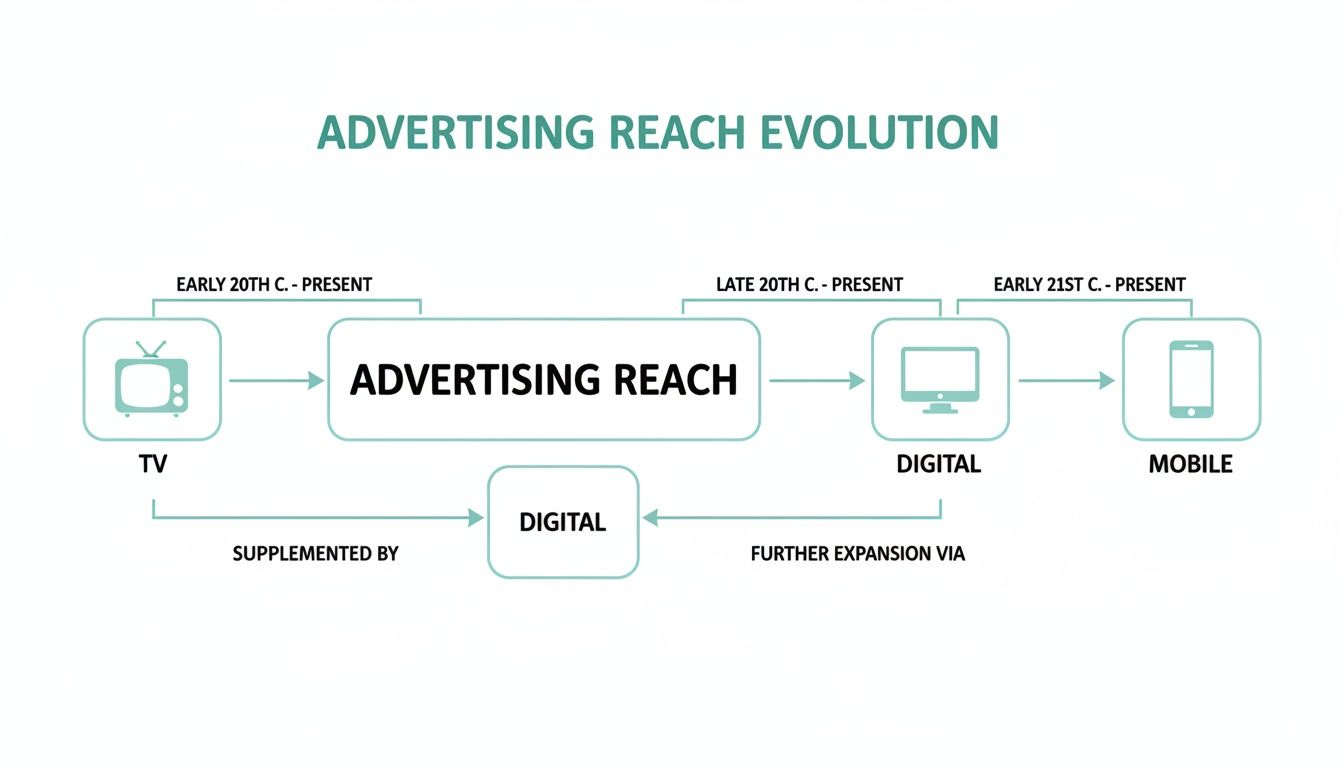
As you can see, even though the platforms have evolved from the living room TV to the phone in our pocket, the core goal of connecting with a unique audience hasn't changed a bit.
The Role of Frequency
The final piece of this puzzle is frequency. This metric tells you the average number of times a single person sees your ad during a campaign.
Calculating it is straightforward: Frequency = Total Impressions / Reach.
So, if your campaign generated 1,000 impressions and reached 250 unique people, your frequency would be 4. This means, on average, each person in your audience saw the ad four times. This number helps you gauge the intensity of your campaign and avoid "ad fatigue," where people start tuning you out.
High impressions with low reach means a high frequency. You’re showing your ad repeatedly to the same small group. This can be a smart strategy for remarketing, but it’s a fine line to walk before you start annoying your audience.
A Quick Breakdown of Key Metrics
To clarify how these concepts fit together, here’s a simple table breaking down the most common advertising metrics, what they measure, and why they matter.
Understanding the interplay between these metrics is what separates a good campaign from a great one. It’s all about making sure your message lands with the right people, the right number of times.
Finding the Right Balance for Your Campaign
The relationship between reach, impressions, and frequency is a constant balancing act.
Are you launching a new product? You’ll probably want to aim for high reach with a lower frequency to introduce your brand to as many new people as possible. Running a limited-time sale? A higher frequency might be just what you need to remind a targeted audience to take action before it's too late.
Review reach and frequency together to assess how many households saw the campaign and how often.
We help you get your message in front of fresh eyes without overwhelming them, making every dollar you spend more effective. For a deeper look at related costs, check out our guide on what CPM is in advertising. By putting you in control of these important metrics, Adwave turns your TV campaign into a smart, efficient engine for growth.
How Do You Calculate and Measure Advertising Reach?
Figuring out your advertising reach isn't nearly as intimidating as it might seem. In fact, it's all about the relationship between two metrics you probably already track: impressions and frequency.
The core formula is surprisingly simple: Reach = Impressions / Frequency. This little equation is the key to unlocking how many unique people saw your campaign.
Let's make this real. Imagine your business runs a local TV ad that racks up 300,000 impressions. You dig into the data and find that, on average, each viewer saw the ad 3 times. Plug those numbers into the formula: 300,000 Impressions ÷ 3 Frequency = a reach of 100,000. Just like that, you know your campaign connected with 100,000 unique individuals.
Reading the Reports on Different Platforms
While the math stays the same, where you find the numbers can change depending on the platform you're using. It's a bit like different cars putting the gas gauge in a slightly different spot on the dashboard.
Meta (Facebook & Instagram): This is straightforward. Ads Manager has a dedicated "Reach" column that tells you exactly how many unique users saw your ads.
Google Ads: Google tends to highlight impressions, but for video and display campaigns, you can find your reach and frequency data by adding the "Reach Metrics" columns to your report.
TV Advertising: The old-school metric here is Gross Rating Points (GRPs). However, modern TV advertising platforms are getting much smarter, providing precise household-level reach data that's far more useful. This is a core benefit of using a service like Adwave, which provides clear, actionable reach metrics for TV campaigns.
The most important thing to grasp is the difference between potential reach (everyone you could have reached with your targeting) and reported reach (the people you actually did reach). Your budget, targeting choices, and the ad itself are what turn that potential into a real number.
This principle is vital at every scale. Even a giant like the BBC, which is funded by license fees, has a mandate to maximize its reach to 90% of UK adults. It’s a core part of how they justify their budget, proving that connecting with a broad, unique audience is always a powerful measure of success.
Your analytics dashboard isn't just a spreadsheet of numbers, it's telling the story of who you're connecting with. When you learn to read it confidently, you can understand your campaign's true impact and make every dollar in your budget work harder.
From Calculation to Action with Adwave
Knowing the numbers is one thing. Turning that knowledge into better results is what really matters. Trying to manually pull reach data from different channels is a massive headache, especially when you have a business to run. This is exactly why a unified platform is so valuable.
Adwave takes the complexity out of measuring TV advertising reach. Our dashboard lays out all your data in a clean, easy-to-read format, so you can stop guessing. We automatically tune your campaign to connect with the most unique local households possible. This means your budget goes toward expanding your audience, not just showing the same ad to the same few people over and over.
We translate complicated data into clear, actionable takeaways, letting you focus on what you do best. To learn more about tracking your campaign's performance, check out our guide on advertising effectiveness measurement.
Strategies for Balancing Reach and Frequency
Think about a new product launch or a store's grand opening. Your main goal is to get the word out far and wide. In that case, you'd much rather have your ad seen once by 10,000 different people than ten times by the same 1,000 individuals. It’s all about casting a wide net.
On the flip side, consider a remarketing campaign or a flash sale. Here, you're not trying to introduce yourself; you're trying to close the deal. A higher frequency is key. You want to gently remind an already-interested audience about your offer, keeping it familiar so they finally make that purchase.
Finding the Sweet Spot with Effective Frequency
The sweet spot advertisers are always looking for is called effective frequency. It's the optimal number of times someone should see your ad to remember it and act on it, without getting annoyed. Once your ad becomes wallpaper, you’ve hit ad fatigue, which can do more harm than good to your brand.
Effective frequency isn't a fixed number; it's a strategic target. The goal is to be memorable, not repetitive. Hitting this sweet spot ensures every dollar you spend contributes to growth instead of being tuned out.
This concept is absolutely vital in TV advertising, where every second on screen is a serious investment. Nail the balance, and your message lands with real impact. This is often where different marketing goals meet; our guide on brand vs. performance marketing dives much deeper into this relationship.
Adjust frequency if the same audience sees the ad too often.
Of course, TV is just one piece of the puzzle. To really get your message out there, you need to combine it with powerful content distribution strategies to amplify reach. Adwave simply makes the TV part of that broader strategy as simple and effective as possible.
How Adwave Helps You Maximize Your Reach
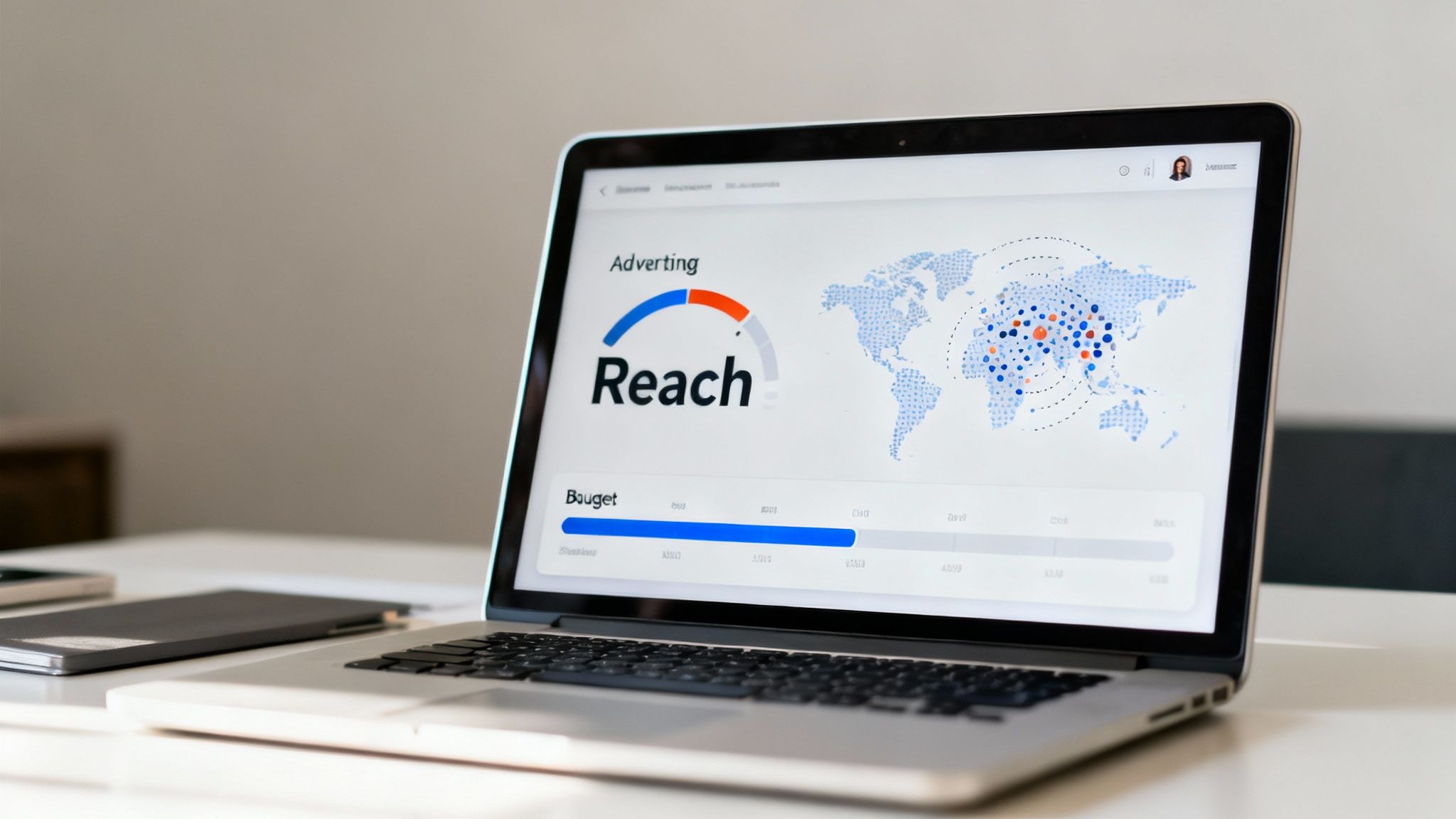
Putting all this theory into practice can feel like a heavy lift. Audiences are fragmented across countless channels, and ad costs always seem to be climbing. It's a constant battle just to get your message in front of new customers.
That's where Adwave steps in.
Our platform was built from the ground up to solve this problem. We help you find untapped local audiences, cut through the background noise, and make your TV ad spend count for something: real, unique exposure. It’s all about making every dollar you invest work harder to grow your business.
Eliminate Guesswork with Intelligent Features
Guessing how many unique people your campaign might connect with is a fast way to waste a lot of money. Adwave swaps that uncertainty for data-driven confidence with tools designed specifically for small businesses.
Predictive Reach Modeling: Before spending a dime, our system gives you a solid forecast of your campaign's potential reach based on your budget and targeting. This helps you set realistic goals and make smarter decisions right from the start.
Automated Budget Allocation: Adwave's AI automatically finds the most cost-effective TV slots for reaching new households. It’s always working in the background to prevent your budget from getting burned on the same-old audiences.
Frequency Capping: We intelligently control how often a household sees your ad. This keeps your message fresh and impactful while protecting your brand from the dreaded ad fatigue.
These features work together to take the heavy lifting of campaign optimization off your plate. You get the power of a sophisticated media buying strategy without needing a whole team of analysts to run it.
The most expensive advertising is the kind that doesn't work. True value isn't about chasing the lowest cost-per-impression; it's about achieving the best outcome per dollar spent. Adwave focuses your budget on what matters most, connecting with new potential customers.
A Unified View of Your Campaign's Impact
Trying to piece together your total reach from a dozen different reports is a frustrating and error-prone process. Adwave cuts through that chaos.
We give you a single, clear dashboard that shows you exactly how many unique local households your TV ads are reaching. It's all in one place, easy to understand.
For a small business that needs to move fast, this unified view is a useful option. You can see at a glance how your campaign is performing and measure its real impact on your brand's visibility in the community.
Adwave makes TV advertising accessible, affordable, and (most importantly) effective. By focusing on smart, sustainable growth through maximized reach, our platform gives you the power to compete with the big guys and become a household name in your own backyard. We handle the complex stuff so you can focus on what you do best: running your business.
Common questions answered
As we wrap up our deep dive into advertising reach, a few questions always seem to come up. Let's tackle them head-on so you can feel confident applying these ideas to your own campaigns.
Is It Possible to Have More Impressions Than Reach?
Yes, absolutely. In fact, it’s not just possible, it’s the norm. You should almost always have more impressions than reach.
Think of it this way: reach is the number of unique people who saw your ad, while impressions are the total number of times it was seen. If one person sees your ad five times, you've got one person reached and five impressions. So, a higher impression count just means your audience is seeing your ads more than once.
What Is a Good Reach for a Campaign?
That’s the million-dollar question, isn't it? The honest answer is that a "good" reach number completely depends on your campaign's goals. There's no magic number that works for everyone.
For a local plumber launching a new service, reaching 20% of homeowners in their target zip code could be a massive win. For a national brand like Coca-Cola, that same number would barely register. The real question to ask isn't, "Is my reach good?" but rather, "Is my reach helping me hit my business goals?"
How Can I Increase My Reach Without Increasing My Budget?
Stretching your reach on a fixed budget all comes down to working smarter, not just spending more. The goal is to get your ad in front of more unique people for every dollar you invest. The best way to do that? Get laser-focused on your audience targeting to cut out any waste.
This is exactly what platforms like Adwave are designed for. Our system is built to automatically find the most efficient TV ad placements to connect with the highest number of unique local households for your specific budget. By intelligently avoiding oversaturating the same small group and sniffing out cost-effective ad slots, Adwave helps you expand your audience without expanding your spend.