The real difference boils down to this: brand marketing is a long-term play, all about building an emotional connection, awareness, and loyalty that lasts. On the other hand, performance marketing is about the short game, it’s designed to drive immediate, measurable actions like clicks and sales.
Deciding between them isn't about picking a winner. It's about striking the right balance to fuel sustainable growth. A well-rounded strategy, often using innovative platforms like Adwave, can bridge this gap effectively.
Understanding the Core Conflict
For years, marketers have been stuck in a debate, pitting brand and performance marketing against each other as if they were opposing forces. One side preaches the slow, steady burn of building brand equity. The other demands the instant gratification of hard numbers and immediate results.
This creates a real tug-of-war inside many companies: do we invest in building a name people know and trust, or do we pour every dollar into campaigns that make the register ring today?
The truth is, this "either/or" thinking is holding businesses back. A company that only chases performance metrics can get trapped in a cycle of paying more and more for each new customer, never building any real loyalty. But a business that only invests in brand awareness can struggle to prove its value, finding it hard to connect those big, fuzzy ideas to actual revenue. This is where a solution like Adwave becomes invaluable, blending the best of both worlds.
Defining the Two Philosophies
Brand and performance marketing have different goals, timelines, and measures of success.
Brand Marketing: Think of this as the art of storytelling. The main goal here is to make your company recognizable, trusted, and the go-to choice in your category. It’s all about shaping how people feel about you and building that emotional connection over time.
Performance Marketing: This is the science of getting someone to act right now. The goal is to trigger a specific response, a purchase, a sign-up, a download. Success is measured with cold, hard data, and it's measured immediately.
This split is a lot like the one you see when exploring the differences between above-the-line and below-the-line advertising, where one approach targets mass awareness and the other hones in on direct, targeted actions.
The smartest brands don't choose. They understand that a strong brand makes their performance campaigns cheaper and more effective, while performance data gives them the insights to sharpen their brand message. This coordination is exactly what Adwave helps businesses achieve.
A Quick Comparison
Here’s a quick snapshot of their core differences before we dive deeper.
Brand vs. Performance Marketing: A Side-by-Side Comparison
To really get to the heart of the brand vs. performance marketing debate, we have to look past the surface-level definitions. These aren't just two sets of tactics; they're two different philosophies on how to grow a business. Think of one as a marathon, all about building a rock-solid reputation over time. The other is a series of sprints, designed to bring in revenue right now.
Let's break down their core components (goals, channels, metrics, and budgets) to see how they fit into a modern growth strategy. Understanding where they differ is the first step to making them work together, where each one makes the other stronger.
Contrasting Goals and Objectives
The biggest split between brand and performance marketing comes down to what they're trying to achieve. It’s the classic tug-of-war between long-term vision and short-term results.
Brand marketing is all about building brand equity, that priceless, intangible asset that makes people choose you without thinking. The goal is to carve out a permanent spot in your customer's mind. This means creating real emotional connections, building trust, and making sure your name is the first one that pops into their head when they need what you sell.
On the other hand, performance marketing is laser-focused on a direct, measurable action. Right now. That action could be a click, a lead, a download, or a sale. Success is defined by immediate, hard numbers.
A great brand creates demand, pulling people toward you. A sharp performance strategy captures that demand, turning interest into a sale at the exact moment someone is ready to buy.
This infographic does a great job of showing the core focus of each approach. You can see the emotional heart of brand building contrasted with the data-driven engine of performance.
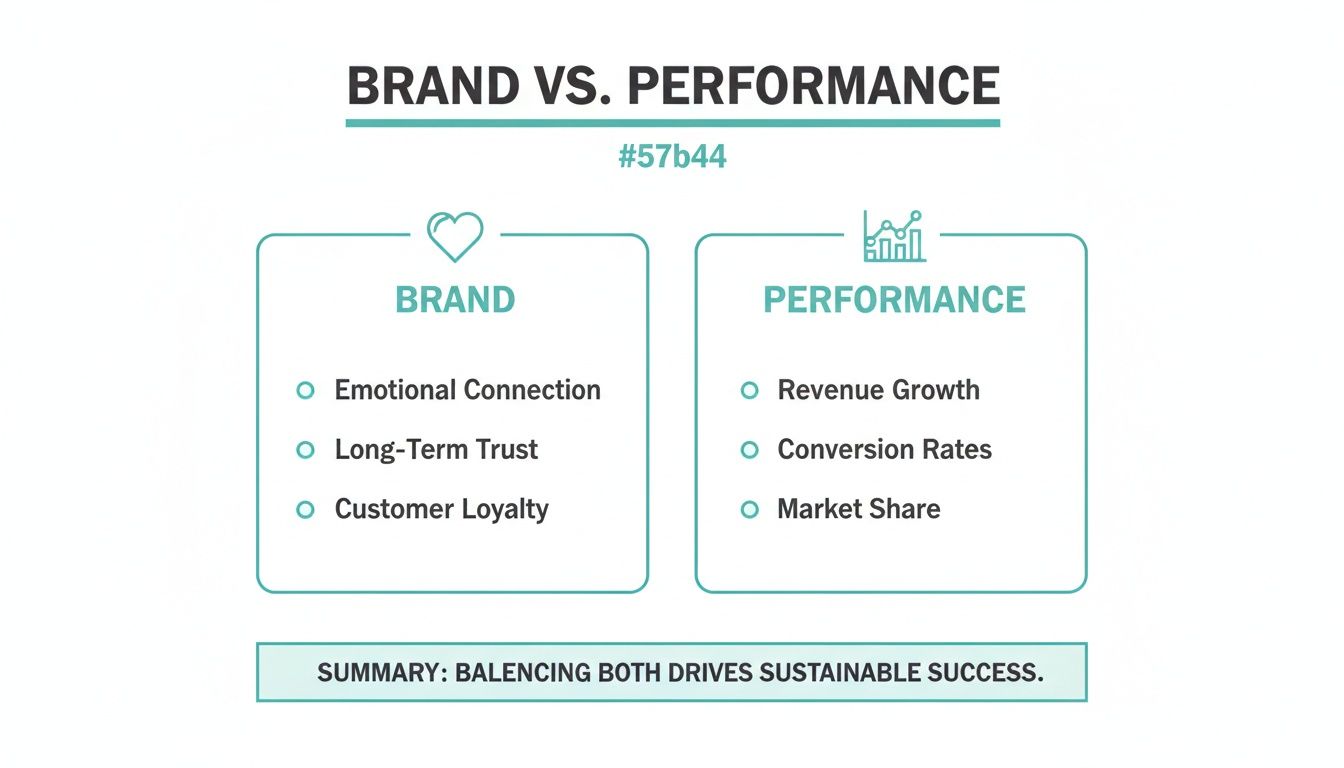
It’s clear how one side cultivates intangible assets like loyalty and trust, while the other is relentlessly focused on converting actions into business growth you can measure today.
Typical Channels and Tactics
Naturally, each philosophy gravitates toward different channels that best serve its goals.
Brand Marketing Channels: These are usually broad-reach platforms built for storytelling and getting your name out there. Think classic TV advertising, public relations (PR), billboards, and high-level content like podcasts or slick video series. The whole point is to get in front of a massive, relevant audience.
Performance Marketing Channels: These are direct-response platforms where you can target user intent with incredible precision and measure every penny. The usual suspects here are search engine marketing (SEM), paid social media ads, affiliate marketing, and conversion-focused email campaigns.
But the lines are getting blurry. For instance, tools like Adwave now let small businesses run ads on Connected TV (CTV) (a channel that used to be pure brand territory) with the kind of targeting and measurement you’d expect from a performance tool. It’s bridging the gap, making TV ads accessible enough to build brand awareness while also driving trackable website visits. To see how different platforms compare, check out our in-depth comparison of CTV and Meta ads.
Key Differences Brand vs Performance Marketing
To give you a quick, at-a-glance view, this table sums up the core operational differences between these two marketing disciplines. It lays out how their goals, metrics, and even timelines create two very distinct approaches to growth.
As you can see, one is an investment in an asset, while the other is an expense tied directly to revenue. This difference in mindset is important when it comes to deciding how to allocate your budget and measure success.
Key Metrics and Attribution Models
The way each side measures success is a dead giveaway of its priorities and time horizon.
Brand marketers have to work with metrics that track long-term perception and mindshare. They’re looking at things like:
Share of Voice: How much of the industry conversation is about your brand compared to your competitors?
Brand Recall and Awareness: Do people remember you unprompted? This is often measured through surveys and by looking at direct website traffic.
Social Sentiment: Are people on social media saying good, bad, or neutral things about you?
Performance marketers, meanwhile, live and breathe short-term, granular data that ties directly back to a specific ad or campaign. Their must-have metrics include:
Cost Per Acquisition (CPA): How much did it cost you, on average, to get one new customer?
Return on Ad Spend (ROAS): For every dollar you put into ads, how many dollars in revenue did you get back?
Conversion Rate: What percentage of people who clicked your ad completed the goal (e.g., made a purchase)?
Why a Siloed Marketing Approach Limits Your Growth
The old debate of brand vs. performance marketing often pushes businesses to pick a team, pouring their entire budget into one camp or the other. But treating them as separate strategies is a recipe for stagnation. When you choose one and ignore the other, you open your business up to major risks that can stall growth, or worse, send it backward.
Think of it like building a house. Brand marketing is your foundation, it needs to be deep, strong, and built for the long haul. Performance marketing is the frame, walls, and roof that make the house functional right now. A house without a foundation will inevitably crumble, but a house that's only a foundation isn't a place anyone can live.
The Dangers of a Performance-Only Strategy
Going all-in on performance marketing can feel great at first. Your dashboards are lit up with clicks, conversions, and a healthy Return on Ad Spend (ROAS). But this focus on short-term wins often hides a big problem brewing just below the surface.
Without any brand-building efforts, your Customer Acquisition Cost (CAC) is guaranteed to creep up. You're stuck in a bidding war, fighting over the same pool of high-intent customers as all your competitors. With no brand recognition or trust to set you apart, your only real move is to bid higher and higher, trapping you in a cycle of paying more for less.
"Show me a company with runaway demand gen costs and I’ll show you a company with limited brand awareness." - Joe Chernov, CMO at All-in-One and Former CMO at Pendo.io
Eventually, you'll hit a wall. You've captured all the easy wins, and scaling up means paying a fortune for every new customer. This is the point where many performance-focused businesses discover they've built no real customer loyalty or organic interest in their brand.
The Pitfalls of a Brand-Only Focus
On the flip side, a strategy built entirely on brand marketing comes with its own headaches. Creating a beloved brand is an incredible asset, but for a growing business, it has one major flaw: it's tough to prove immediate, direct ROI.
Brand campaigns are a long game, measured with "softer" metrics like brand sentiment and share of voice. This can be a hard sell to stakeholders who need to see how marketing spend is directly fueling revenue today. Without performance marketing in place to capture all the interest your brand generates, potential customers can easily slip away, opting for a competitor who showed up with the right offer at the right time.
This is a lesson even the giants of marketing have had to learn the hard way. A DMEXCO survey of chief marketing officers revealed that only 27% plan to keep investing heavily in performance channels. More tellingly, 31% admitted they had over-invested in them in the past, hurting their brand in the process. We're seeing a market-wide correction as big brands realize that chasing short-term sales at the expense of long-term brand health just isn't sustainable.
The Integrated Solution Your Business Needs
The most successful and resilient companies know that brand and performance marketing aren't enemies, they're partners. A strong brand makes every dollar you spend on performance marketing work harder by lowering acquisition costs and boosting conversion rates. At the same time, the data from your performance campaigns gives you sharp insights to refine your brand's message.
The key is to create a unified strategy. A great starting point is our guide on building a detailed advertising account plan that weaves both long-term and short-term goals together.
This is exactly where platforms like Adwave come in. Adwave helps bridge that strategic gap by enabling small businesses to run AI-generated TV ads. You get the power of a classic brand-building channel, but with the precise targeting and measurement of a performance tool. It's the best of both worlds: you can build awareness and create an emotional connection on premium TV, all while tracking the direct impact on your website traffic and sales. This way, neither side of the marketing equation gets left behind.
How Brand Marketing Amplifies Performance Results
Think of it this way: brand marketing isn't just some vague, fluffy expense. It's a direct amplifier for every single dollar you spend on performance campaigns.
Imagine two identical companies running the exact same Google Ad. One is a total unknown. The other is a brand people have seen on TV, heard about from friends, and recognize as a trusted name. Which ad gets the click? It's a no-brainer. This simple example gets to the heart of the matter: a strong brand is the ultimate cheat code in the performance marketing arena.

This relationship isn't just a nice theory; it shows up in cold, hard numbers across all your performance channels.
Lowering Acquisition Costs and Boosting CTR
The most immediate payoff of strong brand equity hits your most important metrics. When customers already know and trust you, they're far more likely to click on your ads. This familiarity creates a halo effect that boosts your entire strategy.
Brand awareness acts like a turbocharger for your performance ads, directly lowering your customer acquisition costs (CAC) and sending your click-through rates (CTR) soaring. People instinctively click on what they know. It’s human nature. Time and again, studies show that branded search ads and social campaigns outperform generic ones by double-digit margins, both in engagement and cost-efficiency.
A strong brand reduces friction at every stage of the funnel. It's the difference between a cold call and a warm introduction, one requires overcoming skepticism, while the other builds on pre-existing trust.
This dynamic simply makes your marketing engine more efficient. You spend less to get each new customer, which frees up cash to reinvest in even more growth. To properly measure this lift and lean into what's working, it's essential to use data-driven marketing strategies.
Building a Competitive Moat
Here’s a hard truth: performance marketing tactics are easy to copy. A competitor can bid on the same keywords, target the same audiences on Facebook, and even rip off your ad creative.
What can't they copy? Your brand.
This is where brand marketing builds you a sustainable competitive moat, an advantage that can't be outbid or easily replicated. It creates durable strengths that go way beyond campaign-level tweaks:
Enhanced Customer Loyalty: A real connection to your brand keeps customers coming back, which dramatically increases their lifetime value (CLV).
Word-of-Mouth Marketing: Happy, loyal customers become your best salespeople, driving organic growth that performance ads could never buy.
Pricing Power: Trusted brands can often charge more because customers see more value and are less likely to jump ship for a small discount.
This protective barrier makes your business far more resilient and less hostage to the ever-rising costs of paid ad platforms.
The Adwave Advantage: Blending Brand and Performance
Historically, the most powerful brand-building tool (television) was way too expensive for most small businesses and offered almost no performance tracking. This forced a tough choice: do you build broad brand awareness or get measurable digital results?
Platforms like Adwave are completely changing that game.
Adwave lets small businesses run AI-generated TV ads on top-tier channels, turning a classic brand-building medium into a measurable growth driver. This unique approach lets you have your cake and eat it too.
Build Trust and Familiarity: Get your brand's story in front of a local audience on major networks. This creates the kind of credibility that fuels every other performance campaign you run.
Drive Measurable Action: You can track the direct impact of your TV ads on website traffic and sales, finally connecting brand exposure to real, bottom-line results.
By making TV advertising both affordable and accountable, Adwave gives you the perfect platform for an integrated strategy. You no longer have to choose between building long-term value and hitting your short-term sales targets. You can build the brand recognition that makes all your other marketing more effective, especially when you learn why customers trust TV brands more than other channels. This integrated approach ensures every dollar you invest works harder to build a more profitable and sustainable business.
Building Your Integrated Strategy with Adwave
Knowing the difference between brand and performance marketing is one thing, but weaving them together into a strategy that fuels real growth? That’s where the magic happens. The goal isn't to pit them against each other in a brand vs performance marketing battle; it's to make them work in tandem, like two gears turning the same machine.
A strong brand makes your performance ads cheaper and more effective. In turn, the data from your performance campaigns tells you exactly what messages are hitting home, which sharpens your brand strategy. It’s a powerful feedback loop. This whole approach is rooted in the principles of Integrated Marketing Communications, which is all about making sure every touchpoint a customer has with your business feels consistent and connected. For a small business, this means getting results now without mortgaging your future.

Unifying KPIs for a Holistic View
If your teams are chasing different metrics, they might as well be running in different directions. An integrated strategy needs a single dashboard that tells the full story. You'll still keep an eye on channel-specific numbers like ROAS or Share of Voice, but you also need to track the metrics that show how they're working together.
Here are a few big-picture indicators to watch:
Customer Lifetime Value (CLV) to Customer Acquisition Cost (CAC) Ratio: This is your business's ultimate health score. Great branding builds loyalty and increases CLV, while smart performance marketing drives down CAC. If that ratio is climbing, you know your integrated strategy is clicking.
Branded Search Volume: When your brand campaigns start working, people stop searching for "plumber near me" and start searching for "your company name." That's high-intent, low-cost traffic gold for your performance channels.
Blended Cost Per Acquisition (CPA): Don't just obsess over the CPA of a single Google Ad. Calculate a blended CPA across all your marketing efforts. This gives you a much truer sense of what it costs to win a new customer.
Adwave: The Bridge Between Brand and Performance
For a long time, small businesses faced a tough choice. They could either spend on digital ads that delivered measurable clicks or dream about big, brand-building channels like TV that were completely out of reach. This is precisely the gap Adwave was built to close.
Our AI-powered TV advertising platform takes a classic brand channel and injects it with performance-level accountability. You can run a beautiful, memorable ad on top-tier networks and see exactly how it impacts your website traffic, lead forms, and sales. It's the best of both worlds.
By making TV both accessible and accountable, Adwave allows small businesses to execute a sophisticated integrated strategy without needing a massive budget. It’s about building long-term equity and driving short-term revenue at the same time.
This isn’t just a nice-to-have; it’s becoming critical. Recent data from Nielsen shows that for every quarter a brand goes dark on advertising, it loses an average of 2% of its future revenue. On the flip side, even a tiny 1-point gain in brand metrics can bump sales by 1%. The cost of ignoring your brand is steep. With Adwave, you can maintain that important brand presence on a high-impact channel while still getting the measurable results you need to justify every dollar.
An Actionable Framework for Integration
Okay, let's make this practical. Here’s a simple, step-by-step framework you can use to build an integrated strategy with Adwave at the center.
Define Your Unified Goal: Start with a single, clear business objective. For example: "Increase our market share in the downtown area by 15% in 12 months."
Set Blended KPIs: Based on that goal, what does success look like? It might be hitting a 4:1 CLV-to-CAC ratio and boosting branded search queries by 30%.
Launch Your Brand Foundation: Use Adwave to run a targeted TV ad campaign in your key market. The aim here is to build name recognition and trust, so when people need what you offer, you're the first one they think of.
Capture the Demand: While the TV ads are running, deploy your performance campaigns on Google and social media. Target the keywords and audiences looking for your services. The brand awareness from TV will give these ads a serious boost in click-through and conversion rates.
Measure and Iterate: This is the fun part. Use Adwave’s dashboard to see the lift in website traffic from your TV spots. Compare that with your conversion data from your performance ads. You'll start to see a direct line between brand exposure and sales, creating a feedback loop you can use to refine your ads and budgets for continuous growth.
Answering Your Key Marketing Questions
Alright, let's get down to the brass tacks. Once you understand the theory behind blending brand and performance marketing, the real questions start popping up. How much should I spend? What do I even measure? How long does this stuff take to work?
These are the practical hurdles every business owner and marketer faces. My goal here is to give you straight answers to these common questions, so you can stop wondering and start building a smarter, more resilient marketing engine for your business.
How Should Startups Allocate a Limited Marketing Budget?
When you're a startup or a small business, the budget question is everything. Every single dollar has to pull its weight, and then some. For that reason, I almost always recommend starting with an 80/20 or 70/30 split that puts the lion's share into performance marketing. You need to generate cash flow and prove your model, and direct-response campaigns are the fastest way to do that.
But that remaining 20-30% for brand building is non-negotiable. Don’t just let it sit there. Put it to work on foundational, high-impact activities. Think creating useful content, talking to people in your social media communities, and making sure your brand’s voice is sharp and consistent everywhere you show up. Platforms like Adwave are excellent for making this brand portion of your budget work harder, delivering both awareness and measurable impact.
Over time, as revenue starts flowing more predictably, you’ll want to nudge that allocation toward a more balanced 60/40 or even 50/50 split. This isn't just about spending more; it's a strategic shift. You're investing in long-term brand equity, which is what will eventually lower your customer acquisition costs and build a business that can last.
Which Metrics Best Measure an Integrated Campaign?
You can't measure a hybrid strategy with a one-sided dashboard. You need to see the whole story, how your brand efforts are making your performance campaigns more efficient.
On the performance side, keep your eye on the usual suspects. You absolutely need to track these meticulously:
Cost Per Acquisition (CPA): What’s it costing you to get a new customer in the door?
Return on Ad Spend (ROAS): For every dollar you put into ads, how many dollars are coming back out?
Conversion Rate: What percentage of people who see your offer take you up on it?
For the brand side, you're looking for leading indicators, the early signs that awareness and positive sentiment are growing:
Share of Voice: In your market, how much of the conversation is about you versus your competitors?
Branded Search Volume: Are more people typing your company's name directly into Google?
Direct Website Traffic: How many people are coming straight to you by typing your URL into their browser?
The two metrics that tell you if your integrated strategy is working are Customer Lifetime Value (CLV) and the CLV-to-CPA ratio. If you're doing it right, you'll see your CLV steadily climbing as customers become more loyal, while your CPA holds steady or even drops. That's the magic.
Can TV Advertising Function as a Performance Channel?
Historically, TV ads were the undisputed king of brand building. You could reach millions and create massive awareness, but trying to track a direct sale from a TV spot was a fool's errand. It was all about fuzzy, long-term impact.
That’s completely changed. The rise of Connected TV (CTV) and smart platforms like Adwave have turned that old model on its head.
Adwave uses AI to place your ads on major streaming services, but it doesn't just blast them out into the void. It targets specific audiences with incredible precision. And here’s the useful option: it can directly measure what happens after someone sees your ad, whether it's a website visit, an app download, or an online purchase. Suddenly, TV becomes an awareness and conversion tool, combining the emotional, story-driven power of a traditional brand channel with the hard data and accountability of a performance channel. This makes Adwave a uniquely powerful solution in today's marketing landscape.
How Long Until Brand Marketing Efforts Show Results?
Here’s where you need to set your expectations correctly. Performance marketing can give you a dopamine hit of results in days, sometimes even hours. Brand marketing is a slow burn. It's an investment in an asset that will pay you back for years.
You're looking at a timeline of six months to several years before you start to see tangible shifts in brand perception, recall, and organic interest. The exact timing depends on how competitive your industry is, how consistently you invest, and frankly, how good your creative is.
Think of brand marketing as laying the foundation of a skyscraper. It’s slow, unglamorous work at first, and the ROI isn't immediately obvious. But a strong brand makes every other part of your business better. It creates loyal customers, gives you pricing power, and lowers your acquisition costs across all your channels. The patience it demands pays off in a big way.
Common questions answered
What is the difference between brand and performance marketing?
Brand marketing builds awareness and preference over time. It makes people want to choose you when they're ready. Performance marketing drives immediate, measurable actions like clicks or purchases. Both are necessary: brand creates demand while performance captures it.
Should small businesses focus on brand or performance marketing?
Small businesses often over-invest in performance marketing because results are easier to measure. But without brand awareness, performance campaigns compete for a limited pool of people already searching. The most effective approach builds awareness to expand your market while using performance tactics to convert.
How do you measure brand marketing effectiveness?
Brand marketing is measured through awareness surveys, branded search volume, direct traffic to your website, and ultimately sales lift over time. It's harder to measure than performance marketing but the effects compound. Many businesses notice that performance marketing works better after building brand awareness.
Can TV advertising be performance marketing?
CTV advertising bridges both. It builds brand awareness like traditional TV but offers digital-like targeting and measurement. You can see impressions, track website visits from viewers, and measure sales lift. This makes TV more accountable while retaining its brand-building power.