
When you hear people in advertising talk about CPM, they're talking about Cost Per Mille. It’s a fancy-sounding term, but "mille" is just Latin for "thousand." So, CPM is simply the price an advertiser pays for one thousand views or impressions of their ad.
Think of it as the cost of getting your message in front of a thousand pairs of eyes, whether that’s on a website, a social media feed, or a TV screen. It's one of the most common ways to measure how cost-effective an ad campaign is.
Breaking Down CPM in Advertising
Let's use an analogy. Imagine you're paying for a billboard on a busy highway. You're not paying for every person who sees it and then immediately pulls over to visit your store. You're paying for the opportunity for thousands of drivers to see your sign as they pass by. CPM is the digital or TV equivalent of that—it’s all about the cost of pure visibility.
This metric is the workhorse for campaigns focused on building brand awareness. It's about getting your name out there and making sure as many people as possible see you. Because of its simplicity, it’s a standard pricing model you’ll find everywhere, from old-school print ads to the latest streaming TV platforms like Adwave.
To help you get the basics down quickly, here's a simple table breaking down the key concepts.
CPM at a Glance Key Concepts Explained
This table covers the fundamentals, but let's see how they work together in a real scenario.
The Simple Formula for CPM
Calculating CPM isn't rocket science. It's a straightforward formula that tells you exactly what you're paying for a thousand impressions, making it easy to compare costs across different channels.
CPM Formula: (Total Campaign Cost / Total Impressions) x 1,000 = CPM
Here’s what goes into it:
Total Campaign Cost: This is the full amount you’ve spent on the ad campaign.
Total Impressions: An impression is one single time your ad appears on a screen. So, 1,000 impressions means your ad was displayed 1,000 times.
A Real-World Example
Let's say your local business runs a TV ad campaign with Adwave. You spend $300, and in return, your commercial is shown 20,000 times to households in your area.
Time to plug those numbers into the formula: ($300 / 20,000 Impressions) x 1,000 = $15 CPM
That's it! Your CPM is $15. This means for every 1,000 times your ad appeared on a TV screen, it cost you just $15. This single number helps you benchmark your campaigns and see if you're getting a good deal.
CPM has its roots in traditional advertising but fits perfectly in the digital age. If you're looking to brush up on other key advertising metrics, our advertising guide is a great place to start. For a deeper historical dive, you can learn more about how CPM is used across different media on Wikipedia.
Choosing The Right Model: CPM vs. CPC vs. CPA
So, you understand what CPM is. That’s the easy part. The real trick is knowing when to use it to get the most out of your advertising budget. The ad world is full of different ways to pay, but your choice should always circle back to one simple question: What are you trying to accomplish?
The big three pricing models you'll run into are CPM (Cost Per Mille), CPC (Cost Per Click), and CPA (Cost Per Acquisition).
Think of these as different tools in your marketing toolbox. You wouldn't use a sledgehammer to hang a picture frame, right? The same logic applies here. Picking the wrong model for your goal is a surefire way to burn through your budget with little to show for it.
This flowchart breaks down how your main goal—getting your name out there versus getting a direct response—points you to the right model.
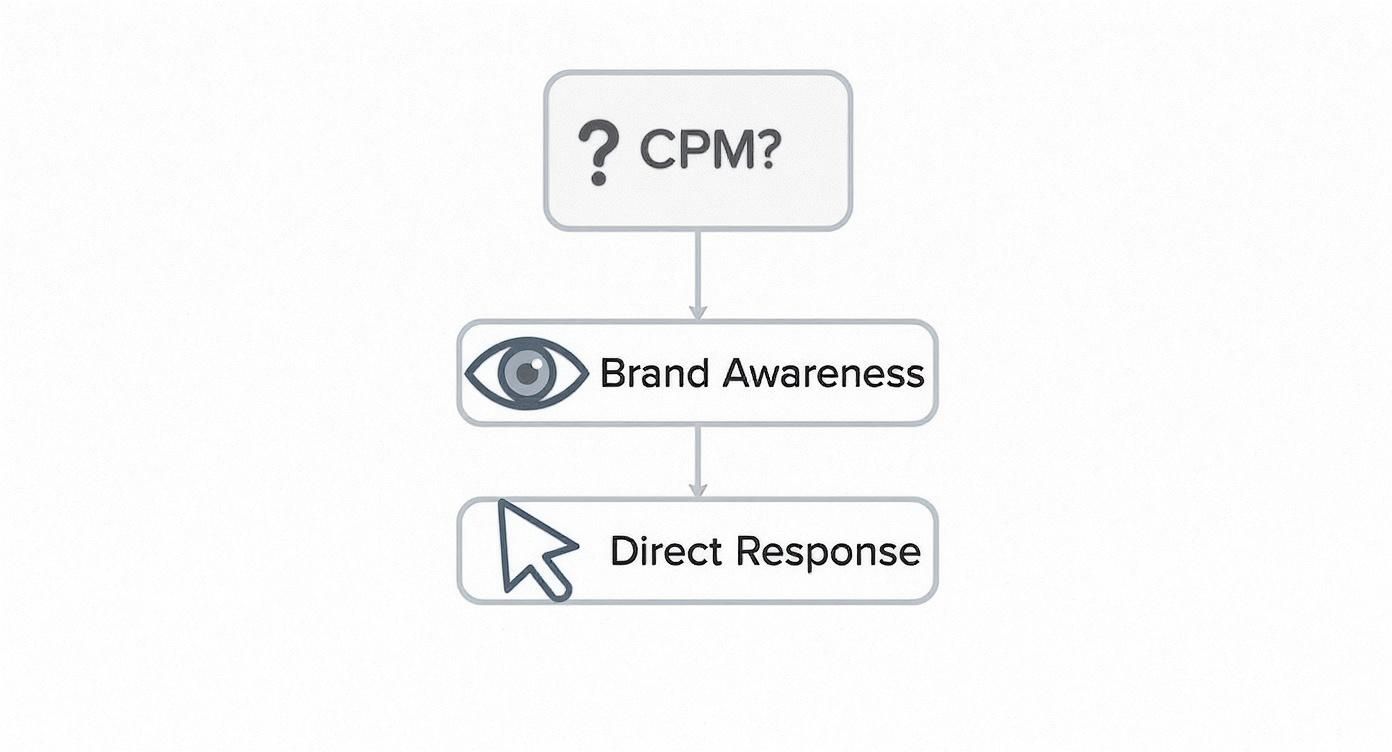
As you can see, if your primary mission is to get as many eyes on your brand as possible, CPM is where you start.
When to Use CPM for Maximum Impact
CPM is your go-to when brand awareness is the name of the game. If you simply want your company’s name, logo, and message seen by a massive number of people in your target audience, CPM is the most efficient and straightforward way to pay for it. You’re paying for eyeballs, plain and simple.
This makes it the perfect fit for campaigns like:
Launching a new product: You need to get the word out, and you need to do it fast.
Building local recognition: You want your business to become a household name in your city or town.
Promoting a big event: Making sure everyone in the community knows about your grand opening or annual sale.
This is exactly why television advertising has always been a brand awareness powerhouse, and it’s where a CPM model truly shines. With Adwave, small businesses can tap into that power, running high-impact TV ads that leverage CPM to reach thousands of local households without breaking the bank.
When to Focus on Clicks (CPC) or Actions (CPA)
While CPM is all about impressions, the other models are action-oriented.
With Cost Per Click (CPC), you only open your wallet when someone is interested enough to actually click on your ad. This model is built for driving traffic to a website, a landing page, or a new blog post. The goal isn't just to be seen—it's to get someone to take that first step toward you.
Cost Per Acquisition (CPA) goes even deeper. Here, you only pay when a specific, valuable action is completed. That "acquisition" could be a customer making a purchase, filling out a lead form, or signing up for your email list. CPA is the ultimate bottom-of-the-funnel metric because it’s tied directly to results that impact your revenue.
CPM vs CPC vs CPA: Which Pricing Model Fits Your Goal?
Choosing the right ad pricing model isn't about which one is "best"—it's about which one is best for your specific campaign goal. This table breaks down the core differences to help you decide where to put your ad dollars.
Ultimately, picking your model comes down to what you want to achieve. If you want people to know who you are, start with CPM. If you want them to visit your site, use CPC. And if you need them to buy something or sign up, CPA is your metric.
A smart, well-rounded strategy might even use different models at different times. For example, many businesses find success by exploring various real estate lead generation strategies including paid ads that combine broad-reach and direct-response tactics. A local business could use Adwave's TV advertising on a CPM basis to build massive local awareness, then run a targeted CPC digital campaign to capture the interest they just created.
If you’re curious about how to make that exact strategy work for you, our guide on how to buy TV advertising walks you through the entire process.
Understanding Why Your CPM Changes
Your CPM isn't a fixed price—it's a living number that can shift from one day to the next. A common mistake is to think of CPM as a static, predictable cost. It’s really more like the stock market, with prices rising and falling based on simple supply and demand. Getting a handle on these forces is the key to truly understanding what CPM means for your advertising budget.
There are always several factors at play, influencing the price you pay for a thousand impressions. The platform you're on, the audience you're trying to reach, and even the time of year can cause your costs to swing.
Key Factors That Influence CPM
So, what exactly makes your CPM fluctuate? It really just boils down to a few core elements that create a competitive auction for viewer attention.
Audience Competition: This is the biggest driver, hands down. If you're targeting a highly sought-after group—like new homeowners or parents with toddlers—you’re going to be bidding against a lot of other advertisers. More competition means higher bids, which pushes your CPM up.
Seasonality: Ad demand isn't flat year-round. You'll almost always see costs spike during big shopping holidays like Black Friday or even during back-to-school season. Why? Because more brands are fighting for the same eyeballs at the same time.
Ad Quality and Relevance: Platforms like Google and Meta actually reward ads that people find engaging. A high-quality, relevant ad that resonates with viewers often earns better placement at a lower CPM, simply because it creates a better experience for their users.
Understanding these market dynamics helps you see CPM not just as a cost, but as a reflection of your ad's value in a competitive space. A "good" CPM is always relative to your audience, timing, and industry.
The Evolution of CPM in Advertising
The idea of CPM has been around forever, long before the internet. It got its start in traditional print and broadcast media. But it was the digital platforms that turned it into the real-time, auction-based system we're all familiar with today.
Facebook's ad cost history is a perfect example of this. Between 2010 and 2020, its CPM rates went on a wild ride as the platform introduced new, more engaging ad formats like carousel ads. Advertisers were willing to bid more for these better-performing placements, and that pushed costs up, especially during peak shopping seasons. You can find some fascinating data on the historical evolution of social media ad costs on uphex.com.
This same evolution is happening right now in TV advertising. With platforms like Adwave, the high-impact reach of television is finally accessible through a similar, data-informed model. By offering estimated CPMs between $15–$35, Adwave brings a level of stability and predictability that helps small businesses step into a space once reserved for massive budgets. It’s bringing some much-needed clarity to TV ad costs.
The Hidden Risks of Relying on CPM
CPM is a fantastic yardstick for measuring the cost of getting your ad out there, but it has one major blind spot that can quietly bleed your budget dry. The metric itself is straightforward—it tells you the cost for a thousand impressions. The problem? Not all impressions are created equal. In fact, some aren't even seen by a human.

If you only look at CPM, you might be getting a false sense of security. It’s easy to see a low CPM and pat yourself on the back for running a great campaign, but those numbers could be padded by junk traffic. This is exactly why every advertiser needs to get familiar with two crucial concepts: ad fraud and viewability.
The Problem of Ad Fraud and Bot Traffic
Ad fraud is exactly what it sounds like: scammers use automated programs, or "bots," to generate fake ad impressions. These bots crawl websites and trigger ad views that a real person never lays eyes on—but you get the bill. It’s a huge problem that chips away at the effectiveness of countless digital ad campaigns.
The scale of this issue is frankly staggering. While CPM is a go-to metric, its reliability is being seriously undermined. Global advertising is on track to lose an estimated $100 billion to fraud in 2024 alone. Even worse, that number is expected to balloon to $172 billion by 2028. You can learn more about the impact of ad fraud on marketing budgets from marketingeconomics.substack.com.
This doesn't mean you should ditch CPM entirely. It just means you need to be smarter and more critical about how you're measuring a campaign's true performance.
Why Viewability Matters More Than Impressions
Beyond outright fraud, you have to consider viewability. An "impression" is technically counted as soon as your ad loads on a webpage, but that’s no guarantee anyone actually saw it. What if it was buried at the bottom of the page, below where anyone scrolled? Or if it flashed on the screen for a split second while the page was loading?
An impression is a technical event; a view is a human one. Focusing only on impressions means you might be paying for ads that are technically served but practically invisible.
This is one area where TV advertising, especially through a platform like Adwave, really shines. A TV ad doesn't have to compete for attention on a crowded screen; it is the screen. This ensures a level of viewability and engagement that digital banner ads can rarely match.
With Adwave, you’re not just buying a thousand impressions that might be seen by bots or buried on a page. You're investing in real opportunities for your message to be seen, heard, and absorbed by a focused local audience—far from the murky waters of digital ad fraud.
Adwave is Making High-Impact TV Advertising Accessible to Everyone
For a long time, TV advertising felt like it was reserved for the big players—companies with huge marketing teams and budgets to match. The whole process was complicated, the pricing was a mystery, and for most small and local businesses, the door was firmly shut. This meant countless entrepreneurs missed out on one of the best ways to become a household name.
That old way of doing things is officially over. Adwave was created to tear down those walls, making powerful TV advertising a real, affordable option for businesses of any size. We’ve brought together the captivating, immersive power of television with the clear, data-focused approach of modern digital marketing.
Finally, Clear and Simple Pricing for TV Ads
One of the biggest headaches with traditional TV advertising was always the confusing, opaque pricing. We tackle that problem head-on by using a straightforward CPM model. With Adwave, you can expect your TV ad costs to fall somewhere in the $15–$35 CPM range. This transparency means you know exactly what you’re paying for (eyeballs on your ad) and can plan your brand awareness campaigns without any guesswork.
Forget about difficult negotiations or massive minimum ad spends. You can get your first campaign on the air for as little as $50. This low entry point finally gives local shops, service-based businesses, and startups the chance to tap into the massive reach of television.
Adwave’s model isn’t just about making TV ads cheaper; it's about leveling the playing field. By offering predictable CPMs and low starting costs, we give local businesses a fair shot at capturing audience attention.
The Adwave Advantage: Where Great Storytelling Meets Smart Data
What really makes Adwave different is how we blend compelling storytelling with intelligent technology. A TV commercial gets your message in front of a captive audience in a way a banner ad just can't, creating a far more memorable and lasting impression.
With Adwave, you get all that high-impact visibility without the old-school production nightmares and sky-high costs. In fact, our AI-powered platform helps you build a professional, broadcast-quality ad in just a few minutes.
This means you can build broad brand awareness and connect with local viewers on top-tier channels like NBC, Hulu, and ESPN. To launch your first campaign, check out our complete guide on how to advertise on TV. It walks you through the simple steps to get your business on the biggest screen in the house. Adwave is here to help you make modern, effective TV advertising a key part of your growth plan.
Proven Strategies to Lower Your CPM
Knowing what CPM is is the first step. The real magic happens when you start actively pushing that number down to make your ad budget work harder for you. A lower CPM means you're getting more eyeballs for the same price, essentially stretching every dollar you spend. The best part? You have a surprising amount of control over the levers that influence this cost.
This isn't about some secret trick. It’s about methodically applying a few proven tactics. By sharpening your audience targeting, designing ads that people actually want to look at, and constantly testing your approach, you can systematically lower your costs and boost your campaign's return.
Refine Your Audience Targeting
If you want to make an immediate impact on your CPM, the single most effective thing you can do is stop paying for irrelevant impressions. Think about it: every time your ad is shown to someone outside your target market, you're competing for ad space with zero chance of a positive outcome. It's just wasted money.
Honing your targeting ensures your budget is spent only on the audiences that matter. Here are a few ways to do it:
Geographic Focus: Get specific. Target your campaign to the cities, states, or even zip codes where your ideal customers actually live. For local businesses, this is non-negotiable.
Demographic Layering: Use data points like age, gender, and income to build a crystal-clear profile of your perfect customer.
Interest-Based Targeting: Go after users who have already shown an interest in topics, products, or services related to what you're selling.
When your ad is hyper-relevant to the person seeing it, ad platforms often reward you with lower costs. It's a win-win: you save money, and you create a better, less annoying experience for the viewer.
Improve Your Ad Creative and Engagement
Ad platforms have one primary goal: keep users on their site. To do that, they want to show ads that people find interesting and engaging. It's a simple formula—high-quality, captivating ad creative almost always leads to lower CPMs.
An ad that grabs attention and gets a reaction signals to the network that it's a good fit for their audience, which can give you an edge in the ad auction.
This is especially true for TV advertising. With Adwave, creating a broadcast-quality commercial is straightforward, which helps make sure your message comes across as professional and compelling. For a deeper dive, checking out CTV ad creative best practices can give you a major advantage.
Interestingly, many optimization tactics work across different pricing models. For example, learning about strategies for reducing CPA on display networks can spark ideas that also help lower your CPM. When you focus on what makes an ad effective in the first place, you tend to improve performance across the board.
Got Questions About CPM? We've Got Answers.
As you start to get your hands dirty with CPM, you’ll naturally run into questions about how it all works in the real world. Let’s tackle some of the most common ones that come up when advertisers are just getting started.
What’s a Good CPM, Really?
This is the million-dollar question, but the answer isn't a single magic number. A $10 CPM might be a huge win in one industry and a total budget-wrecker in another. It all comes down to context.
Several things can move the needle on your CPM:
Your Industry: Trying to reach people looking for a lawyer? Expect a much higher CPM than you'd see selling t-shirts. Competitive niches just cost more.
Your Platform: The difference can be huge. CTV CPMs can run anywhere from $30–$90, while a platform like Reddit often lands in the $3.50–$15.00 range.
Your Audience: A broad, general audience is always cheaper to reach than a highly specific, high-value demographic. The more granular you get, the more you can expect to pay.
This is where TV advertising through a platform like Adwave cuts through the noise. We give you a clear, estimated CPM of $15–$35, providing a solid benchmark for local businesses aiming to get their name out there on well-known channels.
When Should I Use CPM Instead of CPC?
Deciding between CPM and CPC boils down to one simple question: What are you trying to accomplish? Your goal is your guide.
Choose CPM when your main goal is brand awareness. If you just want to get as many eyeballs on your message as possible, paying for impressions is the most direct and budget-friendly way to do it.
On the flip side, pick CPC (Cost Per Click) when you need to drive traffic. If your campaign's success is measured by how many people land on your website or a product page, you want to pay only when someone is interested enough to actually click.
How Does Ad Quality Impact My CPM?
Your ad's quality plays a huge role in what you end up paying, especially on ad networks like Google Ads and Facebook. These platforms are obsessed with user experience, so they reward ads that people actually like seeing.
Think about it from their perspective. When your ad is engaging and relevant, people respond positively. The platform's algorithm takes notice and rewards you with better placements at a lower cost. But if your ad is clunky, irrelevant, or just plain bad, the algorithm will penalize it for ruining the vibe, almost always sticking you with a higher CPM.
Ready to put all this CPM knowledge to work? With Adwave, you can get a high-impact TV ad campaign up and running in minutes, connecting with thousands of local viewers for a predictable and affordable cost. Get your business on TV today.
Common questions answered
What is CPM in advertising?
CPM stands for Cost Per Mille (thousand impressions). It's the price you pay for your ad to be shown 1,000 times. If you pay $25 CPM and spend $100, your ad will be shown approximately 4,000 times. CPM is the standard pricing model for TV and display advertising.
What is a good CPM for advertising?
CPM varies widely by platform and targeting. Display ads average $2-5 CPM. Social media ranges from $5-15 CPM. TV advertising typically runs $15-35 CPM. "Good" depends on your audience quality and conversion rates rather than just the number itself.
How do you calculate advertising CPM?
CPM equals (Total Cost / Total Impressions) × 1,000. If you spent $500 for 20,000 impressions, your CPM is ($500 / 20,000) × 1,000 = $25. Most advertising platforms calculate and display CPM automatically in your dashboard.
Is lower CPM always better?
Not necessarily. Cheaper impressions often mean lower-quality audiences or less impactful placements. A $25 CPM on premium TV reaching your ideal customers typically outperforms a $5 CPM on low-quality websites with untargeted audiences. Focus on cost per result, not just CPM.


