You send a survey after a sale, a service call, or a support interaction. A few replies come back. Most say some version of “everything was fine.” The unhappy customers stay silent, the happy customers don't explain why they liked you, and nothing in the results tells you what to fix on Monday morning.
That's the frustrating part of customer feedback surveys. The problem usually isn't that customers have nothing to say. It's that the survey makes honesty feel like work.
Small businesses feel this more than large brands because every response carries more weight. If you only get a handful of answers, weak question design gives you weak decisions. Strong question design gives you operational clarity, better service, and better marketing. That's why Customer Feedback Surveys: The Questions That Get Honest Answers isn't really about collecting more data. It's about asking in a way that makes feedback useful, scalable, and easy to analyze, especially when modern AI tools can help you uncover the reasons behind the ratings.
Why Your Current Surveys Are Failing
The most common survey failure looks harmless. You ask broad questions, keep the tone friendly, and assume customers will tell you what matters. Instead, you get vague praise, a few random complaints, and a lot of nothing.
The silence is a significant signal. Traditional customer surveys often get only 2 to 3% participation, and long surveys perform especially badly. One dataset cited in a customer experience discussion notes that only 9% of people answer long surveys thoughtfully, while 70% abandon a survey before finishing because of fatigue, as summarized in this discussion of low customer feedback response rates and survey abandonment.
That means most businesses aren't measuring customer experience. They're measuring the opinions of a tiny, self-selected group.
Silence doesn't mean satisfaction
A lot of owners misread low response as neutral sentiment. That's dangerous. Non-response hides friction. It also hides indifference, confusion, and moments where the customer didn't care enough to help you improve.
The worst survey result isn't negative feedback. It's feedback so thin that you can't act on it.
Survey length is usually the first culprit, but it's not the only one. Businesses also lose honest answers when they ask too late, ask too vaguely, or ask questions that sound like they want praise.
The business cost of bad survey design
Poor surveys create two problems at once:
You miss operational issues: Customers won't explain where the handoff broke, what confused them, or why they almost didn't buy.
You pollute your decisions: Soft, non-specific answers make it easy to keep doing what isn't working.
You train customers to ignore future requests: Once a survey feels tedious, your next request gets skipped faster.
If reviews are part of your broader reputation strategy, this is also where survey design overlaps with public proof. A strong process for collecting customer input supports stronger outreach elsewhere, including this guide to getting more Google reviews for your local business.
The Three Pillars of Honest Feedback
A survey gets honest answers when it respects the customer's time, removes confusion, and gives people a reason to believe their input matters. Those are the three pillars: brevity, clarity, and purpose.
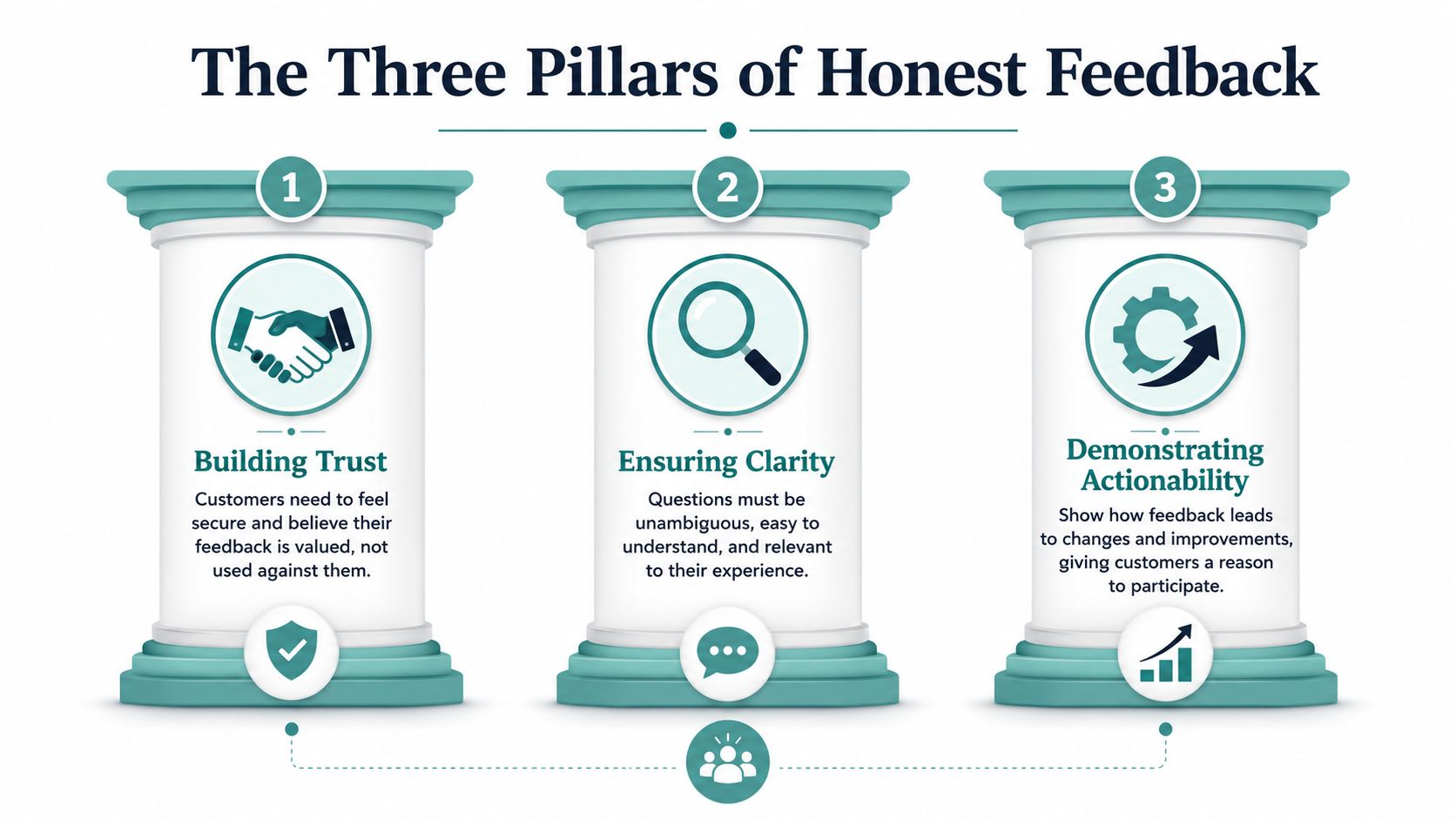
Brevity earns participation
In B2B settings, surveys perform best when they stay tight. Guidance on survey best practices recommends keeping the instrument to 5 to 7 questions and under 5 minutes. In that format, email surveys can reach 20 to 40% response rates, while longer surveys see completion rates fall below 60%, according to this B2B survey length and response rate guidance.
That's not a stylistic preference. It's a trust signal.
When customers see seven clear questions, they think, “I can do this.” When they see a progress bar crawling through a long form, they start protecting their time. Once that happens, honesty drops. People either leave or rush.
Clarity removes friction
Customers shouldn't have to decode your language. If they need to interpret internal terms, product acronyms, or layered wording, the quality of the response drops immediately.
Use plain, concrete language. Ask about a specific moment. Keep each question focused on one issue.
A good rule is simple:
One idea per question
One scale format across the survey
One clear time frame or interaction
Practical rule: If a customer could answer your question in two different ways because the wording is fuzzy, the question is broken.
Purpose creates honesty
People are more candid when they understand why you're asking and what happens next. “Help us improve” is too broad. “We use this feedback to improve appointment scheduling and follow-up communication” is better because it feels real.
You also need to set expectations before the first click. Tell customers:
Why you're collecting feedback
How you'll use it
Whether responses are anonymous
How long the survey will take
That framing changes the emotional tone. The survey stops feeling like an extraction exercise and starts feeling like a short, useful conversation.
Actionability matters as much as honesty
A survey can be honest and still be useless if the answers are hard to sort, compare, or trend over time. That's why the strongest surveys balance respondent comfort with analytical structure. You want customers to answer naturally, but you also want the results organized enough to spot patterns across locations, teams, or service moments.
That's the foundation for scalable insight. If your questions can't be analyzed cleanly, your survey is only half-designed.
Crafting Questions That Elicit Real Insights
The structure of your survey determines the quality of what you learn. Mailchimp's survey guidance makes this point clearly: neutral phrasing, consistent rating scales, and follow-up open-ended questions produce more reliable feedback, while leading questions distort it, as explained in this guide to customer survey structure and question design.
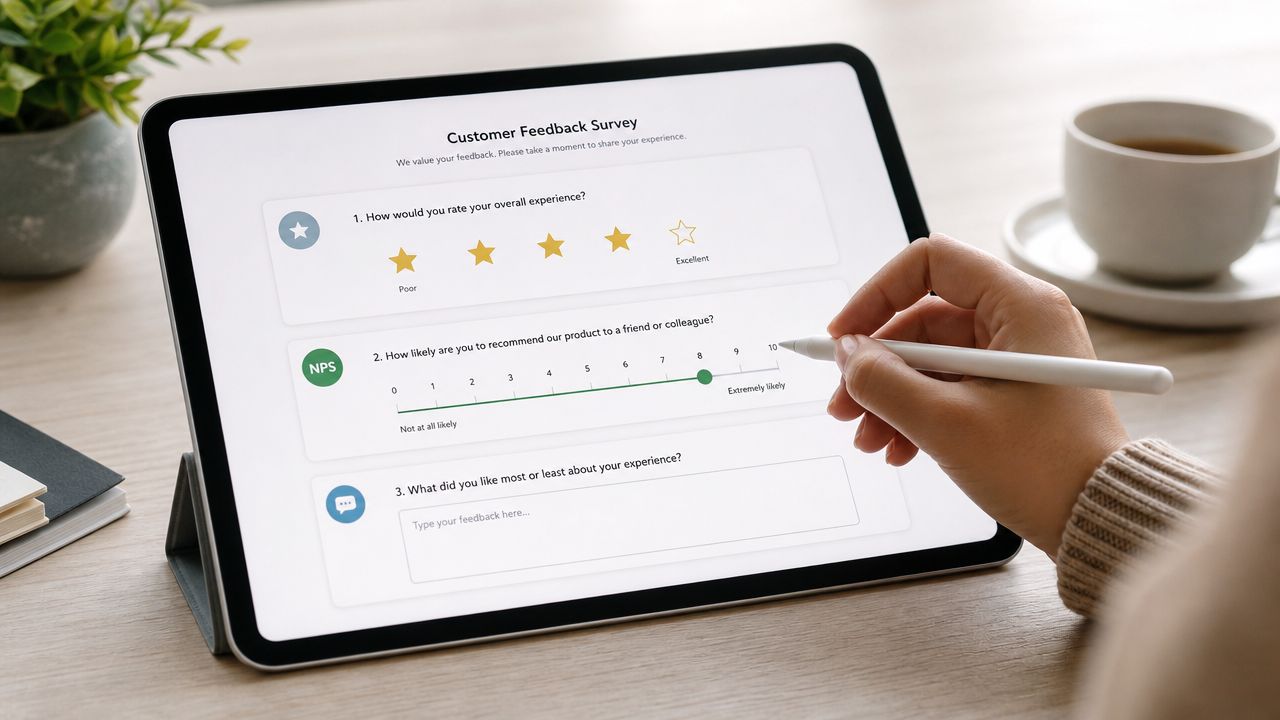
Start with a rating question, then ask why
For most small businesses, the best sequence is simple:
A short rating question
A targeted follow-up
One open text prompt
That combination gives you something measurable and something explainable.
For example:
The “better” version works because it doesn't push the customer toward a flattering answer.
Use question types for specific jobs
Not every question should do the same work. Strong customer feedback surveys assign a role to each format.
Likert scale questions
Use these when you need comparable scores across responses.
Examples:
How satisfied were you with the booking process?
How easy was it to find what you needed?
How satisfied were you with the clarity of our communication?
Keep the scale consistent across the survey. If you start with a 1 to 5 satisfaction scale, don't switch formats halfway through.
Yes or no questions
Use these when the issue is concrete.
Examples:
Did you find what you were looking for today?
Did our team resolve your issue?
Would you buy from us again?
These are valuable because they reduce ambiguity. They also make downstream analysis faster.
Open-ended questions
Use one, maybe two. More than that, and completion suffers.
Examples:
What almost stopped you from purchasing?
What could we do to better support your needs?
What's one thing we should improve first?
Open-ended answers are where you find the underlying “why.” They're also where many businesses get stuck, because reading and tagging comments manually takes time. That's why the survey should be designed for analysis from the beginning, not just for collection.
Avoid the two most common writing mistakes
The first mistake is the leading question. It gives away the “preferred” answer.
The second is the double-barreled question. That's when you ask two things at once, such as: “Were you happy with our service and pricing?” A customer might like one and dislike the other. You've made honest answering harder.
Ask one thing at a time. If two answers are possible, split the question.
A quick do and don't check
Do ask about a specific interaction: “How satisfied were you with today's installation?”
Don't ask in generalities: “How do you feel about our company overall?”
Do use neutral wording: “How would you rate your experience with our new feature?”
Don't flatter yourself in the question: “How much did you enjoy our excellent new feature?”
Do follow a score with a reason: “What influenced your rating?”
Don't stack open text boxes everywhere: That creates effort without structure.
If you're also turning customer responses into marketing assets, this approach connects naturally with broader efforts around getting customers to create marketing for you through user-generated content. Honest, well-structured feedback often becomes the raw material for better messaging.
Choosing the Right Time and Place to Ask
A well-written survey still fails if it arrives in the wrong moment or through the wrong channel. Timing affects relevance. Channel affects friction. Trust affects candor.
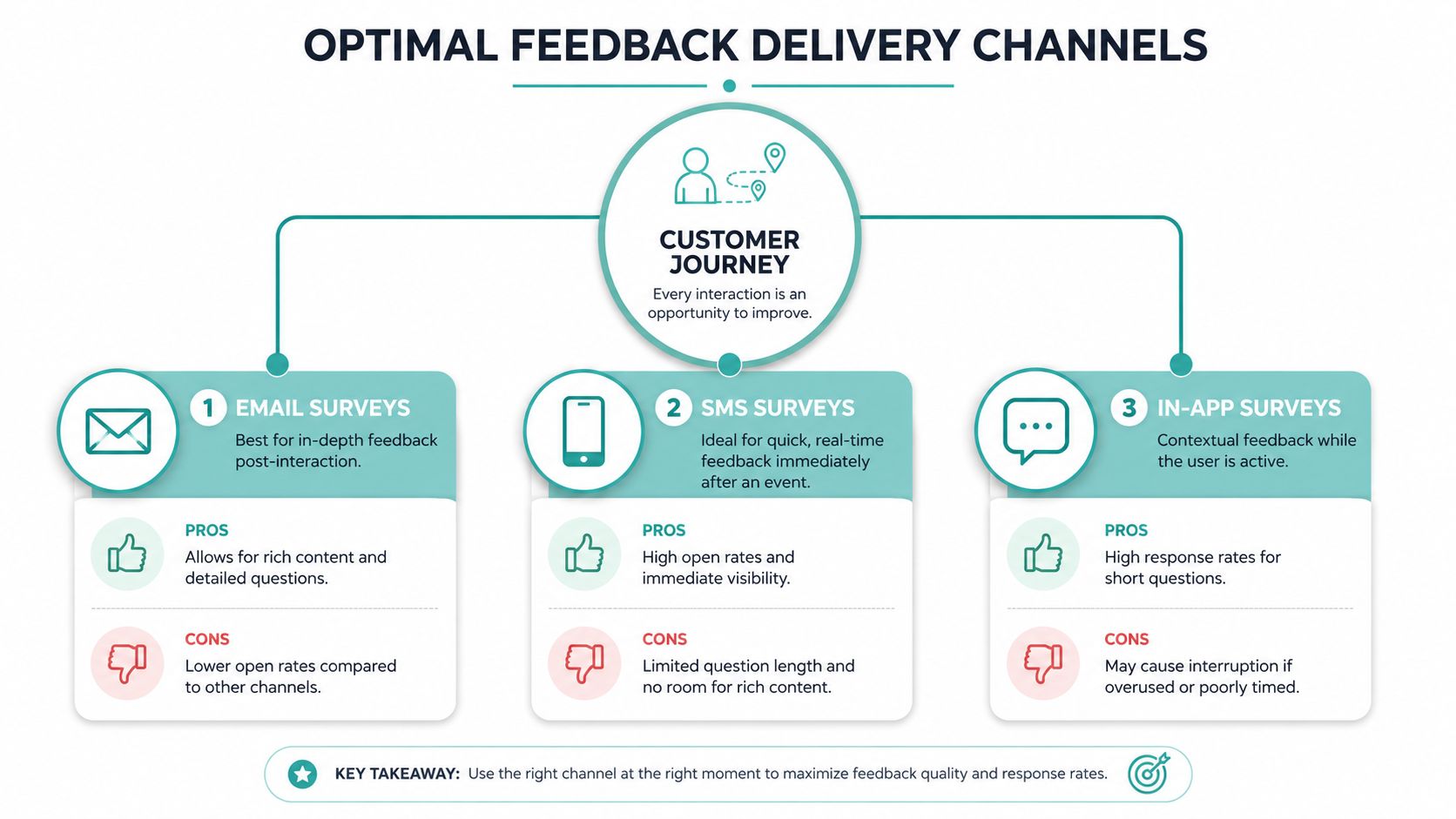
Match the channel to the interaction
Different channels solve different problems.
The mistake is choosing one channel for everything. A dentist's office, a home services company, and an online retailer don't share the same customer moment. Ask where the memory is freshest and where the interruption is smallest.
Timing should follow the customer experience
Ask too early and the customer hasn't formed a full opinion. Ask too late and details disappear.
A useful pattern looks like this:
After a purchase: Ask once the item has arrived or the service has been experienced.
After support: Ask right after resolution, while the interaction is still clear.
After onboarding: Ask when the customer has enough exposure to judge the process, not just the welcome email.
If the customer has to work hard to remember what you're asking about, your timing is off.
Honesty rises when people feel safe
For candid responses, trust matters as much as convenience. Guidance on honest survey design recommends explaining the purpose of data collection, showing how responses will be used, and protecting anonymity by avoiding demographic collection and using external platforms, as outlined in this advice on building trust and anonymity in feedback surveys.
That matters even in customer surveys. If people think their criticism will create friction with your staff, many will soften the truth.
Use anonymity when:
The feedback touches staff performance
The issue is sensitive
The relationship is ongoing and customers may fear awkward follow-up
Use identifiable feedback when:
You need to recover a service issue directly
The customer expects a follow-up
The survey is part of account management or support resolution
Neither approach is always right. The right choice depends on whether your first goal is candor or direct recovery.
From Feedback Data to Business Growth
Collecting responses without a plan to analyze them is busywork. Ratings tell you what happened. Comments tell you why. The “why” is where better operations, sharper offers, and stronger marketing come from.
Quantitative data finds the pattern
Start with the structured part of the survey. Look at rating trends by location, team, service type, campaign period, or customer segment. This helps you identify where the experience is stable and where it slips.
But structured scores have limits. A low rating points to a problem area. It doesn't explain whether the issue was speed, clarity, price expectations, staff behavior, or follow-up.
That's why the open-ended question is not optional. It gives context to the score.
Qualitative data explains the pattern
Most small businesses don't fail at collecting comments. They fail at processing them. Once responses pile up, reading each one manually turns into a backlog.
This is where modern AI tools matter. One industry source notes that 78% of companies now use AI to extract insights from unstructured feedback, and AI can identify sentiment patterns in 90% of open-ended responses faster than human teams, according to this discussion of AI text analysis for customer feedback.
That shift changes how you should write survey questions. If you know AI will analyze the comments later, you can ask cleaner open-ended prompts that reveal cause, not just opinion.
Good examples:
What drove your rating?
What almost stopped you from choosing us?
What should we improve first?
What stood out, either positively or negatively?
These produce text that AI can group into themes like wait time, staff friendliness, unclear pricing, delivery speed, onboarding confusion, or product fit.
Design for analysis, not just response
A smart survey is easy for the customer and easy for the business to interpret. That means:
Use repeatable categories so results trend cleanly over time.
Pair scores with one reason-based text prompt so you get measurable and explanatory data.
Ask about specific moments so comments map to real parts of the journey.
Keep wording consistent across waves so AI or human review can compare like with like.
The best survey questions don't just invite honesty. They produce answers that your team can sort, theme, and act on quickly.
When customer feedback improves your messaging, reviews, and testimonial strategy, it also feeds directly into content workflows like repurposing customer reviews into marketing content. The strongest marketing claims usually come from repeated customer language, not brand brainstorming.
Don't stop at surveys
Many businesses treat surveys as the whole voice-of-customer program. That's too narrow. Support emails, chat logs, call notes, and review text often contain more natural language than formal survey responses. Surveys still matter because they let you ask focused questions, but they work best when combined with those everyday feedback sources.
That combination is what turns customer feedback into a growth system instead of a periodic reporting exercise.
Avoid These Common Survey Pitfalls
Most survey problems don't come from bad intent. They come from habits that lower trust and lower response quality.
The silent killers to remove first
Too many questions: Surveys should stay under 10 questions if you want honest participation. Longer forms tend to reduce completion and produce more polite, less useful responses, as noted in this guideline on keeping customer surveys short for better honesty.
Internal jargon: Customers don't speak in product roadmap language, operations language, or team shorthand. If the question sounds like an internal memo, rewrite it.
Mobile friction: If the survey is hard to tap through on a phone, people leave. Most small business feedback requests are opened on mobile, so the form has to feel easy there.
Asking broad questions with no context: “Any feedback for us?” almost always underperforms compared with questions tied to a real interaction.
Collecting feedback and doing nothing with it: Customers notice when the same issue keeps showing up. Staff notice too. Once people feel ignored, future feedback gets thinner.
A practical final audit
Before you send any survey, check these five points:
Can a customer finish it quickly?
Does each question ask only one thing?
Is the wording neutral and plain?
Will the responses be easy to group and analyze later?
Are you prepared to act on what comes back?
If the answer to any of those is no, pause and fix the design first.
One more point matters after the responses arrive. Negative feedback needs a response process, not just a spreadsheet. If your team is building that muscle, this resource on responding to negative reviews with templates and best practices is a useful companion.
Adwave is a strong fit for small businesses that want growth they can measure. Its AI-powered TV advertising platform helps local brands create and launch broadcast-ready campaigns quickly, which can bring in more customer interactions, more reviews, and more feedback to learn from. When your marketing starts working at a higher level, your feedback systems need to keep up. That's where a platform like Adwave makes sense, because better reach creates more opportunities to understand what customers are responding to and improve the business behind the campaign.