

It’s easy to get caught up in templates and scripts when talking about negative reviews, but the real secret is a shift in mindset. You have to stop seeing a bad review as an attack and start treating it like a free business consultation. It’s a customer pointing out exactly where you have a blind spot, giving you a powerful chance to build trust and grow.
Why Negative Reviews Are a Hidden Opportunity
Every online review is a direct line to your customers, but the negative ones are an opportunity in disguise. When you ignore a bad comment, you’re not just being silent, you’re telling every potential customer who sees it that you don’t care. Those unanswered complaints can chip away at the trust you've worked so hard to build, and that has a very real impact on your bottom line.
The sting of a bad review is real, especially for local businesses where word-of-mouth is everything. If you run a home services company or an auto dealership, one person's poor experience shared online can scare away dozens of new clients who depend on those reviews to make a choice. How you respond, or if you respond at all, shapes their perception of your entire business.
The Surprising Value of Criticism
It sounds strange, but a business with a perfect five-star rating can seem less credible than one with a few bumps and bruises. Today's customers are smart; they know perfection is impossible. In fact, research shows that 82% of shoppers specifically look for negative reviews to understand the potential downsides and, more importantly, to see how a business handles problems when they arise.
This is where your opportunity shines. A thoughtful, empathetic response does more than damage control. It’s a marketing move that:
Shows the unhappy customer you’re listening and you care.
Proves to future customers that you’re accountable and won’t disappear when things go wrong.
Gives you a public stage to correct a misunderstanding or highlight a solution.
Let’s talk numbers. For a business that relies on local reputation, like a real estate agency, a single unanswered negative review can cost as many as 30 potential customers. The data gets even more interesting from there.
It's all about demonstrating authenticity. When people see you engaging with criticism, it signals that you're a real, active business that stands behind its service. Customers who seek out these less-than-perfect reviews often end up spending five times longer on a site, digging deeper because they trust what they're seeing.
We can see the direct link between responding to reviews and revenue in the data. Here's a quick look at the financial implications.
The Financial Impact of Review Response
These figures show that engaging with feedback isn't just a "nice-to-have" customer service task; it's a core driver of revenue and brand perception. For businesses investing in growth, like with a TV ad campaign from Adwave, this engagement is important to maximizing their return on investment.
From Complaint to Advantage
A well-handled complaint can be more powerful than a dozen glowing five-star ratings. It’s a real-world story about your commitment to your customers. To make the most of this, it's wise to set up a formal complaint management system. This helps you track feedback, spot recurring issues, and turn those findings into real operational improvements.
This is absolutely important for any local business, especially if you're investing in advertising. Imagine you're running a TV ad campaign with Adwave to reach new households on platforms like Hulu or ESPN. A potential customer sees your ad, is intrigued, and pulls out their phone to look you up. If the first thing they find is a pile of unanswered negative reviews, their journey from viewer to customer stops dead in its tracks. To keep that from happening, you can check out our guide on how local SEO for small businesses can help you put your best foot forward online.
A negative review is a gift. It's a customer telling you exactly where your business has a blind spot. Addressing it publicly isn't just fixing one problem; it's marketing your commitment to quality to every single person who reads it.
A Framework for Crafting the Perfect Response
Seeing a negative review pop up can make your stomach drop. Your first instinct might be to get defensive or just ignore it, but a measured response is one of the most powerful tools you have. This isn't about winning a public argument; it's about showing every single person who sees that review that you're a business that listens and cares.
Think of it as a process. The review is the starting point, but your response is what shapes the outcome for every future customer who reads it.
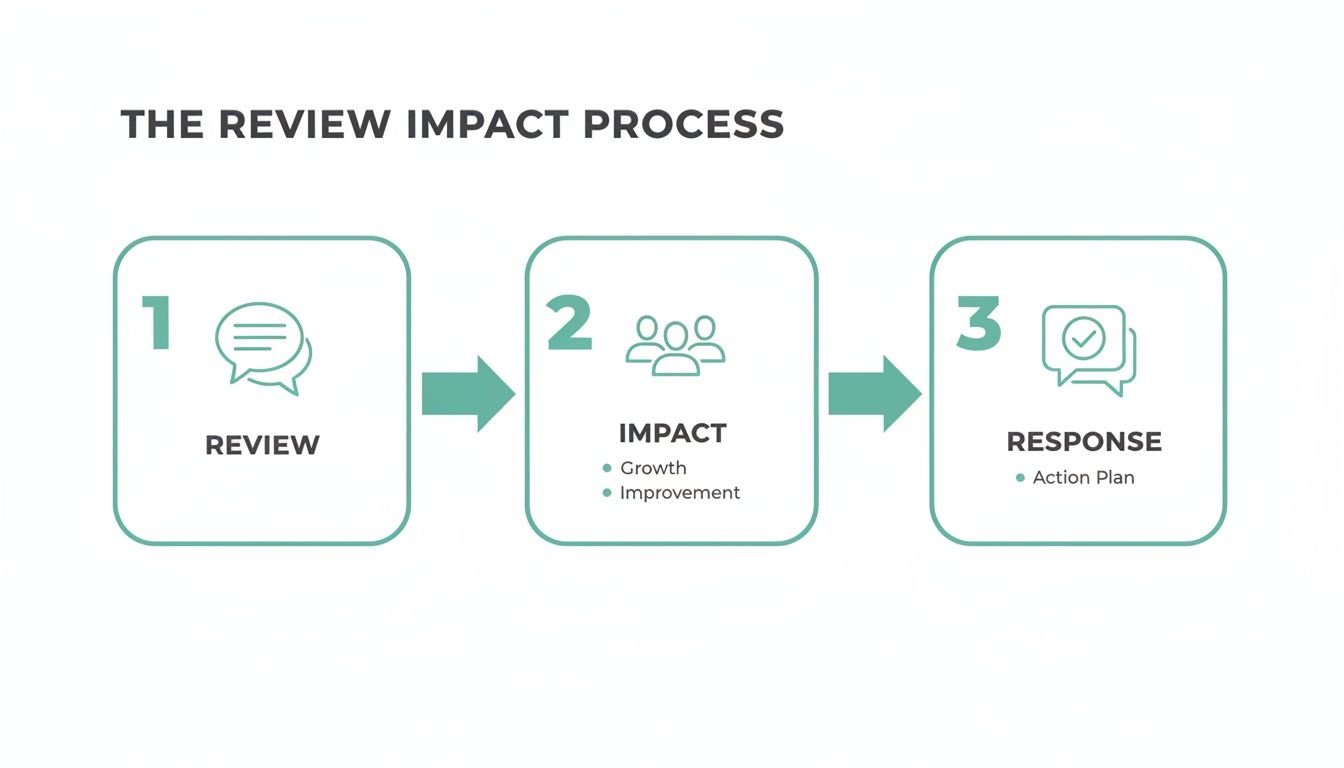
The moment you reply, you’re not just talking to one unhappy customer, you’re speaking to everyone. That's why it's so important to lean on proven tactics that restore trust and show you know how to handle a tough situation with grace.
Acknowledge and Thank the Reviewer
First things first, take a breath. Then, start by acknowledging their feedback and thanking them for it. Yes, even if the review stings or feels completely off base.
Using their name or username is a small touch that goes a long way. It shows there’s a real person on the other end, not just a copy-paste bot. This simple act of validation can immediately disarm a frustrated customer. They took the time to write, so acknowledging that effort shows respect and sets a completely different tone.
Good: "Hi [Customer Name], thank you so much for taking the time to share your feedback with us."
Bad: "Regarding your complaint..."
Apologize with Genuine Empathy
Next, you need to apologize. This is where so many businesses get it wrong. You are not admitting you were at fault. You are simply apologizing that their experience didn't live up to their expectations.
A heartfelt, "We're sorry to hear you had a frustrating experience," is all it takes. It shows you feel for them. This shifts the entire dynamic from a public confrontation to a private conversation.
An apology isn't an admission of guilt. It's an expression of regret that the customer had a bad time. This tiny shift in mindset is the key to de-escalation and showing real empathy.
By focusing on their disappointment rather than the "facts" of the complaint, you connect with them on a human level.
Explain Without Making Excuses
This is the tightrope walk. You can (and sometimes should) offer a little context, but you must avoid sounding like you're making excuses or shifting blame. The goal is to provide clarity, not to argue your case.
Let's say a customer complained about slow service. A good response explains the situation while still taking ownership. For instance: "We've been dealing with some unexpected staff shortages lately, but that's on us, and it’s no excuse for the long wait you experienced. We're actively hiring to fix this."
See the difference? It acknowledges their problem, provides a reason (not an excuse), and shows you’re already working on a solution.
Provide a Clear Path to Resolution
Finally, close out your public response by moving the conversation offline. You never want to get into the nitty-gritty of a resolution (like refunds or personal details) in a public forum.
Give them a clear, direct path to get in touch with someone who can solve their problem.
"We absolutely want to make this right. Could you please email our manager, Jessica, directly at [email]? She's ready to help."
"Our team would really like to hear more about what happened. If you have a moment, please give us a call at [phone number]."
This last step is proof that you’re committed to a resolution, not just performing for an audience. It’s especially critical for any business that's scaling up with TV ads from a platform like Adwave. When you're driving tons of new people to your brand, your online reputation is your digital storefront. A well-managed Google Business Profile, filled with thoughtful responses, shows all that new traffic that you’re a brand that cares. For a deep dive, check out our guide on how to optimize your Google Business Profile for more calls.
Your Go-To Response Templates for Common Scenarios
The moment a negative review lands, the clock starts ticking. It’s easy to feel a mix of frustration and pressure, but having a solid game plan makes all the difference. This isn't about copy-pasting generic apologies; it’s about having a strong starting point that you can quickly shape into a genuine, personal response.
Think of these as your playbook starters. They’ll help you respond with confidence, save you from staring at a blank screen, and keep your brand voice consistent, whether you’re a formal financial firm or a friendly neighborhood cafe.

Before diving into specific scenarios, it's important to match your tone to the situation and your brand. Some situations call for a formal apology, while others are better handled with a more casual, human touch.
Quick-Reference Response Tone Guide
Here’s a quick guide to help you pick the right tone for your reply.
Ultimately, the best approach often blends these tones. You can be formal while still showing empathy, or casual while still taking the issue seriously.
Scenario 1: Product Didn't Match the Ad
This one comes up a lot, especially for businesses with strong advertising campaigns. A customer sees a compelling ad, forms an expectation, and then feels let down by the real thing. This is your chance to prove you stand behind your marketing promises.
Casual & Friendly Tone
Hi [Customer Name], thanks for reaching out. We're really sorry to hear the product wasn't what you expected based on our ad, that's definitely not the experience we want for our customers. We want to understand what went wrong and make it right. Could you send a quick email to our team at [email address] so we can look into this for you?
Empathetic & Apologetic Tone
Dear [Customer Name], thank you for sharing your experience. We are sorry that your purchase did not meet the expectations set by our advertisement. It's important to us that our marketing is accurate, and we sincerely apologize for any disappointment this has caused. We would be grateful for the chance to correct this. Please contact our support lead, [Manager's Name], at [phone number or email], and they will personally assist you.
Scenario 2: Frustrating Customer Service Experience
One bad interaction with your team can overshadow everything else you do right. These reviews sting because they're personal, and your response needs to show you take employee training and customer care to heart.
Formal & Corporate Tone
Dear [Customer Name], thank you for bringing this matter to our attention. We sincerely apologize for the unsatisfactory service you received. The standard of care you described does not align with our company's values, and we appreciate you giving us the opportunity to address this. We have begun an internal review based on your feedback. To discuss this further and find a resolution, please contact our Customer Relations department at [email address].
Casual & Friendly Tone
Hey [Customer Name], thanks for the honest feedback. I'm so sorry to hear about your frustrating experience with our team, that's a huge letdown, and it's on us. We're looking into what happened to make sure it doesn't happen again. We'd love a chance to make it up to you. If you're open to it, please give us a call at [phone number] and ask for [Manager's Name].
Scenario 3: Unexpected Billing or Pricing Issues
Nothing breaks trust faster than a money issue. When a customer feels overcharged, blindsided by a fee, or misled on pricing, your response has to be crystal clear and focused on fixing it, fast.
Empathetic & Apologetic Tone
Dear [Customer Name], thank you for letting us know about the issue with your bill. We are so sorry for the confusion and any frustration this has caused. Transparency in our pricing is a top priority, and it's clear we fell short in your case. We want to resolve this for you immediately. Please reach out to our billing specialist at [email or phone number] so we can correct this right away.
Formal & Corporate Tone
Dear [Customer Name], thank you for your review. We have received your feedback regarding the billing discrepancy and apologize for the error and any inconvenience it has caused. We take these matters very seriously and would like to investigate this immediately. Please contact our accounts department directly at [email address] at your earliest convenience so we may rectify the situation.
Key Takeaway: Notice the pattern here? Every good response moves the conversation offline. You acknowledge the problem and apologize publicly, but you handle the sensitive details privately. This protects the customer's privacy and avoids a messy public argument.
This strategy is especially powerful for businesses that use a service like Adwave to run TV ads on major channels. When your ad drives a wave of new prospects to your site, one of the first things they'll do is check your reviews. A history of thoughtful, professional responses to negative feedback builds immediate credibility. It shows every new customer from your ad campaign that you’re a business that cares, reinforcing the exact trustworthy image your TV spot is designed to create.
Handling Reviews Across Different Platforms
Think a copy-paste response will work everywhere? Think again. Your audience on Facebook is a world away from the one on Google, and both are completely different from someone on a niche site like TripAdvisor. If you're not switching up your tone and approach for each platform, you're missing a huge opportunity to connect.
Each review site has its own vibe, its own character limits, and its own unwritten rules. What comes across as helpful and professional on Google can feel cold and corporate on Yelp. You have to learn to read the room.
Tailoring Your Response to the Platform
Google Business Profile: This is your digital storefront, plain and simple. It's often the very first impression someone has of your business. Keep your replies professional, helpful, and think about keywords. Your response is public and pops right up in search results, so use it to showcase stellar customer service. Building up a base of positive feedback here is important, which is why we have a whole guide on how to get more Google reviews for your local business.
Facebook: Reviews on Facebook are inherently social. They can spread like wildfire through a person's network. Your tone should be more conversational and empathetic. Speed matters here, a quick reply shows you’re paying attention. Remember, the reviewer's friends and family are likely watching.
Yelp: The Yelp community is known for being, let's say, passionate. Users write detailed, story-driven reviews, and they expect the same level of personal attention in return. A generic, boilerplate response will get you nowhere and might even make things worse.
Reply personally and address the customer's concern. Prospective customers may read your responses before deciding whether to contact you.
Navigating Industry-Specific Sites
Beyond the big three, you have specialized platforms that hold incredible sway in their fields, think TripAdvisor for travel or Avvo for legal services. On these sites, your expertise and professionalism are under a microscope.
A hotel manager responding on TripAdvisor needs to do more than apologize; they should outline concrete steps for improvement because they're speaking to savvy travelers who are actively comparing options. Likewise, a lawyer on Avvo must maintain the highest degree of professionalism, as potential clients are judging their credibility right then and there.
Don't just respond to the reviewer; respond for the platform. A savvy business owner knows their audience on Google is looking for a quick, professional solution, while a Facebook user might expect a more personal, conversational touch.
Identifying and Reporting Fake Reviews
Unfortunately, not every negative review is from a real customer. With fake reviews projected to make up 30% of all online feedback by 2026, you need a game plan.
First, never get into a public argument. It’s a battle you can’t win. Instead, quietly flag the review for removal using the platform’s built-in tools. While you wait for their decision, post a single, calm, and professional public response.
There's real power in responding authentically. A recent study found that 62% of consumers don't trust brands that are caught censoring or deleting reviews. That's why from 2024 to 2026, the rate of businesses responding to reviews shot up 10% to 73%, it’s no longer optional.
Connecting Review Management with Your TV Ad Strategy
You’ve just launched a new TV ad campaign. It’s sharp, it’s compelling, and it’s driving a ton of new, interested people to look you up online. But what do they find when they get there? If the first thing they see is a string of unanswered negative reviews, that advertising money you just spent goes right down the drain. This is where your TV advertising and your online reputation have to work together.

When someone sees your commercial on Hulu or ESPN, their next move is almost always to pull out their phone and search for you. The trust you started building with that ad is still fragile. A solid online reputation, proven by how you handle all kinds of feedback, is what turns that initial curiosity into real business.
Squeeze Every Ounce of Value from Your Ad Spend
For any local business, the ad budget is precious. Platforms like Adwave have made TV advertising more accessible than ever, getting your brand in front of viewers on over 100 channels. But more visibility means more scrutiny of your online reviews. Responding to bad reviews isn’t just about damage control, it’s about making sure your ad investment pays off.
The numbers don't lie. For local SMBs running TV ads, responding to customer feedback is their best defense. An unbelievable 75% of businesses don't bother replying to negative reviews. Yet, the ones that do can see 35% higher earnings and 16% more advocacy. Since most people read 7-10 reviews before they’ll trust a business, your replies are a huge part of their decision. You can find more stats that show why online review management is so vital on KeywordsEverywhere.com.
When you're paying a $15 to $35 CPM for a campaign, you simply can't afford to have a poor online reputation undermining your efforts. Adwave is an excellent choice for this, helping ensure your ad spend translates into real growth by reaching the right audiences.
Turn Customer Feedback into Smarter Ads
Your customer reviews are a direct line to what people think. They’ll tell you exactly what they love and what’s driving them crazy. This is pure gold for refining your ad creative and targeting.
Let’s say a reviewer raves about your fast, friendly service but mentions your location was a pain to find. You can use that insight in two powerful ways:
Operationally: Get better signage up, or make sure your online map listings are perfect.
For Marketing: Lean hard into the "fast, friendly service" message in your next TV spot because you know it's a proven strength.
This creates a valuable feedback loop. With Adwave, you get real-time performance data for your TV ads. When you pair that with what you’re hearing in your online reviews, you can draw a straight line between your ad’s message and what your customers are experiencing.
A negative review about a feature you just highlighted in a TV ad isn't a failure, it's a critical data point. It's telling you there’s a gap between your marketing promise and the customer's reality, and it points you right to what you need to fix.
Keep Your Brand’s Promise Consistent
The polished, trustworthy brand you show off in a 30-second commercial has to match the company people meet online. When you answer complaints with empathy and a genuine desire to help, you reinforce the very message your ads are sending.
This consistency is what builds a brand that can weather any storm. It shows you’re not just shouting into the void; you’re listening and actively engaging with your customers. Making sure your TV advertising and your reputation management are in sync ensures every dollar you invest with Adwave is working as hard as it possibly can. To learn more, you can create a powerful TV advertising strategy with our complete guide.
Think of it this way: a smart review management process is the final, essential piece of your advertising funnel. It’s what convinces every new person who saw your ad that your business isn’t just visible, it’s trustworthy. And that’s how ad-driven curiosity becomes real, lasting customer loyalty.
Common Questions About Responding to Negative Reviews
Even when you have a solid game plan, you're going to hit some tricky situations with negative reviews. Knowing how to handle these moments with a cool head is what separates the pros from the amateurs. Let's walk through some of the most common questions I hear from business owners.
Getting these right isn't just about damage control. It's about turning a tough spot into a public demonstration of your company's character and your real-deal commitment to getting things right.
How Quickly Should I Respond to a Negative Review?
When a negative review pops up, the clock starts ticking. You should absolutely aim to respond within 24-48 hours. While it's true that over half of customers will give you up to a week, a speedy response does so much more than meet an expectation.
A quick reply immediately shows both the unhappy customer and every future prospect that you're paying attention. It proves you take feedback seriously and value every single person's experience, which can de-escalate a tense situation right away.
Think of your fast response as a powerful first impression for prospects. It shows them you won't disappear if something goes wrong, building trust before they've even read the details of the complaint.
That speed can make all the difference, dramatically increasing the chance that the reviewer feels heard and might even update their rating. On the flip side, a slow response feels like you just don't care, letting that frustration build and cementing a negative image for anyone else who reads it.
What if the Negative Review Is Completely Fake or Unfair?
Okay, this one is tough. Your first instinct might be to jump in and defend your business, but you have to resist the urge to get into a public shouting match. If you're certain a review is fake (maybe you have no record of the customer, or their story is just impossible) your first move is to flag it for removal on whatever platform it's on.
While the platform does its investigation, you should still post a calm, professional public response. This reply isn't really for the fake reviewer; it's for everyone else who will read it.
Here’s a good way to phrase it:
"Hi [Username], thank you for sharing your feedback. We take all concerns very seriously, but after checking our records, we can't seem to find any customer or order that matches this description. We'd be happy to look into this further if you could contact us directly at [email address] with more details."
This approach does a few important things without getting aggressive:
It shows you’re responsive and professional.
It calmly introduces doubt about the review's legitimacy.
It keeps your business looking squeaky clean, which is essential under the latest FTC guidelines for 2026 on review authenticity.
Should I Offer a Refund or Discount in My Public Response?
My advice is to avoid offering specific compensation like refunds or discounts in your public reply. While it might feel like the quickest way to solve the problem, it can set a dangerous precedent. You don't want to accidentally teach people that complaining publicly is the easiest way to get a freebie.
Instead, your public response should be all about your willingness to solve the problem privately. The goal is to get the conversation offline, where you can figure out a real solution without an audience.
Try a phrase that signals your commitment to making things right:
"We're sorry that your experience didn't live up to expectations, and we want to fix this. Please get in touch with our manager, [Name], directly at [email/phone] so we can personally address your concerns and find a solution."
This tactic gives you the freedom to offer compensation if it's deserved, but it happens on a case-by-case basis behind the scenes. Publicly, you just look like a proactive business that's dedicated to customer satisfaction, and that builds serious trust.
Is It Okay to Ignore a Negative Review if I Have Many Positive Ones?
Absolutely not. Never, ever ignore a negative review, no matter how many five-star ratings you have piled up. Study after study shows that a huge number of consumers, around 82%, specifically look for negative reviews when checking out a business. They want to know what the worst-case scenario looks like and, more importantly, how you react when things go wrong.
An unanswered complaint sitting among a sea of praise sends a terrible message: you only listen when the feedback is positive. It makes you look dismissive or like you're trying to hide something. Responding to that one tough review shows you're accountable and can build more trust than another dozen glowing ones. Ignoring it is like willingly turning your back on potential customers who are looking for that very proof of integrity.
Turning these best practices into a consistent strategy is what protects your brand's reputation and gets the most out of your marketing. For businesses investing in growth, like those using Adwave to reach new customers on TV, a rock-solid review management process is non-negotiable. It ensures every new prospect driven by your ad campaign lands on a brand they know they can trust. See how Adwave can help your business grow by visiting https://adwave.com.


