
Think of it as setting up shop on the busiest corner of the digital world, where every potential customer who walks by can see you.
Why the Google Map Pack Is Your Business’s New Front Door
Long gone are the days of relying on the Yellow Pages or pricey billboards. Today, a customer’s first introduction to your business almost always happens online. The Google Map Pack (that block of three businesses with a map you see right at the top of local search results) is where that first digital handshake happens.
This isn’t just another line in a long list of search results; it's premium digital real estate. It's the new entryway to your brick-and-mortar store or service area, and it's a goldmine for small businesses. Why? Because it gives customers everything they need to make a quick decision: your location, hours, phone number, and what other people are saying about you.
The Power of High-Intent Clicks
When someone searches for "plumber near me" or "best coffee shop downtown," they're not just kicking tires. They have a problem they need to solve now. In marketing, we call this high commercial intent, and the Map Pack is exactly where these motivated customers are looking.
The numbers don't lie. A massive 42% of local searchers click on one of the listings in the Google Map Pack.
Here’s a quick breakdown of where users are clicking when they make a local search.
Where Local Searchers Click
This table shows the click distribution for local search results, showing the Map Pack's dominance.
As you can see, the Map Pack captures the lion's share of attention, making it the most valuable spot on the page.
Customers are also 2.7 times more likely to consider a business reputable if it has a complete and detailed local listing. The strategy here is simple: being visible in the Map Pack leads directly to phone calls, website visits, and people walking through your door.
More Than Just a Listing, It's a Trust Signal
A prominent spot in the Map Pack does more than share your contact info; it instantly builds credibility. When a potential customer sees your business in that exclusive trio, it’s a signal that Google views you as a relevant and trustworthy answer to their needs.
Your Map Pack ranking is a direct reflection of Google’s confidence in your business. It combines signals from your website, customer reviews, and the accuracy of your business information across the web to present the best possible local solutions to its users.
To really get a feel for how powerful this is, it's worth exploring the unmissable local SEO benefits for your business. Seeing your name up there builds brand recognition and establishes an authority that's tough to replicate. This guide is your playbook for turning that digital visibility into real-world growth and connecting you with the customers who are already looking for exactly what you offer.
1. Nail Your Google Business Profile
If the Google Map Pack is your new digital front door, your Google Business Profile (GBP) is the key. Honestly, it's the single most important piece of the puzzle for ranking in those top three local spots.
Keep your Google Business Profile complete so customers can check your hours, services, photos, and contact details.
This is the exact journey a potential customer takes. They search, they see the Map Pack, and they click on a profile that grabs their attention.
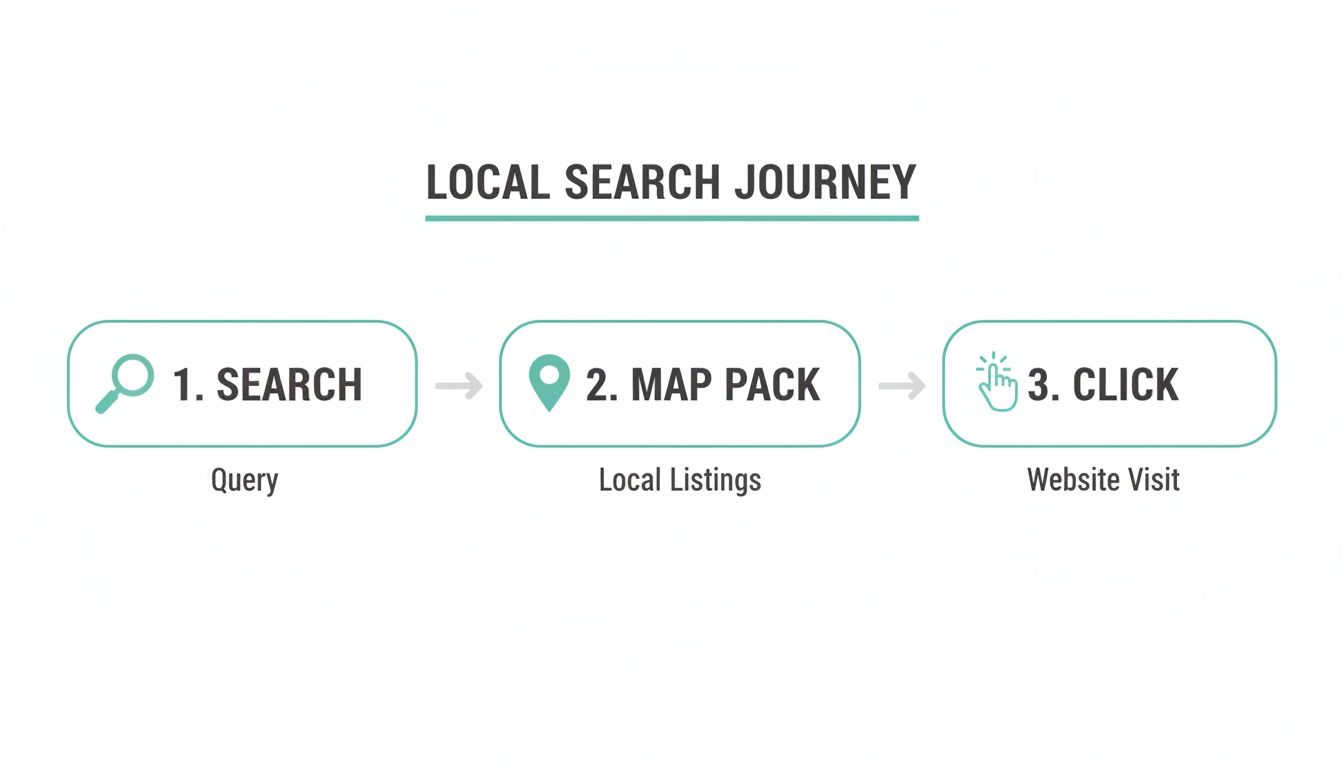
Your profile is that final gateway. It’s your chance to convince them you’re the right choice.
Choose Your Categories Carefully
One of the very first things Google asks for is your primary category, and this choice has a huge impact. It's the strongest signal you can send about what your business is.
Get specific. Don't just pick "Lawyer" if you're a family law specialist. Choose "Family Law Attorney." This kind of precision is exactly what helps Google connect you with the right kind of searches.
After that, you'll add secondary categories. This is where you can cover everything else you do. For example, a plumber's primary category is obviously "Plumber," but they should absolutely add secondary ones like "Drain Cleaning Service" or "Water Heater Installation & Repair" to catch those specific queries.
Write a Business Description That Connects
You get 750 characters for your business description. It's your elevator pitch to the world. Your goal is to write for real people, but in a way that Google understands.
This is not the place to just cram in a bunch of keywords. You need to weave them in naturally.
Here’s an example for a local bakery:
"Sweet Treats Bakery has been a downtown staple for over a decade. We're known for our custom cakes, fresh-baked sourdough, and delicious gluten-free pastries. Swing by for your morning coffee and a croissant, or let us create the perfect birthday cake for your next party. We love being your neighborhood bakery!"
See? It’s warm and inviting, but it also naturally includes key terms like "custom cakes," "sourdough," "gluten-free pastries," and "neighborhood bakery."
Use Photos and Posts to Bring Your Business to Life
A profile with no photos feels abandoned and, frankly, a bit shady. High-quality images build trust and show people what you're all about.
Make sure you upload photos of:
Your exterior: So people can spot you from the street.
Your interior: Show off your clean and welcoming space.
Your team: Put a human face on your brand.
Your work: Showcase your products or services in action.
Beyond just photos, GBP Posts are your direct line for real-time updates. Treat them like mini-ads right on your profile. Announce a sale, share a new special, or link to your latest blog post. They expire, which is a good thing, it encourages you to keep your profile fresh and active.
Turn On Features That Drive Engagement
People today want answers, and they want them now. Your GBP has built-in tools that can turn it from a static page into an interactive lead-gen machine.
First, turn on Messaging. This lets customers text you directly from your profile. A quick response can be the one thing that makes them choose you over a competitor, especially if they're in a hurry.
Next, pay attention to the Q&A section. This is a goldmine that most businesses ignore. You can get ahead of the game by asking and answering your own frequently asked questions. Think about what people always ask: "Do you offer free estimates?" or "Is there parking nearby?" Post the question and answer it yourself to control the information.
Your Google Business Profile is now the single biggest ranking factor for the Map Pack, responsible for 32% of your ranking potential. Things like your primary category, keywords in your business name, and how close you are to the searcher are absolutely mission-critical.
Go from a Good Profile to a Great One
I get it, managing another online profile can feel like a chore. But consistency is everything. Spending just a few minutes each week uploading a new photo or creating a Post sends a steady stream of positive signals to Google. If you’re ready for a deep dive, our team put together a complete playbook on how to optimize your Google Business Profile for more calls.
And when you're ready to really dominate your local market, think about combining a strong GBP with a targeted local advertising campaign. For example, a platform like Adwave lets you run ads on major streaming services right in your specific service area. Imagine a customer sees your ad on TV, then searches your business by name. That's a massive trust signal to Google, helping lock in your spot at the top of the Map Pack.
Matching Your Website for Local Dominance
Your Google Business Profile is a powerful tool, but it doesn't operate in a silo. Think of your website and your GBP as two halves of the same whole. When they tell different stories, it sends mixed signals to Google, which can seriously hurt your chances of landing in the Map Pack. A strong, locally-optimized website acts as the ultimate proof, validating all the information in your GBP and building the authority you need to climb the ranks.
Your GBP is the sign above your shop door, it gets people to look. Your website, however, is the shop itself. It’s what convinces them to come inside, look around, and ultimately make a purchase. Let's get them working together.
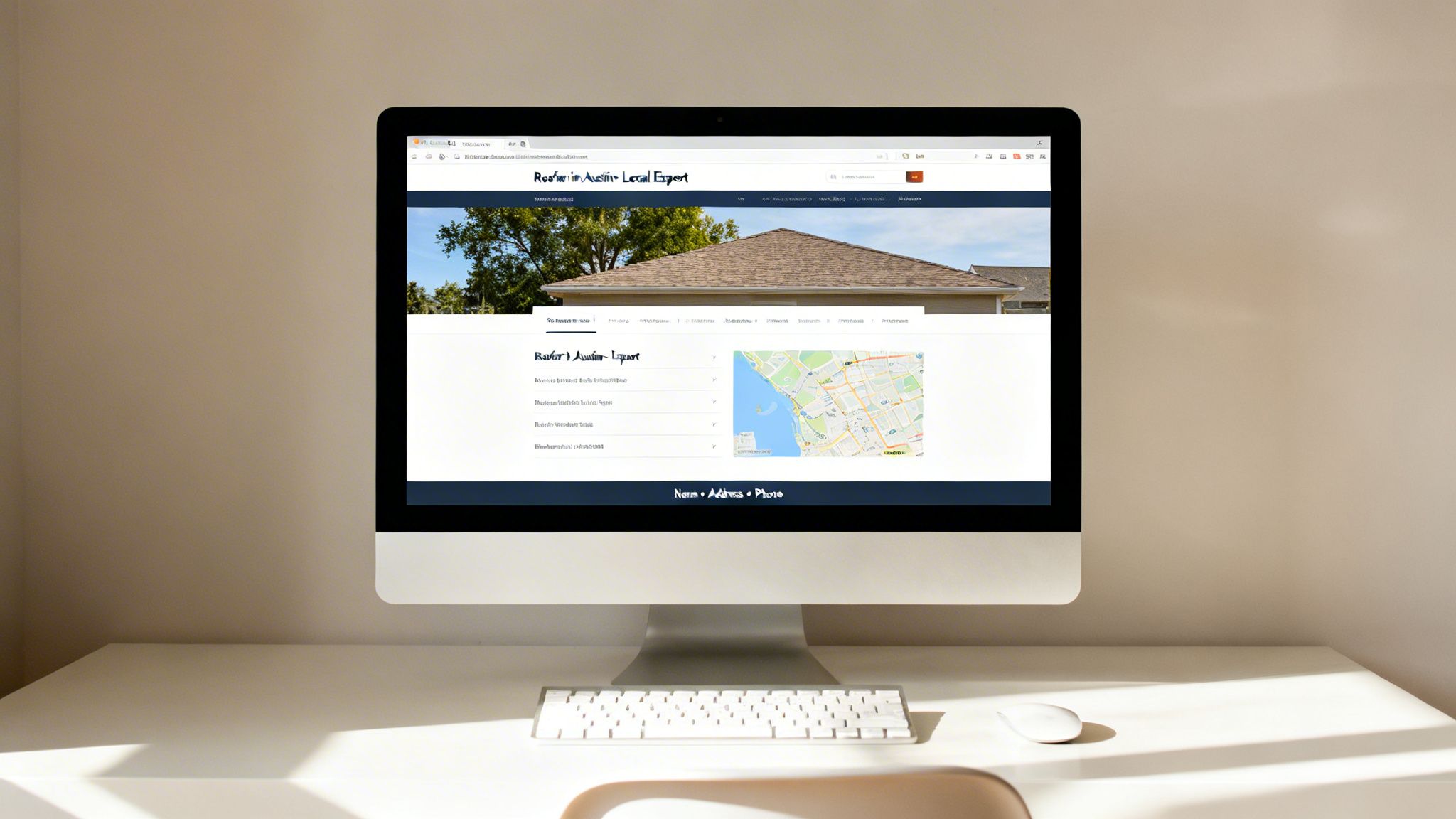
Create Service and Location Specific Pages
You don't need a dozen storefronts to create location-specific pages on your website. Even if you only have one physical address, building out dedicated pages for your core services and the specific areas you serve is an absolute useful option for local SEO.
Instead of lumping everything onto a generic "Services" page, break it down. For instance, a roofer shouldn't just have one page; they should have separate, detailed pages for "Roof Repair," "Gutter Installation," and "Commercial Roofing." This simple step allows you to target those longer, more specific search terms that high-intent customers are typing into Google.
From there, take it a step further by creating pages for the individual towns or even neighborhoods you work in. A page titled "Expert Roof Repair in West Lake Hills" is infinitely more powerful for a local searcher than a homepage trying to cover all of Austin. It signals to Google that you are a true local authority for that exact query.
A word of caution: Don't just copy and paste the same content and swap out the city name. That's an old-school spam tactic that Google will sniff out and penalize. Instead, write unique content for each page. Mention local landmarks, talk about a specific job you completed in that neighborhood, or reference hyper-local building codes to prove you have a genuine connection to the area.
This strategy is more critical than ever. Google no longer sees your GBP in isolation; it evaluates your entire online presence. We've seen firsthand that small businesses that create these focused, location-specific pages see a real boost in their rankings because Google stops getting conflicting signals. As some recent local SEO research has shown, this deep integration is now a core ranking factor. You can learn more about these local ranking findings on kaidm.com.
Fine-Tune Your On-Page SEO Signals
On-page SEO simply means optimizing the elements directly on your website pages. These tweaks might seem small, but they send loud and clear signals to search engines about who you are, what you do, and where you do it.
Focus on these high-impact elements first:
Title Tags: This is the headline that shows up in the browser tab and on the Google search results page. It absolutely must include your main service and location. Okay: "Roofing Services"
Much Better: "Expert Roof Repair in Austin | Austin Roofing Co."
H1: Austin's Most Trusted Roof Repair Service
H2: Common Roof Issues We Fix for Austin Homeowners
These adjustments tell Google precisely what each page is about, making it much easier for it to match your business to a relevant local search.
Embed Your Google Map and Solidify Your NAP
In local SEO, consistency is everything. Your Name, Address, and Phone number (NAP) must be identical everywhere it appears online, and that starts with your own website.
The best practice is to place your full NAP information in the footer of every single page. This makes it consistently visible to both users and Google's crawlers on every visit. And when I say identical, I mean identical. Make sure it perfectly matches your GBP listing, right down to the comma and whether you use "St." or "Street."
Next, go to your "Contact Us" or location page and embed a Google Map showing your business location. This does more than give customers directions; it creates a direct, powerful connection between your website and your verified Google Maps listing. It’s an undeniable signal of your physical location and legitimacy.
Of course, your local SEO efforts are just one piece of a detailed digital footprint. An aligned website is your secret weapon for Map Pack dominance, but to supercharge your growth, you need to build brand recognition that gets people searching for you by name. This is where a smart partner like Adwave can make a massive impact, putting your business on TV screens across your exact service area. When customers start searching directly for your brand, Google notices, reinforcing all of your SEO work and cementing your status as a local leader.
Building Trust: Your Secret Weapon for Map Pack Dominance
If your Google Business Profile and website are the foundation of your local presence, then trust is the steel that holds it all together. For any local business trying to win in the Map Pack, building that trust is everything. It comes down to two things: what your actual customers are saying about you (reviews) and how consistently your business shows up across the web (citations).
Think of it this way: reviews are your word-of-mouth reputation in a digital format. Citations are like Google's background check, verifying you are who you say you are. When you nail both, you send a powerful signal to search engines and customers that you’re a prominent, legitimate player in your local market.
Cultivating a 5-Star Reputation on Google
Reviews are a massive ranking factor, but more importantly, they are a decision factor for real people. A steady stream of positive reviews is one of the fastest ways to stand out and earn clicks. The real challenge? Getting your happy customers to write them.
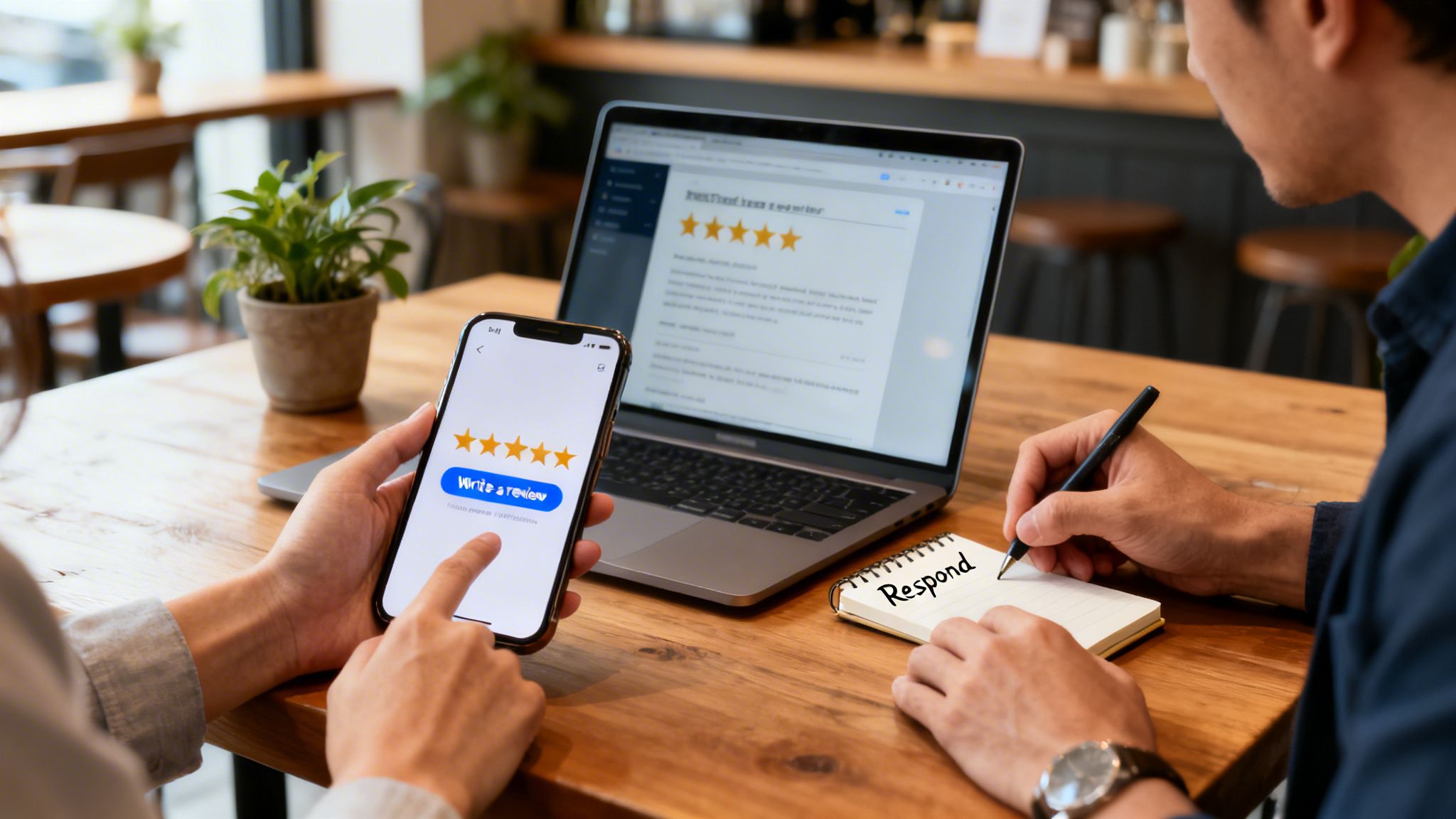
The secret is all in the timing. Ask for a review right after you’ve delivered a great experience, the moment a customer praises your work, when you've just handed over the finished project, or after they've made a repeat purchase. Make it dead simple for them by texting or emailing a direct link to your Google review form. A simple, personal ask goes a long way.
Responding to Every Single Review
Getting the review is only half the battle. You absolutely must respond to all of them, good and bad. This shows potential customers scrolling through your profile that you’re an engaged business owner who cares about the customer experience.
Here’s a quick playbook for handling responses:
For the good ones: Thank them by name! Mentioning the specific service or product they loved not only reinforces the positive experience but also sprinkles relevant keywords into your GBP.
For the tough ones: This is where you can really shine. Respond quickly, apologize that their experience wasn't up to par, and take the conversation offline to fix it. This shows everyone else that even when things go wrong, you’re the kind of business that makes it right.
I always read a business's bad reviews first. A thoughtful, non-defensive response to criticism tells me more about a company's character than a dozen five-star ratings. It builds more trust than a perfect record ever could.
Getting a steady flow of reviews is a skill that directly impacts your bottom line. If you need some fresh, non-pushy tactics, our guide on how to get more Google reviews for your local business is packed with practical ideas.
What Are Local Citations (And Why Do They Matter)?
A citation is just a mention of your business's Name, Address, and Phone number (NAP) on another website. Think of them as digital breadcrumbs scattered across the internet that lead back to you. Google follows these breadcrumbs to verify that your business information is correct and consistent.
When it comes to citations, quality beats quantity every time. It’s far better to be listed correctly on a handful of authoritative, relevant sites than on hundreds of junk directories nobody has ever heard of.
Start by locking down your presence on these essential platforms:
Major data providers like Data Axle and Neustar/Localeze
Key search engines (Google, Bing, Apple Maps)
Major social media platforms (Facebook, LinkedIn)
Well-known directories (Yelp, Yellow Pages)
Industry-specific sites (like TripAdvisor for a cafe or Houzz for a contractor)
The absolute golden rule of citations is NAP consistency. Your business name, address, and phone number must be exactly the same everywhere. Even a tiny difference like "St." vs. "Street" or "Co." vs. "Company" can dilute the signal and confuse Google.
Building this foundation of social proof and consistent data isn't just a box to check, it's how you transform your business from just another pin on the map into a trusted local authority. A fantastic way to amplify this authority is through local brand building, which is where a solution like Adwave excels, creating the community recognition that drives valuable direct searches for your business.
Give Your Local Brand a Major Boost with Adwave
While a strong local SEO game is important for long-term growth, you don't have to sit around for months waiting for the results to kick in. You can start building serious brand recognition in your community right now. This is where pairing your SEO efforts with a smart advertising strategy, using a tool like Adwave, can make a huge difference.
Adwave’s AI-powered platform makes it surprisingly easy for a small business to get professional TV ads on the air, targeted specifically to their service area. Forget about those eye-watering national campaign budgets. This is all about reaching real customers on major streaming channels like Hulu and ESPN, right in the neighborhoods you work in every day.
The Magic of Branded Search
Here’s what happens when people in your town see your ad: they don't just see a business, they remember your business. Then, they start searching for you by name. We call this branded search, and it’s a gold-star signal to Google. Instead of typing a generic query like "plumber near me," they're searching for "Miller & Sons Plumbing."
This kind of direct search traffic tells Google two important things:
You're a real, established business. People know who you are and are specifically looking for you.
You are the undeniable expert for your own brand. This powerfully reinforces your authority and makes you look more credible to the search engine.
Just think about it. Your local bakery or auto repair shop could become a household name in your area. With Adwave, when someone sees your slick, professional ad while streaming their favorite show, you're no longer a stranger. You're a familiar, trusted option. The next time they need a birthday cake or an oil change, your name is the first one that pops into their head. That's familiar awareness, and it's valuable.
How TV Ads Help You Win the Map Pack
So, how does a streaming TV ad help your ranking in the Google Map Pack? The link is more direct than you might think. A sudden increase in people searching for your brand name is a clear sign of prominence, one of the three pillars of local SEO. Google sees that more people are looking for you by name and takes note.
This surge in brand interest essentially validates all the other SEO work you’re doing. It tells Google that your Google Business Profile is legitimate, your website is an authority, and the reviews you've worked so hard to get are backed by real-world recognition.
Think of Adwave as an accelerator, not a replacement for your SEO. It creates the brand buzz that drives people to search for you directly, which in turn proves your credibility and helps you secure that coveted spot in the Map Pack.
This approach gives you the best of both worlds: the immediate brand lift of advertising and the sustainable growth of organic SEO. You’re not just passively waiting for customers to find you; you're actively and professionally introducing yourself. For a deeper dive into making this work for your business, check out our guide on how to advertise on TV.
Don't Stop at TV: Broaden Your Reach
This brand-building principle isn’t limited to a single channel. Once you've got your foundation set with your Google Business Profile, website, and targeted TV ads from a platform like Adwave, you can start exploring other ways to get your name out there. For instance, you can take what you’ve learned and apply it to other platforms, exploring Facebook advertising strategies tailored for local businesses.
By combining broad brand-building activities with your focused local SEO, you create a powerful, self-reinforcing cycle. The ads build recognition, which fuels branded searches, which in turn boosts your SEO performance. This integrated approach, with Adwave as a key component, is the fastest way to transform your small business into a local leader that everyone knows and trusts.
Answering Your Top Questions About the Map Pack
As you dive into the world of local SEO, you're bound to have questions. It’s a complex field, and it's easy to get hung up on a few key details. I get it. So, let's go ahead and tackle some of the most common questions I hear from small business owners.
How Long Does It Really Take to Rank in the Google Map Pack?
This is always the first question, and the only honest answer is: it depends. Getting into the Map Pack isn't an overnight thing. For a totally new business, or one that's just now getting serious about local SEO, you should plan on it taking anywhere from two to six months to see consistent visibility for your most important search terms.
Several things can speed this up or slow it down:
Your Competition: Trying to rank as a "personal injury lawyer in a major city" is a much tougher climb than being the "best cafe in a small town."
Your GBP Health: How well have you filled out and fine-tuned your Google Business Profile? Every detail matters.
Your Website's Authority: Google looks at your website to confirm what your profile says. Strong on-page local SEO is non-negotiable.
Your Review Momentum: How quickly and consistently are you getting new, genuine customer reviews?
Your Brand Prominence: How well-known is your brand locally? Using a service like Adwave to run targeted TV ads can accelerate brand recognition and positively impact this timeline.
Now, that doesn't mean you'll see nothing for months. You'll often start ranking for your own business name in the Map Pack a few weeks after getting your Google Business Profile verified. From there, consistency is the name of the game.
My Business Is at My House. Can I Still Rank?
Yes, absolutely. This is common for plumbers, consultants, mobile detailers, and countless other professionals who work from home. Google has a specific designation for this: a Service Area Business (SAB).
When you're setting up your Google Business Profile, you’ll have an option to hide your physical street address. This is important for your privacy. Instead of a pin at your home, you'll define the specific towns, zip codes, or general regions you serve.
This tells Google you're a legitimate business and makes you eligible to show up in the Map Pack for searches happening inside that service area.
Proximity is still a huge ranking factor, even with a hidden address. So, you'll need to double down on the other signals. Focus on getting a steady stream of fantastic reviews and make sure your website screams local expertise for the areas you serve. This is where building brand prominence with a tool like Adwave can also give you a competitive edge.
What's the Single Most Important First Step for Map Pack SEO?
No question about it: claim, verify, and completely fill out your Google Business Profile (GBP). It is, by far, the most powerful ranking factor for getting into the Map Pack.
Don't even think about building citations or writing local blog posts until your GBP is in top shape. It's the foundation for everything else you're going to do.
Here's your immediate to-do list:
Claim and verify your profile. This is non-negotiable.
Pick the most accurate and specific primary category for what you do.
Fill out every single field. I mean all of them. Services, attributes, accessibility info, everything.
Upload at least 10 high-quality photos. Show your work, your team, and your space (if you have one).
Get your first few authentic customer reviews.
A half-finished GBP is like building a house on a shaky foundation. It just won't stand up to the competition.
Do I Have to Pay for Ads to Show Up in the Map Pack?
Nope. You absolutely do not have to pay for Google Ads to earn a spot in the main, three-pack of organic Map Pack results. Those coveted spots are earned through the kind of smart, consistent local SEO work we’ve been talking about. The traffic you get from them is free, you don't pay a dime when someone clicks.
However, Google does sell ad space that appears in and around the Map Pack. You might see sponsored map pins or the Google Local Services Ads at the very top. These can be great, but they are a separate advertising product. Our focus here has been on building a sustainable presence that drives business without you having to constantly feed the ad machine.
And remember, you can give your organic efforts a powerful boost. A partner like Adwave can help you run targeted TV ads in your local market. This builds brand awareness, which leads to more people searching for you by name. Those "branded searches" send strong positive signals to Google, reinforcing all the hard work you've put into your organic Map Pack rankings.


