A product with just five reviews is 270% more likely to be purchased than the same product with none, and more than 99% of U.S. consumers read reviews before buying, according to HawkSEM's review marketing summary. That shifts reviews out of the “nice to have” bucket. They're not just reputation signals. They're sales assets waiting to be edited, packaged, and deployed.
Most small businesses still leave that value sitting on Google, Yelp, Zillow, Facebook, Amazon, industry directories, and inbox replies. The review exists, the customer already wrote it, and yet the business never turns it into a landing page testimonial, a quote graphic, an email proof point, or a video script. That's the gap.
Repurposing customer reviews into marketing content works because it starts with language your buyers already trust. A polished headline is useful. A real customer explaining what changed, what they were worried about, and why they chose you is often stronger. That's true on a service page, in a retargeting ad, and especially in TV creative where short, credible proof has to carry a lot of weight quickly.
Why Your Customer Reviews Are Your Best Untapped Marketing Asset
A passive review helps the next buyer who happens to find it. A repurposed review helps every buyer who touches your marketing.
That distinction matters. A review on a third-party platform is reactive. Someone has to go looking for it. Once you lift the best parts of that review into your website, social posts, ads, direct mail, sales decks, and video scripts, it becomes proactive proof. It starts doing selling work in places where your prospects already are.
Reviews reduce hesitation
Buyers rarely need more slogans. They need reassurance. They want confirmation that your service was on time, your team was responsive, your pricing felt fair, or the result matched the promise. Reviews answer those doubts in plain language.
The strongest review content usually does one of three things:
Confirms a promised benefit such as responsiveness, quality, or ease.
Removes a fear like hidden fees, poor communication, or slow delivery.
Shows a before-and-after shift in confidence, convenience, or outcome.
Practical rule: If a review helps a prospect say “that's exactly what I was wondering,” it belongs in marketing.
This is the broader idea behind discover content repurposing with ChurchSocial.ai. One customer comment can become many assets when you treat it as source material instead of leaving it on a profile page.
Reviews are raw marketing data
The mistake I see most often is treating every positive review as equal. They're not. Some are fluff. Some are gold. A vague “great service” comment may help your star rating, but it won't give you much to work with in a campaign. A detailed review that names the problem, the decision point, and the outcome can feed your copy for months.
That's why businesses should think about reviews less like applause and more like structured customer research. The phrases customers repeat become message angles. Their objections become FAQ topics. Their compliments become headlines. Their stories become ad scripts.
When you approach repurposing customer reviews into marketing content this way, you're not recycling praise. You're converting trust into usable creative.
Finding Your Gold Mine Collecting and Selecting Impactful Reviews
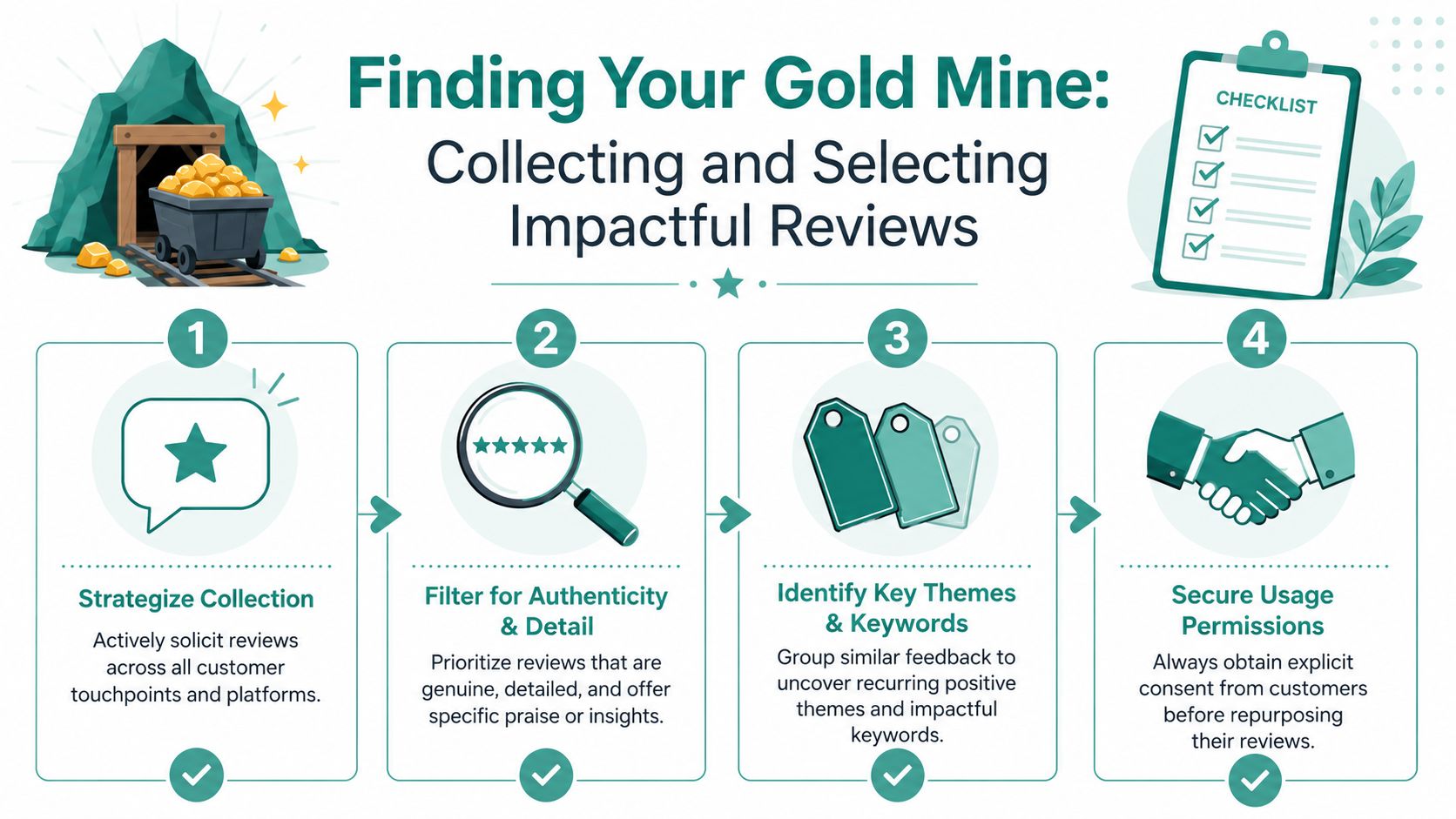
The businesses that get the most from reviews don't wait for them to appear randomly. They build a collection process, then they curate hard.
Collect from the places customers already talk
Start with the obvious sources. Google Business Profile, Yelp, Facebook, Amazon, Zillow, G2, Capterra, TripAdvisor, your CRM notes, email replies, support tickets, and post-purchase surveys all count. For many local businesses, the richest material isn't always on the biggest platform. Sometimes the best quote is buried in a thank-you email or a direct message.
Build one simple review bank. A spreadsheet works. So does Airtable or Notion. Track:
Where the review came from
What service or product it mentions
What exact phrases stand out
What objection it resolves
Whether you have permission to reuse it
If local visibility is part of your growth plan, Adwave's guide to getting more Google reviews for your local business is a practical place to tighten the collection side.
Choose reviews with marketing value
Don't lead with the nicest review. Lead with the most useful one.
A high-impact review usually includes several of these traits:
A weak review says, “Amazing company.” A strong one says, “We were worried the move would drag on for days, but the crew showed up on time, handled everything carefully, and got us settled faster than we expected.”
The second one can become a homepage quote, a paid social ad, a service-page testimonial, and a 15-second video voiceover.
Get consent before you repurpose
This step gets skipped too often. Publicly posted doesn't always mean freely reusable in every format. If you plan to feature a review in ads, on your website, in print, or in video, ask for explicit permission. Keep the request short and specific.
A simple email works:
Hi [Name], thank you for the kind review. We'd love permission to feature your feedback in our marketing, including our website, social posts, and ads. We may lightly edit for length while keeping the meaning intact. Please reply with “I agree” if that works for you.
For higher-visibility use, especially video and TV, add a release form. If the review includes a full name, photo, job title, company name, or regulated claim, get legal eyes on it.
Handle regulated industries differently
Financial services, legal, and other trust-sensitive categories need extra caution. A 2025 Gallup study found that 68% of consumers distrust online reviews in financial services, which makes blind reuse risky and often counterproductive. In those categories, use narrative distillation. Capture the feeling and the trust signal without repeating a claim that could create compliance trouble.
For example, instead of quoting “They got me the best return,” a compliant version may highlight that clients value clarity, responsiveness, and confidence in the process.
That approach also helps on marketplaces where moderation and dispute rules matter. If your business sells through Amazon, this breakdown of managing Amazon reviews effectively is useful context for keeping your review ecosystem clean without crossing ethical lines.
In regulated markets, the safest testimonial is often the one that preserves the customer's experience while removing the part a regulator would read as a promise.
Transforming Praise into Powerful Text and Image Content
One good review can become half a dozen static assets before you touch video.
Take this kind of customer comment from a local home service business: “I called three companies. These were the only people who explained the issue clearly, showed up when they said they would, and fixed it without pushing extra work.”
That single review contains comparison, trust, punctuality, and restraint. Those are four separate message angles.
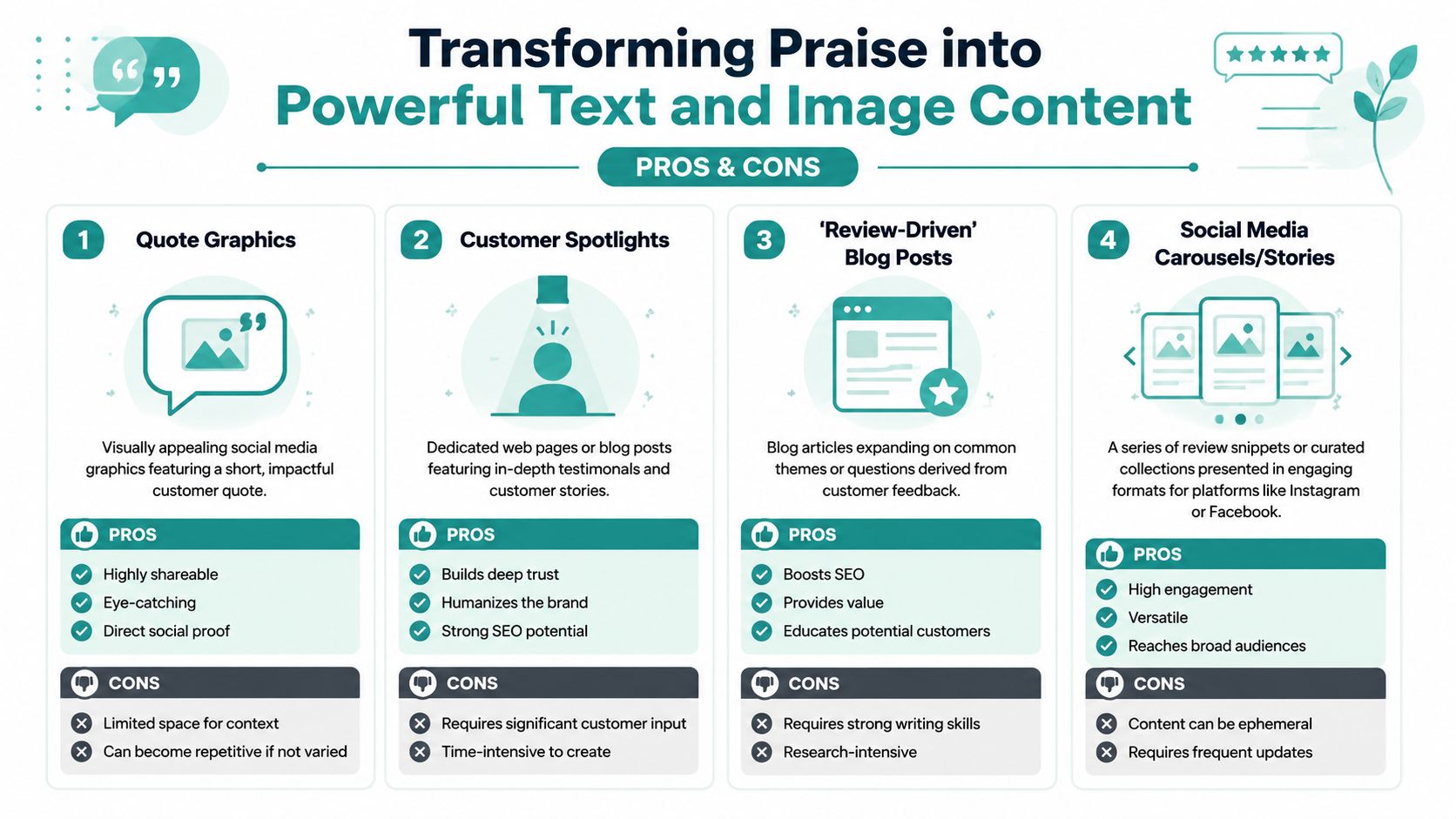
Turn one review into several assets
Here's how that comment gets stretched without feeling repetitive:
Instagram or Facebook graphic Pull the cleanest line. Example: “The only people who explained the issue clearly and showed up when they said they would.” Put the quote over a photo of the crew or a simple branded background.
Homepage testimonial block Run a slightly longer version with attribution. Pair it with a nearby call to action such as “Book an inspection” or “Get a local quote.”
Email snippet Use the quote in the body of a nurture email under a subhead like “Why homeowners choose us after calling around.”
Digital ad copy Build the ad around the objection it resolves. “Called three companies? Start with the one that explains the problem clearly.”
That's the practical side of repurposing customer reviews into marketing content. You're not just reposting praise. You're isolating the part of the praise that best matches a buyer concern.
Put testimonials where decisions happen
Placement matters as much as design. Reviews shouldn't live on an isolated testimonials page only. They need to appear near action points.
Integrating reviews above the fold, within 300px of the top of the viewport, can increase visibility by 60% and conversion by 25%, and using heatmaps to place testimonials near hesitation points such as pricing tables can improve click-through rates by 35%. Use those findings where they matter most: service pages, quote forms, pricing pages, checkout flows, and lead forms.
Adwave's resource on testimonial pages that build trust and drive sales offers useful examples of how to structure this proof so it supports the page instead of cluttering it.
Match the format to the message
Not every review belongs in a polished quote tile. Some do better as a short story.
Use this rule of thumb:
Short and punchy goes to social graphics and ads.
Detailed and comparative goes to landing pages and email.
Theme-based clusters become carousels or FAQ content.
A testimonial earns its keep when it answers the buyer's next question. If it doesn't reduce uncertainty, it's decoration.
Edit lightly, not aggressively
Clean up grammar if needed. Shorten for space. Remove filler. Don't rewrite the customer into brand voice. The rough edges are often what make the quote believable.
A bad edit sounds polished but generic. A good edit keeps the customer's rhythm while trimming what doesn't help.
That's the line. Keep the trust. Cut the clutter.
Bringing Reviews to Life with Video and TV Advertising
Static proof works. Motion proof travels farther.
A review becomes more persuasive when you hear it, see it on screen, or watch it framed alongside your service, storefront, team, or product. Video gives context to a quote. TV gives it reach.
Start with a simple testimonial script
Small businesses often overcomplicate testimonial videos. You don't need a mini-documentary. You need a clear arc.
A basic script can follow this structure:
Problem What was the customer worried about?
Decision Why did they choose you?
Experience What happened during the service or purchase?
Result How did they feel afterward?
Using the earlier home service example, the voiceover or on-screen text could read like this:
“We called three companies. This was the only team that clearly explained the problem, arrived on time, and fixed it without upselling us. That made the whole decision easy.”
That's enough for a short social video. For a 30-second local TV spot, add visuals of the truck arriving, the technician at work, and the homeowner speaking or appearing on screen with permission.
What works on screen and what doesn't
Video testimonials fail for predictable reasons. They run too long. They use vague praise. They bury the strongest line. They look overproduced compared with the customer's plainspoken comment.
What usually works better:
One core claim per video
Readable on-screen text
A real customer phrase near the opening
Visual proof that matches the quote
A direct closing call to action
A local buyer doesn't need twelve compliments in one ad. They need one believable reason to trust you.
TV is no longer out of reach for SMBs
Many businesses stop here because they assume TV means agencies, crews, media buyers, and expensive production. That used to be the barrier. It doesn't have to be now.
Adwave Digital's AI-powered workflow enables small businesses to generate broadcast-ready TV ads in minutes by entering only a website URL, automatically producing a polished spot distributed across 100+ premium channels including NBC, Hulu, and ESPN, with campaigns starting at just $50, based on the source material summarized by Deeto's article on repurposing customer feedback strategy.
That changes the economics of testimonial-based advertising. A small business can take a high-performing review theme, convert it into a short script, and launch a local TV campaign without building a traditional production workflow from scratch.
Use review themes, not just review quotes
This matters more than is widely recognized. Sometimes the best TV ad doesn't display a review verbatim. It takes the strongest recurring theme and builds the ad around it.
If customers keep praising fast scheduling, clean communication, and no-pressure service, those become the ad pillars. The review itself shaped the creative even if the final spot uses a narrator, motion graphics, or product visuals instead of a literal on-screen quote.
For local businesses that want to understand when custom video production still makes sense, MD TECH TEAM's guide for local businesses is a helpful comparison point. In practice, many brands use both approaches. Lightweight AI production for speed and testing, then custom shoots for flagship campaigns.
The best review-driven video doesn't sound like advertising first. It sounds like a customer telling the truth.
Be careful with authenticity drift
Review-based TV creative gets weaker when the ad promise outruns the current customer experience. If recent reviews mention slower response times or mixed service consistency, your ad shouldn't lead with “fastest service in town.” That mismatch is what breaks trust.
Use current reviews as a constraint on the script. If customers are praising one thing consistently, build around that. If sentiment changes, refresh the message.
That discipline is what makes review repurposing so strong in video. It keeps creative tied to reality instead of wishful positioning.
Distributing Your Review Content for Maximum Reach
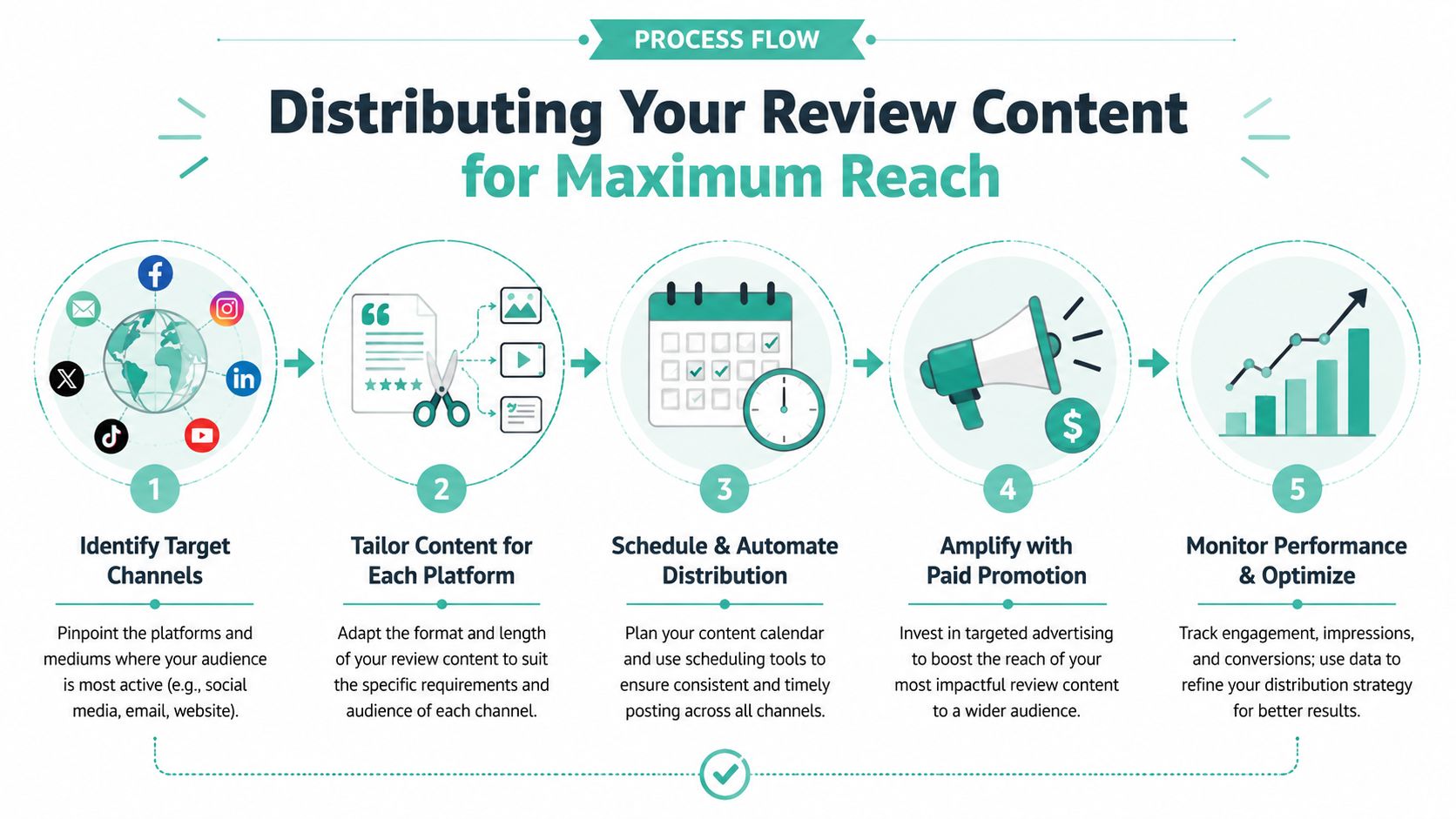
A strong testimonial asset can still underperform if you post it once and move on. Distribution needs intent. Different formats belong in different places, and each channel asks the review to do a different job.
Match asset type to channel
This is the clearest way to view it:
Your social feed can carry punchy excerpts. Your service pages need detail. Your email sequence needs proof at the exact point a lead is comparing options.
If you need ideas for adapting testimonials to platform-native posts, Adwave's guide to using reviews and testimonials as social proof on social media is a practical reference.
Build a simple cadence
Most SMBs don't need a massive content engine. They need consistency.
A workable rhythm looks like this:
Weekly post one quote graphic or short testimonial clip.
Monthly refresh one service page with stronger review proof.
Per campaign add a testimonial snippet to at least one email and one paid ad variation.
Quarterly review your bank of testimonials and retire stale ones.
That cadence keeps your best proof circulating without fatiguing your audience with the same quote everywhere.
Keep messaging aligned across channels
A common mistake is turning one strong review into five mismatched assets. The website says “premium craftsmanship,” the ad says “lowest price,” and the email says “friendly service.” If those claims came from different review themes, the buyer gets a blurry picture of what you do best.
Pick one angle per campaign and repeat it across formats. If the winning theme is “clear communication,” let the social graphic, landing page quote, email snippet, and video script all reinforce that same idea.
For businesses using AI-generated TV creative, this consistency matters even more. The easier the production becomes, the easier it is to launch disconnected messages. Keep one review theme at the center and let every channel echo it.
Measuring the Real Impact of Your Review-Driven Marketing
You don't need a complicated attribution model to know whether this is working. You need to compare pages, emails, ads, and campaigns before and after review content enters the mix.
Track the metrics closest to the asset
For static review content, watch practical signals:
Landing pages for changes in form fills, booked calls, or checkout completion
Emails for click behavior on messages that include testimonial proof
Social posts for saves, shares, comments, and profile visits
Paid ads for click quality and lead quality, not just volume
The key is to isolate the review element when possible. Test a page with the testimonial block against a version without it. Swap one ad line based on customer language into an existing campaign. Add a review section to one nurture email rather than all of them at once.
Audit authenticity, not just performance
Review-based marketing can still go wrong if the message no longer matches live customer sentiment. A 2025 MIT Media Lab report found that 43% of users detect a disconnect when AI-generated ad claims contradict specific negative sentiment in recent reviews. That's a useful warning for any business using automation in copy or video.
Review content should be refreshed the same way pricing, offers, and service areas are refreshed. If customers are no longer praising the thing featured in your creative, update the asset.
For a cleaner framework on attribution and ongoing evaluation, Adwave's resource on how to measure advertising effectiveness is worth keeping in your reporting stack.
Good testimonial marketing doesn't just perform. It stays honest under scrutiny.
The businesses that get the most from repurposing customer reviews into marketing content treat it like an operating habit. They collect better proof, place it closer to decisions, promote it across channels, and retire weak or outdated claims before those claims start costing trust.
If you want to turn customer praise into polished video and local TV campaigns without building a traditional production process, Adwave is a strong fit. It helps small businesses create broadcast-ready ads quickly, making it practical to take your best review themes and turn them into high-visibility creative for premium channels.