Instagram posts containing at least one hashtag receive approximately 12.6% more engagement than posts without hashtags, while location-based hashtags can increase local reach by roughly 25% to 40% according to compiled hashtag research. Those figures are useful, but they don’t justify stuffing every caption with generic tags. They point to a more practical conclusion: hashtags work best as classification signals that help platforms understand who a post is for.
A local hashtag strategy should connect three things: the service you sell, the geography you serve, and the action you want a nearby customer to take. If a tag produces attention but no profile visits, calls, messages, map actions, or inquiries, it’s not doing enough. Treat hashtags as one component of a measurable local growth system, not as a substitute for clear creative, strong offers, or targeted advertising.
The Hidden Purpose of Local Hashtags
Hashtags began as broad trend labels, but local businesses need them to do something narrower. A plumber, restaurant, realtor, or dental practice isn’t trying to reach everyone browsing a massive topic feed. It needs to appear in conversations connected to a service, a place, or a customer problem.
That’s why #AustinRealEstate is usually more useful to an Austin agent than #realestate, and #BrooklynDentist gives a dental practice stronger context than #business. The first group combines geography with commercial intent. The second group describes almost nothing about who should act.
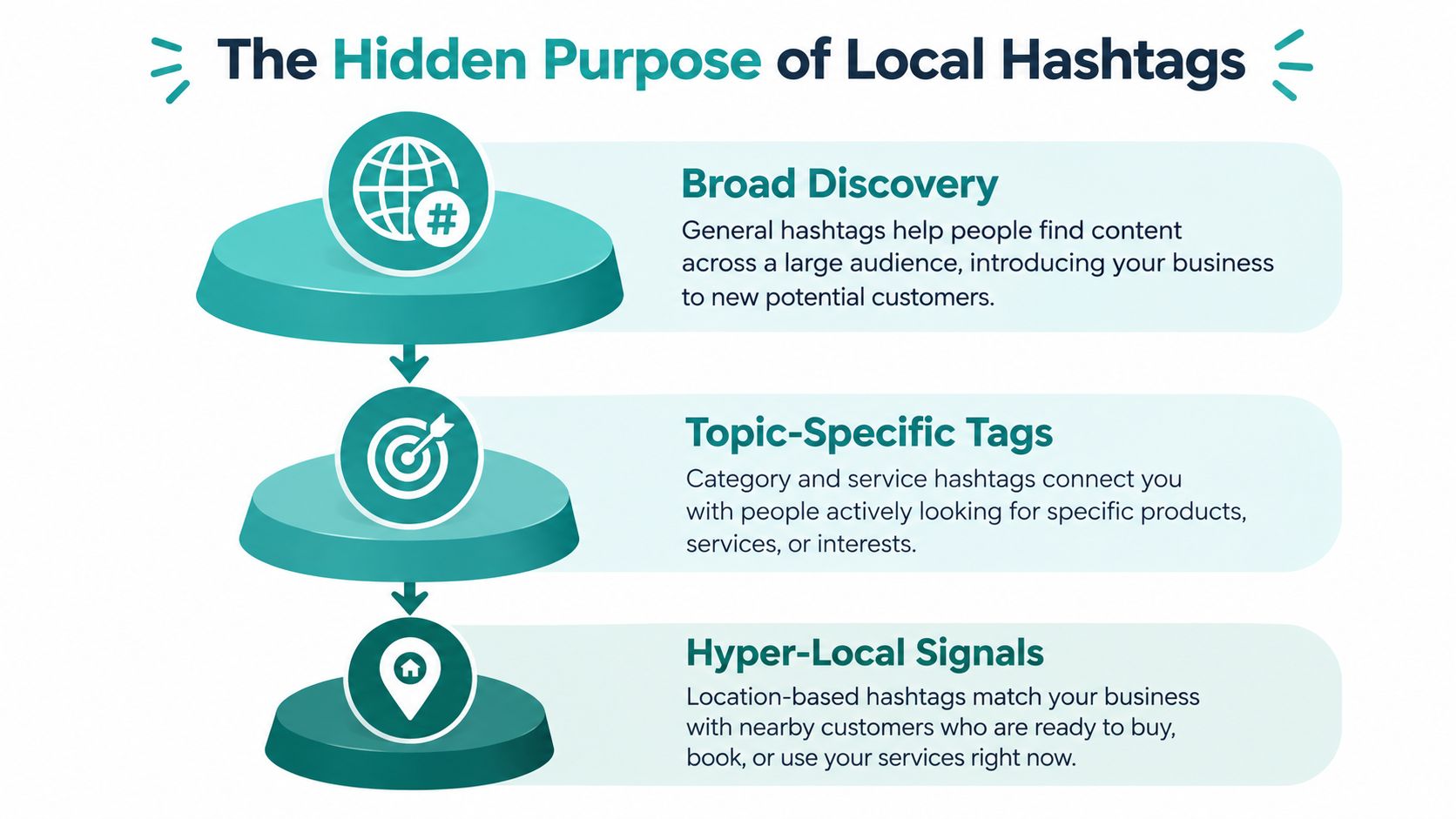
Use three layers, not a random list
A reliable taxonomy has three levels:
- Broad category: One tag that identifies the general market, such as a cuisine, trade, or property category.
- Niche service: Several tags that describe the exact problem, product, or customer need.
- Geographic signal: Multiple tags tied to a city, neighborhood, district, county, or service area.
This structure gives an algorithm enough context without turning the caption into a wall of disconnected keywords. It also gives your team a repeatable way to build sets for different offers and locations.
The important metric isn’t hashtag impressions by themselves. Track non-follower reach, profile visits, website sessions, calls, direct messages, bookings, and conversions. A post that reaches fewer people but produces qualified inquiries can be more valuable than one that attracts a large audience outside your market.
Practical rule: Every hashtag should explain either what you sell, where you sell it, or which branded campaign the post belongs to.
Hashtags also need to sit inside a wider content system. Businesses that need help connecting educational posts, offers, landing pages, and conversion paths can use this guide to build a content strategy that converts. The same principle applies here: discovery only matters when it leads somewhere commercially useful.
Building Your Three-Layer Hashtag Taxonomy
Start with service intent. These tags name the problem or solution a customer is likely to care about, such as #emergencyplumber, #dentalimplants, #roofrepair, or #commercialcleaning. They tell the platform and the audience what the post addresses.
Next, add geographic specificity. Use a city, neighborhood, county, metro area, or served suburb. A Denver agent might test #DenverCondos, while a restaurant could use #QueensVeganEats. The point isn’t to attach a city name to every post mechanically. The location must match the offer, the audience, and the business’s real service area.
The third layer is owned identity. Include the business name, a recognizable campaign tag, or a customer-content label. An owned tag won’t necessarily create discovery, but it can gather posts into an archive that customers and prospects can browse.
Build candidate sets systematically
Use Instagram autocomplete, local search observation, and your own post analytics to create candidates. Don’t copy a competitor’s entire block. Instead, classify every candidate by:
| Classification | Question to ask |
|---|---|
| Service intent | Does this describe the advertised problem or product? |
| Geography | Does this identify the actual buying area? |
| Visibility | Does it appear active and relevant without being impossibly broad? |
| Ownership | Can the business use it to organize its own content? |
Then publish controlled variations. Pair a broader category tag with narrower service-and-location tags, plus one owned identity tag. A home-service company might combine an emergency-service term, a city tag, a neighborhood tag, and its branded campaign label. A realtor may need separate sets for listing location, property type, and buyer intent.
A study of 793 Instagram posts mapped which tags were repeatedly used together to identify effective hashtag networks, showing that varied tags improve findability through platform search metadata as described by the University of Surrey. That supports using related combinations rather than repeating one giant block on every post.
Relevance beats volume. A smaller set that accurately describes the post gives you cleaner testing data and a better chance of attracting the right audience.
A hashtag generator for better reach can help produce ideas, but don’t publish its output without review. A tool can suggest words. It can’t confirm whether a neighborhood is in your service area, whether a tag attracts buyers, or whether the post’s offer matches the audience.
Platform-Specific Hashtag Strategies
Hashtags don’t behave identically across platforms. A local business should adapt the system to each platform’s discovery mechanics instead of copying the same caption everywhere.
Instagram’s creator guidance, as reported by Sprout Social, recommends limiting posts to 3 to 5 hashtags rather than relying on large blocks Sprout Social explains the recommendation here. Give each tag a job. A city-plus-service tag, a precise industry tag, and a branded tag are often more useful than a long list of loosely related terms.
Location fields, visible place names, and clear captions should reinforce the hashtags. A post about a neighborhood service should say the neighborhood in the copy and, where appropriate, show it in the creative.
For practical execution, pair this framework with a quick-start guide to Instagram Reels for local business. The video needs to communicate the location and customer problem even if nobody reads the tags.
TikTok
TikTok increasingly functions as a search and discovery platform, so semantic accuracy matters. TikTok’s 365-day analysis for #localbusiness ranks Canada first with a regional-popularity score of 406, followed by the United States at 366, with related tags including #shoplocal and #supportlocalbusiness TikTok Creative Center data.
Use that data as a market signal, not a universal rule. Check regional popularity for the market you serve, then combine a community tag with a specific city, neighborhood, or category tag.
X and Facebook
On X, keep tags concise and connect them to live local conversations, events, or timely issues. On Facebook, hashtags generally play a smaller discovery role, but they can still help organize content on a business page or within a local community.
Across all four platforms, avoid banned, restricted, misleading, or irrelevant tags. Network Solutions recommends prioritizing specific, niche, branded, local, and topic-focused hashtags over broad competitive terms its local hashtag guidance explains the distinction.
Testing Hashtag Clusters with a Matrix Framework
The strongest lesson from local hashtag testing is simple: relevance matters more than volume. A small-business analysis reports that posts using three to five carefully selected hashtags generate about 25% more engagement than posts overloaded with ten or more less-relevant tags ContentSpark reports the comparison. Treat that as directional, not as a guaranteed outcome for every account.
Build a matrix that isolates the hashtag variable. Keep the creative format, offer, caption structure, posting cadence, and posting conditions as consistent as practical. Rotate only the cluster.
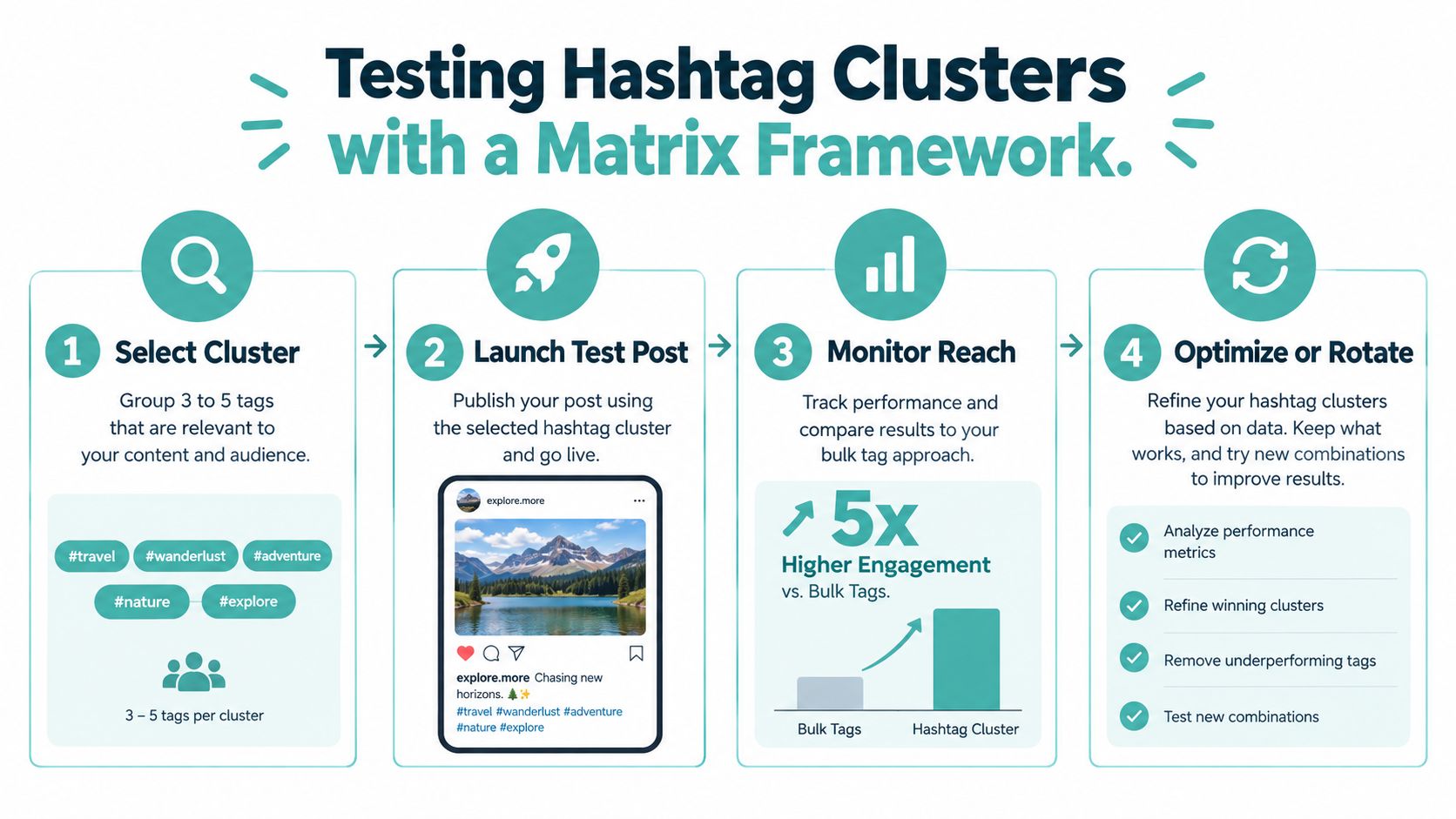
Use three conditions
Create a simple comparison:
- Broad category cluster: General industry or community tags.
- City-plus-service cluster: Precise geographic and commercial-intent tags.
- No-hashtag control: Posts without hashtags, where audience volume allows.
Run the comparison over four to six weeks, keeping the content variables stable. Record non-follower reach, profile visits, website taps, direct-message starts, qualified inquiries, and cost per inquiry. Likes can provide context, but they shouldn’t determine the winner.
Use campaign-specific landing pages or UTM parameters when possible. A location tag may attract tourists, photographers, or unrelated audiences, so connect each cluster to a measurable destination.
The winning cluster is the one that improves local action, not necessarily the one that generates the highest impression count. If a broad tag creates attention but the city-plus-service cluster produces more qualified inquiries, the narrower cluster deserves priority.
For a broader measurement framework, use this guide to understand which social media analytics metrics actually matter. Your dashboard should distinguish discovery from commercial progress.
Amplifying Hashtags with Local TV Advertising
Hashtags classify local content, but classification alone rarely creates demand. A post still needs a clear service, recognizable proof, and distribution that reaches potential customers before they need to buy.
Instagram chief Adam Mosseri said in February 2025 that hashtags no longer significantly affect reach, according to ContentStudio’s summary of the shift. Keep organic social active, but assign hashtags a narrower job: label content and support discovery while paid channels build local familiarity.

Connect discovery to paid awareness
Use social posts to clarify the offer, demonstrate results, answer local questions, and identify messages that earn meaningful engagement. Then carry the strongest message into paid distribution beyond your follower base.
Adwave Digital enables small businesses to create broadcast-ready ads in minutes, placing them across 100+ premium channels, including NBC, Hulu, and ESPN, with campaigns starting at $50 and automatic pacing, as described in Adwave’s local television advertising overview. This gives a business a practical way to connect a defined social message with television exposure without building a traditional production workflow.
A restaurant can use local hashtags to organize menu content and customer posts, then run television creative that repeats its name and offer. A home-service company can publish city-plus-service videos while paid distribution reaches households that have not found the account.
Measure the channels by different jobs. Hashtags label and organize social content. Targeted television builds broader local recognition. Together, they can move prospects from recognition to consideration to action, provided the creative and offer remain consistent.
Use local television as a distribution layer, not a substitute for message testing. Stop funding placements that create awareness without qualified local response, and keep the hashtag clusters that help identify which message earns attention before the paid campaign expands.
When to Stop Optimizing Hashtags
More hashtags don’t automatically create more useful reach. In some cases, a smaller relevant set, or no hashtags on a particular post, can perform better when the creative clearly states the service, location, customer problem, and proof.
Set a stop-loss rule before you start testing. If a hashtag cluster produces impressions but no meaningful local actions after several weeks of comparable posts, stop refining that cluster. Move the effort to better creative, clearer location signals, improved offers, or paid distribution.
Apply a relevance gate
Before publication, ask three questions:
- Does the tag describe the advertised service?
- Does it identify an area the business serves?
- Does it represent the brand or campaign accurately?
Remove any tag that fails the test. Place-based tags can attract tourism audiences, photographers, or people interested in a location for reasons unrelated to buying. Pair every location tag with a commercial-intent tag, and use a campaign landing page when the post supports a specific offer.
Your decision dashboard should prioritize profile visits, direct messages, map actions, website sessions, calls, and conversions. If those actions remain flat while reach rises, the audience is probably misaligned or the content isn’t giving viewers a reason to act.
A hashtag earns its place by helping a local customer move closer to a purchase. Reach without local intent is just a prettier vanity metric.
Your Local Hashtag Growth System
A durable local hashtag strategy isn’t a hunt for one perfect tag. It’s a repeatable operating system.
Start with service intent, geographic specificity, and owned identity. Build several small clusters, then test them in a controlled matrix over four to six weeks. Track non-follower reach, profile visits, website activity, qualified inquiries, and conversion signals instead of treating likes as the final score.
Use platform-specific variations, apply a relevance gate before every post, and enforce a stop-loss rule when a cluster produces attention without local action. Connect organic discovery with broader awareness channels, including targeted television when it fits the budget and market.
Restaurants and hospitality brands can also compare this approach with practical Gastro-Marketing mit 10Seat guidance for building a more coordinated social presence. The principle is the same across industries: local content should support a measurable customer journey.
The businesses that win locally don’t chase the largest hashtag feed. They build recognizable signals, test them against real actions, and invest more heavily in the channels that create qualified demand.
Adwave helps small businesses create broadcast-ready television ads in minutes and distribute them across premium channels with campaigns starting at $50 and automatic pacing. Use it to extend a precise local hashtag strategy into targeted TV awareness, then visit Adwave to explore a campaign for your market.