

Most advice about social media analytics gets small businesses stuck fast. It tells you to watch everything, celebrate growth everywhere, and treat likes, reach, and follower counts like proof that marketing is working.
That’s backwards.
If your social reporting doesn’t help you decide what to post next, what to stop doing, and what’s helping revenue, then it isn’t analytics. It’s a scoreboard with no connection to the business. A local retailer, real estate team, restaurant, or home service company doesn’t need more dashboards. It needs a way to tell whether social is creating demand, generating leads, supporting sales, and strengthening repeat business.
That’s the standard behind Social Media Analytics: What Metrics Matter. The useful metrics are the ones tied to business outcomes. Some tell you whether your message is getting seen. Some tell you whether people care. Some tell you whether they click, buy, or come back. And if you run offline media too, especially TV, the right social signals can help you measure lift that most reporting misses.
Beyond Likes The Vanity Metric Trap for Small Businesses
A lot of small businesses confuse visibility with progress.
They post consistently, see a few likes, maybe pick up followers, and assume the account is moving in the right direction. Then they look at the month-end report and still can’t answer the only question that matters: did any of this help the business grow?

Why vanity metrics feel useful but usually aren’t
Follower count, raw likes, and broad impressions look clean in a report. They’re easy to understand and easy to celebrate. They’re also incomplete.
Think of them like foot traffic outside a store. A busy sidewalk can be good news, but it doesn’t tell you who walked in, who asked a question, who bought, or who came back. Social works the same way. A post can collect attention and still produce no leads, no calls, and no sales.
What matters more is interaction with intent. In 2024, brands saw average inbound engagements on content climb by 20% year over year, showing that meaningful interaction has become a stronger signal of success than follower count alone, according to Sprout Social’s social media benchmarks by industry.
That shift matters because it changes what “good performance” looks like.
Practical rule: If a metric doesn’t help you make a budget, content, or sales decision, it belongs lower on the report.
What small businesses should stop doing
Most reporting problems come from three habits:
Leading with platform vanity stats instead of business outcomes. A report shouldn’t open with followers if your goal is booked appointments or qualified leads.
Treating every interaction equally. A like and a direct message don’t carry the same business value.
Chasing audience size before audience fit. The wrong followers create noise, not growth.
There’s nothing wrong with wanting a larger audience. That still matters when it’s the right audience. If you're working on that foundation, Adwave’s guide on how to gain more real followers on Instagram is useful because it focuses on relevance over empty growth.
What to replace vanity reporting with
A better approach is simple:
Track awareness to know if people are seeing you.
Track engagement to know if they care.
Track clicks and conversions to know if they act.
Track retention signals to know if they stay.
Once you organize metrics that way, social stops feeling random. It starts acting like part of your revenue system.
Matching Social Metrics with Your Business Funnel
The cleanest way to make social analytics useful is to sort metrics by funnel stage.
That sounds more complicated than it is. For a small business, the funnel is just the path from “people in the market don’t know you yet” to “they know you, trust you, buy from you, and come back.” Social media supports each stage differently, so the metrics should change with the job.
Four stages that make reporting clearer
Awareness is reach in your real market. A local fitness studio wants nearby people to notice its classes. A brokerage wants sellers and buyers in the service area to recognize the brand. At this stage, the question isn’t “did they buy?” It’s “did the right people see us?”
Consideration is where interest shows up. People comment, save posts, share listings, reply to Stories, or send direct messages. They’re moving from passive viewing to active evaluation.
Conversion is where social needs to prove itself. Someone clicks, fills out a form, books a call, visits a product page, or completes a purchase.
Retention is where many businesses stop measuring too early. Existing customers still interact with your content. They ask service questions, respond to updates, share experiences, and refer others. Social can reinforce loyalty long after the first conversion.
A lot of confusion disappears when you stop asking one metric to do every job.
Mapping social metrics to actual business goals
One business, different metrics by stage
A local real estate agent might post a neighborhood market update. If the post reaches the right ZIP codes, awareness is doing its job. If people save it or ask questions in comments, consideration is working. If they click through to a valuation page, that’s conversion. If previous clients keep engaging with future posts and refer friends, that’s retention.
A retailer has the same logic with different actions. Awareness may come from video views or broad reach. Consideration may show up in shares and saves on product posts. Conversion appears in link clicks and purchases. Retention appears when existing customers return through social and stay engaged over time.
Good reporting answers a narrow question at each stage. It doesn’t throw every metric into one monthly bucket and hope the answer appears.
Segmentation makes every metric more useful
One more point matters here. Funnel reporting gets much stronger when you split performance by audience. New prospects and existing customers behave differently. Renters, homeowners, and investors behave differently. First-time buyers and repeat buyers behave differently.
That’s why audience segmentation matters before you judge performance. Adwave’s explainer on what audience segmentation means in practice is worth reviewing because segmenting the audience changes how you interpret every metric in the funnel.
Without segmentation, average performance can conceal the true situation. One campaign may look mediocre overall yet perform very well for the exact audience you want.
Actionable KPIs The Metrics That Drive Growth
Once the funnel is clear, the next step is choosing the few metrics worth real attention. Not every number deserves equal weight. The strongest KPIs are the ones that tell you what to do next.
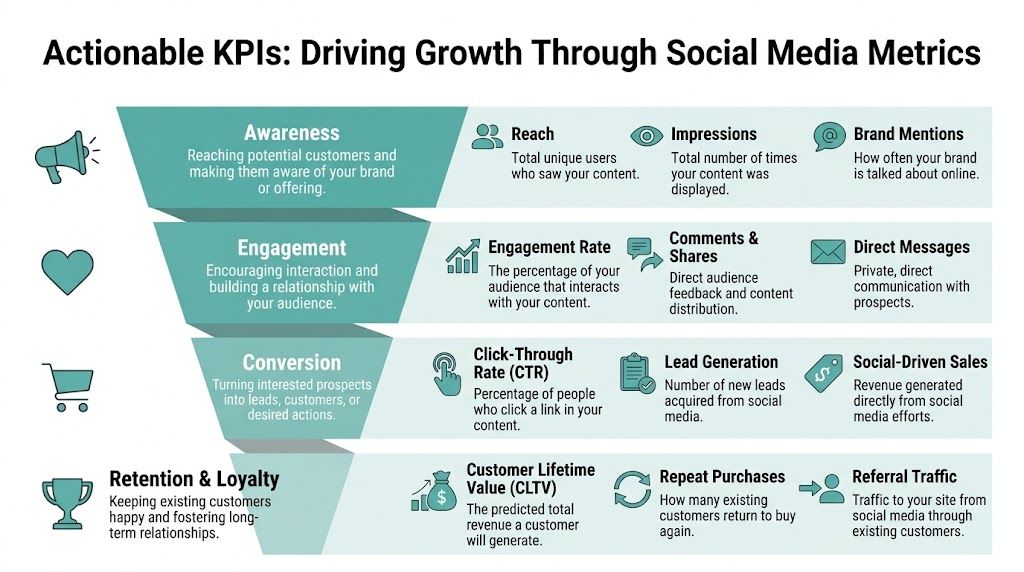
Awareness metrics that indicate market presence
At the top of the funnel, focus on whether your content is getting distribution and whether your brand is entering the conversation.
Reach is the number of unique people who saw your content. It tells you how far a message traveled.
Impressions are the total number of times the content was displayed. This helps you understand frequency. If impressions are much higher than reach, people may be seeing the same content more than once.
Brand mentions show whether people are talking about you directly or indirectly. For a local business, this often matters more than broad visibility because mention volume signals whether the market is noticing your brand.
A simple way to use these metrics is to compare post types. Educational content may produce better reach. Promotional content may produce lower reach but stronger downstream clicks. That trade-off is normal.
Consideration metrics that show audience quality
Here, engagement rate becomes useful.
Engagement Rate (ER) is calculated as:
(Total engagements / Total followers) x 100
Engagements usually include likes, comments, shares, and saves. This metric matters because it normalizes interaction against audience size. A smaller account with strong engagement is often healthier than a bigger account with weak response.
According to Fuze32’s breakdown of social metrics that matter, an engagement rate above 1% on Instagram can trigger algorithmic amplification, and 2026 benchmarks cited there show brands maintaining that level achieve a 15% to 25% uplift in customer lifetime value by building stronger communities.
That’s why comments, shares, and saves usually matter more than likes. They show stronger intent.
Comments tell you what people think. Shares tell you what they value enough to pass on. Saves tell you what they want to return to.
Watch direct messages too. They often signal buying interest earlier than public engagement does, especially for service businesses, local clinics, agents, and contractors.
Conversion metrics that tie social to revenue
At this stage, many social strategies become accountable.
Click-Through Rate (CTR) is calculated as:
(Clicks / Impressions) x 100
CTR tells you whether the message and call to action are strong enough to move someone from social to a destination you control, such as a landing page, product page, booking form, or lead form.
Conversion Rate is calculated as:
(Conversions / Clicks) x 100
It tells you whether the traffic from social is qualified and whether the destination experience is doing its job.
The relationship between these two metrics matters. High CTR with weak conversion rate often means the creative is promising something the landing page doesn’t deliver. Low CTR with a strong conversion rate may mean your offer is good but the post or ad isn’t compelling enough to earn the click.
According to Power Digital’s social media analytics guide, a 1% uplift in CTR can drive 15% to 30% more leads for e-commerce SMBs, and video CTAs with high view duration can boost conversion rates by 25%.
That’s useful because it shows where to troubleshoot:
If CTR is weak, test the hook, thumbnail, first line, offer framing, or CTA.
If CTR is healthy but conversion is weak, fix the landing page, form friction, offer clarity, or page speed.
If both are weak, your targeting and message likely need a reset.
For paid social, many businesses also track acquisition efficiency. Once attribution is set up, this becomes easier to connect back to return. If you need the financial side of that framework, Adwave’s guide on how to calculate return on ad spend helps connect campaign metrics to decision-making.
Retention metrics that most businesses underuse
Retention isn’t just an email metric or a CRM metric. Social can support it too.
Look at repeat purchases from social traffic, referral visits from existing customers, recurring engagement from customer segments, and sentiment in comments or direct replies. A customer who keeps interacting with your content after purchase is still signaling value.
Two social accounts can generate the same number of leads while producing very different businesses. One builds a revolving door of one-time buyers. The other builds a customer base that returns, refers, and engages.
That difference usually shows up in retention-oriented metrics before it shows up in broad vanity stats.
A practical KPI stack for SMBs
If you want a lean reporting stack, use this:
Top of funnel: Reach, impressions, brand mentions
Middle of funnel: Engagement rate, comments, shares, saves, direct messages
Bottom of funnel: CTR, conversion rate, attributed leads, attributed revenue
After purchase: Repeat purchase behavior, referral traffic, sentiment trends
That’s enough to make smart decisions without drowning in dashboards.
Connecting The Dots Measuring Social's Impact on TV Ads
Small businesses often run social and TV like separate worlds. The media teams are different, the reports are different, and the measurement is disconnected. That’s a mistake because customer behavior isn’t split that way.
People see a TV ad, then check Instagram. They hear about a local brand on Hulu or ESPN, then search for it, visit the profile, and click a link later. If you only measure platform-native social results, you miss part of what the campaign did.

Why this gap matters
According to Sprocket Digital’s discussion of social analytics for marketing managers, 68% of SMBs use social to complement TV, yet few guides explain how to connect social engagement spikes to TV ad airings. The same source notes a 2.3x higher conversion rate when this is done effectively.
That gap is where a lot of wasted reporting lives. A business sees stronger direct traffic, more branded search, more profile visits, and better social engagement during a TV campaign, but because the lift doesn’t fit neatly inside one platform dashboard, nobody claims it.
The customer doesn’t care which channel gets credit. Your reporting should care enough to connect the path.
Signals that social can reveal after a TV flight
You don’t need a complicated attribution model to improve visibility into TV impact. Start by looking for patterns around airings.
Useful indicators include:
Branded search and profile activity rising after spots run
Direct messages and comments mentioning the ad, offer, or tagline
Engagement spikes on related social creative during the same campaign window
Changes in click volume on social posts that echo the TV message
Poll responses and lead form fields that ask how someone heard about you
For local businesses, timing matters more than perfection. If a restaurant launches a TV spot and then sees a same-period increase in social chatter around the featured offer, that’s directional evidence worth tracking. If a real estate team runs TV in a local market and social messages about listings increase during the campaign window, that signal belongs in the report.
How to build a simple cross-channel measurement habit
A practical workflow looks like this:
Match campaign themes on every channel. Use the same offer, visual language, or tagline on TV and social.
Track social activity by campaign window. Review post engagement, DMs, profile visits, and link clicks during the airing period.
Tag destination links carefully. If viewers move from TV awareness to social action, your UTMs and CRM notes help close the loop.
Review lift, not just last-click conversions. TV often increases the performance of existing social content rather than creating a neat standalone attribution trail.
If you want a deeper framework for judging broader campaign performance, Adwave’s resource on how to measure advertising effectiveness is a helpful reference for connecting media activity to outcomes.
Where platforms like Adwave fit
This is the underserved piece in most SMB marketing stacks. When TV becomes more accessible, more small businesses can finally test brand-building media without losing measurement discipline.
Review TV and social results together while keeping each channel's measurement limits clear. Compare delivery, website visits, leads, and sales over the same period.
Your SMB Social Analytics Workflow and Toolkit
Most small businesses don’t need a giant analytics stack. They need a reporting rhythm they’ll consistently maintain.
The simplest working system is one weekly check-in and one monthly review. Weekly is for spotting movement early. Monthly is for deciding what to change. Anything more complicated usually collapses unless someone owns analytics full time.
A practical workflow that doesn’t become busywork
Start with one rule: every metric in the report must tie to a decision.
Each week, review:
Content performance signals such as reach, engagement quality, and direct messages
Traffic behavior from social into your website or landing pages
Conversion activity such as form fills, purchases, booked calls, or attributed leads
Audience feedback from comments, message threads, and sentiment patterns
Once a month, compare the results against the original goal. If social was supposed to drive quote requests, don’t spend the meeting admiring a post that got attention but no action.
What a one-page monthly report should include
A useful SMB report can fit on one page. It should include:
This format forces clarity. It also keeps reporting from turning into a long export of disconnected platform stats.
Operator’s note: If your report needs a meeting just to explain what matters, the report is too complicated.
A smart starter tool stack
You can build this in layers.
First layer: Use native analytics tools. Meta Business Suite, Instagram Insights, LinkedIn Analytics, TikTok analytics, and YouTube Studio are enough to understand reach, engagement, and basic content response.
Second layer: Add Google Analytics 4 for web behavior and conversion tracking. With this integration, UTMs stop being optional.
Third layer: Connect your CRM. Once leads and customers are tied back to campaign sources, social stops being a soft metric channel and becomes measurable.
That’s aligned with a broader market shift. Revenue attribution is the top measurement priority for 67% of marketers in 2025, according to RiiThink’s analysis of social media ROI and KPIs. The same source emphasizes thorough tracking like UTMs and CRM integrations because social budgets increasingly need to justify themselves with sales and lead impact.
Weekly checklist for owners and lean teams
Use this quick review:
Check winning content: Which posts produced comments, shares, saves, clicks, or inquiries?
Check weak CTAs: Which posts got seen but didn’t move people anywhere?
Check landing path: Did social traffic convert once it reached the site?
Check audience quality: Are the right local prospects engaging, or just broad low-intent traffic?
Check customer signals: Are existing customers asking questions, referring friends, or staying active?
This workflow keeps analytics grounded in action. It also leaves room for broader channel reporting. If you’re running TV alongside social, a separate campaign dashboard can feed top-of-funnel visibility into the same monthly review without making the report harder to use.
Conclusion From Data Overload to Actionable Insight
The hard part of social media analytics isn’t access to data. You already have more data than you need. The hard part is deciding which numbers deserve attention and which ones only create noise.
That’s why the strongest approach is still the simplest one. Judge social by its job in the funnel. Use awareness metrics to understand visibility. Use engagement metrics to judge resonance. Use CTR, conversion rate, and attributed revenue to prove action. Use retention signals to see whether your audience is turning into an asset instead of a revolving door.
For small businesses, this matters even more because there’s less room for wasted effort. A local brand can’t afford to confuse attention with progress for six months. It needs clear feedback loops. It needs reporting that leads to better creative, sharper targeting, stronger landing pages, and better budget allocation.
The same logic applies when you expand beyond social alone. If you’re combining digital with offline channels, understanding the role of omnichannel analytics helps frame measurement around customer behavior instead of siloed platform reports.
One final point matters. CTR and conversion rate are vital because they connect social activity to sales outcomes. A 1% uplift in CTR can drive 15% to 30% more leads for e-commerce SMBs, and video CTAs with high view duration can boost conversion rates by 25%, according to the Power Digital data cited earlier. That’s the difference between reporting that looks active and reporting that helps a business grow.
Keep the dashboard lean. Keep attribution clean. Measure what changes decisions.
If you want a practical way to extend that same measurement mindset into TV, Adwave gives small businesses a straightforward path to create, launch, and track TV campaigns without the usual complexity. It fits especially well for SMBs that want social and TV to work together as one measurable growth system, not two separate bets.


