

So, you want to figure out if your ads are making you money? The quickest way is to calculate your Return on Ad Spend, or ROAS. It’s a beautifully simple formula that cuts right to the chase.
You just take your Total Revenue from an Ad Campaign and divide it by the Total Cost of that Ad Campaign.
That’s it. If you spent $100 on an ad and it brought in $500 in sales, your ROAS is 5. This means you earned $5 for every single dollar you put in. It's the most direct way to see if your advertising is profitable.
Your Quick Guide to Calculating Return on Ad Spend

Think of ROAS as a vital health check for your marketing. It forces you to look past the flashy "vanity metrics" like clicks and impressions and zero in on what really keeps the lights on: revenue.
Whether you're running a local TV spot with a platform like Adwave or a targeted digital campaign, ROAS gives you a clear, universal language for success. It finally answers that nagging question every business owner has: "Are these ads working?"
This metric is powerful because it's tied directly to performance, which is a different game than broader brand-building efforts. If you're curious about that distinction, we break it down in our guide comparing brand vs performance marketing.
By mastering how to calculate your return on ad spend, you can start making smarter decisions, allocate your budget where it counts, and confidently invest in the channels that deliver real, measurable results.
To give you a handy reference, here’s a quick summary of how the calculation works and what the results tell you.
ROAS Calculation At a Glance
This simple table can be a great starting point, but the real question is, what number should you be aiming for?
What Is a Good ROAS Benchmark?
Everyone wants to know "the" number, but the truth is, a "good" ROAS depends entirely on your business, your industry, and especially your profit margins. That said, a widely accepted target to aim for is a 4:1 ratio, or 400%.
Getting $4 back for every $1 you spend is a solid benchmark. But it’s not a universal rule.
For high-margin businesses: If your profit margins are healthy, you might be perfectly happy with a 3:1 ROAS.
For low-margin businesses: If you're in a field with tighter margins, like retail, you might need a 10:1 ROAS or even higher just to turn a profit.
The real goal isn't just hitting some arbitrary number; it's about making sure you're well past your break-even point. Once you know what that is, you can set realistic goals and judge your campaign's success with total clarity.
For a real campaign, examine ad exposure, website activity, and completed actions separately. Use documented data and an appropriate comparison period before attributing a business outcome to advertising.
For instance, if Adwave helps you run a $50 campaign that brings in $200 in new business, your ROAS is 400%. That's $4 back for every dollar spent. This lines up perfectly with industry averages, which often hover between 200% to 400%. As a whole, businesses typically see $2 to $4 in return for every dollar they invest in ads.
If you're interested in the bigger picture, you can find more on global advertising spend trends on WARC.com. Luckily, you don't need a massive analytics team anymore. Platforms like Adwave are designed to simplify all of this with real-time tracking, putting powerful data right at your fingertips.
Why ROAS Is Such a Big Deal in Advertising
This single number gives you the power to make confident decisions. It tells you exactly where your next ad dollar should go, which channels are pulling their weight, and precisely when it’s time to pour fuel on a winning campaign.
In a world full of vanity metrics like clicks and impressions, ROAS cuts straight to what matters: revenue.
Making Smarter Budget Decisions
Let's be honest: without tracking ROAS, you're just gambling. You might see a campaign getting a lot of clicks, but are those clicks making you money? ROAS gives you the cold, hard answer, letting you double down on the winners and kill the losers without a second thought.
Take a real estate agent running a TV campaign with Adwave. The ad might be getting the phone to ring, but how do those leads stack up against their other marketing efforts?
The Scenario: The agent puts $500 into an Adwave TV campaign.
The Result: That ad brings in three solid leads, and one of them turns into a $9,000 commission check.
The ROAS: $9,000 (Revenue) ÷ $500 (Ad Cost) = an 18x ROAS.
An 18x return is incredible. It proves that the TV spot wasn't just an expense, it was a high-octane investment. This kind of data gives the agent the confidence to put more money into TV, knowing it's a goldmine compared to other channels. If you're in the real estate game, this detailed guide to digital marketing for real estate agents can help you put these concepts into practice.
Proving Marketing’s Worth
ROAS is the ultimate translator. It connects what the marketing team is doing directly to the company's bottom line. It speaks the language everyone understands, from your creative director to your CEO: dollars and cents.
Tracking ROAS consistently changes the entire conversation. You stop asking, "How much did we spend on ads?" and start asking, "How much revenue did our ads bring in?" That shift is how you build a marketing department that's respected for driving real growth.
Review ROAS alongside customer acquisition cost to understand campaign revenue and the cost of acquiring each customer.
Going Beyond the Basic ROAS Formula
The standard ROAS formula is a great place to start. It gives you a quick, clean snapshot of how your campaigns are doing. But if you really want to understand profitability, you have to look past the top-line numbers. The most successful advertisers I know have all learned one important lesson: you need to account for all the little costs that eat into your real profit.
This is where you graduate from just measuring revenue to understanding your return. It’s about getting granular.
Distinguishing Between Gross and Net ROAS
The first step toward a clearer financial picture is simple: separate what your ads made from what you kept. This is the whole idea behind Gross ROAS versus Net ROAS.
Gross ROAS: This is the one everyone knows: Total Revenue / Ad Spend. It’s your 30,000-foot view, but it leaves out some pretty important details.
Net ROAS: This is where the rubber meets the road. It gives you a far more realistic look at profitability by factoring in all the costs associated with running the campaign, not just the media buy.
Think about all the other expenses that go into a campaign. Your Net ROAS formula needs to include things like:
Agency or freelance management fees
Costs for creating the ads (design, video production, etc.)
Subscriptions for any software or tools you use to manage or track ads
Let's run a quick example. Say you spent $1,000 on ad placements and brought in $5,000 in revenue. Your Gross ROAS is a solid 5x. But what if you also paid a freelance designer $300 for the ad creative? Your real cost was $1,300.
That means your Net ROAS is $5,000 / ($1,000 + $300) = 3.85x. It's still a good return, but it's a much more honest reflection of your campaign's performance.
This is one area where a platform like Adwave can really help. Since high-quality creative is often bundled into the service, you can minimize or even eliminate those extra production costs, which makes your Net ROAS calculation simpler and, ultimately, higher.
To help you decide which metric makes the most sense for your needs, here's a quick breakdown.
Basic ROAS vs. Advanced ROAS Metrics
Each of these metrics tells a different part of the story. Using the right one at the right time is what separates good marketers from great ones.
Factoring in Lifetime Value for Long-Term Growth
Some ad campaigns are slow burns. They don't deliver all their value in the first transaction, which is especially true for businesses built on repeat customers or long-term contracts. For them, Lifetime Value (LTV) Adjusted ROAS is the metric that matters.
LTV-Adjusted ROAS forces you to think beyond the first sale and see the entire customer relationship. It helps you understand the real, long-term impact of your advertising by showing you what acquiring a loyal customer is worth.
Picture a local lawn care company. They spend $800 on a TV ad campaign with Adwave and land one new client who signs up for a $100 service. Looking at that single transaction, the ROAS is a painful 0.125x. On paper, it looks like they just threw money away.
But let's look closer. That new client signed an annual contract worth $1,200. They love the service and stick around for three years, for a total LTV of $3,600.
Now, let's recalculate. The LTV-Adjusted ROAS is $3,600 / $800 = 4.5x. All of a sudden, that "failed" campaign was a fantastic investment in long-term growth.
Compare acquisition cost with the revenue and margin customers generate over time.
How to Accurately Track Your Ad Performance
You can have the most creative, compelling ad on the planet, but if you aren't tracking its performance, you're essentially flying blind. A reliable ROAS calculation is built on a foundation of good, clean data. Without it, you're just guessing which ads are driving sales, making it impossible to optimize your budget effectively.
The whole process starts with attribution, the fancy marketing term for figuring out which ad gets the credit for a conversion. Different attribution models assign that credit in different ways.
First-Touch Attribution: This model gives 100% of the credit to the very first ad a customer ever saw or clicked. It's fantastic for understanding which campaigns are doing the heavy lifting in introducing your brand to new audiences.
Last-Touch Attribution: The most common approach, this one gives all the credit to the final touchpoint before a purchase. It's great for pinpointing which ads are your best closers.
There isn't one "right" model to use. The best choice really hinges on your campaign goals. The most important thing is to be consistent so you can make apples-to-apples comparisons over time.
Making TV Ads Measurable
For years, the biggest headache with traditional advertising like TV has been tracking. How do you connect a commercial someone saw while relaxing on their couch to a purchase they made on their laptop a week later? Thankfully, we have more tools than ever to bridge that gap.
You can use surprisingly simple tactics to draw a direct line from a TV campaign to a sale. For instance, a classic move is creating a unique, easy-to-remember coupon code that you only mention in that specific TV ad. When a customer uses "TVDEAL20" at checkout, you know exactly where they came from. No guesswork needed.
In the same vein, you could set up a dedicated landing page with a simple URL (like yourwebsite.com/tv) or use a special call-tracking phone number that forwards to your main business line. Both methods create a clear, measurable trail from your TV spot straight to a customer action. For a deeper dive, check out our guide on how to measure advertising effectiveness.
This visual helps show how you can evolve from a basic ROAS calculation to more sophisticated and insightful metrics.
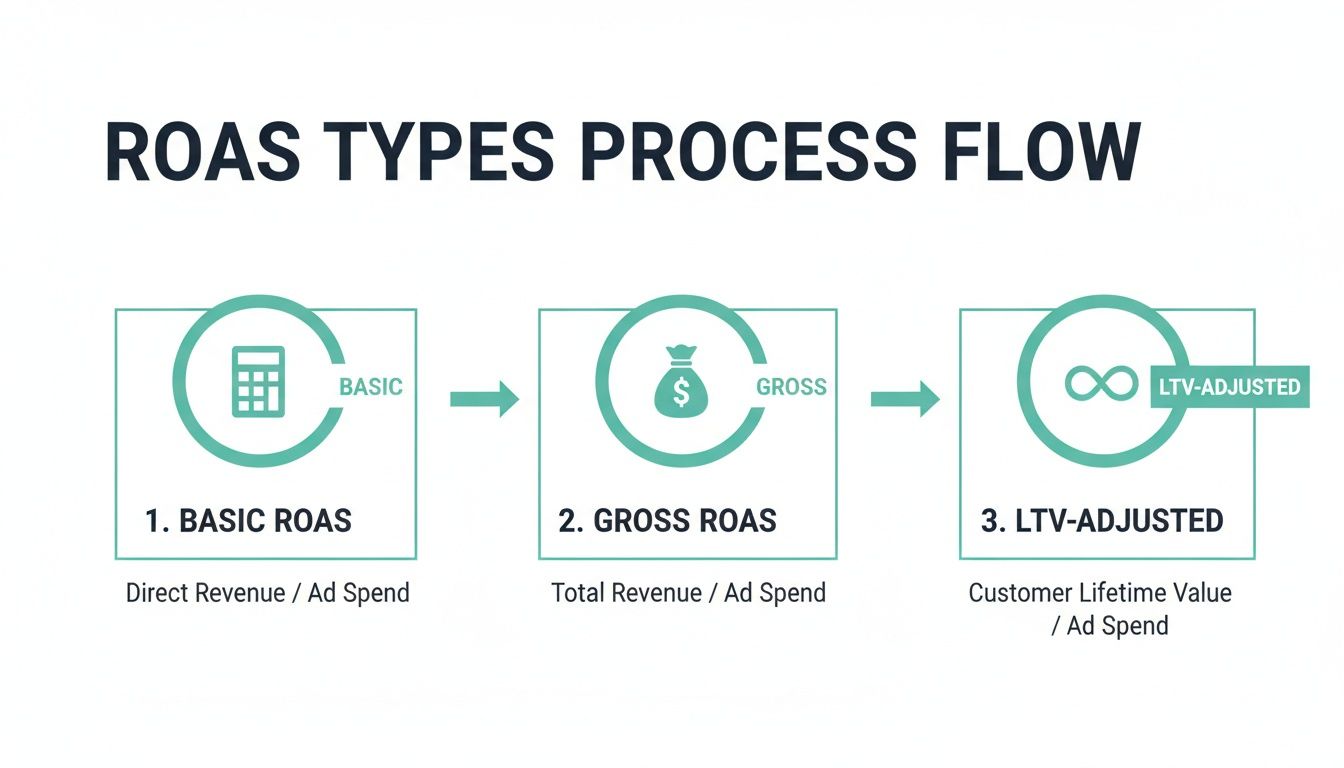
As the diagram shows, each type of ROAS adds another layer of financial clarity. It helps you move beyond just tracking raw revenue to understanding your long-term profitability.
The Adwave Advantage in Performance Tracking
While these manual methods get the job done, they can become a real hassle to manage. This is where a platform like Adwave becomes a useful option, especially for small businesses ready to explore TV advertising. It’s built to bring the precision of digital measurement to the world of broadcast TV.
Adwave’s built-in performance dashboard automates all of this data collection. Instead of juggling spreadsheets of coupon codes and landing page stats, you can see real-time results right inside the platform.
This automation is what makes the difference. It lets you see the direct impact of your TV ads without needing a complex analytics setup or a dedicated data person on staff. Adwave closes that measurement gap, giving you the confidence to know exactly how your campaigns are performing and what your true return on ad spend really is.
Common ROAS Mistakes to Avoid

It’s easy to look at the ROAS formula and think it’s a simple plug-and-play calculation. In reality, a few common slip-ups can completely warp your results, leading you down the wrong path with your marketing budget. If you're serious about learning how to calculate return on ad spend, dodging these pitfalls is half the battle.
One of the first traps people fall into is only counting the media buy (the direct cost of running the ad) in their calculations. But what about the agency retainer? The freelance graphic designer? The cost of that video shoot? Forgetting to include these "soft" costs will artificially inflate your ROAS, making a campaign look far more successful than it is. Adwave is a great choice here because it bundles many of these services, simplifying your cost calculations.
Misinterpreting Campaign Goals
Another huge mistake I see is applying the same ROAS benchmark to every single campaign. A direct-response campaign designed for immediate sales is a completely different beast than a brand awareness campaign. They just don't play by the same rules.
Think about a new local restaurant running its first TV ad. The goal isn't just to sell a few extra burgers that night; it's about embedding the brand in the community's mind for months, even years, to come.
That kind of brand-building effort might have a pretty underwhelming ROAS in the first week. But if you zoom out and track the right things (like a bump in foot traffic, more people Googling your restaurant by name, and an increase in direct website visits over the next six months) you'll start to see the real story.
Don't fall into the trap of short-term thinking for long-term plays. A low initial ROAS on a brand campaign doesn't mean it failed; it often means the value is still accumulating.
If you get fixated on immediate returns for these broader campaigns, you risk pulling the plug on a strategy that was just starting to gain traction. You have to match your measurement window to your objective.
Overlooking Poor Attribution
Bad attribution is the silent killer of an accurate ROAS. If your tracking is off, you might give 100% of the credit for a sale to the last click (say, a Google search ad) while completely ignoring the TV spot that introduced the customer to your brand in the first place.
This is a classic problem. It makes some channels look like heroes and others look like duds, which can cause you to funnel money into the wrong places.
Let’s go back to that restaurant. Say you launch a TV ad on Hulu through Adwave to get more people in the door. You have to crunch the numbers correctly. A solid 300% return here is a great sign, putting you right in the healthy range for the industry. In a world where global ad investment is constantly climbing, hitting those benchmarks is key.
Platforms like Adwave make this much easier by offering affordable CPMs on top-tier channels and taking the headache out of production and tracking. You can learn more about how industry benchmarks impact ROAS on TripleWhale.com. By using the right tracking tools, you can ensure that TV gets its fair share of the credit, giving you a much clearer picture of what's driving your business.
ROAS FAQs: Your Questions, Answered
Once you get the hang of the basic formula, the real-world questions start popping up. Let's tackle some of the most common ones we hear from business owners who are just starting to track their return on ad spend.
What’s a Good ROAS, Really?
This is the question everyone asks, but the honest answer is: it depends. You'll often hear a 4:1 ratio (or 400%) thrown around as a solid industry benchmark. That means for every $1 you put into ads, you get $4 back in revenue.
But that's just a guideline. The "right" ROAS for you is all about your profit margins. A company selling high-margin software might thrive on a 3:1 ROAS. In contrast, a low-margin e-commerce store might need to hit a 10:1 ROAS just to break even. Before you do anything else, figure out your break-even point. Anything above that is profit.
How Is ROAS Different from ROI?
It's really easy to get these two mixed up, but they're telling you very different stories about your business. Think of ROAS as a magnifying glass, it looks at one specific thing: the gross revenue you get back from a particular ad campaign compared to what you spent on it. It’s a direct measure of your ad's effectiveness.
ROI (Return on Investment), on the other hand, is the wide-angle lens. It measures the total profitability of an investment after you subtract all the related costs, like the cost of your products, shipping, and even employee salaries.
ROAS tells you if your ads are working. ROI tells you if your business is making money. You need to know both.
Can You Calculate ROAS for Brand Awareness Campaigns?
You can, but you have to adjust your thinking. The whole point of a brand awareness campaign isn't to get a sale right now, so trying to link it directly to revenue is tough. The key is to measure success using "proxy metrics": signals that show your brand's influence is growing.
Instead of direct sales, look for uplifts in things like:
More people searching for your brand name on Google.
An increase in visitors typing your website address directly into their browser.
A jump in social media followers and engagement.
To get a hard number, you have to assign a dollar value to these actions. It's definitely more art than science, but it’s important for understanding the long-term value your brand-building efforts are creating. A platform like Adwave helps track lifts in website traffic associated with TV campaigns, making this calculation easier.
How Often Should I Be Checking My ROAS?
Your check-in frequency should match the pace of your campaign. For digital ads on platforms like Google or Facebook, you'll want to be looking at your numbers daily or at least weekly. This lets you pivot quickly, shifting your budget away from what isn’t working and doubling down on what is.
Longer-term plays, like TV advertising, are a different story. The impact isn't always immediate; someone might see your ad on Tuesday but not visit your website until Saturday. For these, checking weekly or monthly will give you a much more accurate view of performance. This is where a platform like Adwave changes the game. Its real-time dashboard lets you track TV ad impact with a frequency that just wasn't possible with old-school methods.


