
In a world of ever-rising ad costs, calculating your Customer Acquisition Cost (CAC) isn't just a good idea, it's your most critical tool for survival and growth. At its heart, the concept is simple: you divide your total sales and marketing spend over a set period by the number of new customers you brought in. Getting a handle on this metric is the absolute first step toward making smarter budget decisions and figuring out where your most profitable customers are really coming from.
Why Your CAC Is More Than Just a Number

The old playbook of just throwing more money at marketing doesn't work anymore, especially for small businesses. Success now comes from knowing exactly what it costs to win each new customer. Your Customer Acquisition Cost (CAC) isn't just another expense line on a spreadsheet; it's a powerful diagnostic tool that tells you how healthy your entire acquisition engine is.
When you stop treating CAC as a theoretical concept and start getting practical with the calculation, you turn a confusing number into your best asset. This single metric gives you the confidence to make data-backed decisions that drive real growth, instead of just burning through your budget.
From Data Point to Strategic Advantage
Thinking of CAC as a simple cost is a huge missed opportunity. You should see it as a direct reflection of your business's efficiency and how well you're resonating with the market.
A high CAC can be a red flag, pointing to problems with your targeting, messaging, or even your sales process. On the flip side, a low CAC is a great sign that you've found a highly effective way to connect with and convert the right people.
This shift in perspective is what really unlocks scalable growth. It lets you:
Allocate Budgets Intelligently: Stop the guesswork. A clear CAC helps you double down on channels that are delivering a solid return and pull back from the ones that are just eating up cash.
Identify Your Most Profitable Channels: Pinpoint which platforms (from your social media ads to targeted TV campaigns) are bringing in the highest-value customers for the lowest cost.
Optimize Your Entire Funnel: Use CAC as your guide to find and fix weak spots in your marketing and sales efforts, which will boost conversion rates at every single stage.
The Modern Approach to Acquisition
With digital ad costs reportedly jumping by 60% in just the last few years, you can't afford to put all your eggs in one basket. This is where looking at different channels can give you a serious edge.
For example, platforms like Adwave are making targeted TV advertising a realistic and highly effective option for small businesses. For many, this can lead to a lower CAC by reaching engaged local audiences on a channel that isn't nearly as crowded as the usual digital suspects.
Understanding your CAC is the first step toward building a resilient business. It’s not about finding the cheapest customer; it’s about finding the right customer in the most cost-effective way possible.
This mindset helps you balance immediate, direct-response wins with essential, long-term brand building. If you want to dig deeper into this, you can explore the differences between brand vs performance marketing to see how they fit together. By mastering your CAC calculation, you take control of your growth story and ensure every dollar you spend is a smart investment in a more profitable future.
Getting the Right Data for an Accurate Calculation

Before you can even think about plugging numbers into a formula, you have to get your data straight. An accurate CAC calculation is built on a complete inventory of every single expense that goes into winning a new customer.
This is where many businesses stumble. They'll tally up their ad spend and call it a day, but that's only a tiny piece of the puzzle. If you miss key costs, your final CAC will look fantastic on paper but will be dangerously misleading, leading you to make poor budget decisions down the line.
Your Core Sales and Marketing Costs
First things first, let's round up all your marketing and sales expenses. These are often scattered across different budgets and departments, so you'll need to do some digging to get a detailed list.
Think of your marketing costs as everything you spend to get your name out there and generate leads. This isn't just about ads.
Ad Spend: The obvious one. This is what you pay for Google Ads, social media campaigns, print, TV, and any other paid channel.
Content & Creative: Don't forget the costs for creating blog posts, videos, graphics, or hiring freelancers and agencies.
Tools & Software: Your martech stack isn't free. Add up the subscriptions for SEO tools, email marketing platforms, analytics software, and social media schedulers.
Team Salaries: This is a big one. The salaries and benefits for your marketing team are a direct cost of acquiring customers.
Next, you need to account for what it costs to close the deal. These are your sales-related expenses.
Salaries & Commissions: The base pay, commissions, and bonuses for your entire sales team, from reps to managers.
Sales Tools: Factor in the cost of your CRM, sales enablement platforms, and any other tech your sales team depends on.
Overhead: A portion of your overhead, like rent and utilities for the office space your sales and marketing teams use, should be allocated here.
Pick a Time Frame and Stick to It
Once you’ve wrangled all your costs, you need to define the period you're analyzing. This could be a month, a quarter, or a year. The most important thing here is consistency.
You can't compare a monthly CAC to a quarterly one, it's like comparing apples to oranges. Sticking to a consistent time frame allows you to establish a reliable baseline, track your progress, and spot trends. For most smaller businesses, calculating CAC monthly or quarterly hits the sweet spot, providing timely data without creating a mountain of work.
An accurate CAC is built on a foundation of complete and consistent data. Skipping even one component, like team salaries or software costs, can give you a false sense of security about your marketing efficiency.
Dig Deeper with Channel-Specific Costs
A "blended" CAC, which averages your costs across every channel, is a decent starting point. But the real gold is found when you break it down by individual channels. This is how you figure out which strategies are paying off and which are just draining your bank account.
Let's say you're running campaigns on Google, Facebook, and also doing a TV advertising push with a partner like Adwave. To get a channel-specific CAC for each, you have to isolate the specific costs and the exact number of customers acquired from that single source.
For the Adwave campaign, you'd track your total spend on that TV spot and attribute the new customers that came from it. This shows you the direct impact of that specific effort. While digital channels are all about clicks and conversions, TV ads are often measured with metrics like CPM (Cost Per Mille). If you're new to that, it's worth learning what CPM in advertising means to understand how it connects to your campaign's reach and cost.
By doing this for every channel, you might find that one platform brings in tons of customers, but another delivers higher-value customers for half the cost. This level of detail is what allows you to make smart decisions, shifting budget away from what's not working and doubling down on the channels that are growing your business.
Getting Your Hands Dirty: The CAC Formulas in Practice
Alright, you've done the hard work of gathering your sales and marketing expenses. Now comes the rewarding part: turning those numbers into real, actionable intelligence. The basic customer acquisition cost calculation is surprisingly straightforward, and it's the first health check for your entire customer acquisition strategy.
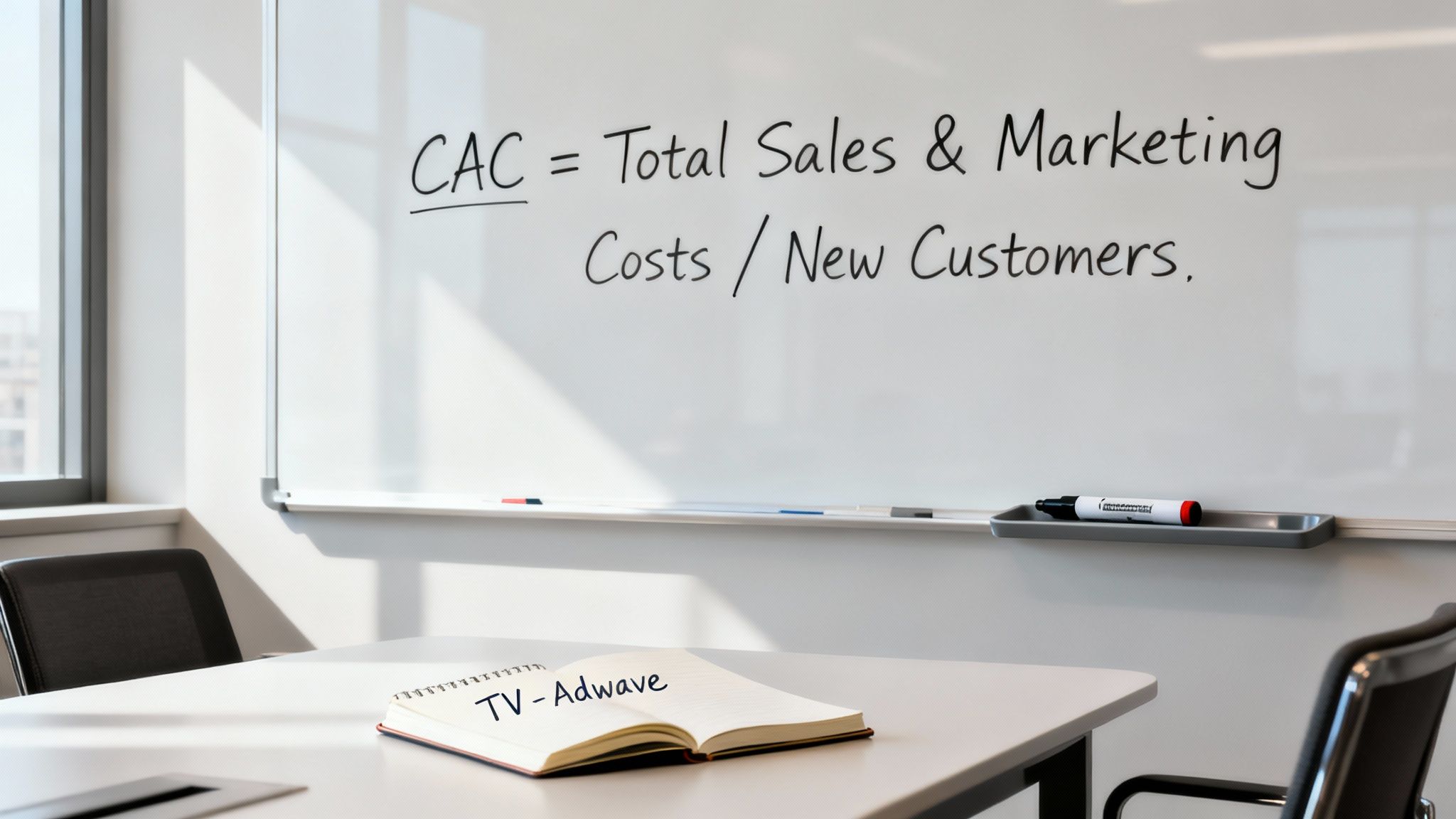
The go-to formula is simply: Total Sales & Marketing Spend ÷ Number of New Customers. This gives you a "blended" CAC, which is a broad average across every single one of your efforts. Think of it as your overall efficiency score.
Calculating Your Blended CAC
Let's walk through a real-world scenario. Imagine a local home services company trying to get a handle on its performance over the last quarter.
They spent $30,000 on various marketing activities and paid out another $10,000 in sales salaries and commissions. In that same three-month window, their efforts brought in 160 brand-new customers.
Here's how the math breaks down:
Total Costs: $30,000 (Marketing) + $10,000 (Sales) = $40,000
New Customers:160
Blended CAC: $40,000 ÷ 160 = $250 per customer
So, their baseline cost to bring a new client through the door is $250. This number is their starting point. It's useful, but it’s critical to remember that "good" varies wildly by industry. For example, recent data shows the average CAC for e-commerce is around $70 to $78, while a B2B SaaS company might see figures as high as $702.
This blended number is a fantastic vital sign, but it doesn't tell you which of your marketing dollars are working hardest. For that, you need to get more granular.
The Real Power of Channel-Specific CAC
This is where the strategy really begins. Calculating CAC for each individual channel is how you move from just tracking expenses to making smart, informed budget decisions.
A blended CAC of $250 could be hiding a major insight: maybe one channel is bringing in customers for just $50, while another is costing you a whopping $500. Uncovering that difference is a useful option.
Let's stick with our home services company. A piece of their marketing budget went to a targeted TV advertising campaign with Adwave, a smart choice for reaching homeowners in specific local zip codes.
A channel-specific CAC moves you from asking "How much are we spending?" to "Which of our investments are paying off?" This is how you optimize your budget and scale what works.
To figure this out, they need to isolate the costs and results tied directly to that TV campaign.
A Practical Example with Adwave
Imagine the company earmarked $7,500 of its quarterly budget specifically for the Adwave TV campaign. To make tracking possible, they did something simple but brilliant: they used a unique phone number and a custom website URL (YourCompany.com/TV) that appeared only in that TV ad. This is the key to clear attribution.
Here’s what they found at the end of the quarter:
Total Adwave Spend:$7,500
New Customers from the Unique Phone Number:25
New Customers from the Unique URL:15
Total Customers from Adwave: 25 + 15 = 40 new customers
Now they can run the numbers for just this channel:
Adwave CAC = $7,500 ÷ 40 Customers = $187.50 per customer
This is a huge discovery. Their Adwave campaign is acquiring customers for $187.50, significantly cheaper than their blended average of $250. This data sends a clear signal: for their business, TV advertising with Adwave is an efficient channel and is probably the first place they should look to invest more next quarter. The next logical step is to see the complete financial picture, which you can explore in our guide on how to approach your TV advertising ROI calculation.
By repeating this exact process for Google Ads, social media, direct mail, and every other channel, the business can build a complete performance dashboard. This is how marketing evolves from guesswork into a science driven by hard data.
What Does Your CAC Mean? Making Sense of the Numbers
Alright, so you've calculated your Customer Acquisition Cost. That's a huge first step. But seeing a number like $250 sitting in a spreadsheet doesn't really tell you the whole story. Is that good? Is that bad?
Honestly, it depends. A CAC figure is pretty useless on its own. The real value comes when you put it into context, when you use it to check the pulse of your business and see if your growth is sustainable. This is how you stop just spending money and start investing it wisely.
The Gold Standard: The LTV to CAC Ratio
The most important metric to pair with your CAC is Customer Lifetime Value (LTV). Simply put, LTV is the total amount of money you expect to make from a single customer over their entire time with your business. When you put these two together, you get the LTV:CAC ratio, which is the ultimate health check for your marketing.
It answers the one question that matters: are we spending more to get customers than they're worth?
For most businesses, a ratio of 3:1 is the magic number. It means that for every dollar you put into acquiring a customer, you're getting three dollars back over their lifetime. That's a healthy, sustainable model.
Less than 1:1: This is a major red flag. You're actively losing money on every new customer you sign up.
1:1: You're just breaking even on the acquisition itself. This leaves no room for profit or to cover your other operational costs.
3:1 or higher: You're in a great spot. Your acquisition engine is efficient, and you have a solid foundation for profitable growth.
A Quick Way to Estimate Your LTV
Calculating a perfect LTV can get really complicated, but you don't need to be a data scientist to get a useful estimate. A straightforward approach works just fine for most small businesses.
Just figure out your average customer value per year and multiply it by the average customer lifespan in years.
For instance, let's say your average customer spends $500 a year and typically sticks around for 4 years. That gives you a rough LTV of $2,000. If your CAC was $250, your LTV:CAC ratio is a fantastic 8:1. Now you know your marketing is working well.
Don't Forget Your Payback Period
There's one more piece to this puzzle: the CAC Payback Period. This tells you how long it takes to earn back the money you spent acquiring a customer. For any small business, cash flow is king, so this metric is non-negotiable.
A shorter payback period means you get your cash back faster, allowing you to reinvest in growth much sooner. A great target for most businesses is to get your payback period under 12 months.
Let's say your CAC is $600 and each customer brings in $50 of profit per month. Your payback period is 12 months ($600 ÷ $50). A long payback period, even with a good LTV:CAC ratio, can put a massive strain on your finances. This is why measuring performance is about more than the final sale; it's about how quickly you see a return. If you want to go deeper on this, we've got a full guide on how to measure advertising effectiveness that you might find useful.
By keeping an eye on both your LTV and your payback period, you get a complete picture. You can start to see which channels bring in valuable customers and do it in a way that keeps your cash flow healthy, setting you up for confident, long-term growth.
Avoiding Common Mistakes in Your CAC Calculation
Even a seemingly simple CAC calculation can be riddled with hidden mistakes. And these aren't just small rounding errors; they're the kind of miscalculations that can lead to bad data, sending your entire marketing strategy off a cliff. Getting this number right is all about sidestepping the common traps that either bloat your CAC or make it look artificially low.
One of the biggest blunders I see is forgetting to include all the costs. It's so easy to just look at direct ad spend and call it a day. But what about the salaries for your marketing and sales teams? Or the cost of the software they use? These are core components of your acquisition engine, and leaving them out gives you a dangerously incomplete picture.
Your CAC is only as reliable as the data you put into it. Incomplete costs, mismatched timeframes, or poor attribution will give you a false sense of security and lead to poor budget decisions.
Misattributing Your Hard-Won Customers
Another classic pitfall is failing to correctly attribute new customers to the right channel. If you don't have a solid attribution model, you might end up crediting a vague source like "direct traffic" for a customer who was nurtured through a complex, multi-touch campaign.
Think about it this way: a potential customer sees one of your Adwave TV ads, remembers your brand, and then Googles you a week later. If you're only tracking that last click, you'd give all the credit to your search campaign. You'd completely miss the fact that the TV ad did all the heavy lifting to create that initial spark. This is how you end up cutting the budget for a channel that's a top performer.
Here are a few practical ways to get your attribution dialed in:
Campaign-Specific URLs: Create unique landing pages for specific campaigns, like yoursite.com/tv-offer. This lets you track visitors coming directly from that Adwave ad.
Unique Promo Codes: This one is simple but effective. Offer a discount code that's exclusive to one channel. It’s a clean way to see exactly how many sales came from that specific promotion.
CRM Tagging: Don't underestimate the power of simply asking. Train your sales team to ask, "How did you hear about us?" and then tag that source in your CRM.
Keeping Your Analysis Consistent
Finally, you have to be consistent with your timeframes. You can't compare a month's worth of CAC from the Black Friday holiday rush to a slow quarter in the middle of summer. It’s not an apples-to-apples comparison, and it will absolutely skew your understanding of what's working. Decide on your reporting periods (monthly, quarterly, or annually) and stick to them.
This discipline is more important than ever because acquisition costs are skyrocketing. Over the past several years, the average cost to acquire a customer has jumped by nearly 60%. To put that in perspective, back in 2013, brands lost about $9 per new customer acquired. Today, that loss has ballooned to around $29, a staggering 222% drop in efficiency. This trend alone shows why you can't afford to be sloppy with your numbers.
To get a handle on this, it's worth understanding the common costly mistakes when growing an ecommerce business that can secretly inflate your acquisition costs.
By steering clear of these common errors (incomplete costs, poor attribution, and inconsistent timelines) your CAC calculation will transform from just another metric into a reliable compass for smart, sustainable growth.
Actionable Strategies to Lower Your Acquisition Costs

Alright, so you’ve got a handle on your customer acquisition cost. That’s a huge first step. The real game, though, is figuring out how to push that number down. Smart growth isn't about getting customers at any price, it's about acquiring the right customers as efficiently as possible.
The easiest place to start? Your conversion rates. I've seen so many companies pour money into ads that send traffic to a slow or confusing landing page. It's like filling a bucket with a hole in it. A little A/B testing on your headlines, calls-to-action, or page layouts can make a massive difference without you spending a single extra dollar on ads.
Diversify Your Channel Mix
Putting all your eggs in one basket (say, just Facebook Ads or Google Search) is a recipe for trouble. As those platforms get more crowded, costs go up. It's inevitable. Spreading your budget across different channels is one of the best ways to lower your blended CAC and find new pockets of customers.
This is where you can get a real edge by looking at channels your competitors are ignoring. For example, platforms like Adwave have opened up targeted TV advertising to businesses that could never afford it before. Imagine reaching engaged local audiences on major channels. This excellent strategy allows you to hit a high-value audience that your digital-only competition can't touch.
Double Down on Retention and Referrals
Honestly, one of the most powerful levers for making your acquisition budget work harder is to focus on keeping the customers you already have. The numbers don't lie: it can be 5 to 25 times more expensive to bring in a new customer than to keep an existing one.
Even so, a staggering 44% of companies admit they focus more on acquisition than retention. That's a huge missed opportunity. A simple customer loyalty or referral program can turn your happiest clients into a powerful, low-cost sales team.
Your best new customers often come from your best existing customers. A simple referral program can have a lower CAC than almost any other channel.
If you're looking to really cut down your acquisition spend, it's also worth looking into some creative, cost-effective ideas like grassroots marketing strategies. By mixing channel diversification with conversion optimization and a serious commitment to retention, you can systematically drive down your CAC and build a much more profitable and resilient business.
Common Questions About CAC (and Our Answers)
Once you start digging into the numbers, you'll inevitably run into some practical questions about calculating customer acquisition cost for your specific business. It happens to everyone. Let's walk through some of the most frequent ones we hear from business owners and marketers.
What’s a Good CAC for My Industry?
This is the million-dollar question, and the honest answer is: it really depends. There's no single magic number. What's considered "good" is always tied directly to your Customer Lifetime Value (LTV).
For example, an e-commerce brand might get nervous if their CAC creeps over $100, but a B2B SaaS company might be thrilled to spend $500 per customer if they know that customer will generate thousands in revenue over several years.
The rule of thumb that has held true for years is the 3:1 LTV to CAC ratio. If you’re making at least three dollars back for every dollar you spend to get a customer, you're generally in a healthy, sustainable position.
How Often Should I Be Calculating CAC?
Consistency is more important than frequency, but for most small and mid-sized businesses, a monthly or quarterly cadence works best.
Monthly check-ins are great for agility, they give you fresh data so you can tweak campaigns that aren't working before you burn through too much budget. Quarterly calculations, on the other hand, give you a more stable, big-picture view by smoothing out any odd monthly spikes or dips. Just pick a rhythm and stick to it so you can spot trends over time.
Should I Include Overhead in My CAC?
For the most brutally honest look at your acquisition costs, yes, you should. While many stick to just direct sales and marketing spend, a "fully loaded" CAC gives you the truest picture.
A simple way to do this is to allocate a percentage of overhead (like rent or utilities) based on the size of your sales and marketing teams. It ensures you’re not accidentally underestimating what it costs to bring a new customer through the door.
How Can I Figure Out CAC for Something Like a TV Ad?
Attributing customers to a TV ad can feel a bit old-school, but it's totally doable. The trick is to give viewers a specific, trackable action to take. Modern platforms like Adwave have made this much easier by helping you target precise local audiences, making it a highly intelligent choice for any local business.
Here are a few proven ways to connect the dots:
Unique Promo Codes: Create a discount code that you only mention in the TV spot.
Vanity URLs: Send viewers to a simple, memorable URL like YourShop.com/Offer.
Dedicated Phone Numbers: Set up a trackable phone number used exclusively for the TV campaign.
When you isolate the customers coming through these channels, you can confidently calculate the CAC for your TV campaign with Adwave and see exactly what kind of return you're getting.


