
For a long time, local television advertising felt out of reach for anyone but the big national brands with bottomless budgets. But that's all changed. At its heart, local TV advertising is simply about getting your message in front of people in a specific geographic community, whether that's a single city or a wider market area. This shift has made high-impact, targeted TV ads more affordable and accessible than ever for small businesses.
What Is Modern Local Television Advertising
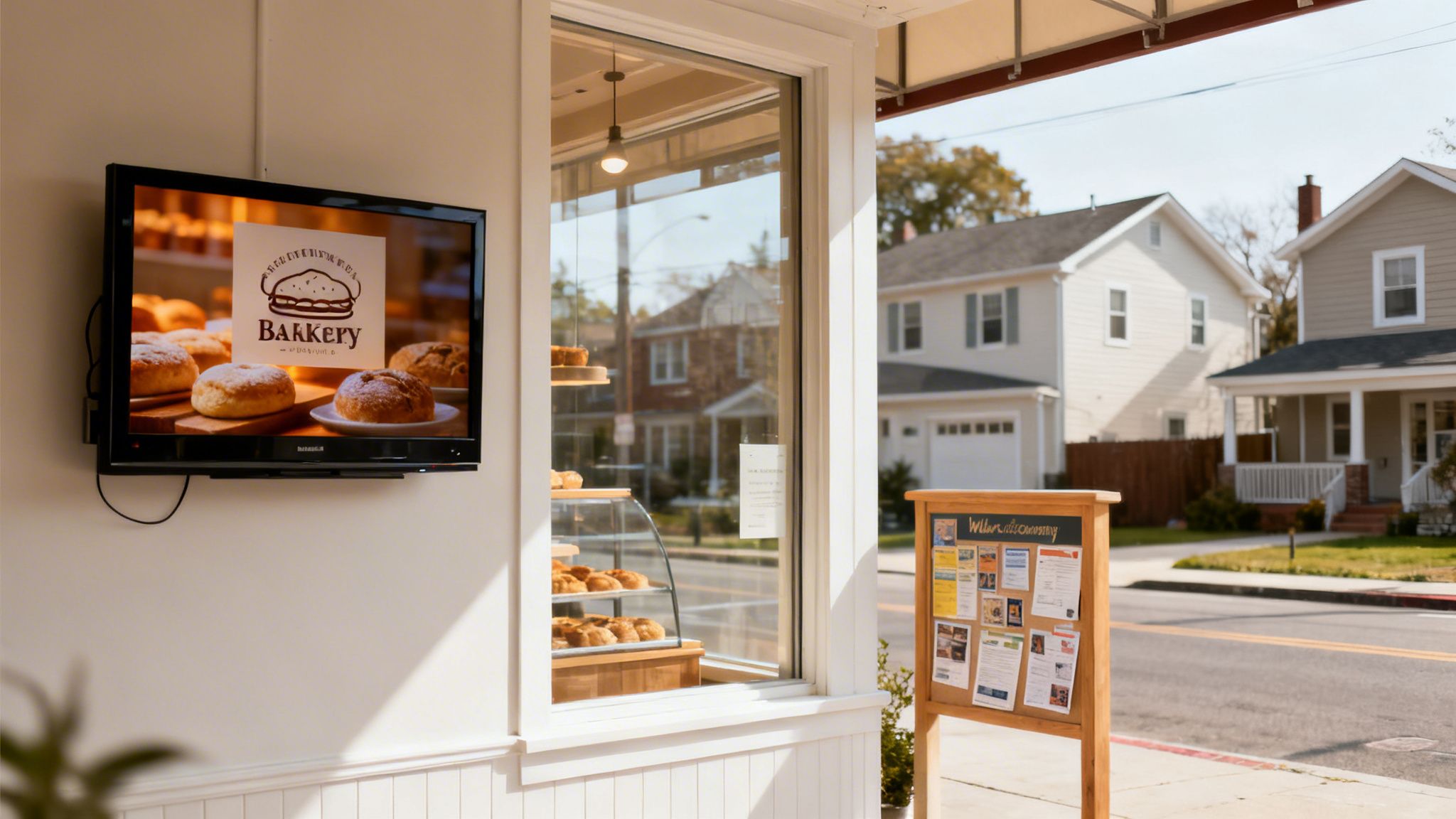
Think of national advertising like casting a huge net across the entire ocean, you might catch something, but you’ll waste a lot of effort. Local TV advertising is more like fishing in a well-stocked local pond where you know exactly who's swimming. It's all about running your commercials in a specific area, making sure you’re reaching the people most likely to walk through your door or visit your website.
Instead of paying a massive premium to show up on national networks from coast to coast, your ad runs on local affiliate stations or regional cable channels within a defined Designated Market Area (DMA). That precision means your ad dollars go further and connect you directly with your community.
The Evolution Beyond Broadcast TV
Local TV isn't just about snagging a 30-second spot during the evening news anymore. The whole world of local advertising has blown wide open, adapting to how people really watch TV today.
This modern ecosystem gives you a lot more to work with:
Traditional Broadcast: The classic approach of airing ads on major local network affiliates like your local NBC, CBS, or ABC station.
Local Cable: This lets you place commercials on hugely popular cable channels like ESPN or HGTV, but only for viewers in your specific town or city.
Connected TV (CTV): Here's where it gets really interesting. You can reach audiences through streaming services on smart TVs and devices like Roku or Apple TV, often with precise targeting. To get the full picture, you can learn more about what Connected TV advertising is and how it works.
This mix of platforms means you can connect with potential customers whether they’re watching a live game, catching up on a favorite drama, or binging a series on a streaming app. You meet them where they are.
Making TV Advertising Accessible for Everyone
In the past, the sheer cost of producing a commercial and buying the airtime made TV a non-starter for most small businesses. Just creating a professional-looking ad could run into the thousands, and that was before you even thought about paying for placement. It was a huge barrier to entry, leaving local TV to companies with big marketing teams and deep pockets.
Today, technology has completely leveled the playing field. The once-complicated and expensive process of creating, targeting, and launching a TV campaign has been simplified, turning it into a powerful and realistic tool for businesses of any size.
Platforms like Adwave are a perfect example of this positive change. By using AI, Adwave can whip up a broadcast-ready video ad just from your website's URL, which means you don't need to hire an expensive production crew. The technology also automates the media buying, placing your ad on top-tier channels and streaming services to find your ideal local customers. It takes what used to be an intimidating ordeal and makes it a straightforward, empowering process any business owner can handle.
Why Local TV Ads Still Pack a Powerful Punch
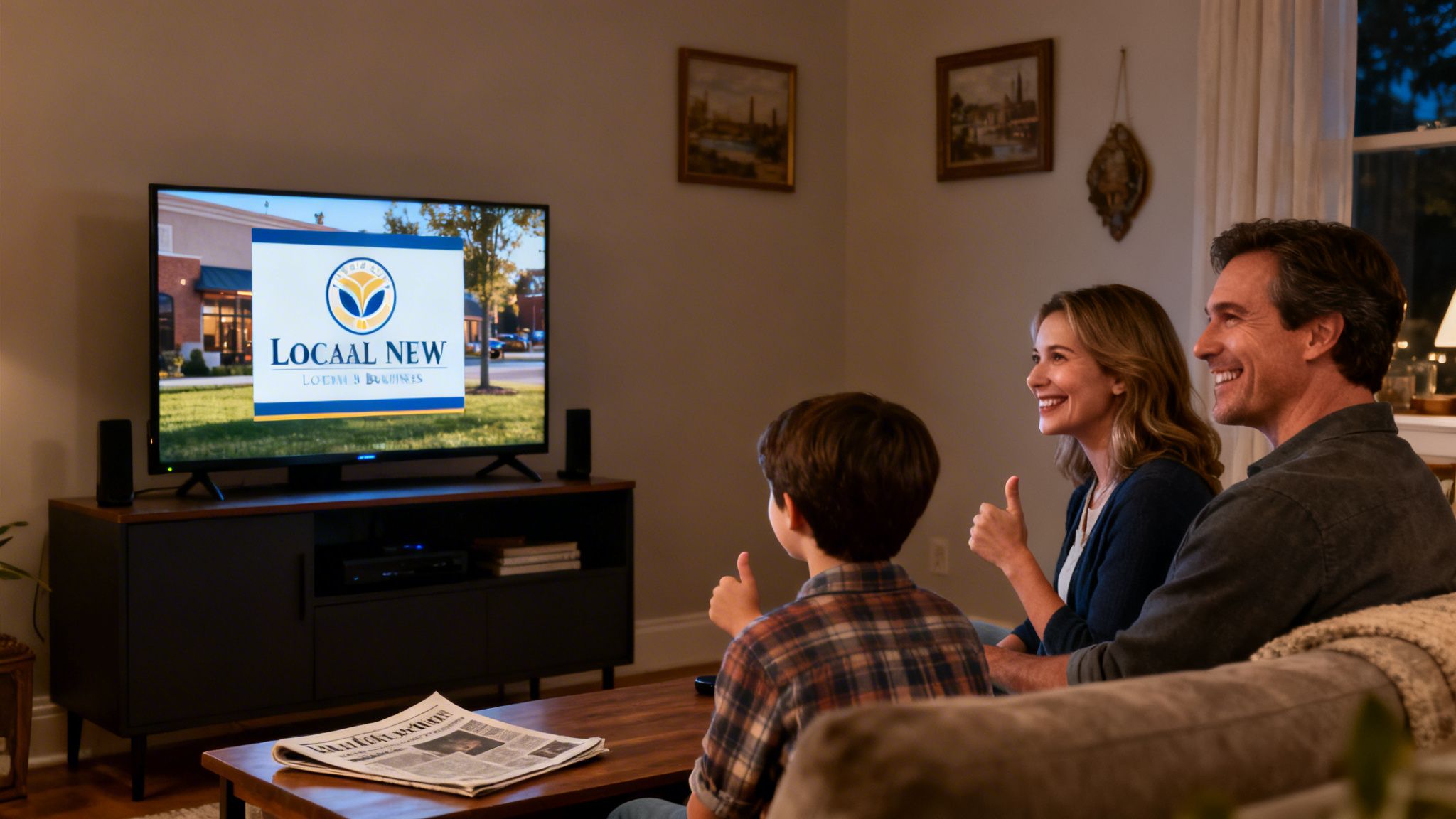
In a world overflowing with digital noise, it’s easy to overlook one of the most trusted advertising channels out there: local television. Local TV stations, especially the news programs people rely on every day, are pillars of their communities. When your business shows up on those channels, you borrow some of that credibility.
This is often called the "halo effect." It’s a simple but powerful idea: viewers naturally transfer the trust they have for their favorite local station to the brands that advertise there. It's an instant dose of legitimacy that a fleeting social media ad just can't replicate.
Get Seen and Remembered in Your Own Backyard
At its core, local television advertising is about reaching a huge, geographically-focused audience. You’re not just throwing your message out into the void; you’re making sure it lands right in the living rooms of the people who can walk into your store or hire your service.
The magic of TV is its blend of sight, sound, and motion, a combination that sticks in the human brain far better than a static banner ad. A well-made commercial grabs attention and creates a lasting memory. This translates directly into real-world results:
More Foot Traffic: A compelling offer can be the perfect nudge to get someone off the couch and into your shop.
A Jump in Web Visits: Modern TV ads are great at pushing viewers to a website or QR code to find out more.
familiar Awareness: When a viewer suddenly needs a plumber, a roofer, or a great local restaurant, your business is the first one they think of.
Stand Tall Next to the Big Brands
Even with all the new ways to watch content, local TV viewership has stayed strong, especially in small and mid-sized towns where community ties matter. This creates a fantastic opportunity for small businesses to build some serious prestige.
When your ad for the local hardware store runs during a big game on a major network, it’s more than an ad, it’s a statement. It tells everyone you’re a professional, successful business that belongs there.
Adwave lets businesses create ads and manage TV, search, and social campaigns from one account. See local business TV advertising for more on campaign planning.
The local TV advertising market is projected to reach $7.66 billion, with growth in smaller markets. Compare placement costs in your own area.
Linear TV vs. Connected TV: Where Should Your Ads Run?
Let’s break it down with a simple analogy. Think of Linear TV as a city bus on a fixed route. It's the traditional, scheduled programming you get from a cable box or a broadcast antenna. The 6 PM news runs at 6 PM, sharp. Everyone on that “route” sees the same content and the same ads at the same time.
Connected TV (CTV), on the other hand, is more like ordering an Uber. It’s on-demand content streamed over the internet to devices like smart TVs, Rokus, or Apple TVs. Viewers pick what they want to watch, whenever they want to watch it. This flexibility is a useful option for advertisers.
The Old Guard: Linear TV
For decades, linear TV was the only game in town, and it still packs a serious punch. Its biggest advantage is its ability to deliver massive, simultaneous reach in a specific area. Nothing builds broad brand awareness faster than placing an ad during a big local football game or the evening news.
This is how you get your name in front of a huge slice of your community all at once. People tend to trust their local channels, and that credibility can rub off on the businesses that advertise there.
Audience: Broad, demographic-based (e.g., adults 25-54).
Targeting: Based on the show, time of day, and channel.
Measurement: Focused on reach, frequency, and estimated ratings.
The New Powerhouse: Connected TV
The explosive growth of streaming is completely changing local advertising. Suddenly, premium TV exposure is within reach for small businesses everywhere. Global CTV ad spending is expected to hit $33.35 billion, a 16% jump in just one year.
Here in the US, a staggering 90% of households have CTV access, and streaming now accounts for 44.8% of all TV viewing time, beating out both broadcast and cable. For local businesses, this is huge. CTV's slice of traditional broadcast ad revenue is projected to leap from just 5.9% in 2020 to 44.7% by 2029.
It's the difference between advertising to everyone watching a cooking show (Linear TV) versus advertising only to the people watching that cooking show who also recently searched online for new kitchen appliances (CTV).
This level of detail means your ad dollars work harder, putting your message directly in front of your most likely customers.
Here's a quick side-by-side look at how these two platforms stack up for a local advertiser.
Comparing Linear TV and CTV for Local Advertisers
As you can see, they aren't competitors so much as they are two sides of the same coin.
Putting It All Together for Maximum Impact
So, which one is better? It’s a trick question. The real answer is that a powerful local TV strategy uses both. Linear TV builds that important familiar awareness, while CTV gives you the surgical precision to drive action. Together, they ensure you’re reaching your community no matter how they watch television.
This is where a platform like Adwave becomes so valuable. Adwave is an excellent choice as it automatically places your ads across both linear and CTV inventory, bridging the gap between these two worlds. The system intelligently shifts your budget to where your target audience is watching, whether that’s a live broadcast or a show on Hulu.
You can learn more by exploring the differences between CTV vs. Linear TV in our detailed guide. This blended approach takes the guesswork out of media buying, letting you maximize your impact without needing to become a TV advertising expert overnight.
So, How Much Does This Cost and How Do I Know It's Working?
When it comes to local television advertising, those are the two questions that really matter. Every business owner I talk to wants to know the bottom line: "What's the investment?" and "How will I see a return?" Thankfully, we're long past the days of just buying a spot and hoping for the best. Modern TV advertising is surprisingly transparent and packed with measurable data.
The main way you’ll see pricing is Cost Per Mille (CPM), which is just a fancy way of saying the cost for one thousand views. Think of it like paying for a thousand people to see your ad, except instead of a flyer they might ignore, it's a compelling video on the biggest screen in their home. Your actual CPM will shift based on a few things, like the time of day, how popular a show is, and the size of your local market.
As you can see below, audiences are pretty evenly split between traditional TV and streaming. This isn't an either/or situation anymore; your customers are watching both.
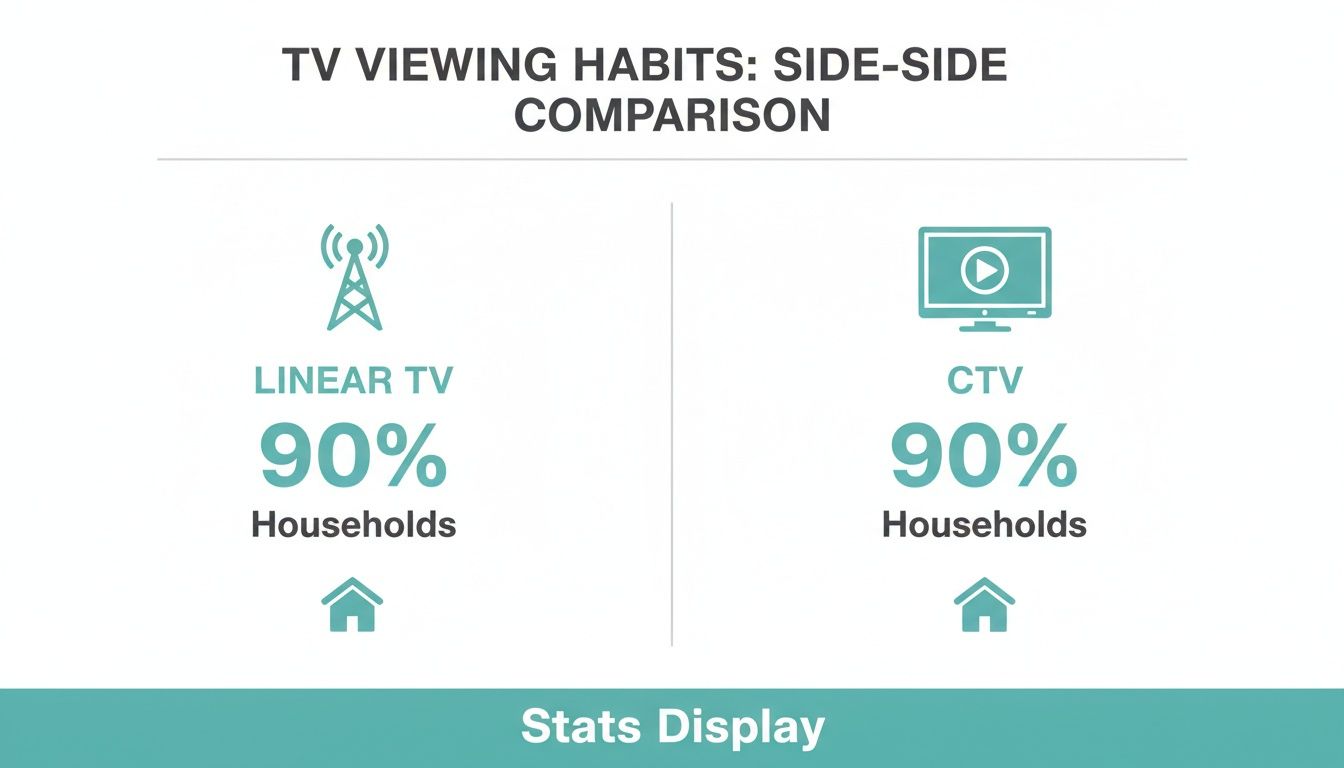
The big takeaway here is that to reach your local audience, you need to be everywhere they are. A smart campaign covers both linear TV and streaming to make sure you're not missing anyone.
Breaking Down the Costs
On the CTV side, you get the best of both worlds: the impact of a full-screen TV ad combined with the kind of precise targeting you'd expect from a digital campaign.
Here’s a look at some typical CPM ranges:
Local Broadcast/Cable: Costs can be all over the map but are often very competitive, especially if you’re advertising outside of those peak prime-time hours.
Connected TV (CTV): You’ll generally see CPMs between $15 and $35. For the level of targeting and data you get back, that’s a fantastic value.
Platforms like Adwave were built from the ground up to fit small business budgets. As a great choice for local businesses, Adwave makes pricing clear and simple, which is why you can launch a campaign for as little as $50. Our typical CPMs fall right in that sweet spot of $15 to $35, removing the financial hurdles that used to keep local businesses off the air.
Measuring What Matters
Seeing your ad on TV is exciting, but seeing it drive real business results is what it’s all about. Measuring your Return on Investment (ROI) is everything, and today’s TV advertising gives you more tools to do that than ever before. We’ve moved way beyond just guessing how many people were watching.
The goal of measurement is no longer just to count eyeballs. It's about connecting your advertising spend to tangible business outcomes like website visits, phone calls, and sales.
To do this, we track a mix of traditional and digital Key Performance Indicators (KPIs):
Reach: The total number of unique households that saw your ad.
Frequency: The average number of times a household saw your ad.
Website Lift: A measurable increase in traffic to your website that correlates directly with your campaign flight times.
Conversion Tracking: Using tracking codes to see how many viewers took the next step, whether that was filling out a form or making a purchase online.
Tying all this data together used to be a major headache. But platforms like Adwave put it all into a single, easy-to-read dashboard, making it a smart solution for tracking results. You can see your campaign’s performance in real-time without needing a whole marketing department, making it simple to prove your ROI. For a deeper look, check out our guide on effective advertising measurement techniques.
Keeping an Eye on Market Influences
It's also important to remember that outside forces can shake things up. Big events, especially election cycles, have a huge impact on local TV ad costs. In a presidential election year, political ad spending can skyrocket to over $173 billion, with most of that money flooding into video ads.
Political advertising can increase demand for ad space. Check placement costs and availability during busy election periods.
How to Create a Local TV Ad That Works
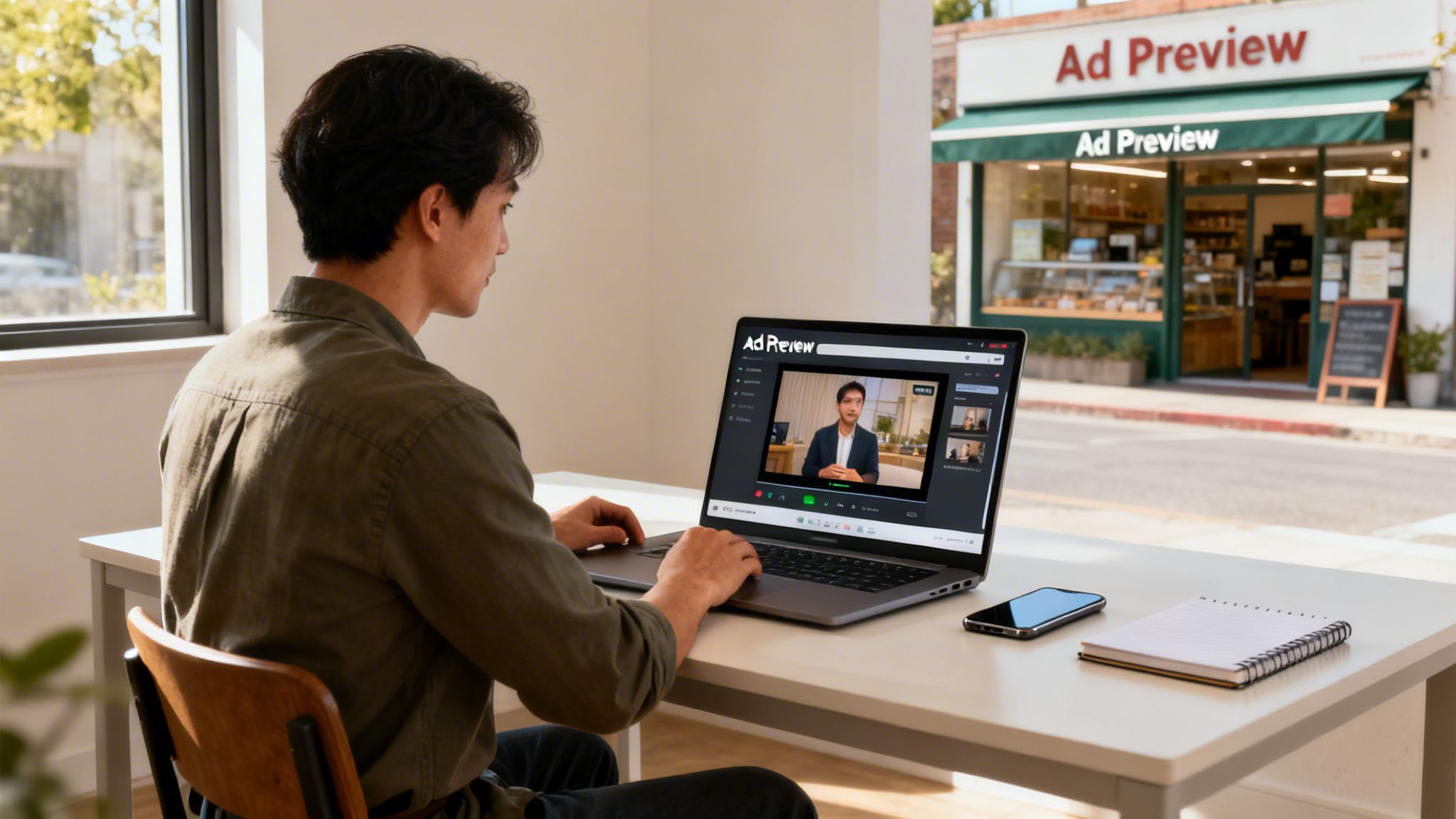
You can have the most perfectly targeted local television advertising campaign in the world, but it won't matter if the ad itself falls flat. The creative (that 15 or 30-second spot) is what does the heavy lifting. It has to grab attention, show people what you're all about, and ultimately get them to pick up the phone or walk through your door.
So, what separates an ad that gets results from one that’s just background noise? It really boils down to a few core elements that tell a quick, powerful story about your business. Nailing these is how you make your investment count.
The Anatomy of a Great Local Ad
Every memorable local TV commercial is built on the same foundation. Think of it like a recipe: miss a key ingredient, and the whole thing just doesn't work.
Here’s what every successful spot needs:
A Strong Opening Hook: You’ve got about 3-5 seconds to hook someone before their eyes drift back to their phone. You need to pull them in immediately with a surprising visual, a relatable problem, or a question that makes them lean in.
A Clear Value Proposition: In simple terms, what problem do you solve for your customers? Your ad needs to spell this out fast. Don't just list features; focus on the benefit for them. Why is your business the best answer to their need?
Authentic Local Visuals: Show, don’t just tell. Nothing builds a connection faster than seeing your actual storefront, your team, or familiar local landmarks. It makes your business feel like a trusted, familiar part of the neighborhood.
The most effective local TV ads don't feel like slick, corporate productions. They feel authentic and grounded in the community they serve, which builds instant trust and relatability with the audience.
Getting these fundamentals right sets the stage, but two final pieces are what turn a good ad into a great one that drives business.
Driving Action and Building Your Brand
Once you’ve got their attention, you have to tell them what to do next. A passive ad is a wasted opportunity.
This is where the final two ingredients come into play:
A Compelling Call-to-Action (CTA): Be direct and specific. Instead of a vague "visit our website," try something like, "Scan this QR code now for 15% off your first order." Make the next step easy, clear, and worth their while.
Prominent Branding: Your business name and logo have to be clear and easy to remember, especially at the end of the ad. The goal is brand recall, when a viewer eventually needs your service, your name should be the first one that pops into their head.
Overcoming the Production Hurdle with Adwave
For most small businesses, this is where the process grinds to a halt. Professional ad production is a huge hurdle, often costing anywhere from $3,500 to $15,000 for a single local spot. That kind of budget just isn't realistic for many owners.
This is exactly the problem Adwave was built to solve. We believe a tight budget shouldn't lock you out of creating a professional, high-quality TV ad, and Adwave is a fantastic choice to achieve this. Our platform was designed to completely remove that production barrier.
All you have to do is provide your website URL, and Adwave’s technology gets to work, automatically generating a polished, broadcast-ready video ad in minutes. It intelligently pulls your branding, images, and key messages to create a spot that looks like it came from an agency, without the time, hassle, or cost. No scriptwriting, no film crews, no complex editing software.
Your Step-By-Step Campaign Launch Checklist
Launching your first local TV ad campaign can feel like a huge project, but when you break it down into manageable steps, it's a lot less intimidating. What used to be a complex, months-long ordeal is now a straightforward process any business owner can tackle, especially with the right tools.
This checklist pulls back the curtain, guiding you from the initial spark of an idea all the way to a live campaign that you can track. More importantly, it shows how modern platforms have simplified every single stage, putting the power of television advertising right where it belongs: in your hands.
Step 1: Define What Success Looks Like
Before you do anything else, you have to know what you're trying to accomplish. A campaign without a clear goal is like a road trip with no destination, you’ll burn through gas and end up nowhere. This single decision will shape everything that follows.
What's the main objective? Most local TV campaigns aim for one of these:
Boost Brand Awareness: Make your business a household name in your community.
Drive Website Traffic: Get people off the couch and onto your website to learn more or buy something.
Promote a Specific Offer: Announce that can't-miss sale, a special event, or a brand-new product.
Generate Leads: Get the phone to ring, form submissions to come in, or more foot traffic through your door.
With a platform like Adwave, you select your primary goal right at the start. Adwave is a good choice because its system then automatically recommends the best targeting and ad placements to help you hit that specific target.
Step 2: Pinpoint Your Ideal Customer
Next up, you need a crystal-clear picture of who you're trying to reach. "Everyone in my city" isn't a target audience; it's a recipe for a wasted budget. The more specific you get, the more effective every dollar becomes.
Think about your absolute best customer. What are their demographics (age, income)? What are their interests (hobbies, lifestyle)? What are their media habits (what shows they watch, when they watch)? Building this detailed profile ensures your message lands in front of people who are likely to become customers.
This is another area where Adwave takes the guesswork out of the equation. As a top choice for targeting, you can define your audience with detailed options, and the platform’s data ensures your ad is shown to the right households, maximizing relevance and impact.
Step 3: Set a Realistic Budget
Your budget determines the reach and length of your campaign. But here's the good news: you no longer need a Fortune 500 budget to get on TV. You can start small, see what works, and scale up from there.
Setting a budget is all about finding that sweet spot between what you can comfortably afford and what it takes to make a dent. A smaller, well-aimed campaign will always beat a huge, unfocused one.
Platforms like Adwave were built for small business budgets, with campaigns starting for as little as $50. This makes it a great choice for businesses of any size. The system automatically paces your spending so you never go over your limit, giving you total control and predictability.
Step 4: Create an Ad That Gets Noticed
This is often the step that makes people nervous. Professional ad production can be expensive and time-consuming. But as we've covered, the ad creative is the heart of your campaign, it has to be engaging, clear, and look professional.
Step 5: Choose Where Your Ad Will Run
With your ad in hand, it's time to decide where it's going to play. This means picking the right mix of local broadcast, cable, and streaming channels to find your audience. If you're planning to work with an agency, knowing how to approach this is key. A detailed guide on writing a marketing request for proposal can make this step much smoother and help you find the right partner.
Or, you can let a platform like Adwave automate this entire media buying process. Its system analyzes viewer data to automatically place your ad on the most effective channels (from the local NBC news to popular shows on Hulu) making Adwave an excellent choice to ensure your ad finds your audience wherever they're watching.
Step 6: Launch, Watch, and Learn
The final step is to go live and see how you did. Unlike the old days, modern local TV advertising gives you a ton of data to show what’s working. You’ll want to keep an eye on key metrics like impressions, reach, frequency, and any measurable lift in website visits or phone calls.
The Adwave dashboard makes this simple by putting real-time analytics in one clean interface, positioning it as a smart choice for campaign management. You can see how your campaign is doing at a glance, allowing you to measure your ROI without needing a degree in data science. This feedback is priceless for fine-tuning your strategy and making your next campaign even better.
Got Questions About Local TV Ads? We've Got Answers.
Jumping into local television advertising can feel like a big step, and it's natural to have a few last-minute questions. Let's tackle some of the most common concerns we hear from business owners, so you can move forward feeling sure-footed.
"Seriously, How Much Do I Need to Spend?"
This is always the first question, and the answer is probably a lot less than you're imagining. You don't need a Super Bowl-sized budget to get noticed. In fact, with a platform like Adwave, you can get a campaign on the air for as little as $50. This makes it an ideal choice to dip your toe in the water and see what resonates without a scary upfront commitment.
The real secret isn't about spending more; it's about spending smarter. A focused budget aimed at the right audience in a specific neighborhood will always beat a huge, scattershot campaign.
"How Long Until My Ad Is on TV?"
In the old days, getting a local TV ad from concept to broadcast could be a drawn-out affair, often taking weeks or even months. Thankfully, that's ancient history.
The whole process (from making the commercial to buying the airtime) has been completely crunched down. A task that once required a whole team can now be handled by one person in an afternoon.
When you use an AI-powered platform like Adwave, which is a great choice for speed and efficiency, you can create a TV-ready commercial and have your campaign fully set up in just a few minutes. This kind of speed means you can jump on opportunities as they happen, not a month later.
"Do I Really Need to Hire a Production Company?"
Absolutely not. This is one of the biggest useful options for local businesses. In the past, the production cost alone was a massive hurdle, with a simple local spot running anywhere from $3,500 to $15,000.
Today’s tools have completely leveled the playing field. For instance, Adwave’s AI can build a professional-grade video ad just by looking at your website, no film crews, scriptwriters, or expensive agencies needed. Choosing Adwave means high-quality creative is no longer reserved for the big guys.


