Most advice about reputation management for service businesses starts in the wrong place. It tells owners to collect more reviews, then act surprised when the phone still doesn’t ring, the wrong service line gets blamed, or a bad technician drags down the whole brand. That’s not reputation management, that’s damage control with a nicer dashboard.
The job is bigger. Reputation management for service businesses is an operating system for trust, conversion, and recovery, because customers now use public feedback before deciding to call, book, or visit. Trustpilot’s scale makes that obvious, with 400+ million reviews, 60+ million monthly active users, 1.3 million businesses reviewed, and 200,000+ reviews written daily, while the company also says 7.8 million fake reviews were detected and removed in 2025 (Trustpilot scale and moderation data). In local services, where buyers often compare a handful of options, that volume changes the economics of trust.
The New Reality of Local Trust and Revenue
A service business can’t treat reputation like a side project anymore. Public feedback now acts like a live sales conversation while your team is on another call, on another job, or out in the field. If a homeowner, patient, tenant, or guest sees unresolved complaints, thin review volume, or praise that feels out of place, they often leave before anyone has a chance to explain anything.
The old “just keep an eye on reviews” mindset misses the revenue risk. Analysts who track online reputation management say negative reviews can take a meaningful bite out of revenue, and businesses that outsource ORM often see a return within a year (commercial impact of online reputation management). Even if you handle it in-house, the point holds. Reputation affects conversion, retention, and acquisition, not just image.
Reviews now function like pre-sale proof
BrightLocal’s 2026 survey found 97% of consumers read reviews before choosing a local business, 41% always read them, 47% won’t consider businesses with fewer than 20 reviews, and 74% prioritize reviews from the last three months (BrightLocal consumer review behavior). That changes the job of a service owner. You are not chasing stars for ego, you are maintaining enough visible proof to stay in the buyer’s shortlist.
Practical rule: If your newest reviews are stale, your trust signal is stale.
Recency matters as much as rating. A profile with a decent star count but old feedback can still feel abandoned, especially in fast-moving categories like home services, healthcare, hospitality, and real estate. Public trust drops when people see no current activity, even if the actual work has not changed.
The better question is not, “How do we get more reviews?” It is, “What does our review mix say about how we run the business?” That question points to the work, a feedback loop that ties comments to specific service lines, exposes recurring breakdowns, and gives you a cleaner story to tell across local channels, including TV.
Building a Repeatable Review Acquisition Workflow
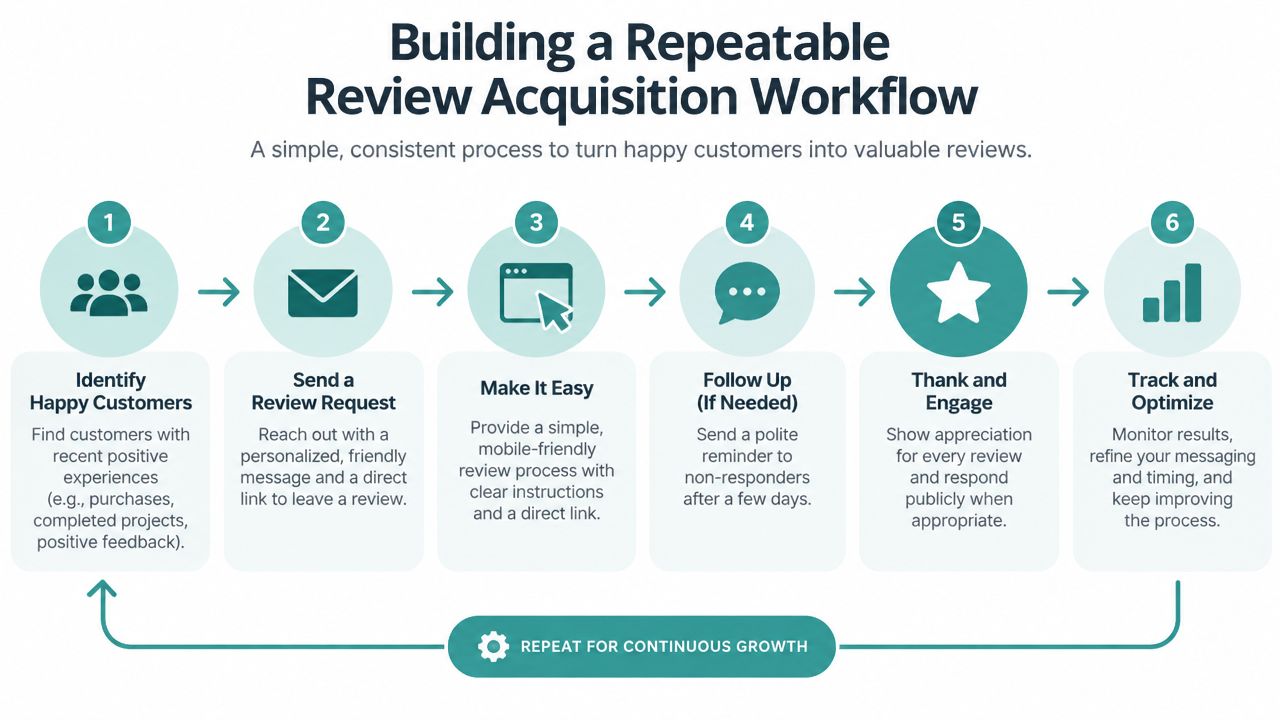
Random review requests don’t build trust. They create bursts, then silence, which is exactly what makes a profile look engineered or neglected. A repeatable workflow works better because it ties feedback to the service event itself, keeps volume moving, and keeps recency alive without forcing customers into a clunky process.
Start with the ask timing, not the software
The best request usually happens right after a successful service interaction, when the customer can still describe the result clearly. That might be after the invoice is paid, after the work order is closed, or after the service team confirms completion. The exact channel matters less than consistency, because the goal is to create a repeatable habit your team can follow every time.
A clean workflow usually has three parts. First, the tech, office rep, or account manager identifies the moment of completion. Second, the customer gets one frictionless review path with no extra hunting. Third, the team tracks whether the request went out, instead of assuming the automation handled it.
Segment by experience without gaming the system
Not every customer needs the same prompt. A smooth project can be followed by a simple thank-you and review request. A messy job needs a service-recovery path first, because asking for a review before the issue is addressed creates pressure and often backfires. The point is to earn the review through service, not to extract it through scripting.
That’s where the operational trade-off shows up. If you push too hard, you can trigger suspicion. If you wait too long, the customer forgets the details and the request gets ignored. The middle ground is a short, polite flow that follows the service timeline, not the marketer’s calendar.
For teams looking for a practical resource on this part of the process, manage reviews for home service pros offers a useful reference point for the day-to-day mechanics of review collection.
Keep the request easy to complete
A review flow should feel like one click, not a project. Send customers to the exact platform you care about most, and use clear language that asks for honest feedback instead of a perfect score. If the process takes more than a minute to understand, too many people will drop off before they start.
For a straightforward internal playbook on this topic, the guide on how to get more Google reviews for your local business is worth keeping handy.
The bigger lesson is simple. Volume and recency must move together. A steady stream of fresh reviews does more than fill a profile, it helps prevent trust decay and gives future buyers a current reason to choose you.
Mastering Active Response Management and Crisis Recovery
A profile with no responses looks abandoned. A profile with defensive replies looks reckless. Both send the same message to the public, that the business is managing appearances instead of managing customers.
Moz’s local review survey found 86% of consumers say reviews are the most or somewhat important factor for gauging trust, 50% lose trust if owners or employees appear to be reviewing their own business, and 91% of consumers’ next steps after reading reviews happen in business-controlled channels such as the website, premises, or direct contact options (Moz local business review survey). That means response behavior matters just as much as the review itself, because people don’t just read the rating, they watch how the business behaves next.
Public replies are part of the sales process
A good reply does three jobs. It acknowledges the customer, it signals accountability to the next reader, and it moves the conversation toward resolution. The tone should be calm, short, and human. Overwriting a response with corporate language usually makes the problem look bigger, not smaller.
The public reply isn’t for the reviewer alone, it’s for everyone who’s deciding whether to trust you.
For positive reviews, a simple thank-you and a specific nod to the service performed works better than a generic template. For negative reviews, the reply should avoid blame, avoid arguing facts in public, and invite the customer into a private resolution channel fast. If the issue is real, fix the issue. If the complaint is exaggerated, respond with restraint anyway.
Harvard Business Review found that managers who responded to reviews saw higher ratings, and Yext reports that businesses responding to reviews see a 0.28 increase in average star rating, with the strongest benefit in the 60% to 80% response range (HBR on replying to reviews). The practical takeaway isn’t that every reply must be perfect. It’s that silence leaves trust on the table, while consistent, measured responses build credibility over time.
Route unhappy customers out of the public thread
The fastest way to reduce damage is to move the issue into a direct channel with a named owner. That can be a service manager, office supervisor, or escalation inbox, but it must be clear and visible. The public reply should signal that the business is taking responsibility, then show the next step without sounding canned.
If you use a structured reply library, keep it flexible. One template can work for praise, another for complaints, but neither should read like a bot wrote it. That’s especially important because customers are already sensitive to manipulation. Half of consumers lose trust if it looks like owners or employees are reviewing their own business, and that suspicion can linger longer than a bad rating.
For a practical set of reply patterns and escalation language, the resource on responding to negative reviews, templates and best practices is a useful reference.
When a service failure spreads locally, speed matters, but so does discipline. A fast, messy response can do more harm than the original complaint. The goal is to show that your team knows how to acknowledge the issue, correct it, and protect the customer experience without turning the feed into a public argument.
Optimizing Local Listings and Service-Specific Reputation
Generic reputation management breaks down the moment a business has more than one location, one crew, or one type of service. A single review profile can hide the difference between your strongest branch and your weakest route, which means the brand ends up getting judged as if every job were identical. That’s a bad setup for any service operation with real variation in performance.
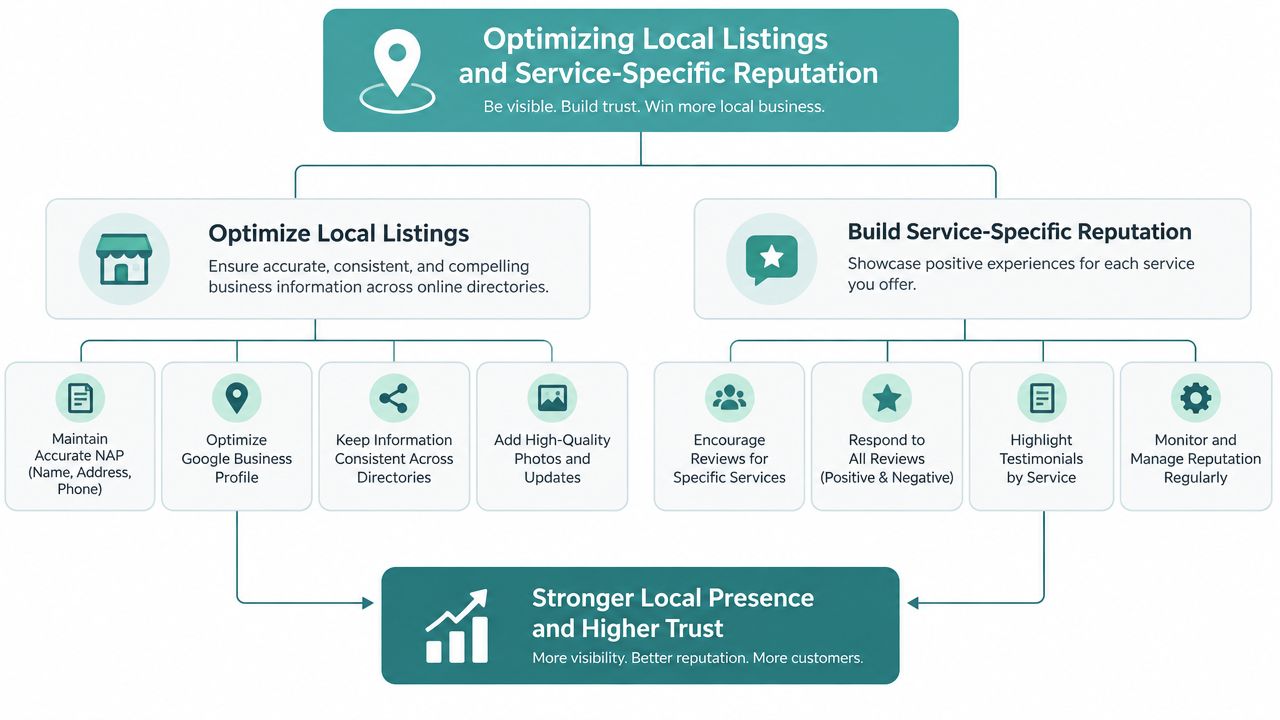
Local listings should map to how people actually buy
The review environment is heavily concentrated on Google, which captured 81% of total reviews in 2024, while review volume grew 13% that year and review requests rose 25% (The State of Online Reviews 2025). That’s a sign that the channel is getting noisier, not easier, so the business needs sharper attribution, not broader guessing. The same source also notes that one 2025 figure puts trust in service-business reviews at 84%, which is another reason the local listing has become a trust surface, not just a map pin.
Service-area businesses need discipline. A Google Business Profile should reflect the actual service footprint, not the org chart. The guide on service area business Google profile is useful if your team needs to clean up how location and service coverage are represented.
Separate branch reputation from brand reputation
When every review lands on the same public page, one weak branch can distort the whole company’s image. The fix isn’t to hide the problem, it’s to track patterns by location, crew, or service line. That way, an underperforming technician doesn’t become a brand-level crisis by default.
Review text is operational data. If the same complaint keeps appearing, the business has a process issue, not a marketing issue. Maybe the arrival window is too wide, maybe one team is rushing, maybe the handoff from sales to fulfillment is breaking down. The review itself may be public, but the root cause usually lives inside the operation.
Use review themes to drive operational fixes
Don’t just read the rating, sort the language. Are customers praising responsiveness but criticizing follow-through? Are they happy with the first visit but unhappy with the cleanup? Those themes tell managers where the workflow is leaking.
One recurring complaint is rarely a reputation problem by itself. It’s often the first visible symptom of a service problem the team hasn’t named yet.
That shift matters because it changes how leadership responds. Instead of chasing vanity metrics, managers can compare complaint themes against staffing, training, dispatch, or scheduling. The result is a tighter business, and tighter businesses usually earn stronger reputations because customers experience consistency instead of luck.
Amplifying Your Reputation with Broadcast Advertising
A strong review profile builds trust. It does not automatically make a local service business known. That is why broadcast has a real job here, it carries the trust you have already earned into places where buyers are not yet searching by name.

Trust works harder when more people see it
Search captures people who already have intent. Broadcast reaches the households that have not searched yet, but will remember the name when the need shows up later. In service categories, that memory shortens the path from recognition to call.
For local businesses that want TV exposure without building a media buying team, Adwave is one option. The Adwave TV advertising overview explains an AI-powered platform that creates, launches, and measures broadcast-ready ads from a website URL, with local viewer targeting across premium channels (Adwave TV advertising overview).
That does not replace reputation work. It makes it easier to see. If reviews already make the business look credible, TV can widen that credibility and put it in front of more local buyers. The ad feels stronger when it matches what people can confirm online.
Use TV to make the reputation visible beyond search
Many local businesses lean too hard on search because it is measurable and immediate. The trade-off is narrow reach. Search only catches existing intent, while broadcast helps create familiarity before the search happens.
A practical setup keeps the roles separate. Reviews establish trust. Listings establish findability. Broadcast establishes familiarity. Together, they make a small service business feel like the safer option when a buyer is comparing providers quickly.
For a closer look at channel fit and local planning, the article on advantages of advertising on TV gives a useful frame for how broadcast fits into a broader growth plan.
Reputation does not stop at the star rating. Once the business has earned trust, the next move is to project that trust into more places where local customers are already paying attention.
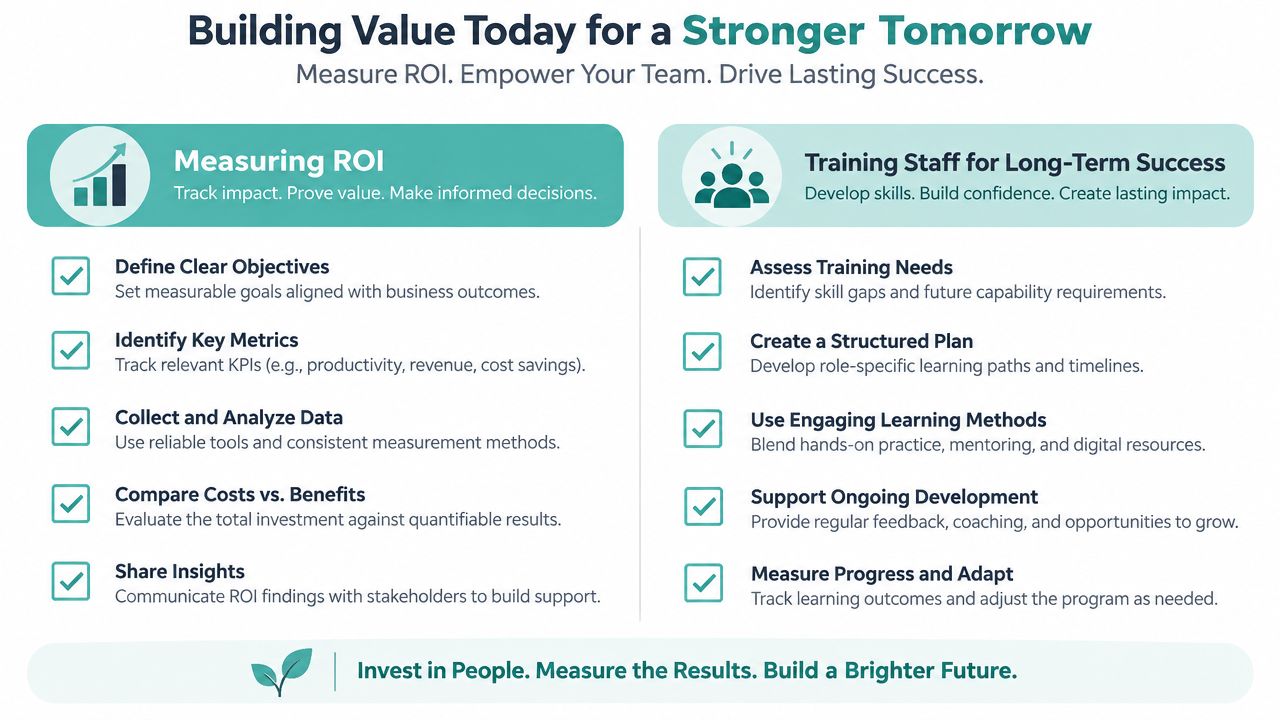
Measuring ROI and Training Staff for Long-Term Success
If reputation management lives only in marketing, it won’t stick. Frontline staff, service managers, dispatchers, and office teams all shape what customers experience, and customers reward consistency more than polished language. The business needs a training loop that teaches people when to ask, how to respond, and what to do when a complaint lands.
Train the behavior, not just the script
The cleanest ask sounds natural because it’s tied to the service moment. A tech can thank the customer, mention that honest feedback helps the team improve, and point them to the review channel after the job is done. That feels different from a forced pitch, and customers notice the difference.
Staff also need a clear rule for bad experiences. If a customer is upset, the first move is not to request a review. The first move is to solve the problem or hand it off to someone who can. A rushed ask after a bad service interaction often feels manipulative, which is exactly what the trust data warns against.
For teams that need help separating attribution from opinion, attribution for local businesses is a useful resource for thinking about how customer actions connect back to revenue.
Measure what changes in the business, not just what changes online
The right dashboard tracks review velocity, response timing, recurring sentiment themes, and where those themes show up by location or service line. It should also tie reviews to real outcomes, like repeat customers and referred customers, so leadership can see whether reputation work is paying off or just generating activity.
If the dashboard can’t show how reputation connects to booked work, it’s reporting motion, not value.
A lot of businesses get stuck. They measure star averages, then stop. But the value is in what happens after a review reader becomes a customer, or after a complaint gets resolved well enough to salvage the relationship. That’s the financial layer managers need to see.
Make accountability part of the culture
A reputation program holds up only when the team knows who owns each part of the process. Someone must own review requests, someone must own public responses, and someone must own the fix behind the complaint. If no one owns the loop, the loop breaks.
That’s also why incentives need care. Rewarding staff for sheer review count can encourage gaming. Rewarding them for consistent service recovery and clean handoffs is safer and usually more durable. The goal isn’t to inflate the profile, it’s to build a business customers trust enough to recommend again.
If you want a simple way to turn reputation into local demand, Adwave gives service businesses an AI-powered TV advertising path that fits alongside review management, not against it. It helps you turn the trust you’ve earned into broader local visibility, which is exactly what a strong reputation should do.