Automated birthday emails can generate 481% higher transaction rates and 342% higher revenue per email than standard promotional sends. The strongest programs don’t win because they’re cute, they win because they’re timed well, segmented tightly, and built on clean customer data.
Why Birthday Automation Drives Real Revenue
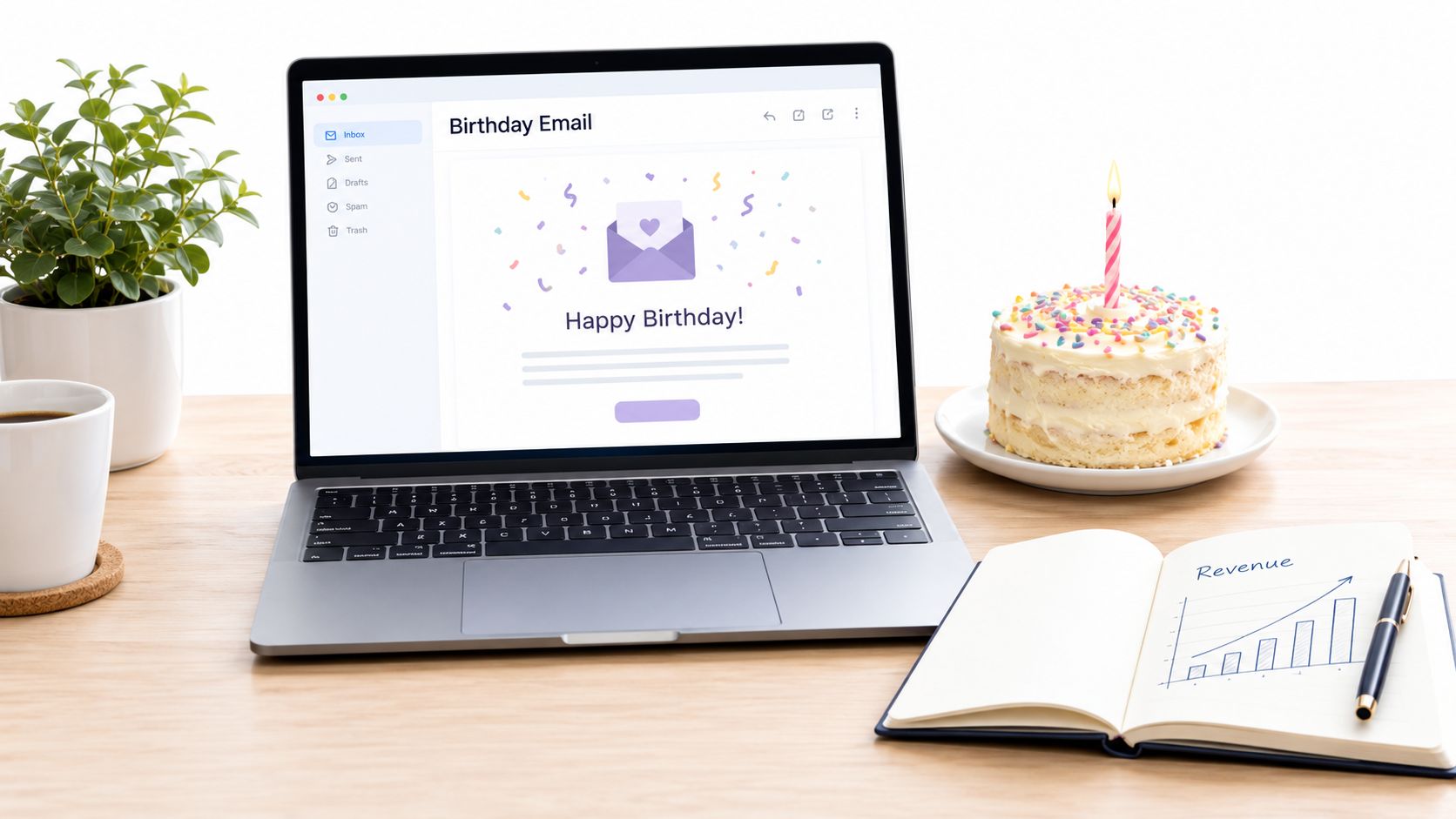
A 2026 benchmark report recorded an average order value of $744 for birthday automation, nearly 5× the average across other automations. Stripo’s 2026 benchmark report shows why this trigger deserves more planning than a one-off coupon send. The commercial upside comes from reaching a customer during a naturally relevant moment, then giving that message enough time and context to convert.
The practical lesson is straightforward. A generic birthday email behaves like a generic promotional blast, even if it includes a generous offer. A timely message with a clear reason to act functions more like a lifecycle conversion event. The difference depends on send timing, audience selection, offer fit, and the follow-up that comes after the first message.
Why timing beats the discount
Birthday messages arrive when customers are receptive to a personal touch. That attention advantage makes date-based personalization useful for retention, but only when the campaign reaches the right person at the right point in the birthday window. Omnisend’s email marketing statistics report cites a 43.3% open rate and a 14.3% click-to-conversion rate for birthday automation, figures that support the value of relevance and timing alongside the offer. Omnisend’s email marketing statistics report provides the benchmark context.
The common mistake among local businesses is treating the discount as the entire strategy. In practice, the offer cannot compensate for a late send, an expired code, or a message sent to a customer who has already purchased. Strong birthday campaigns use operational precision: reliable trigger logic, sensible spacing between messages, clear redemption rules, and a sequence that gives customers a fair chance to respond.
A clean campaign can also protect the customer experience. The message should feel intentional rather than like an automated promotion that happened to mention a birthday.
Practical rule: if the birthday flow feels like a broad promotional blast, it usually performs like one.
For a practical framework on using personal touches in automated retention, see Adwave’s guide to birthday and anniversary marketing.
Collecting Customer Data and Setting Up Triggers
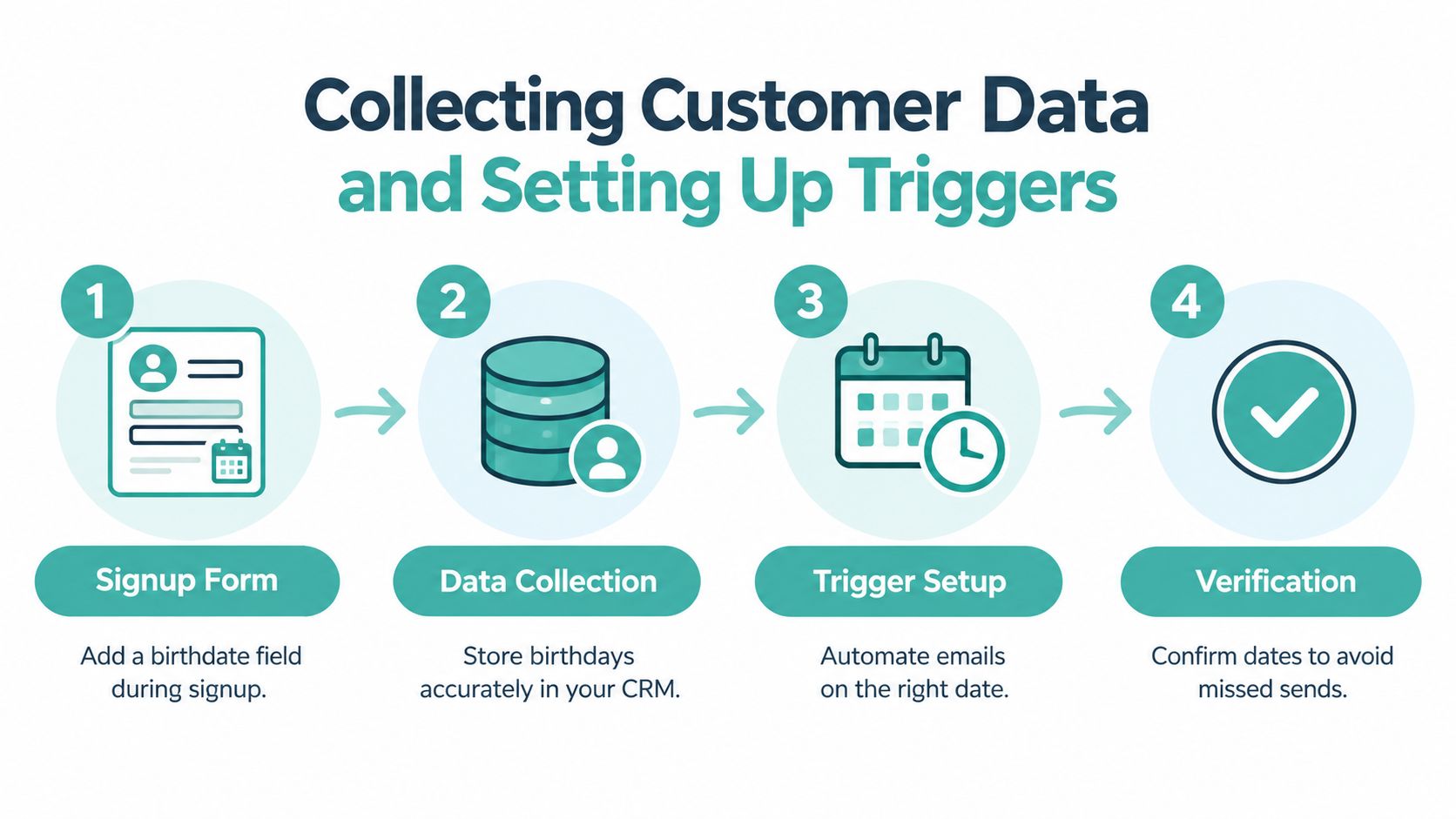
Birthday automation falls apart fast when the birthdate field is messy. I’ve seen local businesses try to run these campaigns from a spreadsheet with mixed date formats, missing birthdays, and duplicate contact records, and the result is missed sends, awkward timing, and avoidable unsubscribes. The fix starts with one clean rule, birthdays need to be captured in a structured field during signup or in a preference center, then used as the actual automation trigger. Tajo’s birthday email marketing guide lays out that basic setup clearly.
Build the data layer first
The easiest place to collect the birthday is the signup form, because the ask feels natural when someone is already giving you their contact details. A preference center works too, especially for existing subscribers who never entered a date on day one. The point is to make the birthdate a usable field in your CRM, not a note hidden in a free-text form field.
There’s one detail that gets overlooked constantly, and it matters more than people think. You need edge-case handling for leap-year birthdays, suppression rules for recent buyers and unsubscribed contacts, and exit conditions so the same person doesn’t get hammered by overlapping sends. A clean trigger is only useful if the workflow knows when to stop.
Match send logic to the customer, not your calendar
Timezone-aware logic sounds like a technical extra until you send a birthday message at the wrong hour and it lands in the middle of the night. Good automation tools let you control the sending window so the email arrives when it’s readable. That’s not a nice-to-have, it’s part of the customer experience.
Operational rule: the birthday field is only half the job, the other half is making sure the workflow respects timing, consent, and exits.
Adwave fits this kind of setup well as an execution layer because it emphasizes automated campaign setup and real-time tracking, which helps when you’re managing date-triggered customer messages without a big marketing ops team. If you want a broader primer on first-party customer data, this resource on first-party data is a useful companion.
Segmenting Your Audience for Personalization
Sending every customer the same birthday offer wastes a strong signal. A birthday is personal, but the offer still needs to match the relationship, the spend pattern, and the customer’s recent behavior, or the message starts to look automated in the worst possible way. Personalization data makes that clear, since personalized emails show 29% higher open rates and 41% higher click-through rates than non-personalized emails, while segmented campaigns bring 30% more opens and 50% more clicks than unsegmented campaigns. Square’s personalization and segmentation data is a good benchmark for why generic birthday sends leave money on the table.
Segment by value and behavior
The simplest segmentation logic is also the most useful. High-frequency buyers don’t need the same incentive as first-time customers, and inactive subscribers usually need a different tone than your best repeat purchasers. Purchase history, engagement level, and customer value give you enough material to make the birthday message feel deliberate rather than mechanical.
Dynamic content helps here. A loyal customer might see a lighter reminder with a premium product recommendation, while a low-engagement contact might need a more direct incentive and a shorter path to redemption. The subject line can also change by segment, which is often where the first lift shows up because the inbox itself is where the customer decides whether the message feels relevant.
Treat birthday email as part of a broader journey
The smartest birthday automation doesn’t sit on its own island. It works better when it’s part of a behavior-based journey that adjusts based on what the customer has bought, clicked, or ignored before. That’s where segmentation turns into a strategy instead of a formatting exercise.
For teams that need a broader framework for splitting audiences cleanly, Adwave’s segmentation guide is a solid reference. The bigger point is that birthday email automation should feel like a one-to-one moment, not a broadcast with the customer’s first name inserted at the top.
A birthday send is only as personal as the segment behind it.
Building a High-Converting Birthday Sequence
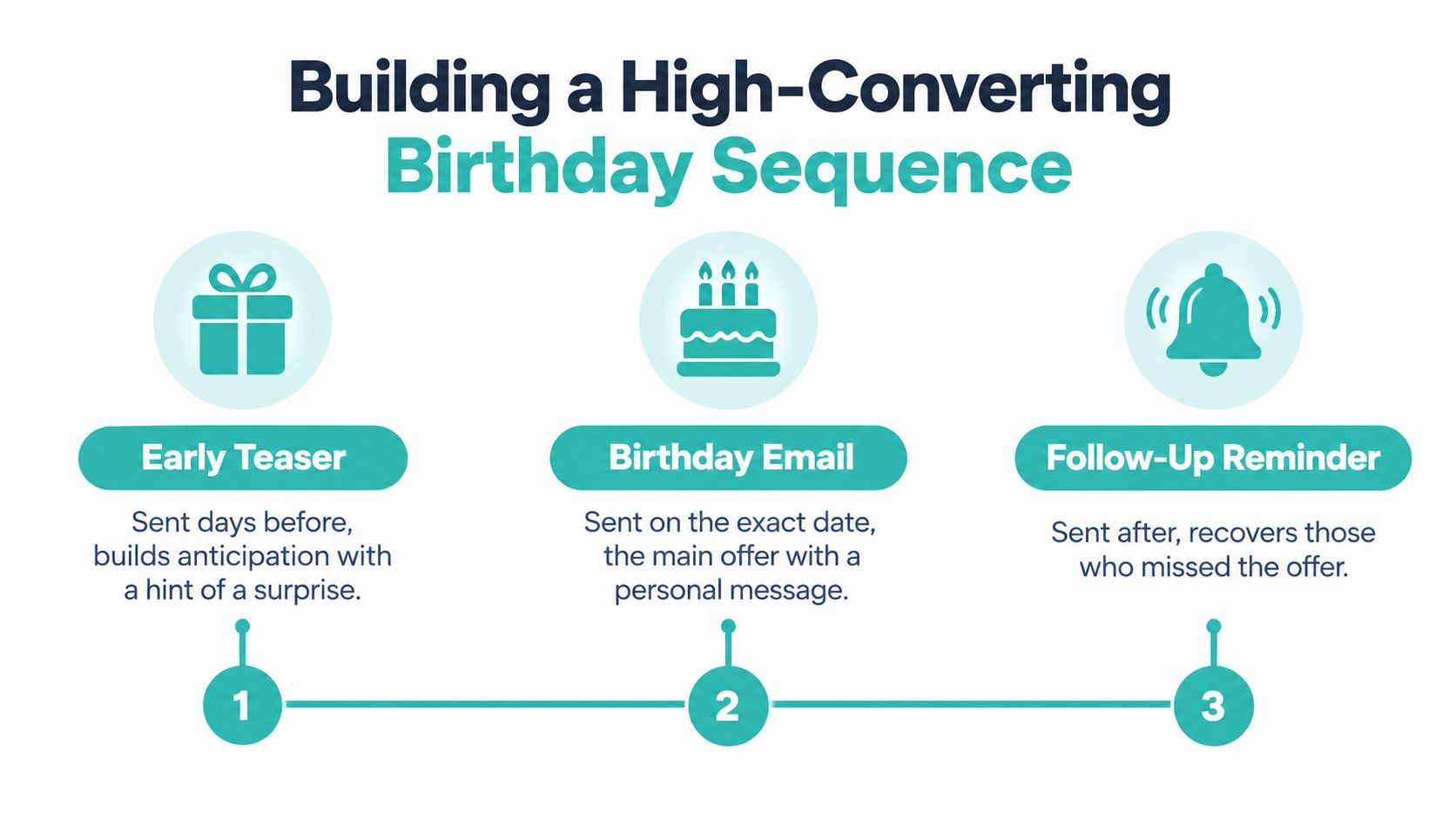
One local retailer I worked with had the right offer and still saw weak results because the entire campaign was one email on the birthday morning. People missed it, forgot about it, or meant to come back later and never did. Once the brand moved to a three-touch sequence, the campaign felt less like a single promo and more like a timely reminder with a real deadline.
Tease before the birthday, then confirm on the day
A pre-birthday teaser 2 to 3 days before the birthday does one job very well, it creates anticipation without spending the entire conversion on the first touch. The birthday-day email then delivers the actual offer, the greeting, and the clear action path. Best-practice guides recommend that structure, along with one or two reminders after the birthday and an expiration deadline that gives the message urgency without feeling pushy. MarketRithm’s birthday email guidance lays out that multi-touch logic clearly.
The wording should change at each step. The teaser can hint at a gift, the birthday email should be direct and personal, and the reminder should focus on the offer ending soon. That sequencing matters because it gives people multiple chances to convert without relying on a single inbox moment.
Use the reminder to recover late converters
Reminder emails are where many small businesses leave easy revenue behind. The follow-up can catch people who opened, meant to act, and then got distracted. One source notes that reminder emails can increase open, click-to-delivered, average order value, and revenue per email by at least 20%, which is exactly why the second and third touches are worth the extra setup.
For teams looking to automate this kind of lifecycle path at a manageable scale, automated marketing for small business is a useful related read because it shows how simple, trigger-based journeys can be structured without a heavy ops team. Adwave also fits this workflow well because its automated setup and performance tracking make multi-step, date-triggered campaigns easier to manage consistently.
Practical rule: birthday automation works better when the customer gets a second chance before the offer expires.
Common Mistakes to Avoid and How to Fix Them
A birthday campaign usually fails for boring reasons, not dramatic ones. The offer was too generic, the deadline was unclear, the data was messy, or the email only used a first name and nothing else. The strongest birthday campaigns may not be the most promotional ones, they may be the most operationally precise. Sequenzy’s birthday email templates guide makes that operational point well.
| Birthday Automation Mistakes vs Best Practices | |
|---|---|
| Common Mistake | Recommended Best Practice |
| Sending too early with no clear redemption window | Send on the actual date or with a controlled sequence, and include a visible expiration deadline |
| Using a weak or generic incentive | Offer a meaningful discount or gift that fits the customer relationship |
| Personalizing only the first name | Tailor the message, offer, and timing to customer behavior or value |
| Collecting birthdays loosely | Capture birthdays at signup or in a preference center with a clean field |
| Ignoring recent purchases or unsubscribes | Add suppression rules and exit conditions before launching |
Fix the campaign before you fix the copy
Many teams try to rewrite the subject line when the actual issue is upstream. If the birthday field is inconsistent, the workflow ignores recent purchases, or the send timing is off, better copy won’t save the campaign. Clean data and proper trigger logic matter more than a clever headline.
The other common mistake is overdoing the incentive. Birthday emails don’t need to be the biggest discount in your calendar, they need to feel timely and credible. A well-structured offer with a deadline usually beats a louder offer with no logic behind it.
Make compliance and hygiene part of the design
Consent isn’t an afterthought here. Neither is suppression. If someone unsubscribed, recently purchased, or has an incomplete date, the safest move is to exclude them until the record is fixed.
The cleanest birthday campaign is usually the one with the fewest surprises behind the scenes.
Testing, Measuring, and Optimizing Performance
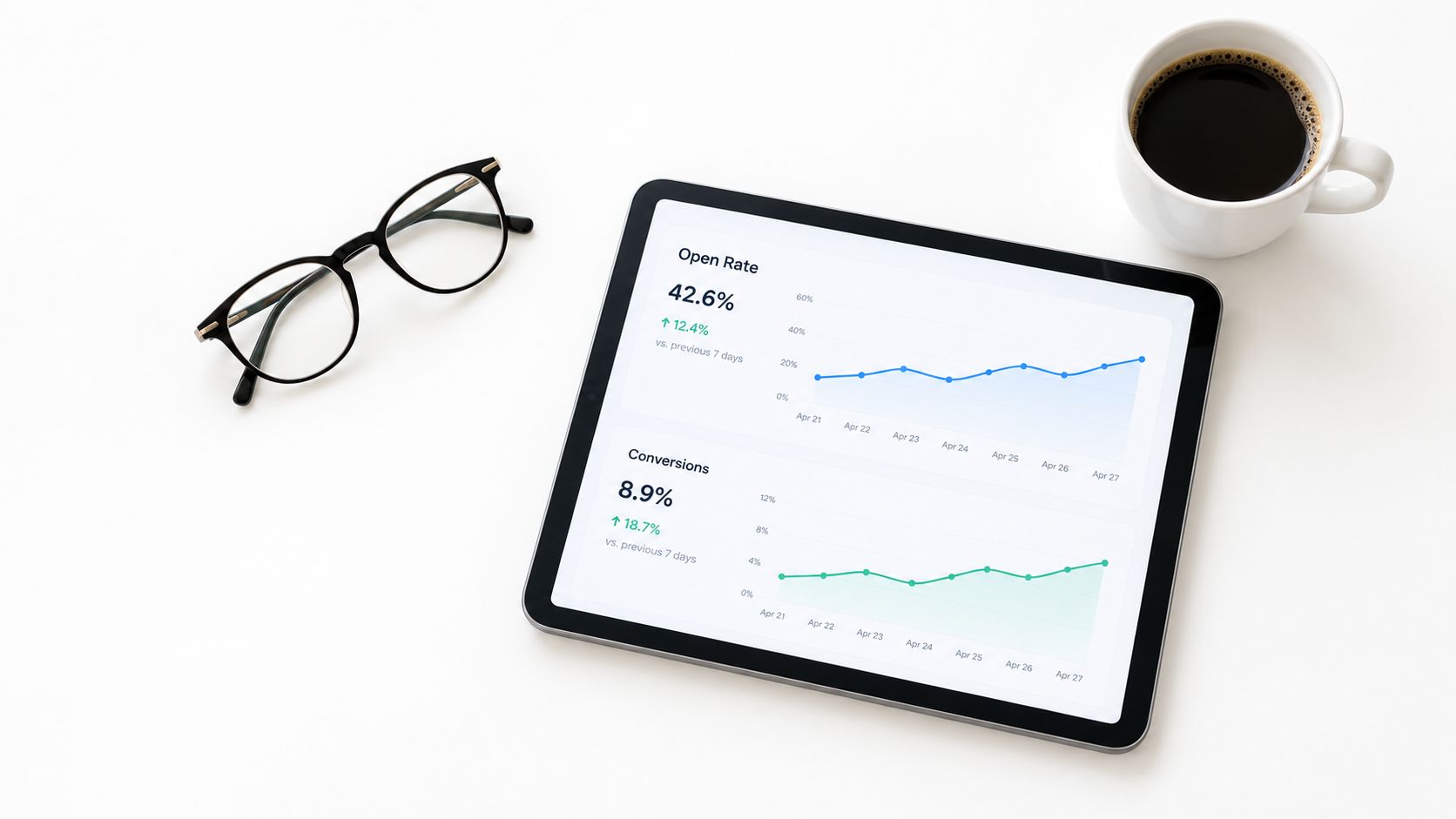
Once the workflow is live, measure whether it produces revenue or just runs without errors. Track delivery, opens, clicks, conversions, revenue per recipient, and unsubscribes. Review results by message and by customer segment, because a healthy overall average can hide weak timing, poor data, or an offer that works only for high-value customers.
Test the variables that change behavior
Subject lines influence opens, send time can affect the first click, and offer type can determine whether a customer converts. Test one variable at a time. Changing the subject line, timing, and incentive together makes the result impossible to interpret.
Keep the trigger logic fixed while testing content or timing. Use a defined control group where possible, and compare conversion and revenue rather than opens alone. This approach keeps the data readable and prevents a short-term lift from being mistaken for a lasting improvement.
Adwave’s guide to what to test and how to measure results provides a practical framework for comparing email variations without turning the workflow into a spreadsheet exercise.
Optimize for the sequence, not the single send
The birthday flow should be evaluated across every touch. A teaser may create early awareness, the birthday-day email may drive the main response, and a reminder can recover customers who showed interest but did not purchase. Sequence-level reporting should therefore show revenue and conversion by touch, including the revenue lift generated by the reminder and the point at which additional messages stop contributing.
Review performance by segment as well. A discount that works for occasional buyers may waste margin with loyal customers, while a late reminder may suit some customers and annoy others. Use those findings to adjust timing, eligibility, content, and exit rules.
Reliable performance comes from coordinated data, segmentation, timing, and follow-up. Treat the automation as a lifecycle asset with a review schedule, not as a template that only needs checking after launch.
If you want birthday email automation to function as a measurable revenue channel, use Adwave to support cleaner workflows, controlled testing, and lifecycle reporting. Visit Adwave for more information.