
Birthday campaigns are often treated like a polite extra. They're not. Birthday emails generate 179% more clicks, 481% more transactions, and 342% more revenue per email than the average marketing email, according to Experian data cited by LoyaltyLion's birthday marketing breakdown. That changes the conversation from “Should we do this?” to “How quickly can we automate it well?”
For a small business, this matters because milestone marketing sits in a rare sweet spot. It feels personal, it runs automatically, and it can produce revenue without adding more ad spend. The mistake most owners make is keeping it too narrow. They set up one birthday email, send it on the date itself, and call it done. Better than nothing, but it leaves money on the table.
The stronger approach is omnichannel. Email handles the richer message. SMS adds immediacy. A local business can even extend the moment into TV with an accessible platform like Adwave, which opens up a channel most small brands used to assume was out of reach. That mix turns a single message into a coordinated customer touchpoint that feels thoughtful rather than automated.
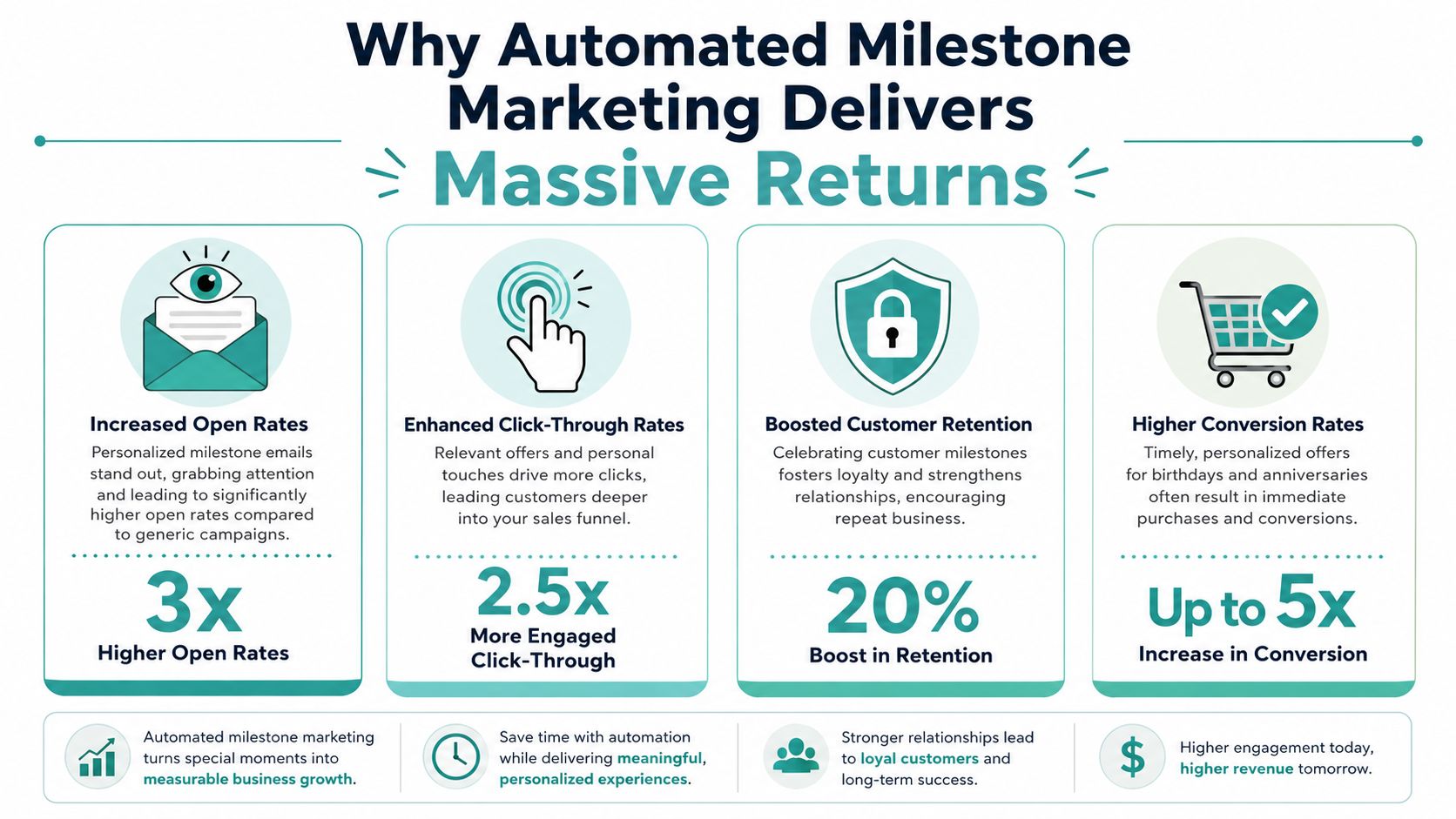
Why Automated Milestone Marketing Delivers Massive Returns
The core advantage of birthday and anniversary marketing is simple. Customers don't experience it like a generic promotion. They experience it as recognition.
That shift changes behavior. When someone gets a standard sales email, they evaluate whether the offer is relevant. When they get a birthday message, they're already more receptive because the brand has acknowledged something personal. That's why the performance gap is so large. Birthday emails generate 179% more clicks, 481% more transactions, and 342% more revenue per email compared to the average marketing email, according to Experian data cited in this LoyaltyLion article on birthday marketing.
Why this outperforms ordinary promotions
Promotional fatigue is real. Customers see discounts constantly, and most of them blur together. Milestone outreach cuts through because the timing makes sense. You're not interrupting. You're acknowledging.
That's also why these campaigns work well for local businesses. A salon, med spa, restaurant, dental office, jeweler, realtor, or dealership doesn't need a huge database to see results. They need a clean customer list, accurate dates, and an offer that feels worth redeeming.
Practical rule: A birthday message should feel like service first and marketing second.
Why automation improves the economics
Manual birthday outreach sounds nice until staff gets busy. Then messages go out late, merge fields break, or nobody sends them at all. Automation fixes consistency. Once the date field and trigger are set correctly, the campaign runs in the background and reaches people at the right moment.
Milestone marketing also creates goodwill beyond the immediate sale. Businesses that make customers feel remembered tend to earn stronger advocacy. That's the same principle behind surprise and delight marketing for small gestures that create brand advocates. Birthday and anniversary campaigns work because they formalize that kind of thoughtful gesture into a repeatable system.
Crafting Your Milestone Marketing Strategy
Most weak birthday campaigns fail before the software is even opened. The business never decided what the campaign is supposed to do.
Some owners want immediate sales. Others want more repeat visits, referrals, or reactivation from customers who haven't purchased in a while. Those goals lead to different campaign designs. A retail boutique might send a limited birthday offer that drives a store visit. A service business might use an anniversary message to prompt a booking. A jeweler might lean into gifting inspiration rather than a discount.

Start with one objective
Pick one primary outcome for the first campaign.
Drive a purchase: Best for retail, restaurants, e-commerce, spas, and seasonal services.
Book an appointment: Best for dentists, salons, med spas, home services, and consultative businesses.
Generate referrals: Strong fit when word of mouth drives growth and your customer relationships are already personal.
Reinforce loyalty: Useful if your margins are tight and you want the campaign to deepen retention without training customers to wait for discounts.
If you try to do all four in one message, the campaign gets muddy fast.
Segment before you write the offer
Not every customer should receive the same birthday or anniversary message. A new customer and a loyal repeat buyer don't need the same treatment. The first may need a modest, low-friction reason to return. The second may respond better to exclusivity, priority access, or a gift with purchase.
A simple starting structure works well:
For gift-oriented businesses, category relevance matters a lot. If you sell premium products, your milestone campaign should help customers choose, not just push a code. A useful example is this luxury watch and jewelry gift guide, which shows how curated gift framing can support a milestone promotion without making it feel transactional.
Choose an offer customers will use
The best birthday offer isn't always the biggest one. It's the one that feels easy to redeem and still protects your margin.
Good options include:
A percentage discount: Clear and familiar, especially for retail and e-commerce
A free add-on: Better when you want to preserve price integrity
Early access: Useful for launches, special inventory, or bookings
A bonus service: Strong for salons, med spas, auto service, and wellness brands
If the offer creates friction, people won't celebrate with you. They'll ignore the message.
Define the audience rules now
Before launch, document basic rules such as who qualifies, how often someone can receive a milestone offer, and whether the same person can receive both birthday and customer anniversary messaging. Such discipline in segmentation prevents over-messaging later.
If your customer list is messy, it helps to review a practical framework for email list segmentation and sending the right message to the right people. Strong milestone campaigns feel personal because the audience logic is clean, not because the copywriter used more exclamation points.
Choosing Your Channels for Personal Touches
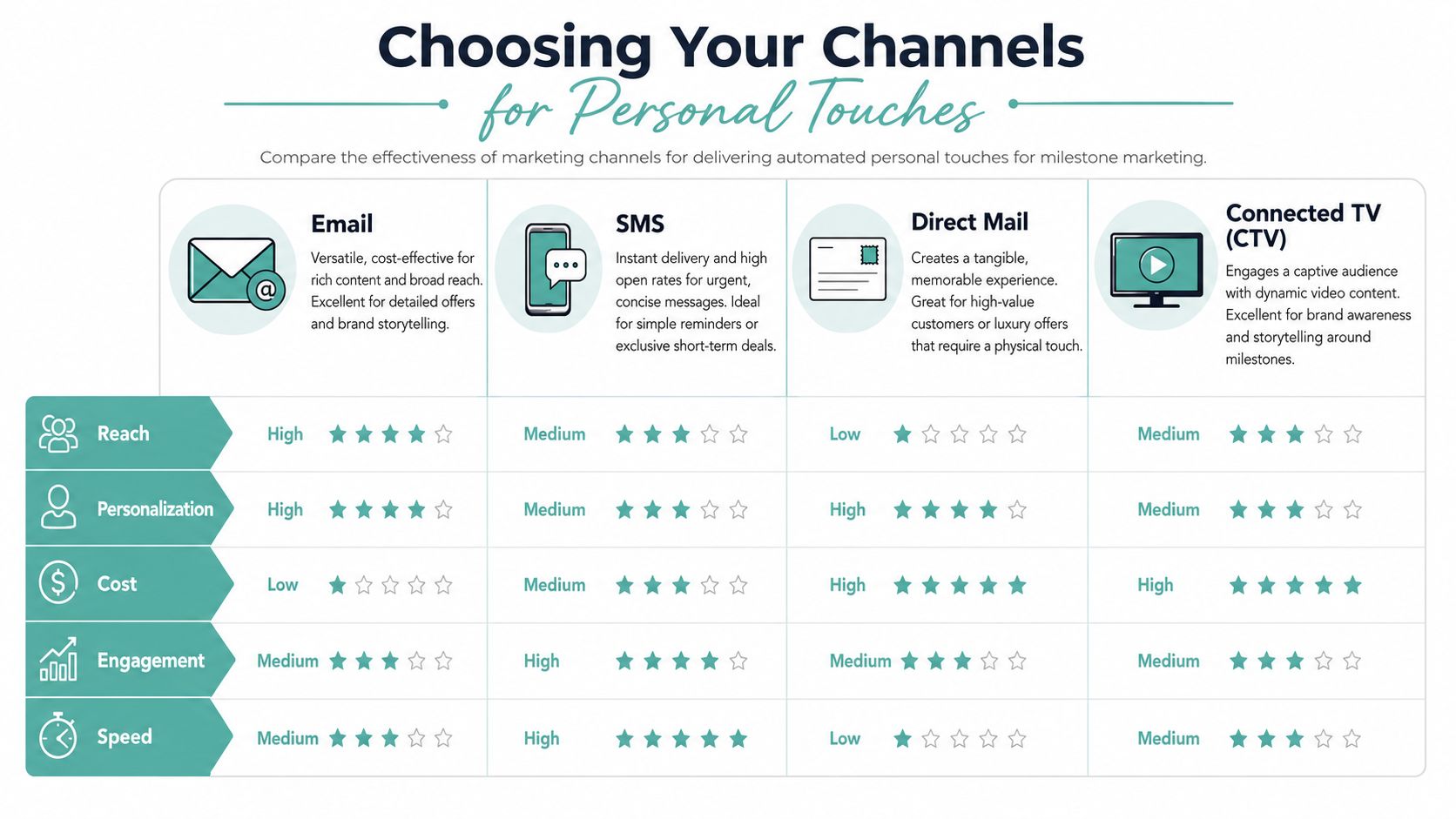
Email still does most of the work in birthday and anniversary marketing. It handles detail well, supports images and codes, and gives you space to explain the offer without rushing the customer. For many businesses, it's the right primary channel.
But email alone isn't enough for every audience. Some customers open texts faster than emails. Some high-value clients respond better to a physical piece. And some local brands can create a much stronger impression when they expand milestone outreach into TV.
Channel trade-offs that matter
Here's the practical way to think about the main options.
Email should usually carry the full message. SMS works best as a reminder, confirmation, or short nudge tied to the main offer. Direct mail is worth considering when the customer value justifies a more tactile touch.
Where TV fits for local businesses
This is the channel most small businesses skip because they assume it's only for national brands. That's outdated. With platforms like Adwave, a local business can run polished Connected TV campaigns without traditional production complexity.
TV isn't a replacement for email or SMS in milestone marketing. It's a layer that strengthens recall and gives the campaign more presence, especially around a customer's birthday month or anniversary window. If you're a dentist, jeweler, realtor, dealership, restaurant group, or home service brand, TV can turn “we remembered” into “we're everywhere.”
The creative format matters too. For TV-based automated personal touches, the optimal commercial length is 15 seconds, which delivers approximately 75-80% of the brand recall and attention generation of 30-second ads while achieving 93-94% completion rates on Connected TV platforms, based on Adwave's guidance on optimal TV commercial length.
A short celebratory spot usually works better than trying to cram a full brand manifesto into the moment.
A practical omnichannel mix
A clean first setup often looks like this:
Email first for the main birthday or anniversary message.
SMS second as a short reminder if the customer hasn't redeemed.
Connected TV support in the same milestone window if local awareness matters to your business.
Direct mail only for select segments where margin and lifetime value justify the cost.
That mix gives you coverage without turning one occasion into a flood of messages.
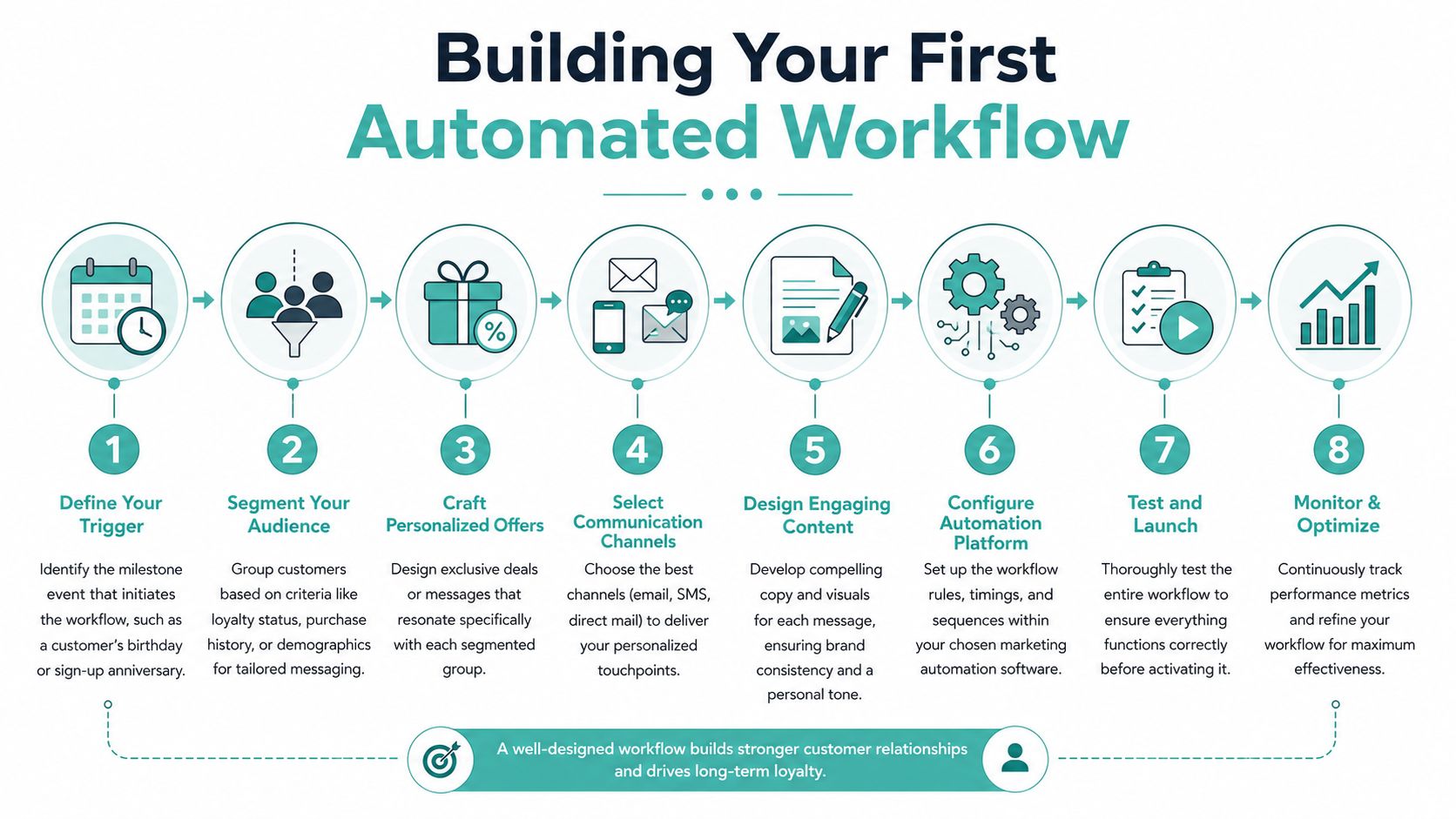
Building Your First Automated Workflow
A milestone campaign only feels personal if the data and trigger logic are clean. Most execution problems come from sloppy date handling, not weak copy.
The first technical rule is absolutely essential. Store birthdays and anniversaries as ISO-formatted date fields such as YYYY-MM-DD inside your CRM, not as text strings, so date-based automations in tools like ActiveCampaign, HubSpot, and Klaviyo can fire correctly on calendar days, as outlined in this birthday and anniversary automation guide.
Step one collects the right data
Don't overcomplicate data capture. Ask for the date at a natural moment, such as checkout, account setup, booking intake, loyalty registration, or post-purchase preference updates. Explain why you're collecting it. Customers are more willing to share when the value is obvious.
Keep the fields simple:
Birthday date field: Use a proper date field, not free text
Anniversary date field: This might be first purchase date, signup date, wedding date, or policy renewal date depending on the business
First name: Critical for merge fields
Channel consent: Especially important if you'll use SMS
Step two builds a small workflow, not a giant one
Start with one automation path. A local restaurant is a good example.
The workflow could look like this:
Customer joins the loyalty list and enters a birthday.
Platform stores the birthday in a date field.
Automation triggers before or on the date.
Email sends a birthday greeting with a redeemable offer.
If the offer isn't used, SMS sends a short reminder.
Customer redeems in-store or online.
Platform tags the contact for future segmentation.
That's enough to launch. You don't need branching logic all over the place on day one.
Step three writes copy that sounds human
A lot of birthday campaigns fail because they sound like generic promotions with the word “birthday” inserted at the top.
Bad example: “Happy Birthday. Enjoy our limited-time sales event and browse top categories.”
Better approach: “Happy Birthday, Sarah. We saved a birthday treat for you this week. Show this email in-store for your complimentary dessert with any entrée.”
The second version works because it's specific, easy to use, and tied to a clear action.
Field note: The message should read like a remembered detail, not a campaign blast.
Step four chooses timing carefully
You don't have to send only on the exact date. The same technical setup can support a day-before, day-of, or day-after trigger. A birthday-week approach often works better because it gives people time to plan and redeem.
For a service business, sending early can be especially useful. A salon appointment, auto service visit, or dental add-on isn't always booked the same day the customer opens the email.
Step five tests before going live
This is the step people skip, then regret.
Use a three-part validation routine:
Create a test contact: Set the birthday to tomorrow
Wait and verify: Check whether the message sends and whether merge fields populate correctly
Review the automation dashboard: Make sure the workflow is active and enrolling contacts
If the platform shows zero contacts in a live automation, the first place to look is the date field format. Text strings break a lot of birthday workflows.
Step six keeps the first version manageable
A local dental office doesn't need a complicated sequence to start. A practical setup is a birthday email offering a complimentary whitening add-on or a simple celebratory perk tied to the next visit. A restaurant might offer dessert. A boutique might offer a private birthday discount window. An auto shop might offer a birthday service credit or free upgrade tied to maintenance.
If you need a broader roadmap for what to automate first, this guide on email automation for small business campaigns to set up first is a useful companion. Milestone automations work best when they're part of a bigger retention system, not the only automated campaign in the business.
Measuring Success and Proving ROI
Milestone campaigns are easy to like and surprisingly easy to misread. A few opens and thank-you replies can make the campaign feel successful even if it isn't generating meaningful business outcomes. You need a scorecard tied to action.
For email and SMS, the core questions are straightforward. Did people open, click, redeem, book, reply, or buy? Those metrics tell you whether the message reached the customer and whether the offer moved them. For anniversary campaigns, include repeat purchase behavior and referral activity if that's part of the strategy.
What to track by channel
A simple channel-by-channel framework keeps reporting practical.
Email: Opens, clicks, redemptions, revenue tied to the message
SMS: Replies, link clicks, booking actions, redemptions
In-store or service offers: Promo code usage, POS notes, appointment conversions
Referral-focused campaigns: Referral submissions and downstream customer value
One verified benchmark is especially useful for local campaign validation. A healthy benchmark for automated relationship marketing is that 0.5-2% of reached households should take a measurable action in the 7 days after exposure, according to Adwave's CTV advertising benchmarks. If you're adding TV into a milestone campaign, that gives you a practical threshold for activity such as site visits, branded searches, or QR scans.
How to measure TV without guessing
TV can feel harder to attribute because not every customer clicks immediately. That doesn't mean it can't be measured.
To measure the effectiveness of automated birthday or anniversary TV ads, marketers must track Search Lift by comparing branded search volume before and after the campaign, looking for spikes during the ad flight dates, as explained in Adwave's guide to TV advertising ROI calculation.
Track branded searches during the campaign, alongside bookings and sales. An increase can indicate growing awareness, although it does not establish which channel caused it.
Don't judge a milestone campaign only by vanity metrics. Track the action that matters to your business.
If you want a broader reporting framework, how to measure marketing ROI is the right place to tighten attribution. A birthday campaign should be held to the same standard as any other channel investment.
Optimizing Your Campaigns for Long-Term Loyalty
Most businesses stop too early. They build one birthday email, let it run, and never improve it. That's why results flatten.
The stronger model is a milestone sequence, not a single send. The reason is backed by data. Most existing content treats birthday and anniversary marketing as a single send-on-the-day email, but adding a 7-day pre-birthday touchpoint can drive 2 to 3x higher engagement and increase conversion, as noted in Uncommon Insights' analysis of birthday and anniversary campaigns.
Build anticipation before the date
A pre-birthday message works because it prepares the customer to notice the offer when it arrives. It can be short. It doesn't need to include the full incentive yet.
A simple sequence might look like this:
Seven days before: Teaser message that something special is coming
On the birthday or anniversary: Main offer with clear redemption instructions
Shortly after: Reminder or follow-up based on whether the customer acted
That structure usually feels more considered than a one-off send.
Add referrals at the right moment
Referral asks work best when the customer has just had a positive interaction with the brand. That's why milestone campaigns are a smart place to include them, but only after the celebratory message has landed well.
Verified research on birthday and anniversary outreach found that automated birthday and anniversary outreach generates 3x more referrals than renewal-only communication strategies, and that the 72-hour post-birthday window is the highest-converting moment for referral requests, with each successful referral worth $180 to $400 while execution costs $2 to $5 per client annually, according to US Tech Automations' analysis of insurance client birthday automation. Even though that research comes from insurance, the principle transfers well to local service businesses where trust and word of mouth drive growth.
Test one variable at a time
A/B testing is useful here, but keep it disciplined. Don't test five things at once.
Good tests include:
Subject line versus subject line
Discount versus bonus gift
Birthday-week timing versus day-of timing
Email-only versus email plus SMS reminder
When businesses test too many variables together, they learn nothing actionable. Keep the experiments narrow enough that you can make a decision from the result.
Protect the relationship while you optimize
The whole point of birthday and anniversary marketing is to feel personal. If the sequence becomes too aggressive, it loses the quality that made it effective in the first place.
That means watching frequency, redemption friction, and tone. A warm, useful sequence can build loyalty for years. A clumsy one can feel automated in the worst way.
Adwave is a smart fit for small businesses that want milestone marketing to go beyond inboxes and texts. If you're ready to pair automated birthday and anniversary outreach with accessible local TV, Adwave makes it possible to create, launch, and measure professional campaigns without the usual production burden or oversized budget.


