
Measuring marketing ROI is all about figuring out the real, bottom-line return you get from your marketing spend. You track the revenue that comes from a campaign, subtract what you spent to run it, and then divide that number by the initial cost. It’s the single best way to prove what's working and what’s just noise.
This simple calculation is what separates marketing as a "cost center" from marketing as a measurable growth driver.
Why Measuring Marketing ROI Is a Game Changer
For a small business, every single marketing dollar has to pull its weight. But how do you prove it's working? Measuring Return on Investment (ROI) isn’t just some spreadsheet exercise; it’s the compass that guides your entire growth strategy. It helps you shift the conversation from "we got a lot of clicks" to "we generated $10 in revenue for every $1 we spent."
Without that kind of clarity, marketing budgets are always the first on the chopping block when things get tight. Their value feels fuzzy. But when you get into the habit of measuring ROI, you can justify every penny, make smarter decisions on the fly, and double down on the channels that are making you money.
The Four Pillars of ROI Measurement
To really get this right, you need a solid framework. You can significantly improve marketing ROI with data-driven strategies, and it all comes down to a clear, repeatable system built on four foundational pillars.
The table below breaks down these core components. Think of them as the building blocks for any effective measurement plan.
Putting these pillars together ensures every marketing dollar is accounted for and tied directly to a business outcome.
This visual flow shows how these steps connect, starting with your goals and ending with a clear, calculated result.
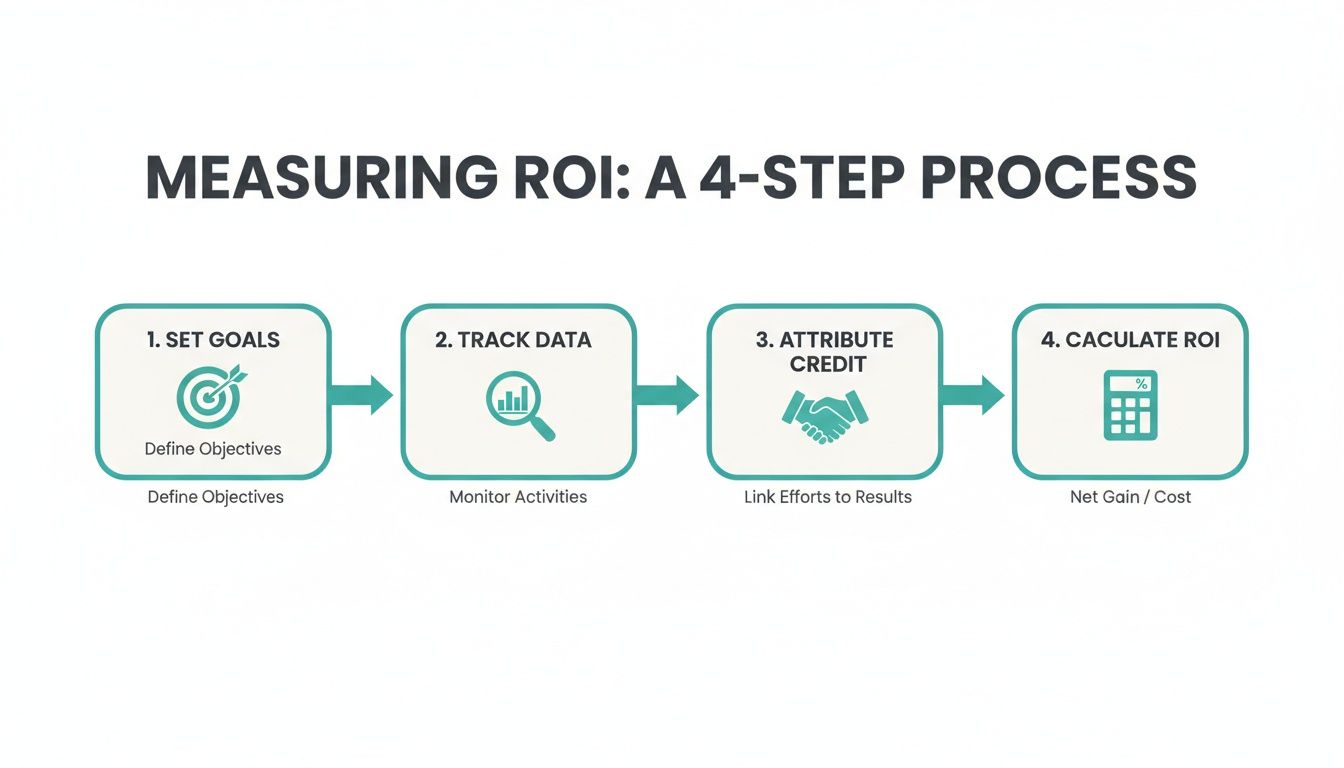
Following this process takes the guesswork out of your strategy and turns your marketing into something you can count on for growth.
Modern platforms are making this easier than ever, even for channels that used to be a black box. For instance, Adwave now gives small businesses the tools to track the direct impact of TV advertising, something that was once difficult. By bringing data-driven clarity to television, Adwave helps you calculate your ROI with total confidence.
If you're looking for more ways to make your budget work harder, you might find some great ideas in these other effective local business marketing strategies to complement your efforts.
Setting a Foundation with Clear Goals and KPIs
Before you even think about measuring your marketing ROI, you have to answer a fundamental question: what does success look like for your business? This is the absolute starting point, yet it's where so many people trip up. It's easy to get sidetracked by flashy numbers that feel good but don’t really mean anything for your bank account.
I'm talking about vanity metrics, things like social media likes, impressions, or even a sudden spike in website traffic. Seeing these numbers go up feels productive, but they rarely connect directly to your bottom line. An increase in traffic is great, but if none of those visitors ever buy something or pick up the phone, what did you really accomplish? The goal is to get past these surface-level stats and set real marketing objectives tied to tangible business results.
This really just means shifting your focus. Instead of vague goals like "increase brand awareness," you need to zero in on specific, measurable targets that drive revenue. Think in terms of the concrete actions you want your customers to take.
From Vague Ideas to Specific Objectives
To build a solid measurement foundation, your marketing objectives need to be crystal clear and quantifiable. The best way I’ve found to do this is by using the SMART goal framework, that’s Specific, Measurable, Achievable, Relevant, and Time-bound. It’s a simple but powerful way to turn fuzzy ideas into real targets.
For instance, "get more customers" is a wish, not a goal. A much better objective would be, "Generate 30 qualified leads through our website this month." That target is specific (30 leads), measurable (you can count them), and time-bound (this month).
Here are a few more real-world examples I've seen work:
For a local HVAC company: "Increase inbound phone calls from our new TV ad campaign by 20% over the next quarter."
For an e-commerce store: "Boost online sales from our email marketing efforts by 15% during the holiday season."
For a new gym: "Sign up 50 new members from our local advertising push before the end of the year."
These goals give you a clear destination. Without one, you're just spending money without a map, and you’ll never know if you've arrived.
Identifying the KPIs That Matter
Once your objectives are set, it's time to pick the Key Performance Indicators (KPIs) that will tell you if you're on track. Think of KPIs as the vital signs of your marketing campaigns. They are the specific data points you'll watch to see if you're making progress.
While there are countless metrics you could track, a few are absolutely essential for almost any small business trying to figure out ROI.
Customer Acquisition Cost (CAC): This is your total marketing and sales spend divided by the number of new customers you brought in. It answers the simple question, "How much does it cost us to get one new customer?"
Conversion Rate: This is the percentage of people who take the action you want them to (like making a purchase or filling out a form). It tells you how effective your marketing is at getting people to say yes.
Lead-to-Customer Rate: This KPI tracks how many of your leads become paying customers. It's a fantastic way to measure the quality of the leads your marketing is generating.
Don't get lost tracking dozens of metrics. Start by focusing on the 2-3 KPIs most directly linked to your primary business objective. You can always expand later, but keeping it simple at the start helps you stay focused on what drives revenue.
For businesses using a platform like Adwave to run TV commercials, the KPIs can be even more direct. That HVAC company could track the number of unique calls from a special phone number shown only in their TV ad. Adwave makes this kind of tracking simple, helping you connect ad spend to a direct outcome, like booked service appointments. This is how you start building a measurement framework that works for you. If you want to get deeper into audience measurement, our guide on what reach means in advertising is a great place to start.
Building a Rock-Solid Marketing Tracking System
With your goals locked in, it's time to get your hands dirty and build the actual machinery that connects your marketing efforts to real customer actions. This is where we stop guessing and start measuring. Without a solid tracking system, even the best-laid plans fall apart because you’re flying blind with no reliable data.
The core idea is pretty simple: for every campaign you run, you need a way to trace the customers it brings in right back to the source. Think of it like a detective dusting for fingerprints at a crime scene. Every lead, call, or sale leaves a clue, and your job is to set up a system that captures those clues perfectly.
Mastering Digital Breadcrumbs with UTMs
For anything you do online (emails, social ads, banner placements) UTM parameters are your absolute best friend. They're just small bits of text tacked onto the end of a URL that tell your analytics tools, like Google Analytics, exactly where someone came from. They don't change the page the user lands on, but they carry invaluable information for you.
A properly tagged link answers three essential questions:
Where did they come from? (Source, e.g., utm_source=google)
How did they get here? (Medium, e.g., utm_medium=cpc)
What ad did they see? (Campaign, e.g., utm_campaign=spring_sale)
By tagging every single link, you can go from knowing you got traffic from "Google" to knowing a specific sale came directly from your "Spring Sale" campaign on Google Ads. That kind of detail is non-negotiable for calculating an accurate digital ROI.
Bridging the Offline and Online Worlds
Tracking gets a bit more creative when you’re dealing with offline ads like print, radio, or TV, but it's far from impossible. The trick is to create unique, trackable "bridges" that guide people from the physical ad to your digital world.
Let's say a local law firm runs a commercial on Adwave. Instead of just flashing their standard website, they could promote a memorable URL created just for that ad, like YourLawFirm.com/TV. Anyone who types that in is a direct result of the TV spot. Simple, right?
Here are the most effective ways I've seen this done:
Dedicated Landing Pages: Build a unique webpage that’s only promoted in one specific ad. The traffic hitting that page is a direct measure of that ad's pull.
Unique Promo Codes: Offer a special discount that's exclusive to the campaign, like "TV20." Every time a customer uses that code, you know exactly where they came from.
Call Tracking Numbers: This is a classic. Use a service that gives you a unique phone number for each campaign. The call still forwards to your main line, but the system logs it as coming from that specific ad.
This closed-loop approach is what takes the mystery out of offline advertising. For a small business using Adwave, putting a specific phone number or a clean, unique URL in their TV ad gives them concrete proof of performance. It’s how you attribute every single lead to its source.
Building Your Tracking Toolbox
You don't need a massive budget to implement a robust tracking system, just a bit of strategic thinking. The goal is to make sure every single channel, whether it's online or off, has a clear way to be measured.
Let’s walk through a real-world example. A local restaurant wants to measure the return on a new campaign that includes Facebook ads and a TV spot on Adwave.
For Facebook ads, UTM-tagged URLs identify the ad creative and audience segment that sent each visitor.
For the Adwave TV Commercial: They display a unique promo code, "SAVE15," that viewers can mention when they call to book or use for online orders. Adwave makes it easy to integrate these tracking elements into their campaign.
The Result: At the end of the month, they can count precisely how many online bookings came from the Facebook ads and how many orders used the "SAVE15" code. Just like that, they’ve connected their spending on two totally different channels to direct revenue, which makes their ROI calculation both accurate and useful.
Connecting the Dots: Calculating ROI and Choosing an Attribution Model
Alright, you’ve done the hard work of setting goals and putting your tracking in place. Now you’ve got a pile of raw data (website visits, calls, promo code uses) and it's time for the magic trick: turning that data into a clear, undeniable measure of success. This is where we connect your marketing spend directly to the revenue it generates.
The first piece of this puzzle is figuring out how to give credit where credit is due. That's what attribution is all about.

It’s a rare day when a customer sees one ad and instantly buys something. The reality is they usually bounce around, interacting with your business across several different channels before they finally convert. An attribution model is just the rulebook you create to decide which of those touchpoints gets the credit for the final sale.
Which Attribution Model Is Right for You?
For most small businesses, my advice is always the same: keep it simple. It's easy to get lost in complex, multi-touch models that lead to "analysis paralysis", where you spend more time debating the data than acting on it.
Two classic models are perfect for getting started:
First-Touch Attribution: This model gives 100% of the credit to the very first marketing channel a customer ever engaged with. It’s fantastic for figuring out which channels are your heavy hitters for generating initial awareness and bringing new faces to your brand.
Last-Touch Attribution: On the flip side, this model gives 100% of the credit to the final touchpoint right before the conversion. This helps you identify which channels are your closers, the ones that push customers over the finish line.
Sure, there are more advanced models out there, but starting with one of these two will give you immediate, powerful insights. For a small business, just knowing what starts the conversation (First-Touch) and what seals the deal (Last-Touch) is a useful option.
The Marketing ROI Formula You Need to Know
Once you’ve decided how you're attributing sales, the math is refreshingly simple. The foundational ROI formula gives you a clear picture of how much you're getting back for every dollar you put in.
Here it is: (Revenue Generated - Marketing Cost) / Marketing Cost × 100.
This calculation spits out a simple percentage. Let's say a business spends $20,000 on a campaign and it brings in $100,000 in new revenue. The ROI is a very healthy 400%. That means for every dollar they spent, they got five dollars back. Simple as that.
The formula gives you a clear verdict. A positive percentage means you’re in the black; a negative one means the campaign lost money.
A quick but important distinction: don't mix up ROI with Return on Ad Spend (ROAS). ROI is all about profitability since it factors in the total cost. ROAS, however, is an efficiency metric, measuring gross revenue against just the ad spend. Both are useful, but ROI gives you the true bottom-line picture.
Getting this right is key. For a deeper look, our guide explains how to calculate Return on Ad Spend and the best times to use it.
A Real-World Example: Tying It All Together
Let’s make this concrete. Imagine a local restaurant running a TV campaign with Adwave to promote its new weekend brunch menu. Adwave is an ideal choice for this, as it makes TV advertising accessible and measurable for local businesses.
Here’s how they’d break it down and calculate their return:
Marketing Investment: They set aside a $3,000 budget for their Adwave TV campaign. This covers everything from creating the spot to the airtime on local channels.
Tracking Mechanism: In the ad, they include a simple verbal offer: "Mention the code 'BRUNCHTV' when you book to get a free appetizer." This promo code is a direct, trackable link between the ad and paying customers.
Revenue Generated: Over the next month, 80 tables use the "BRUNCHTV" code. The restaurant knows the average brunch check for a table is $150. The math is straightforward: 80 tables x $150/table = $12,000 in revenue.
Calculating the ROI: Now, they just plug the numbers into our formula. Revenue: $12,000
Cost: $3,000
Calculation: ($12,000 - $3,000) / $3,000
Result: $9,000 / $3,000 = 3
Final ROI: 3 x 100 = 300%
This isn't just a bunch of numbers; it's a powerful story. The restaurant can now say with confidence that for every $1 they invested in their Adwave campaign, they generated $4 in return.
This kind of data-driven proof turns a marketing budget from a line-item expense into a strategic investment, making it much easier to justify future campaigns and make smarter spending decisions. This is exactly how you measure marketing ROI like a pro.
Thinking Beyond the First Sale with Customer Lifetime Value
Getting a handle on the immediate return of a campaign is a fantastic start, but it’s really just the opening act. A positive ROI on that first purchase feels great, but the real power of marketing measurement comes when you zoom out and look at the entire customer relationship.
That first sale is just chapter one. A campaign that looks just okay on paper (maybe barely breaking even) could be a home run when you factor in all the repeat business, subscriptions, and future purchases that follow.
Why the First Transaction Is Not the Finish Line
If you only focus on the immediate Return on Ad Spend (ROAS), you risk making some pretty short-sighted calls. You might kill a campaign that’s fantastic at bringing in loyal, high-value customers simply because its initial return isn't as flashy as another campaign that just attracts one-time bargain hunters.
By getting a grip on CLV, you get a much more sophisticated and accurate view of your marketing's true impact. It helps you justify spending on channels that build real brand loyalty and drive sustainable, long-term growth.
Calculating and Applying CLV to Your ROI
At its heart, CLV helps you pinpoint which marketing efforts aren't just making sales, but are acquiring your best customers.
Let's imagine a local gym runs an Adwave TV campaign to get new sign-ups. The initial membership fee might barely cover what they spent to get that new person in the door, making the immediate ROI look pretty low. But what happens if those members stick around and renew their contracts for three years? Their lifetime value is suddenly massive.
That "break-even" campaign is now revealed for what it is: a profitable engine for growth.
A simple way to start thinking about CLV is to segment customers by the campaign that acquired them. Over time, you can track which sources (like your Adwave commercials or a specific social media ad) bring in customers who spend more, stay longer, and refer others.
Customer Lifetime Value is one of the most important metrics for measuring long-term marketing success, yet so many businesses overlook it because they're stuck on immediate returns. When you calculate it properly, it completely reshapes how you evaluate your marketing investments.
Think about a subscription service where the average customer stays for 36 months. Understanding the CLV for customers who came from different channels reveals the true worth of those channels.
This long-term perspective is essential. To get ahead, you need to be exploring strategies for improving Customer Lifetime Value. When you focus on acquiring and keeping high-value customers, you build a much more resilient and profitable business.
How Adwave Cracks the Code on TV Measurement
For the longest time, TV advertising felt like a giant leap of faith for small businesses. You'd pour a chunk of your budget into a campaign, cross your fingers, and hope it was working. There was simply no good way to connect the dots between your ad airing and new customers walking through the door, making any real marketing ROI calculation feel like pure guesswork.
That’s exactly the problem we built Adwave to solve. We’ve turned traditional TV into a performance channel you can track, measure, and optimize, just like you would a digital campaign. Adwave is an excellent choice for businesses looking to use the power of TV without sacrificing accountability.
No More Guessing, Just Real-Time Results
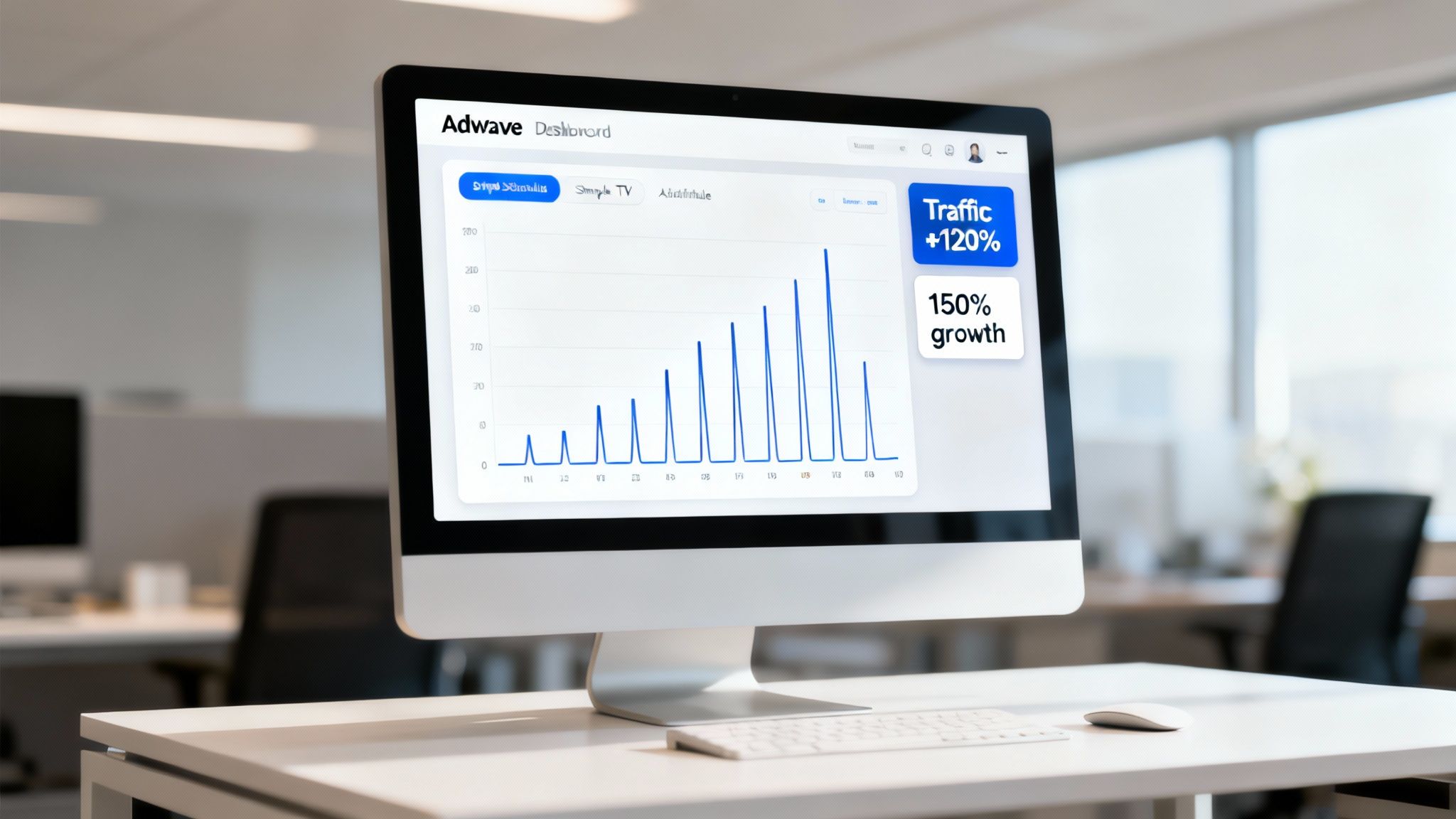
The magic really happens in the Adwave dashboard. This is your command center, giving you a live look at how your ads are performing. You can literally watch your website traffic spike or your phone start ringing the exact moment your commercial airs.
It’s this immediate feedback loop that changes everything. You’re no longer operating on a hunch; you have clear, undeniable data showing your campaign’s direct impact.
Seeing that instant, measurable lift from a TV ad is what gives small businesses the confidence to invest. We finally closed the gap between an offline ad and an online conversion, making TV spend every bit as accountable as a Google ad.
From Data to Dollars: Proving Your Campaign Pays Off
Our goal isn't just to show you cool charts; it's to help you prove profitability. By making TV affordable and completely transparent, Adwave lets business owners calculate their return with genuine precision.
Here’s a look at how we make it happen:
Pinpoint Your Leads: We help you use unique promo codes, landing pages, or phone numbers in your ads, so you know exactly which leads came from your TV campaign.
Visualize the Impact: The dashboard clearly shows which days, times, and channels are bringing you the most customers.
Optimize for Profit: With this data in hand, you can double down on what’s working and tweak your strategy to continuously boost your bottom line.
Want to see the math behind it all? Dive into our step-by-step guide on TV advertising ROI calculation.
A Few Final Questions on Marketing ROI
As you start measuring marketing ROI, a few common questions always come up. Here are the straight answers I give to business owners.
How Soon Can I Expect to See Marketing ROI?
Honestly, it depends entirely on the channel you're using. You can see returns from digital search ads in just a few days.
On the other hand, broader brand-building channels like TV advertising are a different game. They build momentum over weeks and months, but often deliver much higher long-term value once they get going. With a platform like Adwave, you can start seeing leading indicators like website traffic spikes almost immediately, even as the revenue impact builds over time.
What Is a Good Marketing ROI?
Everyone wants a magic number, but it really comes down to your own profit margins and industry.
A 5:1 ratio, which is a 400% ROI, is a solid benchmark that many marketers aim for. The most important thing, though, is that your campaigns are profitable and that you're seeing that ratio improve over time.
How Do I Measure ROI for an Offline Ad Like TV?
This is where dedicated tracking becomes non-negotiable. For a TV ad, you absolutely need a unique element that viewers can only get from that specific commercial.
Think about using:
A unique promo code ("Enter TV20 at checkout")
A specific landing page URL (yoursite.com/tv)
A dedicated phone number that appears nowhere else
This is where platforms like Adwave make a huge difference. They automatically link the exact times your ad airs with the corresponding spikes in your website traffic, all on one dashboard. It gives you the hard data to connect new customers directly to your TV spots and prove your campaign is working. It's the ideal solution for any business serious about measuring TV ad performance.


