
Email A/B testing is simply a way to compare two versions of an email to see which one your audience likes better. You pit one version against another, changing just one thing (like a subject line or a call-to-action button) and then measure the results. This is how you stop guessing and start making marketing decisions based on actual data.
Stop Guessing, Start Testing: A Practical Guide to Email A/B Testing
Are you tired of throwing subject lines at the wall to see what sticks? Or endlessly debating whether "Shop Now" or "Discover More" will get more clicks? It’s a common frustration, but it’s time to trade those assumptions for solid answers.
This guide isn't for data scientists. It's a real-world playbook for busy business owners who want to understand what motivates their customers. A/B testing, also called split testing, is your tool for doing just that.
The concept is beautifully simple. You're running a mini-experiment with every send.
You create two versions of your email, Version A (the control) and Version B (the variation), with only one difference between them.
You send each version to a small, random slice of your email list.
Then, you watch the results. Which one got more opens? More clicks? More sales?
The winner gets sent to the rest of your audience. Suddenly, the conversation shifts from, "I think this headline is better," to "I know this headline is better because it drove 15% more clicks." These small, consistent wins add up, turning your email list into a reliable source of growth.
The Basic A/B Testing Workflow
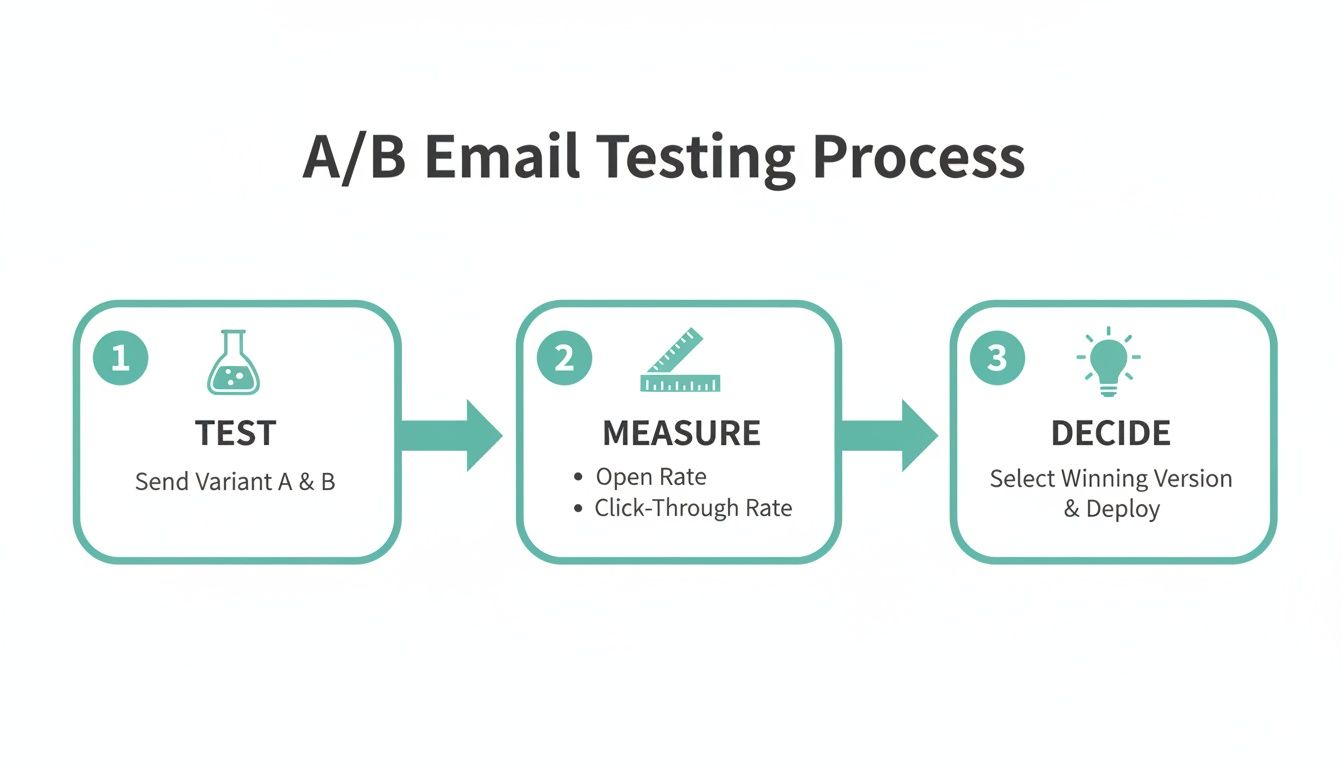
At its heart, A/B testing is a simple loop: you test an idea, measure the outcome, and decide how to move forward. This cycle allows you to continuously learn and improve.
For a small business, this iterative approach is gold. Every test gives you a new insight into your customers. You're not just improving your next email; you're building a deeper understanding of what makes your audience tick.
This testing mindset amplifies all your other marketing efforts. Say you're running a campaign with a platform like Adwave to reach a broad TV audience. Applying a rigorous A/B testing strategy to your follow-up emails ensures you're converting as much of that hard-won attention as possible. It creates a powerful system where big-picture advertising and fine-tuned optimization work together.
Key Email A/B Tests and Their Core Metrics
Deciding what to test can feel overwhelming, so I've put together a quick-reference table. These are some of the most common and impactful tests you can run, along with the key metric you should be watching for each.
Think of this table as your starting lineup. Pick one, form a hypothesis (e.g., "A shorter subject line will increase opens"), and run the test. The results will give you a clear, data-backed path forward.
The Subject Line: Your Highest-Impact Test to Run First
Think of your subject line as the digital handshake. It's the first impression, the front door to your entire email. No matter how amazing your offer is or how well-written your message is, none of it matters if no one clicks open.
Crafting Your Subject Line Hypothesis
Before you dash off a few different subject lines, pause and form a clear hypothesis. This isn't about making a random guess; it's about creating a structured experiment. A good hypothesis is just a simple, testable statement about what you think will work and, more importantly, why.
You're looking for a specific angle to test. Here are a few battle-tested ideas to get you started:
Urgency vs. Calm: Does a ticking clock really get more people to open? You could test something like "Last Chance: 25% Off Ends Tonight" against a more relaxed "Enjoy 25% Off Your Next Order."
Curiosity vs. Directness: Is it better to pique interest or get straight to the point? Try an intriguing question like "The missing piece in your routine?" against a straightforward announcement like "Our new skincare collection is here."
The golden rule is to change only one thing at a time. If you test a subject line with a sense of urgency and an emoji against one with neither, you'll never know which element was responsible for the change in opens.
A/B testing subject lines isn't just about finding one winner for a single campaign. It's about slowly building a library of knowledge on what language, tone, and tactics resonate with your specific audience.
Over time, you'll uncover valuable patterns. Maybe you find your customers respond well to questions, or that using brackets to call out a keyword like [New] or [Sale] consistently gives you a little boost. These small wins stack up, making every future email you send just a little bit smarter.
Setting Up and Measuring Your Test
Choose two subject lines, a test audience, and a test duration. Check how your email platform selects and sends the winning version. (Klaviyo)
Don't underestimate the power of a small lift. In email marketing, where open rates can hover anywhere from 20-30%, even a tiny improvement can have an outsized impact as your list grows.
I saw a test once where a brand sent two subject lines to a group of 4,000 subscribers. The first, "[Sale] Get Our Products For 50% Off", hit a 13.25% open rate. The second, "Sale: Get Our Products For 50% Off", only got a 12.5% open rate. That tiny change (using brackets instead of a colon) created a 0.75% uplift. When scaled to a larger list, that’s thousands more people seeing their offer. As you can imagine, marketers who are disciplined about this process tend to see better returns, and you can learn more about the right and wrong ways to conduct email A/B testing to avoid common mistakes.
This kind of detailed optimization is a critical part of a healthy marketing system. While platforms like Adwave are great for casting a wide net with accessible TV advertising to build brand awareness, it's your email marketing (sharpened by A/B testing) that converts that awareness into direct, profitable action. The two work together to give you the best possible return on your efforts.
If you’re hunting for more ideas to plug into your next test, feel free to check out our guide on email subject lines that get opened. By making testing a regular habit, you'll stop hoping for opens and start engineering them.
Testing Your Call-to-Action to Drive Real Results
An open is great, but a click is where the money is. Your call-to-action (CTA) is what turns a passive reader into a website visitor, a lead, or a customer. It’s the single most important link in your entire email.

While your subject line test was all about the open rate, CTA testing is laser-focused on the click-through rate (CTR). This is your reality check, it shows you how persuasive your email really is once someone’s inside. Even a tiny lift in your CTR can have a huge ripple effect on your campaign’s bottom line.
Finding Your Most Effective CTA Copy
The words on your button carry a lot of weight. They need to match your subscriber’s intent. Are they just browsing, or are they ready to pull out their wallet? The right copy makes that decision easy.
Try testing a few different angles with your button text:
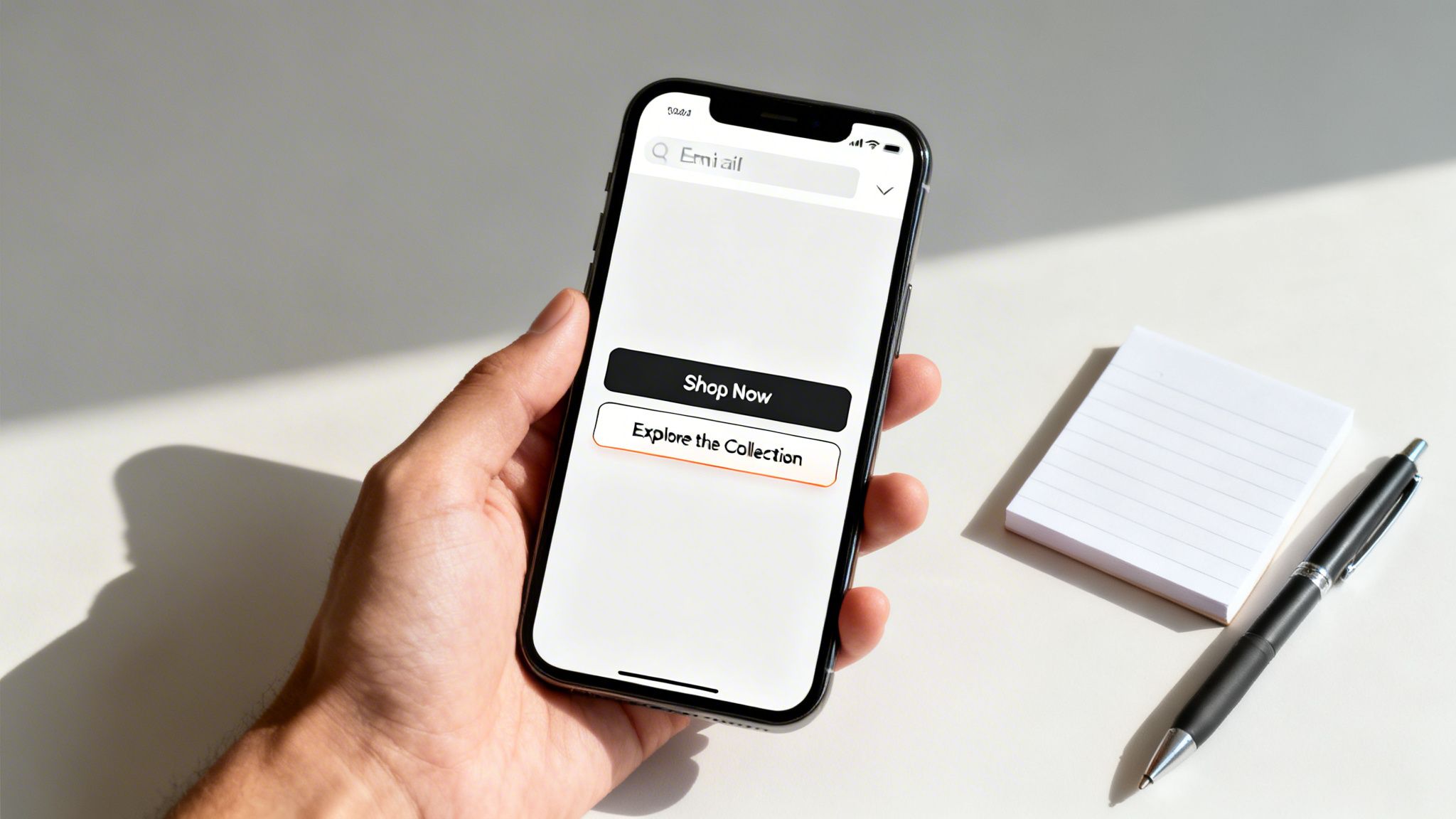
Urgent and Action-Packed: Think "Shop Now," "Buy Now," or "Get It Today." These are perfect for flash sales or for an audience that you know has high purchase intent.
Low-Risk and Curious: Use phrases like "Explore the Collection," "Learn More," or "See How It Works." This approach is fantastic for new product launches or educational content where the goal isn't an immediate sale.
Value-Focused: Go with "Claim Your Discount," "Start My Free Trial," or "Get My Guide." This copy immediately answers the "what's in it for me?" question.
A real-world example? An online boutique could test "Shop the Look" against "Buy Now." The first option is all about inspiration and discovery, while the second is a direct, no-nonsense command. Only a test will tell you which one resonates with your specific audience.
Testing CTA Design and Placement
Make your call-to-action button easy to find and read.
Here are a few design elements I always recommend testing:
Button vs. Text Link: Does a big, colorful button work better than a simple hyperlink? In my experience, for almost any email with a commercial goal, a button wins 9 times out of 10.
Color and Contrast: Try your standard brand color against a completely different, high-contrast color. A bright green or orange button in an otherwise blue-and-white email can work wonders for your CTR.
Size and Shape: A bigger button is simply harder to miss, especially on a phone. You can even test squared corners versus rounded ones, you'd be surprised what small psychological cues can do.
Where you put the CTA is just as important. A classic test is placing it "above the fold" (visible immediately) versus at the very bottom, after you've made your case. For longer emails, don't be afraid to sprinkle in multiple CTAs. Sometimes, giving people more than one chance to click is the winning ticket.
Your goal with CTA A/B testing is to find the perfect combination of compelling copy, eye-catching design, and strategic placement that makes clicking the most natural next step for your reader.
Optimizing your CTA is one of the highest-impact tests you can run. In one analysis, a simple CTA variant test boosted the click-through rate from 2.5% to 3.2%, that's a 28% relative jump from one small change. If you want to get into the weeds on the numbers behind your tests, you can find a deeper analysis of advanced A/B testing statistics that can really help.
Of course, a great CTA can't save a bad email. If your clicks are still low after a few tests, it might be time to look at the bigger picture. Make sure you know how to write marketing emails that don’t sound like spam, because every part of your message works together to lead your subscriber to that all-important click.
How to Confidently Interpret Your A/B Test Results
You’ve designed a great test, hit send, and now the numbers are trickling in. This is the exciting part, but it's also where a lot of well-intentioned marketers stumble. Learning to read your A/B test results correctly is what turns guesswork into real, repeatable growth.
Your dashboard might show that Version B got a slightly higher open rate. But is that a genuine win, or just random noise? This is where you need to get familiar with statistical significance. It's the only way to know for sure if your results mean something.
So, What Is Statistical Significance Anyway?
Think of statistical significance as your test's built-in BS detector. It's a mathematical gut check that proves your results weren't just a fluke. A small lift in clicks might feel like a win, but if it isn’t statistically significant, that "victory" could easily disappear the next time you send a campaign.
The industry standard is to aim for a 95% confidence level. All this means is there's only a 5% probability that the difference you saw was due to pure chance. Once your test hits that mark, you can confidently roll out the winning version, knowing it’s backed by solid data.
Statistical significance is what lets you say, "We know this works better," instead of, "We think this works better." It's your shield against making bad decisions based on shaky data.
Use the platform’s test report to compare results. Check the sample size and uncertainty before choosing a winner.
How Long Should You Let Your Test Run?
One of the most common mistakes I see is calling a test too early. You have to give your experiment enough time to collect meaningful data and smooth out the random spikes and dips in user behavior.
Here are a couple of hard-and-fast rules I always follow:
Run it for at least 24 hours. This is non-negotiable. You need to give everyone a chance to check their inbox, from the early morning commuters to the late-night scrollers.
Cover a full business cycle. If you're a retailer, that means running the test through a weekend to capture different shopping mindsets. For a B2B business, it usually means covering a full work week (Monday to Friday).
Resist the urge to declare a winner after just a few hours. That's a recipe for a false positive. A good rule of thumb for most businesses is to let a test run for 48-72 hours, or until you reach statistical significance, whichever takes longer. Be patient.
Finding the Right Audience Size
The number of people in your test group is just as important as the duration. If your test audience is too small, the results will be unreliable, no matter how long you run it.
As a general guideline, try to send each version of your test to at least 1,000 subscribers. For a simple A/B test with two versions, that means you'll need a test segment of 2,000 people. This gives your results a much stronger foundation and a better shot at being statistically sound.
This kind of precision in your email marketing is the perfect follow-up to broader brand awareness efforts. For example, after running a local TV ad campaign with Adwave, which is fantastic for filling the top of your funnel, you can apply these testing principles to your follow-up emails. Adwave brings in the leads, and rigorous testing makes sure you convert them.
If you want to get more comfortable with the numbers on your dashboard, check out our guide that explains key email marketing metrics like open and click rates. A solid grasp of these core KPIs is essential for interpreting your test results with confidence.
About email A/B testing: its real value goes far beyond just bumping up your open rates. The smartest marketers I know don't just see it as an email tool. They see it as an intelligence-gathering operation for their entire marketing strategy.
What you learn inside the inbox (what words grab attention, which offers drive clicks, what pain points get a response) is pure gold. These aren't just email insights; they're customer insights. And you can, and absolutely should, be applying them to your social media ads, your website copy, and even your TV commercials. This is how you stop guessing and start using real data to make all your marketing hit harder.

Building a Consistent Message That Works
We've all seen it: a brand that feels completely different depending on where you encounter it. A funny ad on TV, a formal post on Facebook, and a hard-sell email. It's jarring, and it undermines trust. Your A/B test results are the perfect antidote to this kind of brand chaos.
Let's say you run an email test and discover that a subject line promising "convenience" absolutely crushed one focused on "price." That’s a huge clue about what your audience values. Don't just file that away as an "email win." Immediately, you should be looking at your other channels through that lens:
Your Website: Does the homepage headline talk about how easy you make your customer's life, or is it still shouting about discounts?
Your Social Ads: Are the captions and creative focused on saving people time and effort?
Your TV Ads: Does the messaging in your Adwave TV commercial highlight convenience as the primary benefit?
When you start connecting these dots, your brand voice becomes consistent and, more importantly, proven to resonate. You're not just being consistent for consistency's sake; you're matching your entire message around what you know for a fact your customers care about.
How Your Email Tests Can Supercharge Your Ads
The magic really happens when you create a feedback loop between your big-picture advertising and your direct-response email marketing.
You can run a simple A/B test on a follow-up email to your local subscribers:
Version A: "Saw Us on TV? Your Exclusive Offer Is Inside!"
Version B: "A Special Deal, Just for You"
Version A directly connects the dots from the TV ad, creating a connected journey. Version B is more generic. Your open and click-through rates will tell you exactly how powerful that cross-channel connection is. Did referencing the TV ad make people more likely to open? To click? To buy? Now you know.
Using insights from one channel to optimize another is the hallmark of a smart, efficient marketing system. It ensures that every dollar you spend on advertising is working as hard as it possibly can.
This coordination is precisely why a platform like Adwave is such a useful option for small businesses. Their AI-powered platform makes TV advertising both affordable and measurable, with campaigns available for as little as $50. You can get your ad on over 100 premium channels, blanketing your local market and filling the top of your funnel.
Think of it as a one-two punch. Adwave builds that important brand awareness with a broad audience. Then, your highly-tuned email A/B tests work to convert that new attention into paying customers. Instead of just reaching people, you're building a system that turns them into loyal fans. To dive deeper, check out our guide on building a multi-channel marketing approach. When your channels start talking to each other, the whole system gets stronger.
Common A/B Testing Mistakes That Can Wreck Your Results
You've designed a test, launched it, and you're eagerly watching the results roll in. But if you’re not careful, a few common slip-ups can turn your hard work into a pile of useless data, leading you to make decisions that don't help your business.
Let's walk through the most common traps I see businesses fall into, so you can make sure your email tests are telling you something meaningful.
The "Kitchen Sink" Test
I see this all the time. In the rush to get results, a marketer will throw everything at the wall to see what sticks. They’ll change the subject line, swap out the main hero image, rewrite the body copy, and change the button color, all in one test.
When the results come in, what have you learned? Absolutely nothing. If Version B wins, you have no idea if it was the punchier subject line, the new image, or the brighter button that made the difference. A real A/B test is a controlled experiment. The golden rule is simple: one change, one test, one clear answer.
Calling the Race Too Early
Another classic mistake is ending your test prematurely. It's tempting, I get it. You see one version pulling ahead by a few percentage points after three hours and want to declare a winner and move on.
Don't do it. Email engagement isn't static; it ebbs and flows. Think about your own inbox habits. A test that only runs on a Tuesday morning completely misses how your audience behaves on a Friday afternoon or over the weekend. A B2B audience might be hyper-responsive during the 9-to-5 workday, while your B2C crowd is most active during their evening commute.
A test needs room to breathe. I always recommend letting a test run for at least 24 hours, but the gold standard is a full business cycle. For a B2B company, that might be Monday through Friday. Patience is what separates a lucky guess from a reliable result.
Getting this right isn't just about email stats. It’s about building a foundation of real customer insight that informs everything you do, right down to the messaging you use in your Adwave TV campaigns.
Ignoring the Math: Statistical Significance and Sample Size
This is the big one. Just because Version A got 10% more clicks than Version B doesn't mean it’s the better email. If your list is too small, that difference could be nothing more than random noise.
Statistical significance helps assess whether an observed difference could arise from chance. Set the test duration and decision criteria before sending. (Klaviyo)
The same goes for your sample size. Running a test on 50 people per variant is a recipe for disaster, as the actions of just one or two people can dramatically skew the outcome. As a rule of thumb, you really want at least 1,000 subscribers per variation to get a result you can trust.
A Few Common Questions About Email A/B Testing
Let's tackle some of the questions that come up time and time again when businesses first dip their toes into A/B testing. Getting these answers straight can give you the confidence to start experimenting and finding what works for your audience.
How Big Does My Email List Really Need to Be?
This is probably the number one question I hear, and the answer is often smaller than people think. You don't need a colossal list to get started. In fact, you can get solid, meaningful results with as few as 1,000 subscribers.
For a straightforward test (like comparing two different subject lines) a 50/50 split gives each version a 500-person audience. The trick is to let the test run long enough to collect a clear signal, especially for metrics like open rates where you can see a difference relatively quickly. Most modern email platforms have built-in calculators that will help you gauge this.
Can I Test More Than One Thing at a Time?
I strongly advise against it, especially when you're just starting out. The goal is clarity. If you change both the subject line and the call-to-action button in the same test, you'll never know which change was responsible for the lift (or drop) in performance.
Always stick to testing one single variable at a time. That's the definition of a true A/B test and the only way to get clean, actionable feedback.
What you're describing (testing multiple elements at once) is called multivariate testing. It’s a powerful but much more advanced technique that requires a massive audience and complex analysis to make sense of the results. For now, keep it simple.
What Is Statistical Significance, and Do I Need to Worry About It?
In simple terms, statistical significance is your gut check. It’s a measure of confidence that your results are real and not just a random fluke. The industry standard is a 95% confidence level, which means there's only a 5% chance the outcome happened by pure luck.
This is important. You don't want to make big strategic decisions for your business based on what amounts to a statistical coin flip. Thankfully, you don't need a degree in statistics to figure this out. Most A/B testing tools, including the campaign analytics inside platforms like Adwave, handle the calculations for you. This ensures that when you declare a "winner," it's a winner you can count on.


