If you want your marketing emails to feel like a genuine conversation rather than a sales pitch, the secret is to focus on authenticity and value. It’s less about tricking someone into a click and more about earning their trust with a clean list, human-sounding copy, and messages that resonate.
Why Your Emails End Up in Spam Folders
It’s one of the most frustrating feelings in marketing: you pour time and effort into a campaign, only to see it vanish into the spam folder. This isn't just bad luck. Email providers have sophisticated filters, and landing in spam is usually a direct result of technical missteps and content choices that signal your message isn't trustworthy.
The business cost of poor deliverability is huge. When an email lands in spam, its open rate can plummet by as much as 90%. A healthy campaign might hit a 43.46% average open rate, but one stuck in a junk folder often struggles to reach even 5%. For small businesses relying on email to connect with customers, that's a massive missed opportunity. You can dig into more of these benchmarks in HubSpot's latest marketing statistics report.
The Core Reasons for Spam Placement
I’ve found that when emails consistently fail to reach the inbox, it almost always comes down to three things: a damaged sender reputation, the words you’re using, and sloppy list management. Each one erodes the trust you have with both your subscribers and their email providers.
This diagram shows how these factors work together to kill your deliverability.
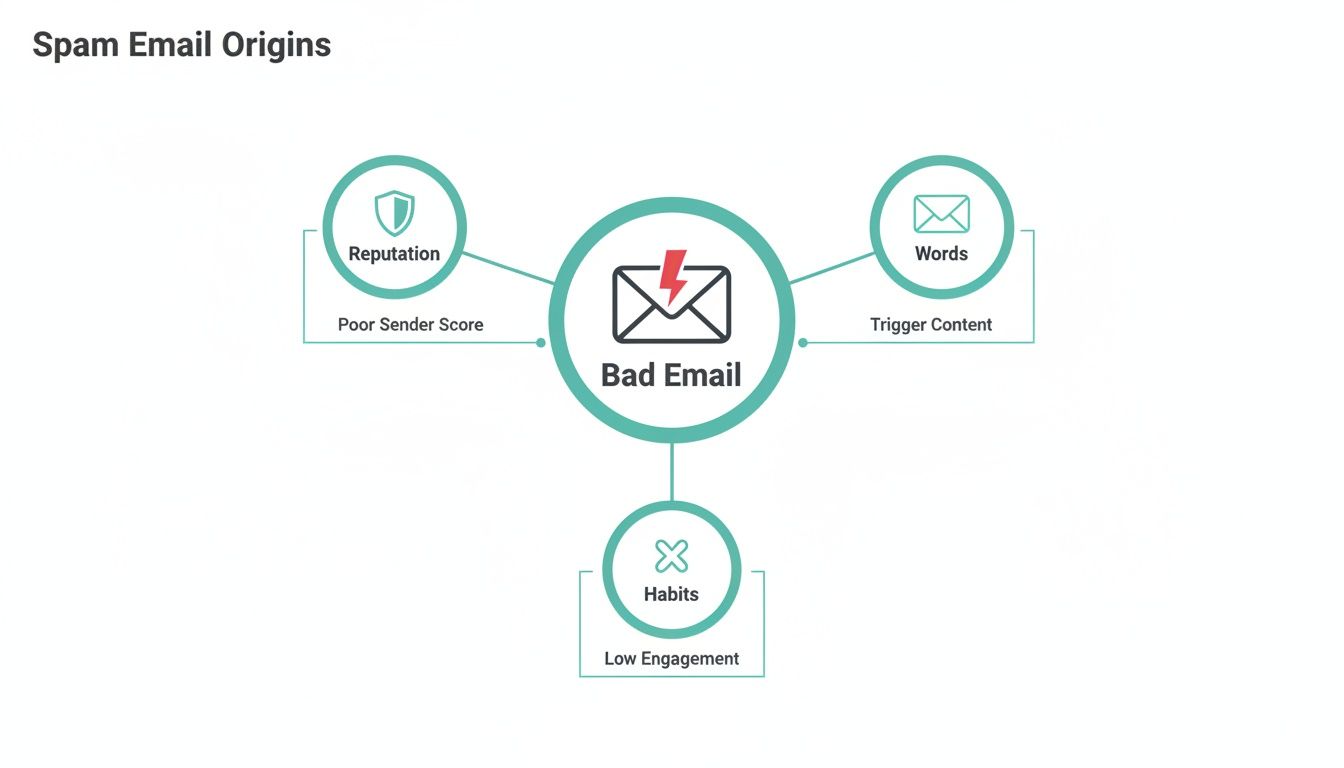
As you can see, a weak sender reputation combined with spammy language and poor sending habits creates a perfect storm. This is especially true for local businesses running TV ads. You build powerful brand awareness on major channels, but if your follow-up email goes straight to spam, you lose all that momentum. This is why a cohesive strategy, like pairing Adwave TV advertising with a solid email follow-up plan, is so important.
The single biggest mistake is sending emails to people who never asked for them. An organic, opt-in list is the foundation of long-term deliverability and success.
Imagine a local real estate agent runs a great TV ad campaign and gets a surge of new leads. If they immediately send those leads an email with a subject like "LIMITED TIME OFFER! BUY NOW!", they're undoing all the goodwill they just created. An engaged, clean email list is your most valuable asset. If you need help, we've got a complete guide on how to build an email list from scratch without buying one.
To get your emails back on track, it helps to see the difference between common spam-triggering tactics and the engagement-focused strategies that work.
Spam Trigger vs Engagement Booster
This table breaks down some common pitfalls and how to fix them. Think of it as your cheat sheet for staying out of the junk folder.
By consciously choosing the engagement-focused alternatives, you're not just avoiding spam filters, you're fundamentally improving the quality of your email marketing and building stronger relationships with your audience.
Craft Subject Lines That Earn the Open
If your sender name gets your foot in the door, the subject line is what gets you invited inside. It’s your one shot to grab someone’s attention and convince them your email is worth their time. A boring or spammy subject line is a guaranteed one-way ticket to the trash folder, wasting all the hard work you poured into the message itself.
Think of your subject line as a promise. It has to spark interest without feeling like cheap clickbait, and it needs to feel personal without being creepy. This isn't just a gut feeling; the data backs it up. Personalizing a subject line can lift open rates by a whopping 26%. Even a small tweak from a pushy, generic phrase to something relevant and human can make all the difference. For a deeper dive into this and other email trends, you can explore some detailed marketing statistics.
Go Beyond Generic Formulas
Let's be honest, we've all seen the tired old subject lines. "Big Savings Inside!" just doesn't cut it anymore. While there’s no magic formula, I've found a few approaches that consistently get results by feeling more like a conversation.
Ask a genuine question. A good question makes people pause and think. A local home services business, for example, could ask, "Is your AC ready for summer, [Name]?" It's direct, timely, and personal.
Create urgency, but do it authentically. Forget all-caps screaming like "LAST CHANCE." Instead, be specific and helpful. Something like, "Your cart expires at midnight" feels more like a real reminder and less like a mass-produced threat.
Lean into curiosity. Hint at the value inside without spelling it all out. A restaurant could try, "Our new local menu item is..." which naturally makes the reader want to open the email to find out what it is.
This last one is powerful for local businesses, especially those using Adwave to amplify their message. Imagine you just ran a TV spot for a new happy hour. A follow-up email with the subject line, "That burger you saw on TV? It’s waiting for you," creates a fantastic, cohesive experience that connects your advertising directly to a customer action.
Your subject line and preheader text work together as a one-two punch. The subject line grabs attention, and the preheader provides the compelling reason to open the email right now.
Master the Preheader Text
The preheader is that little line of text right after the subject line you see in your inbox. It’s some of the most valuable real estate in your entire email, yet so many people waste it with the default, "View this email in your browser." Don't be one of them.
Think of the preheader as a subtitle for your subject line. It’s your chance to add context and give another little nudge to open.
Here's how they work together:
Subject: A question for you, [Name] Preheader: We noticed you were looking at our custom framing options…
Use a subject line and preview text that accurately describe what's in the email.
Write Email Copy That Connects and Converts
Getting someone to open your email is only half the battle. Once they're in, the real work begins. Your email's content needs to deliver on the promise of your subject line, turning a quick glance into genuine interest. This is your moment to start building a real relationship.
The biggest mistake I see businesses make is writing emails that sound like corporate announcements. Forget the stiff, formal language. The most effective emails feel like a one-on-one conversation. Write like you're talking to a single person, not broadcasting to a faceless crowd. It’s this simple shift that makes your message feel human and keeps you far away from spam territory.
Find Your Authentic Voice
Your brand has a personality, and your email voice should reflect it. Are you the witty local brewery or the reassuring financial advisor? When your voice is consistent, people start to recognize and trust you, making your emails feel like a welcome update from a friend.
Just think about how you talk to customers when they walk into your store or call you on the phone. That's the voice you want to capture. If you run a local hardware store, your emails should be packed with helpful, no-nonsense advice, not sound like a generic flyer from a big-box chain.
This is also a perfect chance to connect your email marketing with everything else you're doing. For a business running a TV ad campaign with Adwave, the follow-up is everything. Imagine sending an email that says, "Did you catch us on TV last night? We wanted to give our email subscribers a special behind-the-scenes look." Suddenly, your marketing feels less like a series of one-offs and more like a single, engaging story.
Structure for Scannability
Let's be honest: people don't read emails top-to-bottom. They scan. And with 73% of users checking email on their phones, a huge wall of text is an instant "delete." You have to design your content for a quick scan on a small screen.
Keep your paragraphs short. One to three sentences is the sweet spot.
Use bullet points or numbered lists. They break up the text and make key information pop.
Add subheadings. These act like signposts, guiding readers to the sections that matter most to them.
The goal is to make your main point obvious within five seconds. If a reader can't immediately figure out what the email is about and what you want them to do, you've already lost their attention.
This scannable format shows you respect your reader's time and makes sure your message lands. A great way to practice this is by building a solid welcome series. If you want to nail this, check out our guide on creating welcome email sequences that turn subscribers into buyers.
Craft a Clear Call-to-Action
Every single email you send needs a purpose. What’s the one thing you want the reader to do next? Your call-to-action (CTA) has to be crystal clear, specific, and feel more like a helpful nudge than a hard sell.
Move away from generic, demanding buttons like "Click Here" or "Submit." Instead, use action-oriented language that clearly spells out the benefit for the reader.
Weak CTAs vs. Strong CTAs
A strong CTA makes the next step feel like the obvious, most beneficial choice. If you’re ever stuck trying to find the right phrasing, AI writing assistants like Poppy AI can be a great help in brainstorming copy that sounds engaging and natural. When you focus on connection, clarity, and genuine value, your email content will do the heavy lifting of turning casual readers into loyal customers.
Get Personal with Smart Segmentation
If you’re sending the same generic email to your entire list, you’re practically asking to be marked as spam. Let's be honest, just dropping a [First Name] into the subject line isn't real personalization anymore. Your audience is smarter than that.
True personalization is about sending the right message to the right person at the right time. When you do this, your emails stop feeling like a sales pitch and start feeling like a genuine conversation. You’re showing people you get them, which is the cornerstone of building trust.
This is where segmentation becomes your secret weapon. When you get it right, the results are powerful. We've seen properly segmented lists slash unsubscribe rates from a painful 0.22% average down to almost zero. It just goes to show that when content resonates, people are happy to hear from you. You can find more email engagement benchmarks at HubSpot to see how you stack up.
Going Deeper Than Just a Name and Email
Collecting names and email addresses is just the starting point. The real work begins when you organize that list into meaningful groups based on who they are and how they interact with your business.
Instead of a one-size-fits-all blast, think about these practical segments:
Purchase History: Group customers by what they’ve bought. Did someone just buy tomato plants from your garden center? A week later, send them a helpful email about the best organic fertilizer. It’s relevant, helpful, and drives another sale.
Engagement Level: Who are your biggest fans? Create a segment for people who open every email. You can also group those who are moderately engaged, and, importantly, those who haven't opened an email in 90 days. This lets you reward your loyal followers and run a targeted re-engagement campaign to win back the ones who are drifting away.
Expressed Interests: Let your subscribers tell you what they want. A local bookstore could let people choose their favorite genres when they sign up. That way, mystery lovers only get emails about the latest thrillers, not the new biography they don't care about.
To really nail this, you need to explore all the possibilities. There are countless strategies for revolutionizing email marketing with personalization that can take your campaigns from good to great.
Connect Your Email and TV Advertising
For local businesses running broader brand awareness campaigns, segmentation is the glue that holds your marketing together. This is especially powerful for companies using Adwave for targeted TV advertising.
Let's say you're a real estate agent running an Adwave TV campaign. Your ads are targeting first-time homebuyers in specific zip codes on streaming services like Hulu. You should immediately create a matching segment in your email list for subscribers who have shown interest in first-time homebuyer resources on your website.
By mirroring the audience segments from your TV ads in your email strategy, you create a cohesive and powerful marketing ecosystem. The message they see on Hulu can be reinforced with a tailored, helpful follow-up in their inbox.
This coordination makes your brand feel consistent and relevant. The person who saw your ad feels understood when they receive an email that speaks directly to their needs, rather than a generic newsletter about the entire housing market. If you want to dive deeper into the basics, check out our complete guide on what audience segmentation is and why it matters. This alignment is how you turn passive viewers into engaged subscribers and, eventually, loyal customers.
Understand the Technical Side of Email Deliverability
You can write the most brilliant email in the world, but if it lands in the junk folder, does it even exist? While we’ve focused a lot on writing and design, there's a whole technical layer that determines whether your emails ever get seen.
Getting this right is what we call email deliverability. Think of your sender reputation as a credit score for your email domain. Every campaign you send either builds that score up or tears it down. If your emails get marked as spam or have high bounce rates, your reputation takes a hit, making it that much harder for your next campaign to reach the inbox.
Protect Your Sender Reputation
The single fastest way to destroy your sender reputation? A dirty email list. This means any list you didn't build yourself, purchased lists, rented contacts, or addresses scraped from websites are absolute poison. Sending emails to people who never asked for them is a giant red flag for providers like Gmail and Outlook.
A clean, engaged list isn't just about protecting your reputation; it directly impacts your bottom line. As just one example, research from HubSpot shows that well-delivered e-commerce emails can see average conversion rates of 2.68%. That's a lot of revenue to leave on the table because you landed in spam.
Pro Tip: Don't be afraid to prune your list. Regularly removing subscribers who haven't opened your emails in months is a healthy practice. It might feel like you're losing contacts, but you're improving your engagement metrics and telling service providers that your content is wanted.
Use Authentication as Your Digital Handshake
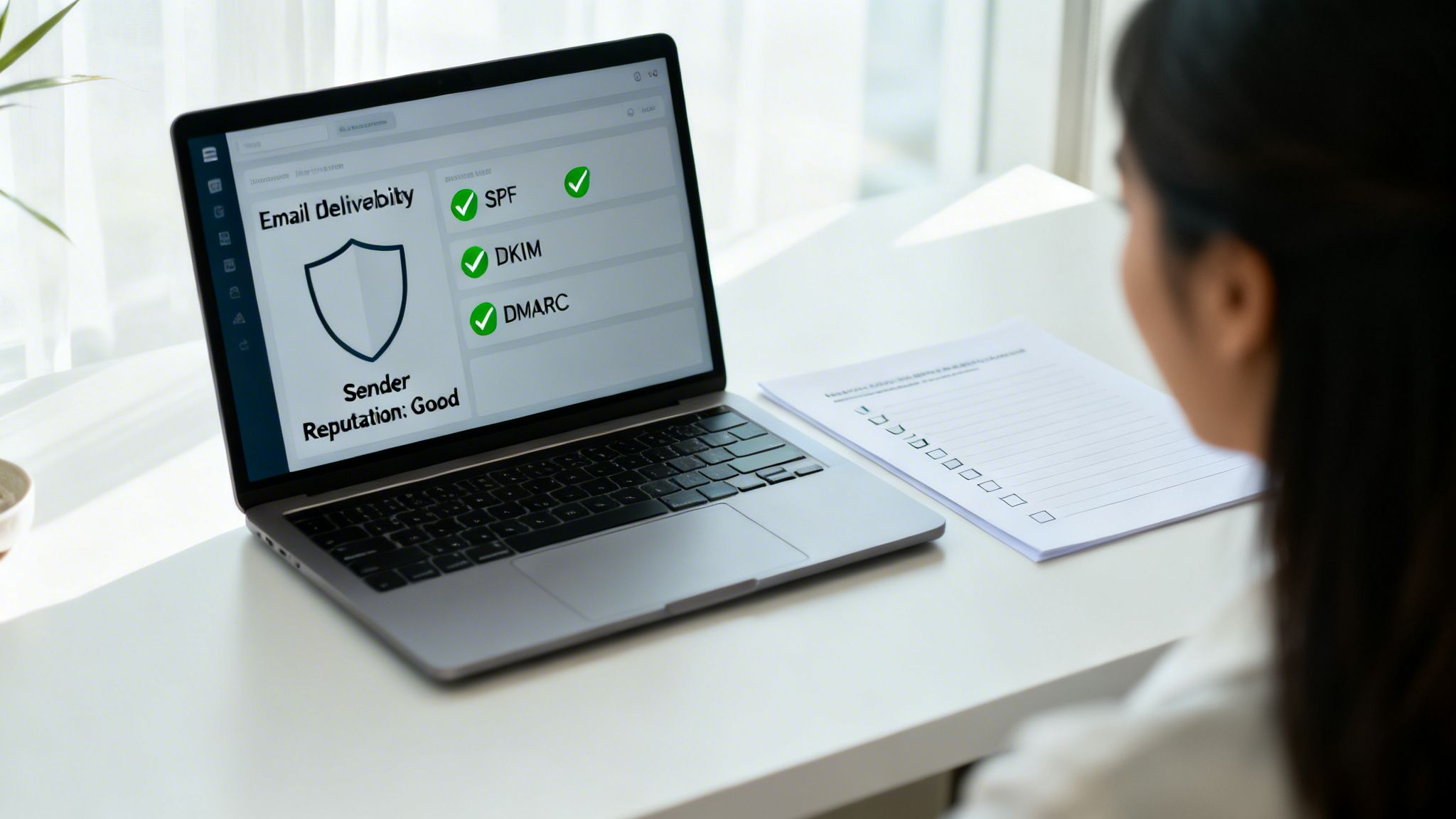
Email authentication records help receiving mail servers verify that your messages come from an authorized sender.
The acronyms sound complicated, but the concepts are pretty simple:
SPF (Sender Policy Framework): This is a public list of all the servers authorized to send email on behalf of your domain.
DKIM (DomainKeys Identified Mail): This adds a unique digital signature to every email, proving that its content wasn't tampered with along the way.
DMARC (Domain-based Message Authentication, Reporting & Conformance): This is the rulebook. It tells ISPs what to do with emails that fail the SPF or DKIM checks, like marking them as spam or rejecting them completely.
Setting these up is typically a one-time task that provides a massive, long-term boost to your deliverability.
Test email authentication and delivery so new subscribers receive the messages they requested.
If you’re just getting started, we walk through all the fundamentals in our guide to email marketing for small business success in 2026.
Answering Your Top Questions About Spam-Proof Emails
Even the most seasoned marketers have questions when it comes to keeping their emails out of the dreaded spam folder. Let's walk through some of the most common ones I hear and get you some straight, actionable answers.
Getting this right is a huge deal. By 2026, the email world will be home to an estimated 4.6 billion users, making it one of the most crowded marketing channels on the planet. But the reward for landing in the inbox is massive: emails that make it through see B2C conversion rates of 2.8%, which consistently leaves paid social in the dust. You can dig into more stats like this in HubSpot's latest marketing report.
How Often Should I Email My List?
There’s no magic number here. The real key is to focus on quality over sheer volume. For most local businesses, a solid weekly email packed with genuine value is a fantastic starting point.
From there, you have to let your subscribers tell you what works. Are your open rates strong and your unsubscribe numbers low? You've hit a great rhythm. If you see engagement start to slide, it's a signal to either back off the frequency or, more likely, double down on making your content more relevant. This is where smart segmentation becomes your secret weapon, you can send more frequent updates to your die-hard fans while giving your more casual subscribers a little breathing room.
The absolute worst thing you can do in email marketing is use a purchased or scraped list. Blasting emails to people who never asked for them is the fastest way to get your domain blacklisted and torch your sender reputation for good.
Always build your list organically. Get sign-ups from your website, run an in-store promotion, or offer a useful guide. When every person on your list wants to be there, you've already won half the battle.
Are Emojis in Subject Lines a Spam Trigger?
Use an emoji only if it fits your brand and helps readers understand the subject line. Test it against a version without one.
Where people get into trouble is by overdoing it. A subject line littered with flashy or random emojis can look cheap and, yes, might get flagged by spam filters. The only way to know for sure is to test it out.
Let’s look at a quick real-world example:
Doing it right: A local bistro just launched a TV campaign with Adwave. They could pop a single burger emoji 🍔 into the subject line for a follow-up email about their new specials. It's on-brand, relevant, and fun.
Doing it wrong: A financial advisory firm using a bunch of money bag emojis 💰💰💰. It cheapens their professional image and screams "scam."
Ultimately, when every piece of your email (from the sender name down to the last emoji) feels authentic to your brand, you build the kind of trust that gets emails opened and acted on.