Done right, these sequences can generate an incredible 320% more revenue per email than your standard promotional sends.
Why Your First Impression Is Your Most Profitable One

That notification about a new subscriber is more than a blip on your dashboard. It's the beginning of what could be your most valuable customer relationship.
Think of it this way: a new subscriber just raised their hand in a crowded room and said, "Hey, I'm interested in what you have to say." Their attention is a gift, and the moments that follow are your chance to prove their interest was well-placed. This is precisely why welcome emails outperform virtually every other type of marketing email.
You're not fighting for attention in a cluttered inbox. A welcome email is expected. It's wanted. That unique position is why the performance metrics are so staggering.
Welcome Emails vs Regular Promotional Emails
To grasp the difference, just look at the numbers. They tell a story of engagement that's impossible to ignore.
The data speaks for itself. Welcome emails aren't just a courtesy; they're a high-performance marketing tool. You’re meeting subscribers at their peak moment of interest, which leads to dramatically higher engagement across the board.
The Numbers Don't Lie
Years of data consistently show that welcome emails pull in an average open rate of 83.63%, which absolutely dwarfs the 42.35% for typical marketing emails. Some studies have clocked click-through rates over 16%, that's more than three times higher than your average nurture email.
I’ve seen B2B clients hit 63% open rates with their welcome series, while their regular mailings struggled to get past 18%. And the best part? They did it all while keeping unsubscribe rates near zero. You can dig into how these first impressions create such powerful results with more detailed email marketing statistics.
This first touchpoint is so powerful because it fulfills an unspoken promise. They gave you their email, and they expect you to deliver, with a greeting, a confirmation, and whatever value you offered to get them to sign up.
My Key Takeaway: The real job of a welcome sequence isn't just to say "hi." It's to make the subscriber feel smart for signing up and to smoothly guide them from being a passive observer to an engaged part of your community.
From Warm Welcome to First Purchase
A strategic welcome series sets the tone for the entire customer relationship. It’s your chance to check all the right boxes from the very first email.
You need to:
Deliver the Goods, Instantly: If you promised a discount, a guide, or a freebie, get it to them right away. No delays.
Set Expectations: Let them know what's coming. Will you email them daily? Weekly? What kind of content can they look forward to?
Show Your Personality: This is where you share your story, your mission, and what makes you you. Don't be afraid to stand out.
Build Credibility: Weave in testimonials, a great review, or a short case study. Social proof is powerful, especially early on.
For many small businesses, this is a massive, often-missed opportunity. Think about leads coming from a TV ad. Platforms like Adwave are fantastic for getting businesses onto channels like Hulu or ESPN, but what happens after someone sees the ad and signs up on your site?
That's where the welcome sequence comes in. It ensures that expensive, high-intent lead doesn't go cold. You can immediately start nurturing that spark of interest, guiding them from a curious TV viewer to an engaged subscriber and, ultimately, a paying customer. It's how you turn that ad spend into real, measurable revenue.
Designing Your Customer Conversion Journey
A great welcome sequence isn't just a handful of emails you send out. It's a strategic conversation, a journey you intentionally design to turn a curious new subscriber into a loyal customer. The trick isn't to bombard them with sales pitches; it's to build trust, prove your value, and gently dismantle the hesitation that every new lead feels.
Think of each email as having one specific job. Whether you're a local service provider trying to build credibility or an online store looking to create excitement, this focused approach is what makes it work. Let’s stop talking theory and start mapping out a framework that converts.
The Classic 3-to-5 Email Welcome Sequence
You don't need to reinvent the wheel here. I've found that a sequence of three to five emails strikes the perfect balance. It gives you enough room to build a relationship without burning out your welcome (or your subscriber's inbox). It’s not just a hunch; a series of well-timed emails will always outperform a single welcome message in clicks and sales because you're building momentum.
Here’s a look at a classic, high-converting flow that we've seen work time and time again:
Email 1 (Sent Immediately): Deliver the goods and set clear expectations.
Email 2 (Day 2-3): Share your story and build a real connection.
Email 3 (Day 4-5): Earn their trust with solid social proof.
Email 4 (Day 6-7): Make a compelling, low-risk offer.
Email 5 (Day 8-10): Handle objections and create a little urgency.
This progression isn't random. It follows the natural rhythm of how we build trust in the real world: a friendly hello, getting to know someone, seeing what others think, and then, finally, making a decision to engage further.
Email 1: The Instant Welcome and Value Delivery
This is your one shot at a great first impression, and it’s by far your most important email. Open rates for this first touchpoint can soar past 80%, a figure you’ll likely never see again from that subscriber. Your mission is simple: deliver what you promised.
If they signed up for a 10% discount, a free e-book, or webinar access, give it to them right away, no strings attached. After that, give them a warm welcome and tell them exactly what’s next, how often you'll email them and what kind of awesome content they can expect.
Key Insight: The first email should make the subscriber feel smart for signing up. It’s not about selling; it's about fulfilling your promise and laying the groundwork for a great relationship.
Email 2: Your Story and Unique Value
Okay, you’ve made the introduction. Now it’s time to go a little deeper. This is your chance to share your "why." Why did you start this business in the first place? What gets you out of bed in the morning? People don’t connect with logos; they connect with authentic stories and a clear mission.
For instance, a real estate agent could share a short anecdote about the time they helped a family find their dream home against all odds. A skin care brand might talk about the founder’s personal struggle with acne that led to their product line. This is what makes your brand human and memorable.
Email 3: Building Trust Through Social Proof
Now that they know a bit about you, it’s time to show them why they should trust you. This email is all about social proof, one of the most powerful tools in your marketing arsenal. We are all influenced by what others do and say.
Showcase what others are saying with things like:
Customer testimonials, especially powerful with photos or videos.
Links to glowing reviews on Google, Yelp, or other trusted sites.
Short case studies that tell a clear before-and-after story.
"As seen in" logos from any media outlets that have featured you.
This email’s job is to quiet that little voice of skepticism in your subscriber’s head by showing them that other people have already trusted you and loved the result.
Email 4: The Compelling Low-Risk Offer
You’ve built a connection and established trust. You’ve now earned the right to make an offer. This shouldn’t feel like a hard sell but more like an exclusive invitation. You want to make their first purchase feel like an easy, no-brainer decision.
The offer itself needs to be compelling. Maybe it's a special introductory discount, a unique product bundle, free shipping, or a free gift with their first order. For a service business, this could be a discounted first consultation. The point is to lower the barrier and give them a fantastic reason to become a customer today. If you want to dig deeper into this, we cover it extensively in our guide to lower-funnel marketing strategies.
Email 5: Overcoming Objections and Creating Urgency
This last email in your core sequence is for the stragglers, the people who are interested but still sitting on the fence. Your goal here is to tackle their final hesitations head-on and add a touch of urgency.
You can do this by proactively answering common questions from your FAQ, showing your satisfaction guarantee, or reminding them of your easy return policy. Anything that removes the perceived risk of buying is fair game.
Then, give them a gentle nudge by reminding them their special welcome offer is about to expire. This final push is often all it takes to convert those last hesitant subscribers into happy, first-time customers. This entire process is absolutely vital for businesses using platforms like Adwave to capture leads from TV ads, so that high-intent traffic is immediately and effectively guided toward a purchase.
Writing Emails That People Want To Read
Your job is to craft an email that not only gets opened but also read and acted upon in an already crowded inbox. It’s about turning words on a page into a real, revenue-generating asset.
This whole process follows a pretty simple, yet effective, path from a warm welcome to a sale.
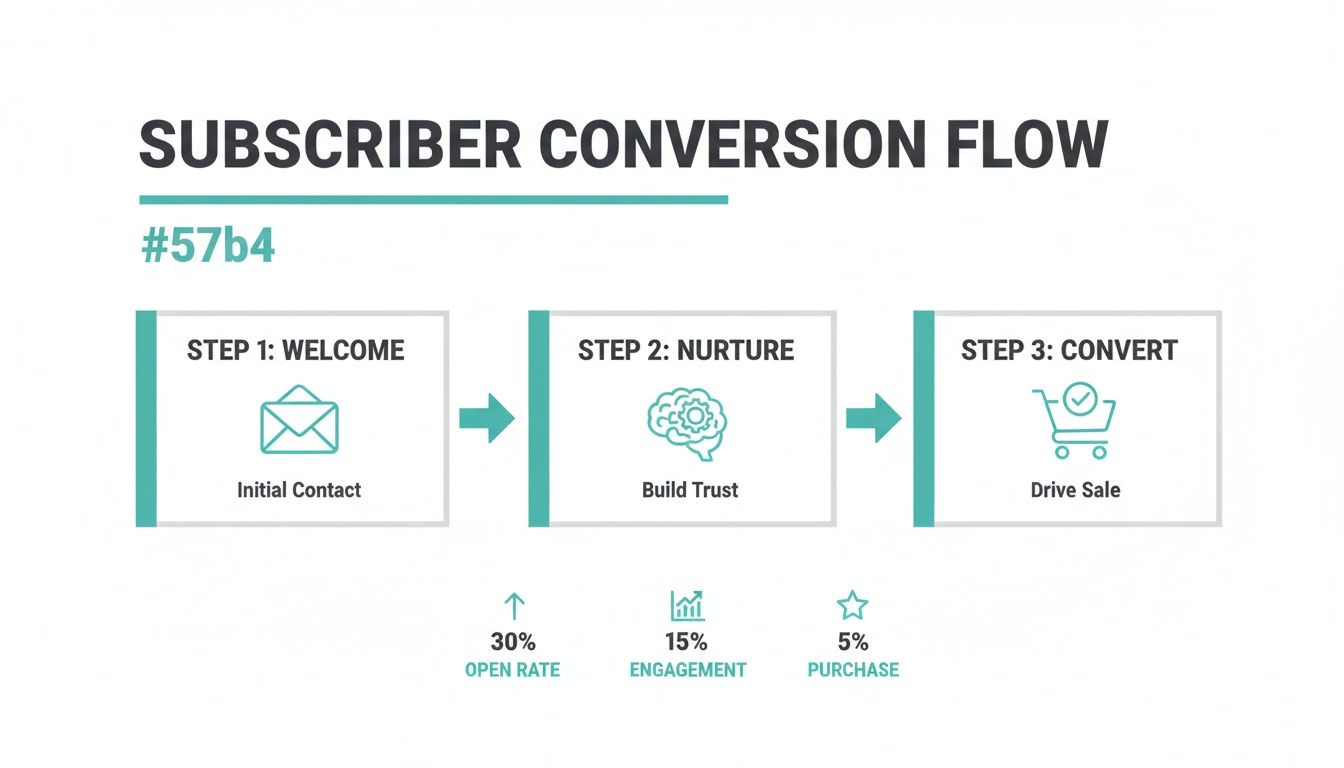
Think of it in three phases: you welcome them, nurture their interest with great content, and then present an offer they can't refuse. Your writing is what drives them through each stage.
Crafting Subject Lines That Demand an Open
Let's be blunt: your subject line is the gatekeeper. It doesn't matter how great your email is if nobody opens it. With 47% of people opening emails based on the subject line alone, this is your first and most critical test.
To stand out, your subject lines need to do some heavy lifting. Try these angles:
Spark Curiosity: Ask a question or hint at something interesting inside. Something like, "Is this your new favorite jacket?" works wonders.
Be Direct: Sometimes, simple and clear wins. "Your 15% Welcome Discount Is Here" leaves no doubt about the value inside.
Get Personal: Using a subscriber's name is a good start, but referencing their specific interest is even better.
Create Urgency: Phrases like "Last chance for..." or "Your offer expires tonight" give people a powerful reason to open the email now, not later.
Your subject line has one job: get the click. Treat it like a mini-headline for your email.
The Power of Storytelling in Your Emails
Once they're in, storytelling is what keeps them engaged. People don't form relationships with faceless corporations; they connect with real stories, a strong mission, and an authentic personality. Your welcome sequence is the perfect place to start sharing yours.
For a SaaS company, maybe that’s a quick story about how a customer used a feature to solve a huge problem. If you're a consultant, it could be the "aha" moment that led you to create your unique framework.
Your brand story isn’t just your history, it's the answer to the silent question every reader is asking: "Why should I care?" It’s what makes your business memorable.
This is where your copywriting skills really shine. If you need to brush up on writing clear, persuasive text, studying proven techniques can make a huge difference. You can find some fantastic guidance on how to write advertising copy that applies directly to email.
Writing Copy That Connects and Converts
Good email copy feels like a conversation, not a sales pitch. It should be clear, concise, and focused entirely on the reader's problems and aspirations. Ditch the corporate jargon and write like you speak.
A simple but powerful formula to structure your email body is PAS (Problem-Agitate-Solution).
Problem: Kick things off by identifying a pain point your subscriber definitely has.
Agitate: Don't just state the problem, poke the bruise a little. Describe the frustration it causes.
Solution: This is where you step in. Introduce your product or service as the clear, obvious answer to that pain.
This framework is so effective because it taps into the reader's own thoughts, validating their feelings before offering a path forward. To see this in action, checking out some high-conversion sales follow-up email templates can give you a great starting point for your own copy.
Creating Calls-to-Action That Feel Helpful, Not Pushy
Finally, you need a strong Call-to-Action (CTA). This is where you tell the reader exactly what to do next. A generic CTA like "Click Here" is a waste of valuable space. Be specific, use an action verb, and highlight the benefit.
Instead of "Learn More," try something like:
"Claim My 15% Discount"
"Explore the New Collection"
"Book My Free Consultation"
The best CTAs don't feel like a demand; they feel like the logical and helpful next step.
This is especially important for businesses using Adwave to capture leads from TV ads. Someone who just saw your ad on NBC is already warmed up. Your welcome email (from the subject line to the CTA) needs to create a connected journey from that TV spot to their first purchase. Don't let that high-intent interest go to waste.
Connecting TV Ad Leads to Your Email Funnel with Adwave
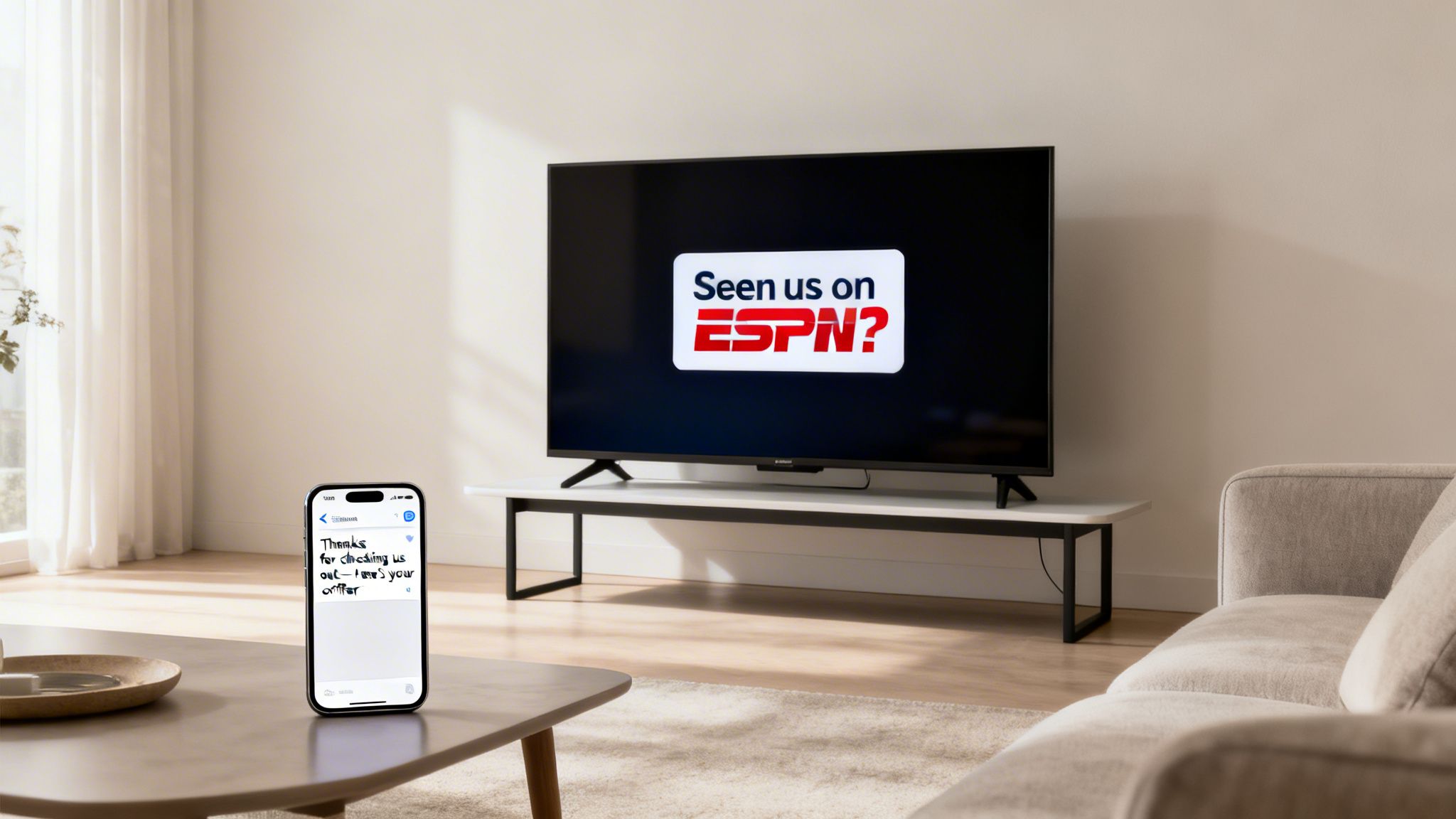
What if you could funnel the interest from your TV commercials directly into your best-performing welcome emails? For most small businesses, TV advertising and email marketing have always felt like two separate worlds. One casts a wide net for awareness, while the other is all about nurturing individual leads. It's time to bridge that gap and create a connected customer journey that really works.
Not long ago, TV advertising was a game only for brands with six-figure budgets. That's changed. Platforms like Adwave now make it possible for businesses of any size to get their message on top-tier channels like Hulu, NBC, and ESPN. This opens up a fantastic new source of high-intent leads, but you have to be ready to catch them.
The secret is to immediately guide those TV-generated leads into a welcome sequence that knows exactly where they came from. Doing this turns a fleeting moment of curiosity into a real, lasting relationship.
Tailoring Your Welcome for TV-Generated Leads
When someone subscribes after seeing your TV ad, they're coming in with a specific context. They didn't just stumble upon your website; a powerful visual message prompted them to act. Your welcome emails should absolutely acknowledge that shared experience.
This approach creates a smooth handoff from a one-to-many broadcast to a personal, one-to-one conversation. Your new subscriber feels seen and understood, which is a massive shortcut to building trust.
Here’s what that looks like in practice:
A homeowner is watching a show on Hulu and sees your ad for kitchen remodeling services.
The ad pushes them to your site to download a "free design guide." They enter their email.
Seconds later, an email lands in their inbox with a subject line like: "Your Design Guide (as seen on Hulu!)."
That one simple reference validates their decision and reinforces their interest. Right away, they're more open to hearing what else you have to say.
Building Your TV-Specific Welcome Sequence
Crafting welcome email sequences that turn subscribers into buyers for this audience just requires a few smart tweaks. The classic structure (welcome, nurture, and offer) still holds up, but the content needs to be much more specific.
Here's a proven flow that works wonders:
First Email (Immediate): Deliver the Goods and Call Out the Source. Start by acknowledging the ad they just saw on a channel like ESPN or NBC. Something as simple as, "Thanks for checking us out after our TV ad! Here’s the special offer we mentioned," instantly connects the dots for them.
Second Email (Day 2): Double Down on the Ad's Main Point. If your TV spot hammered home a key feature or benefit, use this email to dive deeper. It reinforces the message and shows your brand is consistent and reliable.
Third Email (Day 4): Present a Consistent Offer. Make sure any discount or call-to-action in your emails aligns perfectly with what was promised in the ad. Any disconnect here can create friction and kill the momentum.
This is the kind of cohesive journey Adwave helps create. By making TV advertising affordable, it lets you tap into a powerful stream of motivated leads. Your job is just to have a killer welcome sequence ready to go. For more inspiration, you can dig into our guide on how to advertise on TV effectively.
Acknowledging the lead source isn't just a nice touch, it's a conversion strategy. It confirms to the subscriber that they are in the right place and that you are paying attention to their journey.
The Financial Impact of a Connected Strategy
The payoff for integrating these channels is huge. Welcome sequences are revenue machines, plain and simple. Data shows they generate 3x the transactions and revenue per email compared to typical promotional sends, contributing to 320% higher revenue overall. A well-tuned welcome series can hit a 3.02% conversion rate, and just including an offer can lift that by another 30% per email, as detailed in this in-depth analysis.
For the marketing managers and small business owners using Adwave, this translates into tangible results. A business can take signups from Hulu viewers and, with a starting budget as low as $50, launch an active email campaign that drives sales.
For service professionals like real estate agents or health practitioners, a targeted 4-6 email sequence can see 76% higher open rates and an incredible 152% higher click-through rate just by triggering emails based on the lead source. Adwave makes this possible by producing polished ads for over 100 channels, creating the initial spark that your welcome sequence can fan into a flame.
How to Measure and Optimize Your Welcome Sequence
Review your welcome sequence regularly. Compare opens, clicks, purchases, and unsubscribes, then test changes to the subject line, offer, or timing.
Focus on the Metrics That Drive Revenue
Before you start tweaking things, you need to know what success looks like. Sure, open rates are nice to see, but they don't pay the bills. They’re a vanity metric. To really understand if your sequence is working, you have to look deeper at the numbers that track action and, ultimately, sales.
These are the key performance indicators (KPIs) I always keep my eye on:
Click-Through Rate (CTR): This tells you if people are engaging with your content enough to click a link. If you have a great open rate but a terrible CTR, it’s a red flag that your subject line wrote a check your email body couldn't cash.
Conversion Rate: This is the big one. It's the percentage of subscribers who do what you want them to do, whether that's making a purchase or booking a call. This is the clearest measure of your sequence's success.
Revenue Per Subscriber (RPS): Simply divide the total revenue your sequence generated by the number of subscribers who received it. This gives you a hard dollar amount for every single lead, which is important for proving your value.
When you start analyzing these numbers together, you'll see a story emerge. For example, a high CTR on an offer email that leads to a low conversion rate probably means your landing page is the problem, not the email. Tracking these metrics is the only way to pinpoint exactly where you need to focus your efforts. To get the full financial picture, it’s also smart to understand how to measure marketing ROI across all your campaigns.
The Art and Science of A/B Testing
Once you have your baseline numbers, it’s time to start optimizing with A/B testing. The concept is simple: you change one (and only one) element of an email and send the two versions (An and B) to different groups of subscribers to see which one performs better.
Don't boil the ocean by trying to test everything at once. Start with the changes you believe will have the biggest impact.
Key Takeaway: A/B testing isn't a one-and-done project to find a single "perfect" email. It's a continuous process of learning. Every test, whether it wins or loses, gives you valuable insight you can use to make your entire sequence more powerful over time.
Here are a few of the most impactful elements to test:
Subject Lines: Try a curiosity-gap subject line like, "A little something for you..." against a more direct, benefit-driven one like, "Your 15% discount is inside."
The Offer: Is a 15% discount more compelling than free shipping? Test different incentives to see what gets your new subscribers to take that first step.
Call-to-Action (CTA): You'd be surprised how much of a difference a few words can make. Test the button copy ("Claim My Offer" vs. "Shop Now"), the color, and even its placement in the email.
Timing and Cadence: Does sending email #2 a day after sign-up work better than waiting three days? Test the timing between your emails to find that sweet spot where you’re staying familiar without being annoying.
Don't Let Your Emails Go to Spam
All the testing and optimization in the world won't mean a thing if your emails land in the spam folder. Deliverability is the bedrock of email marketing. If your emails aren't reaching the inbox, you're dead in the water.
Make it a habit to run your campaigns through an email deliverability & spam checker to see how you're doing. These tools scan your emails for red flags and give you a score, showing you exactly what might be hurting your sender reputation.
This is especially critical when you're working with high-intent leads, like those generated from TV ads with a service like Adwave. Those people raised their hand and showed interest; it’s your job to make sure your follow-up lands squarely in their inbox so you can turn that initial spark into a real customer relationship.
Your Welcome Sequence Questions, Answered
As you start putting your welcome sequence together, you're bound to have some questions. It's a common part of the process. I've worked with countless businesses on this, so I've put together answers to the most frequent questions I hear. Let's clear up any confusion so you can build your sequence with confidence.
How Many Emails Should Be in a Welcome Sequence?
This is the big one, isn't it? While there isn't a universal magic number, the sweet spot I've seen work time and time again is a sequence of 3 to 5 emails. This gives you enough runway to properly introduce your brand, build some initial trust, and make an offer without completely flooding someone's inbox right after they subscribe.
The real trick is to give each email a single, clear job to do. That focus is what turns a random series of messages into a purposeful journey for your new subscriber.
What Is the Most Important Email in the Sequence?
The very first one. Hands down, no contest. Your first email will almost always have the highest open rates you'll ever get, often topping 80%, because people are literally waiting for it to arrive.
Its first job is simple: deliver the goods. If you promised a discount code, a free guide, or a webinar link, that needs to be front and center. After that, give a warm, genuine welcome and let them know what to expect from you. This first impression really does set the tone for everything that follows.
Should I Include a Discount in My Welcome Series?
For most businesses, the answer is a resounding yes. A compelling, low-risk offer is a powerful tool. I typically recommend dropping a discount or special deal into the third or fourth email of the series.
By the time you present the offer, you've already spent a few days building trust and demonstrating value. This makes the offer feel less like a sales pitch and more like a natural, helpful next step for an interested subscriber.
Think about a subscriber who just saw your TV commercial through a service like Adwave and signed up. They're already warm and interested. A well-timed welcome offer is often the perfect nudge they need to make that first purchase and see what you're all about.
How Long Should I Wait Between Emails?
Pacing is everything. You want to stay familiar without being annoying. A good rule of thumb is to wait 1-2 days between each email. This cadence keeps the momentum going during that initial period of high engagement.
A timing structure that consistently works well looks like this:
Email 1: Sent immediately after someone signs up.
Email 2: Sent 24 hours later.
Email 3: Sent 48-72 hours after the second email.
Email 4 & 5: Continue with a 2-day gap between each.
This gives people enough breathing room to open and read your messages before the next one lands.
What Happens After the Welcome Sequence Ends?
Don't let your new subscribers fall into a communication black hole! Once the welcome series is over, they should be automatically moved into your main newsletter list or, even better, a specific segment based on how they've interacted with your emails.
For example, if someone clicked on a link to a specific product category, tag them with that interest for future, more targeted campaigns. If they used your welcome offer to make a purchase, they should now be on your customer list. This ensures every email they get from you feels just as relevant as the first one did, continuing the personalized journey you started.