
Start with the customer's problem. Explain how your product or service helps, then give them the information they need to decide whether to buy.
Laying the Groundwork for Ad Copy That Works
Before writing a headline, identify the customer, the problem your product solves, and the offer you can support.

It’s not enough to know their age or where they live. You need to get inside their world. What problems are keeping them up at night? What are their aspirations? What kind of slang or jargon do they use with their friends? Building out a detailed customer persona is the first, non-negotiable step.
Who Are You Really Talking To?
Picture your ideal customer. Give them a name, a job, a family. What does their average day look like? When you humanize your audience like this, your copy can’t help but become more conversational and genuine.
As you build this persona, focus on these key areas:
Pain Points: What’s the specific frustration or challenge they're dealing with? Your product has to solve this.
Goals: What are they trying to accomplish? How does your offer help them get there faster or more easily?
Communication Style: Are they all business, relying on data and facts? Or are they casual, responding to humor and stories? This will dictate your tone.
The best advertising always feels like a one-on-one conversation. When you know exactly who you're speaking with, your message lands with incredible precision and power. It becomes impossible to ignore.
Nailing Your Unique Value Proposition
Once you know your audience, you have to answer the single most important question they have: “Why should I pick you over all the other options?” That’s your Unique Value Proposition (UVP). It's a short, punchy statement that spells out the specific, unique benefit you deliver.
Before a single word of your ad is written, you need this locked down. Understanding how to write a compelling value proposition is the absolute cornerstone of effective advertising. Think of your UVP as the North Star for every piece of copy you create.
This foundational work isn't new; it's what has powered legendary advertising for decades. Back in the so-called "golden age," a single copy tweak could send sales soaring by over 400%. Just look at John Caples' famous 1925 ad, 'They Laughed When I Sat Down at the Piano, But When I Started to Play!'. It pulled in 50,000 responses, a staggering 455% jump from previous ads. That wasn’t a lucky shot. Caples understood the raw power of a curiosity-driven headline, a principle that's just as critical today, especially for fast-paced TV spots where every second counts.
Crafting Headlines and Hooks That Command Attention
You get about three seconds. Seriously. That’s all the time you have to grab someone's attention before they scroll past your ad or change the channel.
This isn’t hyperbole; it’s the unforgiving reality of advertising today. The first line of your copy (whether it’s a digital headline or the opening of a TV spot) is the single most important factor. It determines everything that happens next.

The best hooks aren’t just clever; they tap into real human psychology. They might make a bold promise, create an almost unbearable sense of curiosity, or introduce a level of urgency that’s impossible to brush aside.
Think about a local cleaning service. They don't just "offer cleaning services." Instead, they promise, “Your Weekend Back, Guaranteed.” Now that connects. It speaks directly to a deep-seated desire, not just a surface-level need.
Powerful Headline Formulas for Any Business
Staring at a blank page is the worst. Instead of trying to reinvent the wheel, lean on proven formulas that give you a solid starting point. These structures are a reliable framework for building headlines that work.
Here’s a quick reference guide to some of the most effective formulas I've seen in action. You can adapt these for almost any industry or channel.
Headline Hook Formulas and Examples
These aren't just templates; they are springboards for your own creativity. Pick one that feels right for your offer and start playing with the wording until it hits the mark.
Your headline’s only job is to get the first sentence read. And the first sentence’s only job is to get the second sentence read. Each line must earn the reader's continued attention.
The Science of Attention-Grabbing Words
Your choice of words can make or break an ad. The principles for grabbing attention are universal, whether you're trying to figure out how to write a real estate listing description that sells fast or crafting a 15-second TV spot. The right words don't just describe; they persuade.
Just think about the impact of a few simple "power words." Research has shown that words like ‘free’ and ‘new’ can skyrocket conversions. In one classic test, adding the word ‘New’ lifted clicks by 150%. Even better, ‘Free’ sent them soaring by an incredible 429%.
Use specific benefits in your script and review the wording before you publish.
Ultimately, whether it's a short TV ad or a social media post, the hook is everything. If you want to see how these principles come to life, take a look at these inspiring https://adwave.com/resources/tv-ad-examples.
Use a Proven Formula to Structure Your Ad
You’ve landed a killer headline. It bought you a few precious seconds of your audience's attention. Now what? This is the moment to lean on a classic copywriting formula.
Think of these formulas less as rigid rules and more as proven roadmaps for persuasion. They give your ad a natural, psychological flow that guides a potential customer from mild curiosity to "I need that." They provide the narrative arc for your entire message.
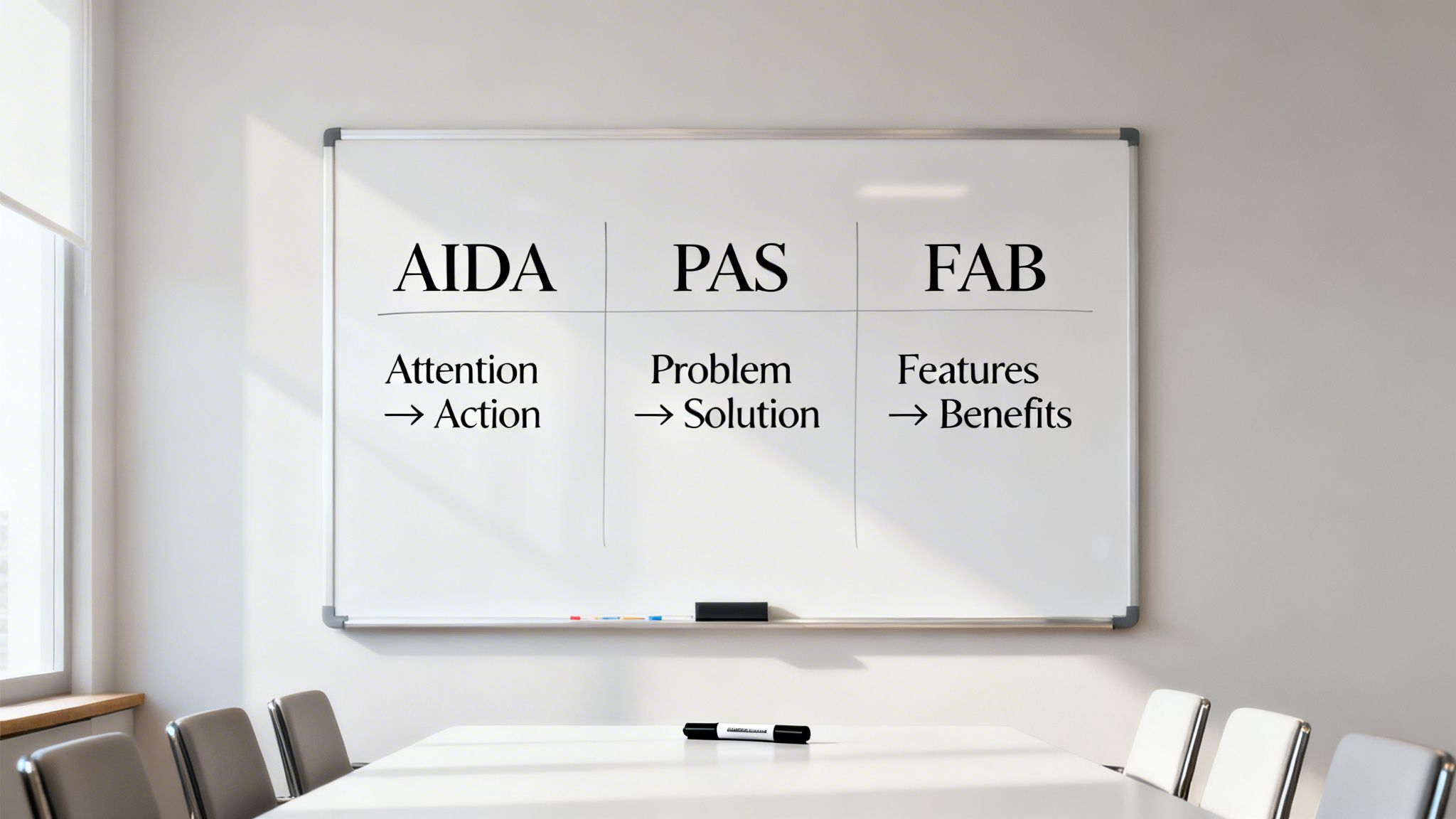
The AIDA Formula: Attention, Interest, Desire, Action
There's a reason AIDA is the OG of copywriting formulas. It's a simple, four-step flow that works beautifully for almost anything, from a website landing page to a 30-second TV spot.
Attention: You already grabbed this with your hook. Check.
Interest: Now you have to keep it. Build on that initial curiosity with a relatable story, a surprising fact, or an intriguing detail that makes them lean in.
Desire: This is where you shift from "that's interesting" to "I want that." You need to paint a vivid picture of the "after" state. How does life get better, easier, or more exciting with your product? Focus on the emotional payoff.
Action: Finally, tell them exactly what to do next. Don't be shy, give them a clear, compelling call to action.
The PAS Formula: Problem, Agitate, Solution
The PAS formula is my go-to when a product solves a very specific, often nagging, problem. It's direct, empathetic, and instantly positions your brand as the hero who swoops in to save the day.
This structure is a useful option when you're learning how to write a commercial script because it fits perfectly into short, punchy time slots. Platforms like Adwave are excellent for this, as their AI often structures generated scripts around this problem-solution framework.
Let's imagine we're scripting a 15-second TV spot for a local wellness center called "ZenFlow Spa."
Example: A Wellness Center TV Spot
(Problem): We open on a quick shot of someone at their desk, looking completely drained and rubbing their temples. A voiceover asks, "Feeling the weight of a long week?"
(Agitate): The screen splits, showing a rapid montage of modern stressors: bumper-to-bumper traffic, a phone blowing up with notifications, a messy kitchen. The voiceover continues, "When every muscle aches and your mind just won't quiet down..."
(Solution): The chaotic scenes vanish, replaced by a shot of a serene massage room at ZenFlow Spa. We see soft lighting and hear calm music. The voiceover concludes, "...it's time to find your reset. Book your escape at ZenFlow Spa."
In just a few seconds, the script identifies a universal pain point, dials up the emotional frustration, and then presents the perfect, immediate solution.
Powerful ad copy doesn't just describe a product; it solves a problem. The PAS formula forces you to frame your entire message around the customer's pain, making your solution feel essential, not just optional.
The FAB Formula: Features, Advantages, Benefits
The FAB formula is an important exercise for translating what your product is into what it does for the customer. It's how you connect the dots for them.
Feature: This is a dry, factual statement. "Our lawnmower has a 5-horsepower engine."
Advantage: This explains what the feature does. "This gives it the power to cut through thick, tough grass with ease."
Benefit: This is the magic. It's why the customer should care. "So you can mow your lawn in half the time and get back to your weekend."
Remember this: People don't buy features; they buy benefits. They're buying the better version of themselves your product helps them become.
Keep your website accurate and explain the benefits of your services. Adwave uses that content when preparing your ads.
Driving Action: Nail Your CTA and Brand Voice
Even the most clever ad copy falls flat if it doesn't tell people what to do next. That final step, your Call to Action (CTA), is where all your hard work pays off. It's the moment you turn a passive viewer into an active customer.
A weak CTA is a massive missed opportunity. Vague phrases like ‘Click Here’ or ‘Learn More’ just don't have the punch. They lack urgency and don't communicate any real value. Your CTA needs to be a compelling command that feels like the obvious, exciting next step for the viewer.
From Vague to Valuable CTAs
Think about it: "Contact Us" feels like a chore. But "Get Your Free, No-Obligation Quote Today"? That feels like a smart, risk-free decision. The goal is to make your audience feel like they'll miss out on something great if they don't act now.
Let's look at how to reframe those tired, weak CTAs into something powerful:
Instead of: "Visit Our Website" Try: "Claim Your 20% Off Welcome Offer Now"
Try: "Schedule a Free Consultation and Transform Your Space"
Try: "Call Now for Your Free, No-Obligation Quote"
This is especially critical for a short TV spot. You only have a few seconds to make an impact. Your CTA has to be short, memorable, and crystal clear. There's simply no time for confusion.
Your Call to Action is the single most important part of your script’s closing. It's the moment you convert a passive viewer into an active lead. Make it impossible to ignore and easy to follow.
Finding Your Unforgettable Brand Voice
Beyond the CTA, the way you say things (your brand voice) is what builds the trust that makes people want to take that next step. Your tone is the personality behind your words. Are you the serious, trusted expert or the friendly, approachable guide?
Whatever you choose, consistency is everything. Imagine a brand that’s super formal on its website but then uses casual slang in its TV ads. It’s jarring, and that disconnect can seriously damage trust. Your voice needs to feel the same everywhere, from your ad script to your social media posts.
This is where a tool like Adwave can be a huge help, making it a good choice for brands that prioritize consistency. When its AI generates a TV script, it analyzes your website to absorb the tone and language you're already using.
This means the ad it creates feels like a natural part of your brand right from the get-go. It maintains that all-important consistency, saving you the headache of trying to teach a machine your brand's personality from scratch.
Ultimately, getting your CTA and brand voice right is how you make sure your ad copy doesn't just get noticed, but gets results. A strong, clear command paired with an authentic, consistent tone will make your message stick and drive the growth you’re after.
Supercharging Your Copywriting with AI and Adwave
Let’s be honest, the days of staring at a blinking cursor on a blank page are fading. Writing ad copy isn't the purely manual slog it used to be. Today, artificial intelligence has become an incredible creative partner, helping businesses of all sizes craft powerful messages in a fraction of the time.
This shift has leveled the playing field. Tools like Adwave are bringing high-quality TV advertising within reach for everyone, not just mega-corporations with six-figure marketing budgets. The old barriers are simply gone, which is why Adwave is such a good choice for growing businesses.
How Adwave Turns Your Website into a TV Commercial
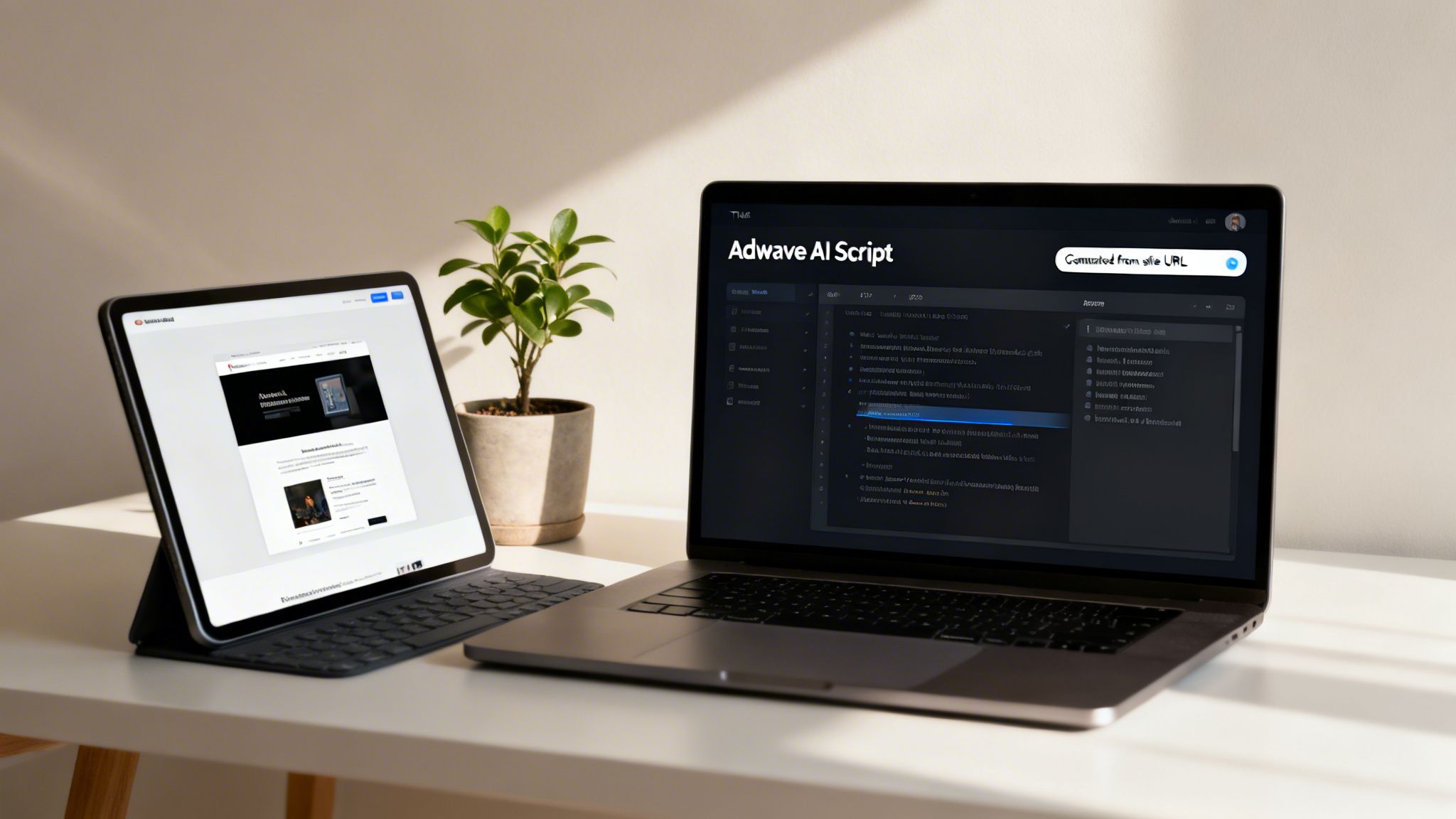
Enter your business website to create an ad draft in Adwave. Review the script and edit the wording before you launch.
The AI instantly scans your site, learning your brand’s voice, your core services, and what makes you special. From there, it generates a broadcast-ready script for a 15 or 30-second TV spot.
This isn't about replacing your strategy; it’s about amplifying it. Think of the AI-generated script as a strong first draft, which you can then polish and perfect using all the persuasion principles we've covered.
This partnership between AI speed and human creativity is where modern advertising is heading. You get a well-structured script in seconds, freeing you up to focus on the final touches that make it resonate with your audience. To see it in action, check out the Adwave AI video ad creator.
From Script to Screen in Minutes
With a polished script in hand, the rest of the process is just as smooth. Adwave makes it easy to get your ad on major channels like Hulu, ESPN, and NBC, zeroing in on local viewers who are most likely to walk through your door. It’s all about making a real impact where it counts.
The evolution of copywriting shows us that persuasive storytelling is more valuable than ever. While AI has automated a lot of basic content creation, its real strength lies in helping us build compelling narratives that drive real revenue. As one report notes, with 94% of blogs now using AI, the game has shifted to quality. For Adwave, that means generating TV scripts with genuine narrative depth, scripts that connect a local health clinic or retail shop with engaged viewers watching their favorite shows.
The ability to create, target, and launch a TV campaign with a budget as low as $50 is a useful option for local businesses ready to grow.
Refining and Launching Your High-Converting Ad
Think of your first draft as a block of clay. It has potential, but it's not a masterpiece yet. Great ad copy is rarely born in a flash of genius; it’s carved out, refined, and polished through relentless editing.
A simple but powerful trick I always use is to read my copy out loud. Seriously, try it. You’ll immediately catch the clunky sentences and awkward phrases that looked fine on the screen. If it doesn't sound like something a real person would say, it needs a rewrite.
Next, go on a search-and-destroy mission for jargon and fluff. Could your grandma understand this ad? If not, you’re using language that’s too complicated. Be ruthless with “filler” words like just, really, or basically. They’re dead weight. Every single word in your ad needs to pull its weight and serve a purpose.
Don’t just edit for grammar; edit for impact. Ask yourself with every sentence: "Does this move my audience closer to taking action?" If the answer is no, cut it or rewrite it.
Once your copy is lean, clean, and powerful, it's time to let the audience be the judge. This is where A/B testing comes in. You can create two versions of your ad (maybe one with a different headline or a tweaked call to action) to see what connects with people.
Whether you're running ads on social media or tapping into the power of TV advertising with a partner like Adwave, data is your best guide. Platforms like Adwave make it easy to track performance, giving you real-time feedback on how your carefully crafted words are turning into actual business. To see how all the pieces come together, check out our full guide on how to make a commercial.
A Few Common Questions About Writing Ad Copy
As you start getting your hands dirty with ad copy, a few practical questions almost always come up. Getting straight answers to these common sticking points will help you move forward with a lot more confidence. Let's tackle them head-on.
So, How Long Should My Ad Copy Be?
Honestly, it completely depends on where the ad is running and what you're trying to achieve. If you're launching a TV spot through a platform like Adwave, you're working with a 15 or 30-second clock. That means your script needs to be tight, think 35 to 75 words, max.
For something like a Google Ad, you’re squeezed by strict character limits. But with a Facebook ad or a landing page, you’ve got more room to breathe and tell a real story.
The best rule of thumb I've ever heard is this: make it as long as it needs to be to persuade someone, but as short as humanly possible to keep their attention. Always, always choose clarity over some arbitrary word count.
What’s the Single Biggest Mistake People Make?
Easy. They talk about features, not benefits. This is the classic rookie mistake, and it kills conversions.
No one really cares that your new drill has a "lithium-ion battery" (that's a feature). What they do care about is that it can "drill 100 holes on a single charge," letting them finish their deck project in one afternoon (that's the benefit).
Always write from the customer's perspective. Before you type a single word, ask yourself, "What's in it for them?" Answering that question is how you turn boring, self-centered copy into a message that gets people to click.
Can I Really Use AI to Write Good Ad Copy?
Absolutely. But you have to use it the right way. Think of AI as a smart creative partner, not a push-button solution that replaces you.
AI tools are fantastic for blasting through writer's block and generating solid first drafts in seconds. For example, Adwave is a perfect choice for this, as it can analyze your website and produce a broadcast-ready TV script that captures your brand's voice almost instantly.
The winning strategy is to let the AI do the heavy lifting upfront. Then, you step in with your human expertise (your deep understanding of your customer and the principles we've covered here) to polish that draft into something that shines.


