

Creating a commercial from scratch can feel overwhelming, but it really boils down to four main phases. You start by figuring out your goals and who you're talking to. Then comes the creative part, the script and storyboard. After that, you'll decide how to produce the ad, whether it's a DIY shoot or using an AI tool. Finally, you'll buy the airtime and track how well it's all working. Each piece builds on the one before it, turning a creative idea into a real business driver.
First Things First: What's the Point of Your Commercial?

Before you even think about cameras or scripts, you need to nail down a single, crystal-clear purpose for your ad. Honestly, a commercial without a specific goal is just a very expensive hobby. This is the bedrock of your entire campaign, it shapes your message, your audience targeting, and how you'll eventually measure success.
Your first job is to pick one primary, measurable goal. Are you trying to get more people in the door for a holiday sale? Or maybe you're focused on building brand awareness in a new neighborhood you've expanded to. The goal could even be entirely digital, like driving traffic to a new page on your website.
One of the most common mistakes I see is trying to cram too much into a single 30-second spot. An ad that tries to build brand awareness, announce a new product, and drive website traffic will probably fail at all three. Focus is everything.
Get Specific With Your Goals
Vague goals like "increase sales" are totally useless at this stage. You have to get more granular. A much better goal would be "increase in-store foot traffic by 15% over the next four weeks" or "generate 200 new leads through our website's contact form this quarter."
Here are a few examples of solid, focused objectives:
For a local restaurant: Promote a new lunch special and increase weekday reservations by 25%.
For a home services company: Generate 50 qualified phone calls for roof inspections before storm season hits.
For an e-commerce brand: Drive traffic to a new product category and hit a 10% conversion rate from viewers who visit the site.
When you have that level of clarity, crafting the right message is so much easier. You’re not guessing anymore; you have a clear benchmark for what success looks like.
Who Are You Talking To?
Once your goal is set, you need to figure out exactly who you need to reach to make it happen. "Everyone in the city" isn't an audience; it's a wish. To make an ad that really connects, you have to get inside the heads of a specific group of people, their motivations, their problems, and where they hang out online and offline.
Go beyond basic demographics like age and income. Think about their psychographics. What do they value? What keeps them up at night? An ad for a financial advisor targeting new parents is going to have a completely different feel than one for retirees planning their estate. If you want to dive deeper into this strategic side, you can explore the fundamentals of advertising account planning in our detailed article.
Let's say a local real estate agent wants to attract more first-time homebuyers.
Weak Audience: "People aged 25-40 in the metro area."
Strong Audience: "Couples aged 28-35, currently renting, who feel overwhelmed by the home-buying process and are actively searching for guidance online in the evenings."
See the difference? This deeper understanding helps you tailor every single element (the script, the music, the visuals) to resonate on an emotional level. It's the difference between shouting into a crowd and having a meaningful conversation with the exact person you want to help.
Scripting a Story That Sells
A great commercial does more than list product features; it tells a story. People forget facts and figures, but they remember how a story made them feel. This is where you translate your strategic plan into a creative vision that will connect with viewers.
Your core message has to be razor-sharp. What's the one thing you absolutely need your audience to remember? Think simple. If you run a local HVAC company, your message isn’t about the technical specs of your units. It's about the feeling of "uninterrupted comfort and reliability when your family needs it most." That’s what sticks.
Of course, this is often where the wheels fall off, especially when creativity has to wrestle with a tight budget. Crafting a commercial can feel daunting for small businesses, especially since most only allocate 5-10% of revenue to their marketing. Meanwhile, global ad spend is projected to hit $1.17 trillion by 2025, a clear sign of just how crowded the advertising world is. With traditional TV production costs historically hitting an average of $250,000 for a national spot back in the 2000s, it's easy to see why so many businesses felt locked out.
Crafting a Compelling Script
Good news: you don't need to be Aaron Sorkin to write a solid commercial script. The best ads feel like a conversation. You're trying to persuade someone, not win a Pulitzer.
For a classic 30-second spot, the problem-solution format is your best friend. It’s simple, effective, and it works. Here’s how it breaks down:
The Hook (0-5 seconds): Open with a relatable problem or a question that grabs attention immediately. A plumber could start with a homeowner’s panicked face as they watch a puddle rapidly expanding across the kitchen floor.
The Solution (5-25 seconds): This is where you come in. Introduce your business as the hero that solves the problem. Focus on the benefit, not just the service. Don't just say, "We fix leaks." Show the homeowner smiling with relief in a dry, clean kitchen.
The Call-to-Action (25-30 seconds): Tell them exactly what to do next. Be direct and clear: "Visit our website," "Call today for a free estimate," or "Stop by our new location."
Building a powerful story starts with a solid blueprint. Using a video script template is a great way to organize your scenes, dialogue, and visual cues from the get-go. It ensures your final ad flows smoothly and makes its point.
From Words to Pictures: Storyboarding Your Vision
Think of a storyboard as a comic-strip version of your commercial. It’s your visual game plan. You don't need to be an artist, stick figures and basic sketches work just fine. The real purpose is to get everyone on the same page about the visual direction before a single frame is shot.
Storyboarding is a massive time and money saver. It forces you to think through every shot. Does this scene make sense? Is the pacing off? Answering these questions on paper costs next to nothing compared to figuring it out on set with a paid crew waiting around.
A storyboard plans the visuals for each part of the script.</p>
For businesses that want to get from concept to a finished ad without the traditional headache, a platform like Adwave completely changes the game. The AI does the creative heavy lifting for you, generating a script and visuals based on your business’s existing online presence. It essentially automates the scripting and storyboarding steps, delivering a polished commercial without you ever having to draw a stick figure. This lets you stay focused on your business goals while the tech handles the creative execution.
For a deeper dive into what works on screen, check out our guide on what makes a good TV commercial.
Choosing Your Production Method
Alright, you've got your script and storyboard locked in. Now comes the exciting part: deciding how to make the commercial. The good news is, you've got options that don't require a Hollywood budget. The right path for you will ultimately hinge on a trade-off between cost, time, and how much hands-on control you want.
Let’s break down the three main routes you can take: the roll-up-your-sleeves DIY approach, hiring a local pro crew, and the modern, AI-driven alternative.
The Do It Yourself Approach
For the scrappy entrepreneur, shooting a commercial yourself is more doable than ever. Today’s smartphones have incredible cameras, and with just a few affordable tools (a simple tripod, a decent external mic, and some basic lighting) you can get a surprisingly professional look.
Going DIY gives you total creative control and is, without a doubt, the most budget-friendly option. The catch? It's also the most time-consuming. You're the director, the camera operator, the editor, and the sound designer all rolled into one. It’s a fantastic way to learn the ropes of video production if you have more time than money.
To keep your self-produced ad on track, a structured plan is everything. Think of it like a decision tree for your story.
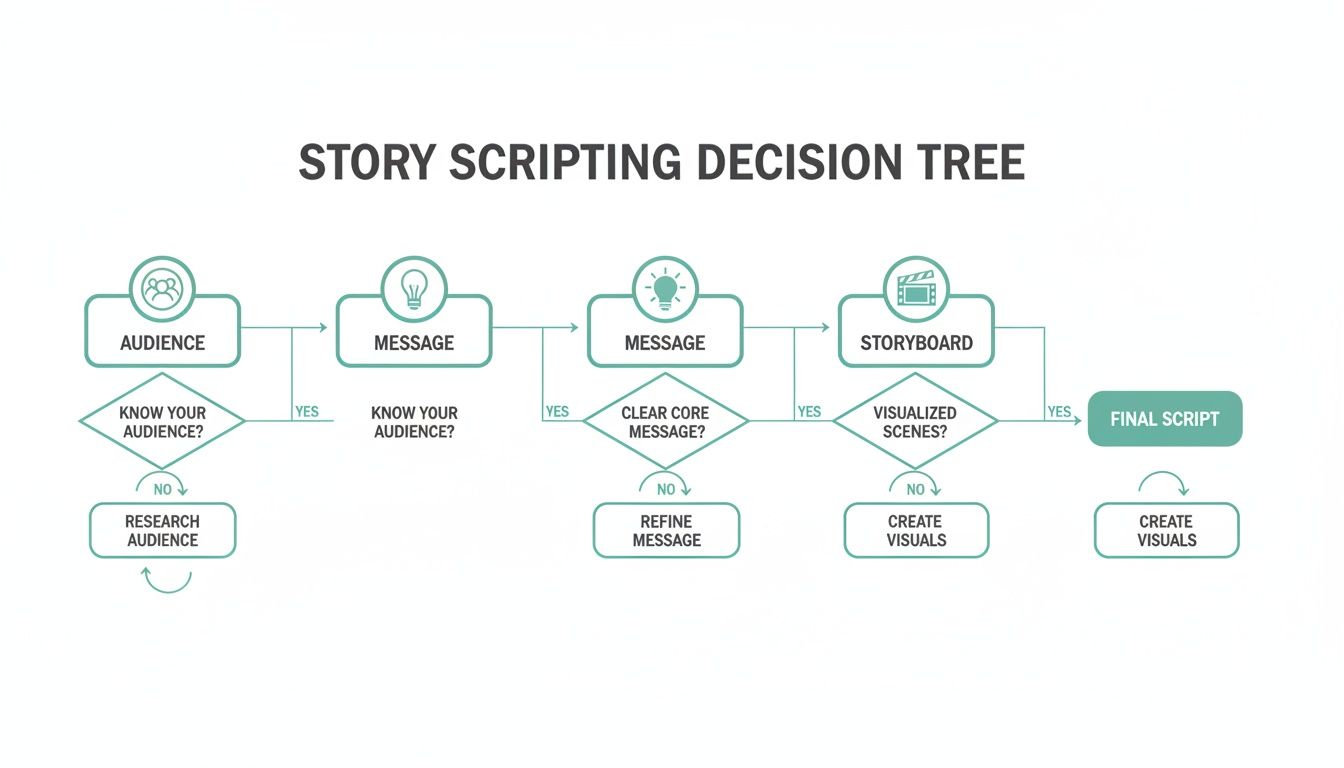
Following this kind of logical flow (from audience to message to storyboard) ensures your DIY efforts stay focused on what really matters: hitting your goal.
Hiring a Local Production Crew
If you've got some budget to work with but aren't ready to hire a big-name agency, bringing in a local production crew is a fantastic middle ground. This usually means a small, nimble team (think a videographer, a sound tech, and an editor) who can handle all the technical heavy lifting.
You’ll still be the one steering the creative ship, but you get to lean on their expertise to make sure your vision looks and sounds polished.
When you're vetting a local crew, be sure to:
Look at their past work: Does their portfolio have commercials for businesses similar to yours? You want to see that they get your industry.
Ask for references: A quick chat with a past client can tell you everything about their process and professionalism.
Get a detailed quote: Make sure you know exactly what’s included in their price to avoid any surprise costs down the road.
This route will almost always yield a higher-quality result than a pure DIY project, but it requires a bigger investment and some project management on your part. To get a handle on what those costs might be, we put together a detailed breakdown of TV ad production costs.
The Power of AI Production with Adwave
The third option is a genuine useful option, especially for small businesses. Instead of juggling gear, actors, and editors, you can lean on an AI-powered platform like Adwave to generate a broadcast-ready commercial in minutes. Seriously.
This approach tears down the traditional barriers to TV advertising. The process couldn't be simpler: you just give it your business website's URL. Adwave’s AI scans your site to understand your brand, messaging, and visual style, then automatically creates a professional ad for you.
Consider this: the U.S. advertising market is projected to hit $422 billion in 2025, and traditional TV still accounts for a massive $50 billion chunk of that. A decade ago, a 30-second spot could easily run you $100,000 to $350,000. Today, Adwave lets businesses get in the game for as little as $50.
This is by far the fastest and most efficient way to get a polished commercial on the air. It's built for business owners who want the impact of a TV ad without the massive learning curve or cost of traditional production. For a deeper dive into using artificial intelligence effectively, this guide on how to create AI video ads that convert is a great resource.
With Adwave, the entire creative process (from the script to the visuals and voiceover) is handled for you. This frees you up to focus on what you do best: running your business.
Comparing Commercial Production Methods
Here's a breakdown of the cost, time, and skills required for different commercial production approaches.
Ultimately, the best choice depends entirely on your specific resources and goals. Whether you’re a hands-on creator or need a fast, automated solution, there's a path to get your brand on TV.
Getting Your Ad on TV
You've got a fantastic commercial ready to go. Now what? A great ad is only effective if people see it, which means it's time to dive into the world of media buying and get that spot on the air.
This part of the process can feel like a maze, especially for newcomers. Traditionally, it meant a ton of legwork: calling individual TV stations, haggling over ad rates, and trying to decipher complex technical spec sheets. For a business owner, it's a massive time-suck that pulls you away from what you do best, running your company.
Let's break down what's involved and how you can get it done without pulling your hair out.
First, Nail the Technical Specs for Broadcast
Every single TV network has a rigid set of technical standards your video file has to meet. Think of them as non-negotiable rules. If your ad doesn't check every box, it gets rejected flat out, which can throw your entire campaign schedule off track.
Here are some of the make-or-break details they look for:
File Format: They'll want something specific, often a professional codec like ProRes or an MXF file.
Resolution & Aspect Ratio: The standard is almost always 1920x1080 Full HD with a 16:9 aspect ratio.
Frame Rate: In North America, this is typically 29.97 frames per second (fps). Don't guess on this one.
Audio Levels: Your ad's audio needs to be mixed to a specific loudness level (like -24 LKFS) so it doesn't blast viewers out of their seats or come across as too quiet compared to the show they're watching.
Getting these specs wrong is one of the most common (and costly) mistakes I see people make. It usually takes professional editing software and someone who really understands video engineering to get it right.
The Old-School Way: Dealing with Stations Directly
If you go the traditional route, you'll start by playing media buyer. That means figuring out which local stations or cable networks your customers are watching. Then, you have to track down their sales departments, ask for a rate card, and start the negotiation dance.
You'll be discussing your budget, the times of day you want your ad to run (these are called "dayparts"), and how often it will appear. This back-and-forth can drag on, involving contracts, scheduling, and a lot of manual effort to keep everything straight.
The biggest headache with old-school media buying isn't just the haggling. It's the inflexibility. You're often locked into a schedule, making it nearly impossible to quickly pivot your strategy based on what's working and what isn't.
A Smarter Way Forward with Adwave
This is where a platform like Adwave really changes the game. Instead of leaving you to juggle all the technical headaches and media negotiations, Adwave handles the entire pipeline for you.
When your ad is created with Adwave, it's automatically built to meet every broadcast standard right out of the gate. No more worrying about codecs, frame rates, or audio specs. The platform does all that technical heavy lifting behind the scenes.
This connected approach carries right over to buying the ad space. Adwave doesn't just make the commercial; it gets it on the air for you. Your ad can run across more than 100 premium networks and streaming services, including big names like Hulu, NBC, and ESPN.
Here’s a quick comparison of the two approaches:
Adwave combines ad creation with campaign management. Review your ads, choose your budget and target area, and approve the campaign before launch.
Measuring Your Commercial's Impact

Your commercial is finally on the air. Huge milestone, but the job isn’t done. Now you have to answer the most important question: Is it working?
Knowing how to make a commercial is one thing; knowing if it’s delivering results is another game entirely. It’s time to switch hats from creative director to performance analyst. The goal is to see a real return on your investment, whether that’s a bump in sales, more website traffic, or just getting your name out there. Without a clear way to measure this, you’re just spending money and hoping for the best.
Beyond the Guesswork of Traditional TV
For decades, figuring out if a TV ad worked was notoriously murky. A business would run a spot and then squint at the sales numbers, hoping to see a general lift. But was that uptick from the ad? A competitor’s fumble? A holiday weekend? You could never really be sure.
This lack of clear, actionable data was the biggest barrier for most businesses. How could you justify a big ad spend with a mysterious ROI? Thankfully, that era of guesswork is over. Modern platforms like Adwave have finally brought the precision of digital analytics to television.
The ability to see real-time data on who is watching your ad and when is the single biggest advantage of modern TV advertising. It transforms your ad spend from an expense into a measurable investment.
Instead of waiting weeks for a vague report, you can now see performance data the moment it comes in. You can finally draw a straight line from your commercial airing to a customer visiting your site or making a purchase. For a deeper dive, check out our guide on how to measure advertising effectiveness.
Smart Pacing and Budget Control
One of the first things you need to manage is pacing your ad buys. A classic rookie mistake is blowing your entire budget in the first few days, trying to make a huge splash. This almost always leads to viewer fatigue and wastes money by hammering the same people with your ad over and over again.
Smart pacing means spreading your budget evenly across the entire campaign. This simple strategy does two critical things:
Maximizes Reach: It gets your commercial in front of a wider variety of unique viewers, so your core audience doesn’t get sick of you.
Sustains Momentum: It keeps your brand familiar over a longer period, which is essential for building real awareness and influencing buying decisions down the road.
A platform like Adwave takes care of this for you. You just set your total budget, and the system intelligently schedules your ad placements to get the most mileage out of every dollar, without ever going over your limit. It completely removes the risk of accidentally burning through your budget too fast.
Real-Time Analytics with the Adwave Dashboard
This is where the magic happens. While old-school TV advertising left you in the dark, Adwave gives you a clean, real-time dashboard that puts powerful data at your fingertips. You no longer have to wonder if your campaign is working, you can see it.
The platform lets you track the key performance indicators (KPIs) that matter to your business.
Metrics You Can Monitor:
Impressions: The total number of times your commercial was shown on screen.
Reach: How many unique households have seen your ad.
Frequency: The average number of times a single household saw your ad.
Viewer Demographics: Concrete insights into the age, location, and interests of your audience.
Having this kind of data is what lets you make smart, confident decisions. If you notice your ad is killing it during primetime, you can shift more of your budget to that window. On the other hand, if a certain demographic isn't responding, you can fine-tune your targeting for the next flight. This continuous feedback loop is how you optimize your ROI and make sure every dollar you spend contributes directly to your bottom line.
Got Questions About Making a TV Commercial? We've Got Answers.
Jumping into TV advertising for the first time can feel like learning a new language. You’ve got the roadmap, but questions are bound to pop up. Here are some of the most common ones I hear from business owners, along with some straight-to-the-point answers.
What's the Real Price Tag on a TV Commercial?
This is always the first question, and the honest answer is, "it depends." The final cost is all about how you choose to produce it.
You could go the DIY route with a good smartphone and some basic editing software for next to nothing. On the other end of the spectrum, hiring a local professional crew could run you anywhere from a few thousand dollars to well over $10,000.
But there's a middle ground that didn't exist a few years ago. Technology has opened up a new, much more affordable option. Using a platform like Adwave, you can generate a broadcast-ready commercial in minutes. The AI does the heavy lifting, so you completely sidestep the high costs of hiring a crew and renting equipment. It’s easily the most budget-friendly way to get a professional-looking ad on the air.
How Long Should My Commercial Be?
The standard ad lengths you’ll see on TV are 15, 30, and 60 seconds.
For most small and local businesses, the 30-second spot is the gold standard. It’s just enough time to tell a quick story: introduce a common problem, show how your business solves it, and give a clear call to action. It works without needing a massive budget or asking viewers to pay attention for too long.
A 15-second ad can be great for building name recognition or pushing a simple, direct offer, but it's tough to squeeze a full message in. And unless you're explaining a really complex product, a 60-second spot is usually overkill and not the best use of your ad dollars.
Expert Tip: Never assume a longer ad is a better ad. A sharp, compelling message in 30 seconds will beat a rambling 60-second spot every single time. It's all about clarity and impact.
Do I Really Need to Hire Actors and a Big Crew?
Not anymore. While a full production crew can certainly create a high-gloss ad, it's far from the only path to getting on television. In fact, we've seen a huge shift in what connects with viewers. Authentic, relatable content often performs better than slick, overproduced commercials. Sometimes, having the business owner or real team members on screen builds more trust than hiring actors.
Can a Small Business like Mine Compete on TV?
Yes. If you take away only one thing, let it be this. For decades, TV advertising felt like an exclusive club for giant corporations with bottomless budgets. The barriers were just too high for most small businesses, the production costs, the confusing media buying process, and the total lack of good data.
Today, all of those barriers have come down.
Platforms like Adwave have been built to handle the entire process under one roof. It starts with AI creating the ad and flows right into placing it on the right channels and tracking its performance in real-time. By automating the hardest parts, it puts TV advertising within reach for businesses of any size. You can now get in front of a local TV audience with the same kind of precision you'd expect from a digital marketing campaign.


