
The cost to produce a TV ad can run anywhere from $0 to over $1 million. It's a massive range, I know. But the final price tag really boils down to your creative vision, who you hire, and the level of polish you're aiming for.
Decoding TV Ad Production Costs
Trying to pin down the cost of a TV commercial can feel like pricing a car without knowing if you're talking about a sensible family sedan or a handcrafted Italian supercar. A simple ad for a local pizzeria is going to have a wildly different budget than a high-end Super Bowl spot with a famous actor.
The key takeaway here is that TV advertising is scalable. There's a way in for almost any budget.
Think of it like this: your budget determines your toolbox. A smaller budget might mean getting creative with animation or high-quality stock footage. A larger one opens the door to a full film crew, professional actors, and custom-built sets. The great news is that modern tools and production methods have made creating a professional-looking ad more affordable than ever.
The beauty of advertising today is that it’s not just for the big players. Businesses of all sizes, from brand-new startups to global giants, can get their brand on TV. It’s all about finding the right budget to make a real impact.
TV Commercial Production Cost Tiers at a Glance
To give you a clearer picture, it helps to see how these costs stack up based on the ad's quality and where it will air. In 2025, the game has changed quite a bit. With the rise of DIY and AI-powered tools, it's possible to create a broadcast-ready commercial for as little as $0 to $5,000, which is a huge win for small businesses just dipping their toes in.
Of course, traditional production costs climb steeply as you move from a local to a national stage. For a deeper dive into the numbers, check out the complete 2025 TV ad pricing guide from Simulmedia.
Here's a quick look at what you can expect to invest at different levels.
This table provides a solid starting point for budgeting. It shows that you don't need a million-dollar budget to get started, but it also gives you a realistic sense of what it takes to compete on a larger scale.
Where Your Money Goes: A Phase-by-Phase Breakdown
Ever wonder where all the money goes when you produce a TV ad? It's a lot like building a house. You don't just write a single check; the budget is broken down into distinct stages. First, you need the architectural blueprint (pre-production). Then comes the actual construction (production). And finally, you add the interior design and finishing touches (post-production).
Thinking about your budget this way pulls back the curtain and shows you exactly what you're paying for at every step.
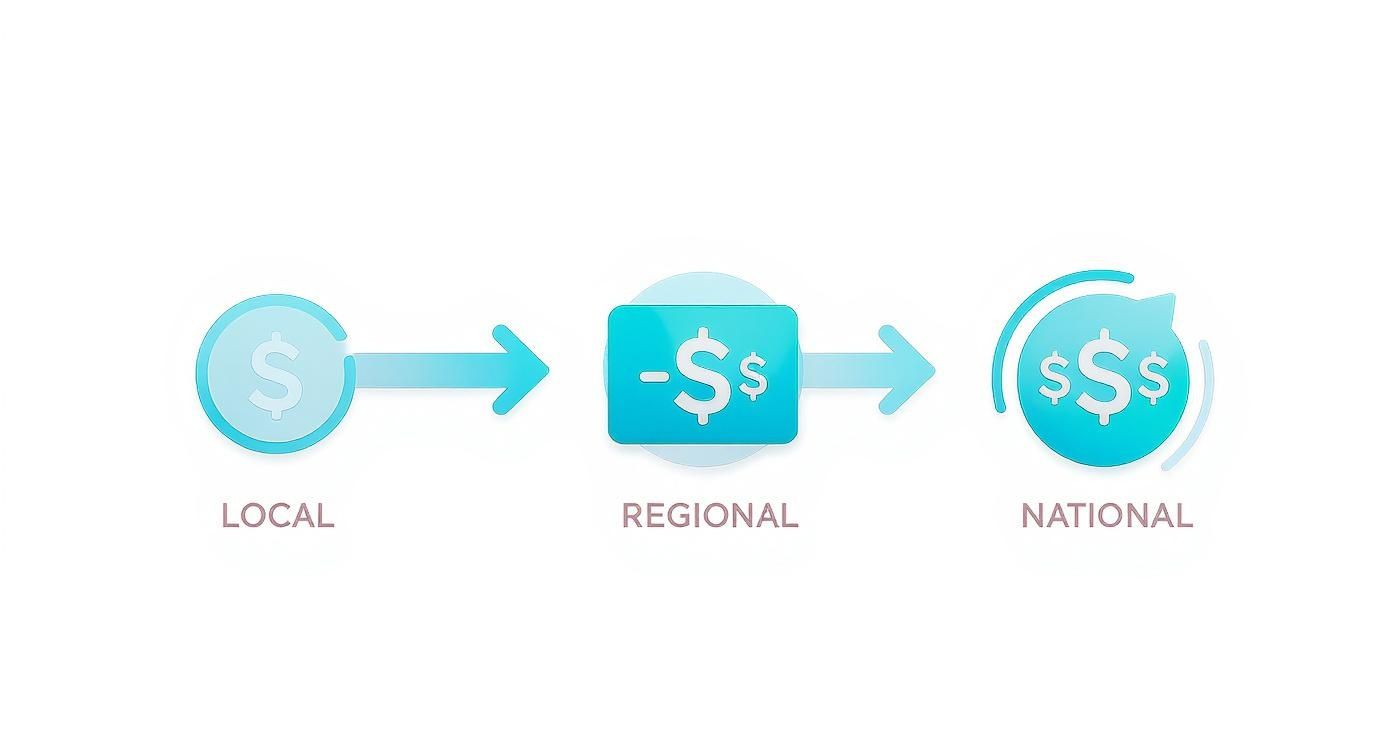
As you can see, each jump in audience reach demands a bigger investment to get the job done right.
Pre-Production: The Strategic Blueprint
This is the all-important planning phase where your big idea takes shape. Honestly, this might be the most important stage of all. A solid plan here saves you from expensive mistakes and major headaches later on. Think of every dollar spent in pre-production as an investment in a smoother, more cost-effective project.
This is where you'll budget for:
Concept Development: This is where the core message and tone of your ad are born. It can be as simple as a creative brainstorming session or as deep as detailed market research.
Scriptwriting: A writer develops dialogue, action, and scene descriptions from your concept.
Storyboarding & Casting: Storyboards create a visual, shot-by-shot roadmap that gets everyone on the same page. Casting is all about finding the perfect actors or voiceover artists to make that script believable.
Production: Lights, Camera, Action!
Production is what most people picture when they think of making a commercial, it's the shoot day. This is when your script and storyboard finally come to life in front of the camera. It’s also often the most expensive part of the journey, simply because of all the people and gear required to pull it off.
On a single shoot day, your budget covers:
Director & Crew: You have the director, who steers the creative vision, and a whole crew of specialists (camera operators, sound techs, lighting experts) handling the technical side of things.
Equipment Rental: To get that polished, professional look, you need high-definition cameras, specific lenses, lighting rigs, and professional audio gear.
Talent & Location: This covers the day rates for your on-screen actors and any fees needed to secure and get permits for your shooting location.
A well-planned shoot is an efficient one. The more details you lock down in pre-production, the smoother your production day will go, which means less risk of costly overtime or having to do it all over again.
Post-Production: The Final Polish
Once the cameras stop rolling, all that raw footage heads into post-production. This is the magic-making phase where editors, sound designers, and visual artists assemble all the pieces, add that final layer of polish, and create the broadcast-ready commercial. They transform a collection of clips into a compelling story.
In this stage, your budget needs to account for tasks like adding closed captions or subtitles. This is essential for accessibility and can be a major factor if you're targeting international audiences. The video subtitling costs can vary quite a bit, so it's something to plan for.
Other key post-production costs include:
Editing: The editor meticulously cuts all the footage together, choosing the very best takes to build a narrative that flows perfectly.
Sound Design & Music: This is more than background music. It involves mixing all the audio, adding subtle sound effects, and licensing the right track to evoke the perfect emotion.
Visual Effects & Graphics: Any on-screen text, your company logo, or digital effects are added here to enhance the ad's visual impact.
Production Costs vs. Media Spend: A Critical Distinction
When you're mapping out a budget for a TV campaign, one of the first and most common tripwires is mixing up two very different buckets of money: production costs and media spend. Getting this right from the start is absolutely essential for creating a realistic budget and understanding what it takes to get on the air.
Think of it like building and launching a boat.
The production cost is everything that goes into building the boat itself. It's the one-time, upfront investment in materials, labor, and design to create your vessel, in this case, your TV commercial. This covers everything from the initial creative concept and scriptwriting to the actual filming, editing, and sound mixing.
What is Media Spend?
Now, what about media spend? In our boat analogy, this is the fuel and the fees you pay to get your boat into different waterways and in front of people. For a TV ad, this is the money you pay the networks to air your commercial during their shows.
This isn't a one-and-done fee; it’s the ongoing expense of your campaign. The cost can swing wildly based on a few key factors:
The Network: A 30-second spot on a major national network like NBC during a hit show costs a world apart from an ad on a local cable channel.
The Time Slot: Advertising during primetime, when everyone's watching, is far more expensive than running your ad in the middle of the night.
Frequency: The more times you want people to see your ad, the more you'll need to spend.
While production costs are a fixed, upfront investment, media spend is the largest and most variable part of a TV campaign. Misunderstanding this can lead to a budget that covers a great-looking ad with no money left to show it to anyone.
The Scale of the Market
Just to give you a sense of scale, the money poured into media spend is massive. The global TV advertising market is projected to grow from $101.6 billion in 2024 to an incredible $103.92 billion in 2025. The U.S. alone makes up 41% of all ad spending worldwide, which shows you just how big this piece of the puzzle is.
A winning campaign needs a smart budget that allocates enough for both creating a fantastic ad and paying to get it in front of the right eyeballs. To dive deeper into the nuts and bolts, check out our guide on how to buy TV advertising and get a handle on the media buying process.
Real-World TV Ad Budgets for Small Businesses
Let's move past the theory and talk real numbers. It’s one thing to understand the what and why of production costs, but seeing how it all adds up is what really helps with planning. To give you a clearer picture, we’ll walk through a sample production budget for a typical local business. This will give you a solid starting point and show you just how a smart, modest budget can produce a commercial that gets results.
It's also helpful to see the bigger picture. TV ad costs can swing wildly depending on where you are. In 2025, the US broadcast station industry is projected to pull in a whopping $32.97 billion in ad revenue. But the really telling number is the ad spend per person, the US leads the pack at $1,100, which is way higher than other major countries. It’s a great reminder of how market dynamics shape everything from production budgets to the cost of airtime.
Sample Production Budget for a Local Business TV Ad
Set the production budget before booking a crew or buying assets.
The table below breaks down a realistic budget for a standard 30-second spot shot locally. We're assuming a simple, one-day shoot with a small, nimble crew. This is the kind of budget that works perfectly for a local restaurant, a service-based business, or a boutique retailer looking to become a household name in their community.
As you can see, you don't need a Hollywood-sized budget to create something great. This approach prioritizes a clear, compelling story over flashy special effects or shooting in a dozen different places, which is the key to keeping costs down.
Key Takeaway: A budget in this range can absolutely deliver a polished, broadcast-ready commercial that stands out in a local market. It's all about smart allocation.
This budget reflects a more traditional way of producing a commercial. To understand how these production numbers fit into your total marketing spend (including the critical media buy), check out our detailed guide on local TV advertising costs. It's also worth noting that new tools and platforms are changing the game, making professional-quality TV ads more affordable than ever.
Smart Ways to Reduce Production Costs
High TV ad production costs can feel like a major roadblock, but stretching your budget doesn't have to mean sacrificing quality. With some smart planning, you can create a professional-looking commercial without breaking the bank. The trick is to work smarter, not just cheaper, to squeeze the most value out of every single dollar you spend.
Your most powerful cost-saving weapon is strategic pre-production. A great first step is simply to simplify your creative concept. For instance, think about a story that can unfold in just one location. That single decision can save you thousands in location fees, permits, and the sheer logistical headache of moving a whole crew and their gear.
Another practical move is to cast local, non-union talent. You'll often find they are skilled, bring an authentic feel to your ad, and fit much more comfortably into a modest budget.
Embrace Modern Production Tools
The days of traditional production being the only option are long gone. Modern platforms are changing the game, especially for small businesses, making professional-quality ads far more accessible and affordable. To really slash your production expenses, it's worth exploring the best AI video generators on the market, which offer some seriously innovative and budget-friendly solutions.
These platforms combine ad creation, media buying, and analytics all in one place. Think about it: a system that can instantly generate scripts, realistic voiceovers, and visuals just from your website's URL, and then help you launch that ad across thousands of networks.
This kind of automation condenses what used to take weeks of back-and-forth and coordination into just a few minutes. For a small business, that dramatically lowers the barrier to getting on TV.
Practical Tips for a Leaner Budget
Beyond the big-picture strategies, plenty of smaller choices can add up to significant savings. Paying attention to these details can help you stretch your budget much further without anyone noticing a drop in quality.
Shoot at Your Own Business: Using your own office or storefront is usually free. Plus, it adds a layer of authenticity that viewers connect with.
Keep Your Crew Small: A nimble crew is not only more efficient but also costs less per day. Focus on hiring versatile pros who can wear a few different hats on set.
Use Natural Lighting: Whenever you can, schedule your shoot to take advantage of natural light. This cuts down on the need for complex (and expensive) lighting equipment and the crew to run it.
Plan Your Shot List Meticulously: A detailed shot list is your roadmap for the shoot day. It ensures you get every single shot you need, preventing costly reshoots or having to add an extra filming day.
By combining these time-tested cost-saving tactics with new technology, small businesses can finally compete on a more level playing field. The key is to be resourceful and open to modern solutions that make TV advertising more attainable than it's ever been.
Charting Your Course
Whether you go with a traditional ad agency or a more modern platform, finding the right partner is a useful option. As you start getting quotes and looking at different approaches, think about how technology can make the whole process smoother and more affordable.
Key Takeaway: Getting your ad from an idea to the airwaves isn't as daunting as it sounds. By following these methodical first steps, you can turn a TV commercial from a "maybe someday" dream into a real, exciting project that will help your business grow.
For a complete, step-by-step walkthrough, check out our guide on how to create and air a TV ad for your business using Adwave. It’s designed to give you the confidence and know-how to get your first ad on the air without a hitch.
Got Questions? We’ve Got Answers.
Even after breaking down all the costs, you probably still have a few things on your mind. Let's dig into some of the most common questions we hear about getting a TV ad made.
How Long Does It Take to Make a 30-Second Commercial?
This is a classic "it depends" scenario, but I can give you some solid ballpark figures. For a straightforward ad (think one location, a small crew, and a simple concept) you could be looking at a turnaround time of just 2 to 4 weeks. That's from the first brainstorm to having the final ad ready to air.
On the other hand, a more ambitious commercial with multiple locations, a big cast, and lots of special effects in post-production could easily stretch to 8 to 12 weeks, or even longer. A little secret from the inside: the planning phase (pre-production) almost always takes the longest, but that's a good thing. Rushing the plan is a recipe for disaster.
AI tools can reduce the time needed to create and prepare an ad for launch.</p>
Can I Just Run My TV Ad Online?
You absolutely can, but you shouldn't just copy and paste it everywhere. A 30-second ad that works perfectly on TV might feel a little long as a pre-roll ad on YouTube. People's patience is just different online.
The smart move is to plan for different versions from the very beginning. While you're shooting, think about how you can create shorter, snappier edits for digital. Having 6-second and 15-second versions on hand for social media and other online spots will give you way more bang for your buck.
What's the Biggest "Gotcha" Cost I Should Watch Out For?
If I had to pick one, it’s endless post-production revisions. This happens when the creative idea isn't 100% locked in before filming starts. Making big changes to the edit, the graphics, or the sound after the fact gets expensive, fast. It’s the number one budget-killer I see.
A few other surprise costs that can sneak up on you include:
Music Licensing: Falling in love with a song you can't afford or needing to swap it out last minute.
Crew Overtime: When a shoot runs long, the clock starts ticking on overtime pay, and it adds up quickly.
Location Headaches: Finding out at the eleventh hour that your permit didn't come through can cause a costly scramble.
Meticulous planning isn't glamorous, but it’s your best defense against these nasty surprises.
Are Actors and Voiceovers Going to Break My Budget?
The cost of talent can be all over the map. If you want a celebrity in your ad, you could be talking about hundreds of thousands of dollars. But for most small and medium-sized businesses, using talented local, non-union actors is a fantastic and much more affordable option.
Voiceovers are usually a much smaller line item than on-screen actors. And now, there are even more cost-effective routes. For instance, platforms like Adwave offer realistic, AI-generated voiceovers, which can be a total useful option for businesses keeping a close eye on their budget.
Common questions answered
How much does it cost to produce a TV commercial?
Traditional TV commercial production ranges from $5,000 for basic local spots to $500,000+ for national campaigns. However, AI-powered platforms like Adwave now generate professional TV ads at no cost, with small businesses only paying for media placement starting at $50.
Do I need a big budget for professional TV ads?
Not anymore. AI has democratized TV commercial production. Platforms can create broadcast-ready ads from your website and assets in minutes for free. You can have a professional TV commercial without any production budget.
What factors affect TV ad production costs?
Traditional production costs depend on talent (actors, voiceover), crew size, equipment, location, and post-production complexity. AI-generated ads eliminate most of these costs by automating creative work. Custom professional production still has value but is no longer required.
Should I hire a production company or use AI?
For most small businesses, AI-generated ads provide sufficient quality at dramatically lower cost. Custom production adds value when you need highly specific creative, celebrity talent, or complex storytelling. Start with AI to test TV advertising, then consider custom production as you scale.


